

HTML to PDF Evidence Renderer
Pricing
from $33.50 / 1,000 html to pdf evidence renderer verdicts
HTML to PDF Evidence Renderer
Renders each HTML document or permitted public URL to a hashed, print-pinned PDF evidence artifact: page count, resource-failure ledger, input+output SHA-256, final URL, and an honest COMPLETE / PARTIAL usability label.
Pricing
from $33.50 / 1,000 html to pdf evidence renderer verdicts
Rating
0.0
(0)
Developer

NexGen Watch
Maintained by CommunityActor stats
0
Bookmarked
2
Total users
1
Monthly active users
a day ago
Last modified
Categories
Share
🌐 HTML to PDF Evidence Renderer
Renders each HTML document or permitted public URL to a hashed, print-pinned PDF evidence artifact: page count, resource-failure ledger, input+output SHA-256, final URL, and an honest COMPLETE / PARTIAL usability label. Deterministic settings, no login or cookies.
Output is one pdf_render_evidence row per result; billing is pay-per-event, the value event being one html to pdf evidence renderer verdict (a $0.02 start fee per run, then $0.05 per html to pdf evidence renderer verdict).
📊 Sample Output
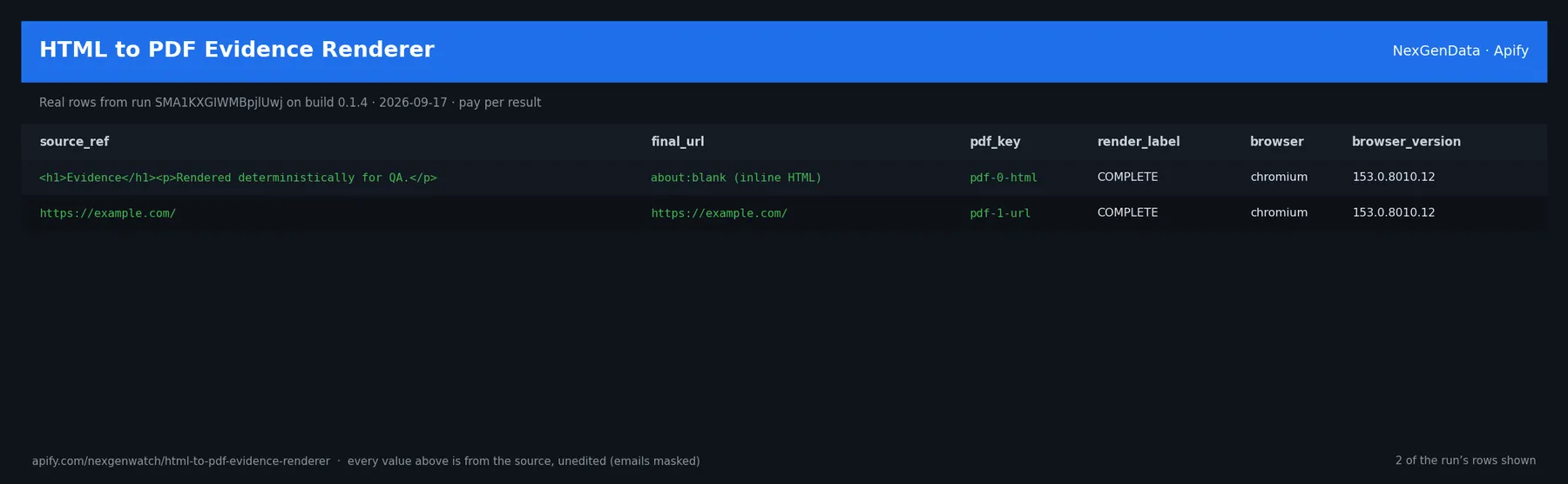
Real rows from run SMA1KXGIWMBpjlUwj on build 0.1.4 (2026-09-17), the same input as the Quick start below — every value is as the source published it (emails masked, long text shortened):
| final_url | pdf_key | render_label | browser | browser_version |
|---|---|---|---|---|
| about:blank (inline HTML) | pdf-0-html | COMPLETE | chromium | 153.0.8010.12 |
| https://example.com/ | pdf-1-url | COMPLETE | chromium | 153.0.8010.12 |
The run finished with the status message: 2 item(s): 2 usable PDF artifact(s) charged, 0 unbilled (unusable/blocked/unreachable/unparseable) | pdf_render_check charged=2
✅ What you get
Each row is flat JSON with these fields (from the dataset schema and the sample run; a field the source does not publish for a given row is null):
input_type(string/null) — e.g.htmlsource_ref(string/null) — e.g.<h1>Evidence</h1><p>Rendered deterministically for QA.</p>final_url(string/null) — e.g.about:blank (inline HTML)http_status(integer/string/null) — e.g.200pdf_key(string/null) — e.g.pdf-0-htmlpdf_bytes(integer/string/null) — e.g.13887page_count(integer/string/null) — e.g.1input_sha256(string/null) — e.g.5995dce6313eb902d9cc3a56607c7d2581e0f14d49e2c7e01a29c0d00111863aoutput_sha256(string/null) — e.g.f64370f57eda8a719c74c405e11b1dbc825d984483c67fe3704aaea7bc45df05print_format(string/null) — e.g.A4print_settings(string/null) — e.g.{"format":"A4","print_background":true,"margin":{"top":"12mm","bottom":"12mm","lresource_failures(string/null) — null in every sample rowresource_failure_count(integer/string/null) — e.g.0render_label(string/null) — e.g.COMPLETEbrowser(string/null) — e.g.chromiumbrowser_version(string/null) — e.g.153.0.8010.12render_timestamp(string/null) — e.g.2026-09-17T17:27:49.282709+00:00render_warnings(string/null) — null in every sample rowfaults(string/null) — null in every sample rowrecord_type(string) — e.g.pdf_render_evidencesource(string/null) — e.g.buyer-submitted HTML or permitted public URLsoutcome(string/null) — e.g.answerinput(string/null) — e.g.<h1>Evidence</h1><p>Rendered deterministically for QA.</p>outcome_reason(string/null) — null in every sample rowobserved_at(string/null) — null in every sample rowterminal(string/null) — null in every sample row
Output & billing
One row per item. A render bills once if and only if it produced a valid, openable PDF of at least one page. COMPLETE = valid PDF with zero resource failures; PARTIAL = valid, openable, paginated PDF that had one or more resource failures (a missing image/font) — still genuinely usable, so it bills. A render that never produced an openable PDF is labelled UNUSABLE and never bills; a blocked or unreachable URL never bills. Push-then-charge: every row is delivered before its charge, so a billing hiccup can only ever undercharge.
⚙️ Sample inputs
1. Quick start — the Store example (this is what the sample above came from)
The sample run charged exactly: 2 × $0.02 apify-actor-start + 2 × $0.05 pdf_render_check = $0.14 on the Free tier — every delivered row was billed.
2. A smaller, narrowed run
Caps the run at 5 rows — about $0.27 on the Free tier ($0.02 start + 5 × $0.05). format narrows what the source is asked for.
3. A full-size run
Up to 10 rows (the schema default for maxItems) — about $0.52 on the Free tier ($0.02 start + 10 × $0.05) if the source has that many.
🧾 JSON sample record
One real record from run SMA1KXGIWMBpjlUwj, exactly as it lands in the dataset (emails masked, long text shortened):
🔧 How it works
Transport. Plain HTTPS from the Apify platform, no proxy. A headless browser renders the page. robots.txt is read first and a disallowed path is never fetched. Every request carries an identified contact User-Agent.
Terminal states. A run ends NORMAL, CAPPED (your cap was reached), PARTIAL (something was withheld and the message says what), GENUINE_EMPTY (the source was read and truly had nothing in scope) or BLOCKED (the source refused or changed shape — the run FAILS loud and bills nothing). A zero-row run is never reported as a silent success.
Charging. Each html to pdf evidence renderer verdict is charged at the moment it is pushed (pdf_render_check); a row that fails to charge is not delivered, so the dataset count always equals the charged count.
What you submit
sources — html strings or permitted public urls. Each item is either an inline HTML document (recognized by a leading '<' or a data:text/html URL) or a permitted public http(s) URL. URL items pass the per-origin runtime gate (robots + SSRF) before any fetch. Per item ONE hashed PDF artifact (stored in the run key-value store) with pinned print settings, page count, resource-failure list, input+output SHA-256, final URL, and an honest COMPLETE / PARTIAL label. Deterministic fonts, bounded resources, no login/cookies. A PARTIAL render bills ONLY when the artifact is a valid, openable PDF of at least one page; a render that fails to produce a usable PDF, or a blocked/unreachable URL, never bills.
The runtime source gate (per submitted target)
You choose the targets, so the source contract is enforced at run time — for every URL-mode item (inline HTML is rendered locally and is not fetched) — per origin, before any page is read:
- robots.txt fetched once per origin and honored; no robots / 404 = permitted, a disallowed path or an unavailable/forbidden robots file = BLOCKED.
- SSRF guard — every host is resolved and must be public; private, loopback, link-local, reserved and cloud-metadata addresses are refused before a socket opens.
- HTTP —
403/429/5xx= BLOCKED; DNS / timeout / connection faults = UNREACHABLE.
A BLOCKED or UNREACHABLE target is delivered as an unbilled status row — never a broken-site verdict, and never charged.
Why this and not the obvious alternative
a hashed, print-pinned PDF evidence artifact per HTML/URL with an honest COMPLETE/PARTIAL usability label and a resource-failure ledger — not a screenshot API and not an unbounded website-to-PDF crawler.
What is not done. No login, no cookie or CAPTCHA bypass, no private or personal-account data.
💰 Pricing example
| Event | Free | Bronze | Silver | Gold |
|---|---|---|---|---|
Actor Start (apify-actor-start) | $0.02 | $0.02 | $0.02 | $0.02 |
HTML to PDF Evidence Renderer verdict (pdf_render_check) | $0.05 | $0.04 | $0.04 | $0.03 |
Worked at the live Free-tier price:
- 2 html to pdf evidence renderer verdicts: $0.02 start + 2 × $0.05 = $0.12
- 10 html to pdf evidence renderer verdicts: $0.02 start + 10 × $0.05 = $0.52
- 25 html to pdf evidence renderer verdicts: $0.02 start + 25 × $0.05 = $1.27
A run that delivers zero rows charges the $0.02 start fee only. A BLOCKED run (source refused) fails loud and charges no value event. The start fee is charged once per GB of run memory; the default run memory is 2048 MB.
Yield on the sample run: 2 item(s): 2 usable PDF artifact(s) charged, 0 unbilled (unusable/blocked/unreachable/unparseable) | pdf_render_check charged=2. maxItems is a hard ceiling on what is delivered and billed, never a target.
⚖️ Legal & ToS
This actor reads public data only. It collects only what the source publishes to any visitor, keeps to the source's robots rules (checked on every run), identifies itself with a contact User-Agent, and does not access accounts, private data or anything behind authentication. Use the output in line with the source's terms and your local law; the intended use is B2B research and monitoring.
❓ FAQ
Q: Do I need an API key or a login?
A: No. the input schema has no key field and the actor carries no secrets.
Q: Why did my run return 0 rows?
A: Read the run's status message. GENUINE_EMPTY means the source was read and had nothing in scope for your input; BLOCKED means the source refused and the run failed without billing a value event — retry later or narrow the input. A zero-row run bills the start fee only.
Q: How many rows can one run return?
A: Up to maxItems (default 10). Raise the cap for a bigger run; you pay per delivered row.
Q: How fresh is the data?
A: Every run reads the source live at run time; nothing is cached between runs. Put it on a schedule for a continuous feed.
Q: What formats can I export?
A: The dataset downloads as JSON, CSV, Excel, XML or RSS from the run's Dataset tab or the Apify API, and any run can push to a webhook or integration.
Q: How is this different from the other web QA and enrichment tools actors?
A: Same output shape and billing model; this one covers HTML to PDF Evidence Renderer. The siblings under Related Actors cover the other sources or slices — run several on one schedule for a combined feed.
Q: Are there rate limits?
A: The actor paces itself against the source and honours its robots rules; there is no per-buyer limit beyond your Apify plan's concurrency.
🆘 Troubleshooting
- Run FAILED with BLOCKED → the source refused the request or changed its page shape → nothing was billed beyond the start fee; retry after a while, and if it persists open an Issue with the run id.
- Status says CAPPED → your cap (
maxItems) was reached → raise it for a bigger run. - Input validation error on start → a field is outside the schema's allowed values → start from the Quick start block and change one field at a time.
- Run TIMED-OUT → a very wide request on a slow day → raise the run timeout in Run options or narrow the input; what was delivered before the timeout is still in the dataset.
🔗 Related Actors
- Brand Asset Pack — Give it a list of company domains; it returns one CRM-ready record per domain describing
- Contact Evidence Enricher — Give it a list of company domains; it returns one CRM-ready record per domain describing
- Crossref DOI Metadata QA — A per-DOI QA verdict from official Crossref metadata — each DOI returns valid, not_found, or metadata_incomplete with every missing required field na…
- Internal Link Architecture Verifier — Runs a bounded same-origin crawl unioned with your sitemap, builds the internal link graph, and returns one evidenced verdict per page: orphan-from-s…
- Marketing Stack Enricher — Give it a list of company domains; it returns one CRM-ready record per domain describing
- PDF Text Intake Auditor — Judges whether a PDF is ingestible before you spend on extraction: text-layer presence, page count, encryption, scan likelihood, per-page text densit…
- 🏢 About NexGenData — NexGen Watch is NexGenData's fleet of 256 public monitoring and lookup actors built on official sources, pay-per-result. Browse the catalog at apify.com/nexgenwatch.
⭐ Found this useful?
If this actor saved you a manual check, a quick review on the Apify Store helps other teams find it. Feature request or a source that changed? Open it from the Issues tab — every one is read.


