

Seed & Pre-Seed Funding Leads
Pricing
from $33.50 / 1,000 qualified funding leads
Seed & Pre-Seed Funding Leads
Seed and pre-seed funding leads from SEC Form D: one row per new operating-company Form D with a total offering of $3M or less — issuer, CIK, city/state, industry group, offering size, amount sold, first-sale date, EDGAR link. Pay per lead.
Pricing
from $33.50 / 1,000 qualified funding leads
Rating
0.0
(0)
Developer
NexGen Watch
Maintained by CommunityActor stats
0
Bookmarked
2
Total users
1
Monthly active users
2 days ago
Last modified
Categories
Share
💸 Seed & Pre-Seed Funding Leads
Seed & Pre-seed funding leads straight from SEC Form D, the notice a company files with the SEC within 15 days of the first sale in a Regulation D private placement. One qualified_funding_lead row per Form D filing that matches this cut, with the issuer's legal name, CIK, city and state, industry group, total offering, amount sold, first-sale date, exemptions and the EDGAR link — the facts a fund, banker, vendor or recruiter needs to act the same week.
How this cut is defined. An operating-company Form D (any industry group except Pooled Investment Fund) whose total offering amount is $3,000,000 or less — a seed-sized raise. The stage is inferred from the offering size; Form D does not state a round name. Measured on the 2026-09-16 filing date: 10 leads delivered at maxRecords 10 with more qualified.
Why Form D and not news. The previous version of this actor read startup-news feeds and resolved company domains; those feeds are bot-walled or carry no sector tags, so it returned 0–1 leads per run. Form D is the primary source: the issuer files it, the SEC publishes it, and the actor reads the daily EDGAR index and each filing's XML directly. Pooled investment funds (VC/PE/hedge vehicles raising their own capital) are never delivered as leads.
Output is one qualified_funding_lead row per result; billing is pay-per-event, the value event being one qualified funding lead (a $0.02 start fee per run, then $0.05 per qualified funding lead). Source: www.sec.gov.
No login, no API key and no CAPTCHA solving are involved: the source is read logged-out.
📊 Sample Output
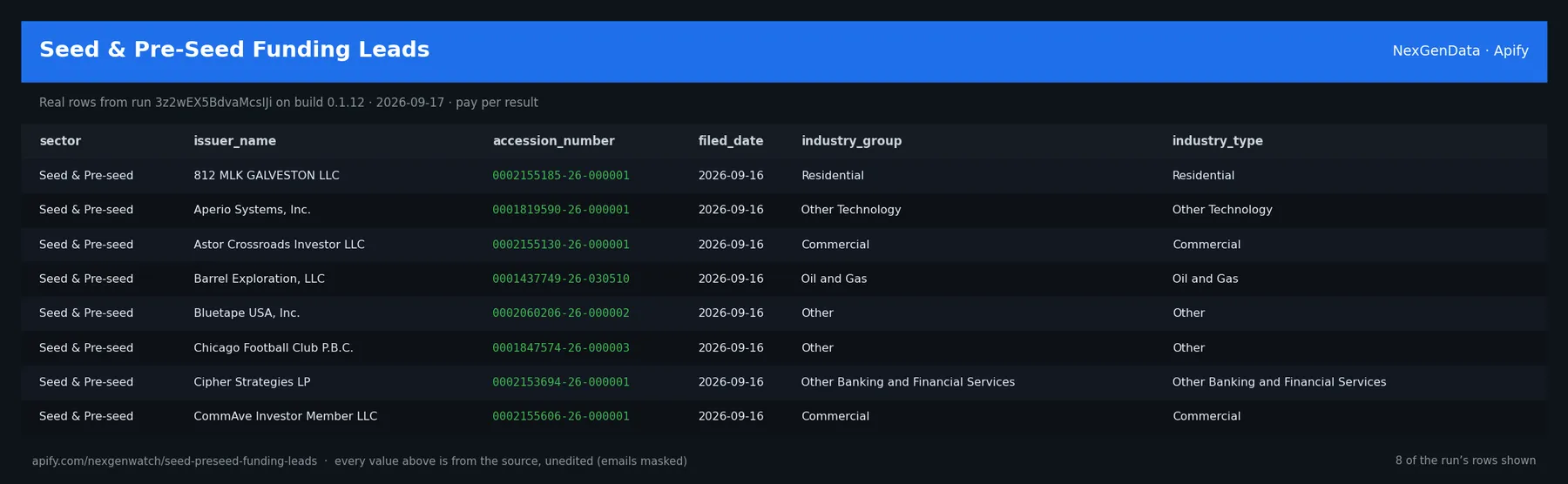
Real rows from run 3z2wEX5BdvaMcsIJi on build 0.1.12 (2026-09-17), the same input as the Quick start below — every value is as the source published it (emails masked, long text shortened):
| sector | issuer_name | accession_number | filed_date | industry_group | industry_type |
|---|---|---|---|---|---|
| Seed & Pre-seed | 812 MLK GALVESTON LLC | 0002155185-26-000001 | 2026-09-16 | Residential | Residential |
| Seed & Pre-seed | Aperio Systems, Inc. | 0001819590-26-000001 | 2026-09-16 | Other Technology | Other Technology |
| Seed & Pre-seed | Astor Crossroads Investor LLC | 0002155130-26-000001 | 2026-09-16 | Commercial | Commercial |
| Seed & Pre-seed | Barrel Exploration, LLC | 0001437749-26-030510 | 2026-09-16 | Oil and Gas | Oil and Gas |
| Seed & Pre-seed | Bluetape USA, Inc. | 0002060206-26-000002 | 2026-09-16 | Other | Other |
| Seed & Pre-seed | Chicago Football Club P.B.C. | 0001847574-26-000003 | 2026-09-16 | Other | Other |
| Seed & Pre-seed | Cipher Strategies LP | 0002153694-26-000001 | 2026-09-16 | Other Banking and Financial Services | Other Banking and Financial Services |
| Seed & Pre-seed | CommAve Investor Member LLC | 0002155606-26-000001 | 2026-09-16 | Commercial | Commercial |
The run finished with the status message: CAPPED: delivered 10 Seed & Pre-seed leads (maxRecords=10); more qualified on the date(s) read — raise maxRecords. billable=10
✅ What you get
One qualified_funding_lead per SEC Form D filing that matches the sector rule; every field is as filed on EDGAR.
Each row is flat JSON with these fields (from the dataset schema and the sample run; a field the source does not publish for a given row is null):
record_type(string) — e.g.qualified_funding_leadsector(string/null) — e.g.Seed & Pre-seedsector_rule(string/null) — e.g.An operating-company Form D (any industry group except Pooled Investment Fund) wissuer_name(string/null) — e.g.812 MLK GALVESTON LLCcik(string/null) — e.g.2155185accession_number(string/null) — e.g.0002155185-26-000001form_type(string/null) — e.g.Dfiled_date(string/null) — e.g.2026-09-16industry_group(string/null) — e.g.Residentialindustry_type(string/null) — e.g.Residentialentity_type(string/null) — e.g.Limited Liability Companyjurisdiction_of_incorporation(string/null) — e.g.TEXASyear_of_incorporation(integer/string/null) — e.g.2026issuer_city(string/null) — e.g.PORT ARTHURissuer_state_or_country(string/null) — e.g.TXissuer_postal_code(string/null) — e.g.77640issuer_phone(string/null) — e.g.4092230407revenue_range(string/null) — e.g.Decline to Disclosefederal_exemptions(array/null) — e.g.["06b"]security_types(array/null) — e.g.["Equity"]total_offering_amount(integer/number/null) — e.g.375000total_amount_sold(integer/number/null) — e.g.145000total_remaining(integer/number/null) — e.g.230000investor_count(integer/null) — e.g.1minimum_investment(integer/number/null) — e.g.50000date_of_first_sale(string/null) — e.g.2026-09-07yet_to_sell(boolean/null) — e.g.Trueis_amendment(boolean/null) — e.g.Falserelated_persons(array/null) — null in every sample rowfiling_index_url(string/null) — e.g.https://www.sec.gov/Archives/edgar/data/2155185/000215518526000001/index.jsonsource_url(string/null) — e.g.https://www.sec.gov/Archives/edgar/data/2155185/000215518526000001/primary_doc.xobserved_at(string/null) — e.g.2026-09-17T23:36:05Z
Every run also writes a RUN_RECEIPT record to its key-value store with the source checks it made and the counts it charged — diagnostics never land in the paid dataset.
⚙️ Sample inputs
1. Quick start — the Store example (this is what the sample above came from)
The sample run charged exactly: 1 × $0.02 apify-actor-start + 10 × $0.05 qualified_funding_lead = $0.52 on the Free tier — every delivered row was billed.
2. A smaller, narrowed run
Caps the run at 5 rows — about $0.27 on the Free tier ($0.02 start + 5 × $0.05).
3. A full-size run
Up to 40 rows (the schema default for maxRecords) — about $2.02 on the Free tier ($0.02 start + 40 × $0.05) if the source has that many.
🧾 JSON sample record
One real record from run 3z2wEX5BdvaMcsIJi, exactly as it lands in the dataset (emails masked, long text shortened):
🔧 How it works
Source. The actor reads www.sec.gov. Public pages and feeds only; nothing behind a login.
Transport. Plain HTTPS from the Apify platform, no proxy.
Terminal states. A run ends NORMAL, CAPPED (your cap was reached), PARTIAL (something was withheld and the message says what), GENUINE_EMPTY (the source was read and truly had nothing in scope) or BLOCKED (the source refused or changed shape — the run FAILS loud and bills nothing). A zero-row run is never reported as a silent success.
Charging. Each qualified funding lead is charged at the moment it is pushed (qualified_funding_lead); a row that fails to charge is not delivered, so the dataset count always equals the charged count.
Source. SEC EDGAR daily index (https://www.sec.gov/Archives/edgar/daily-index/…/form.YYYYMMDD.idx) for the latest complete filing date(s), then each Form D's primary_doc.xml under https://www.sec.gov/Archives/edgar/data/<CIK>/<accession>/. A fixed known-good index is fetched first as a canary; if EDGAR's shape or availability changes, the run fails loud and bills nothing.
Fair access. At most 2 requests per second with the SEC-required contact User-Agent (NexGenData FormDWatch/1.0 fleet2@nexgendata.com, overridable with secUserAgent). A full filing day is 150–300 Form D filings, so a run takes 2–4 minutes.
Filtering. The engine keeps filings whose industry group matches the cut, then the sector layer applies the name pattern (where the cut has one) and drops every pooled investment fund. filingDates controls how many complete EDGAR dates are read (1 = the latest); issuerStates, minTotalOfferingAmount and maxTotalOfferingAmount narrow further; includeAmendments adds Form D/A.
No repeats on a schedule. Filings are read by EDGAR filing date, so a daily schedule with filingDates: 1 delivers each filing once. There is no watch baseline to seed.
What is not done. No login, no cookie or CAPTCHA bypass, no private or personal-account data, no browser automation.
⏰ Set it on a schedule
A single run is a snapshot. The value is the feed: open the actor in Apify Console → Schedules → Create new, add this actor with the input you want, and pick a cadence:
- Daily —
0 7 * * *(07:00 UTC): catch changes within a day. - Weekly —
0 7 * * 1: a Monday digest.
Each run is independent; keep the same input on the schedule so the results stay comparable. Schedules can also POST results to a webhook (Console → Integrations).
💰 Pricing example
| Event | Free | Bronze | Silver | Gold |
|---|---|---|---|---|
Actor Start (apify-actor-start) | $0.02 | $0.02 | $0.02 | $0.02 |
Qualified Funding Lead (qualified_funding_lead) | $0.05 | $0.04 | $0.04 | $0.03 |
Worked at the live Free-tier price:
- 8 qualified funding leads: $0.02 start + 8 × $0.05 = $0.42
- 25 qualified funding leads: $0.02 start + 25 × $0.05 = $1.27
- 40 qualified funding leads: $0.02 start + 40 × $0.05 = $2.02
A run that delivers zero rows charges the $0.02 start fee only. A BLOCKED run (source refused) fails loud and charges no value event. The start fee is charged once per GB of run memory; the default run memory is 1024 MB.
Yield on the sample run: CAPPED: delivered 10 Seed & Pre-seed leads (maxRecords=10); more qualified on the date(s) read — raise maxRecords. billable=10. maxRecords is a hard ceiling on what is delivered and billed, never a target.
⚖️ Legal & ToS
This actor reads public, logged-out pages and feeds published by www.sec.gov. It collects only what the source publishes to any visitor, identifies itself, and does not access accounts, private data or anything behind authentication. Use the output in line with the source's terms and your local law; the intended use is B2B research and monitoring.
❓ FAQ
Q: Do I need an API key or a login?
A: No. The source (www.sec.gov) is read logged-out; the input schema has no key field and the actor carries no secrets.
Q: Why did my run return 0 rows?
A: Read the run's status message. GENUINE_EMPTY means the source was read and had nothing in scope for your input; BLOCKED means the source refused and the run failed without billing a value event — retry later or narrow the input. A zero-row run bills the start fee only.
Q: How many rows can one run return?
A: Up to maxRecords (default 40). Raise the cap for a bigger run; you pay per delivered row.
Q: How fresh is the data?
A: Every run reads the source live at run time; nothing is cached between runs. Put it on a schedule for a continuous feed.
Q: What formats can I export?
A: The dataset downloads as JSON, CSV, Excel, XML or RSS from the run's Dataset tab or the Apify API, and any run can push to a webhook or integration.
Q: How is this different from the other startup funding leads actors?
A: Same output shape and billing model; this one covers www.sec.gov. The siblings under Related Actors cover the other sources or slices — run several on one schedule for a combined feed.
Q: Are there rate limits?
A: The actor paces itself against the source; there is no per-buyer limit beyond your Apify plan's concurrency.
🆘 Troubleshooting
- Run FAILED with BLOCKED → the source refused the request or changed its page shape → nothing was billed beyond the start fee; retry after a while, and if it persists open an Issue with the run id.
- Status says CAPPED → your cap (
maxRecords) was reached → raise it for a bigger run. - Input validation error on start → a field is outside the schema's allowed values → start from the Quick start block and change one field at a time.
- Run TIMED-OUT → a very wide request on a slow day → raise the run timeout in Run options or narrow the input; what was delivered before the timeout is still in the dataset.
🔗 Related Actors
- 💵 SEC Form D Funding Leads — New Raises Watch — SEC EDGAR Form D watch — new private placements and funding leads (issuer, amount, dates) with deltas on new and changed filings
- Funding Leads Report — Scored SEC Form D Raises — One report call surfaces the newly-funded companies in your sector and geography from SEC Form D filings — a dated, sourced funding-leads book
- LatAm Startup Funding Tracker — Latin American startup funding rounds — company, amount, currency, location, date, source. Ready for CRM and market mapping
- Startup Funding Leads from SEC Form D Filings — Fresh company-round funding leads pulled from official SEC Form D filings — company, round, amount, date, provenance. Ready for CRM and outreach
- 🏢 About NexGenData — NexGen Watch is NexGenData's fleet of 256 public monitoring and lookup actors built on official sources, pay-per-result. Browse the catalog at apify.com/nexgenwatch.
⭐ Found this useful?
If this actor saved you a manual check, a quick review on the Apify Store helps other teams find it. Feature request or a source that changed? Open it from the Issues tab — every one is read.


