

USGS MRDS Mineral Occurrence Master
Under maintenancePricing
from $13.40 / 1,000 mrds occurrence records
USGS MRDS Mineral Occurrence Master
Under maintenanceOne structured occurrence record per USGS Mineral Resource Data System (MRDS) deposit — the source-native dep_id, deposit name, commodities, coordinates, and development status — filtered by commodity, development status, and/or bounding box.
Pricing
from $13.40 / 1,000 mrds occurrence records
Rating
0.0
(0)
Developer

NexGen Watch
Maintained by CommunityActor stats
0
Bookmarked
2
Total users
1
Monthly active users
4 days ago
Last modified
Categories
Share
🔔 USGS MRDS Mineral Occurrence Master
One structured occurrence record per USGS Mineral Resource Data System (MRDS) deposit — the
source-native dep_id, deposit name, commodities, coordinates, and development status — filtered by
commodity, development status, and/or bounding box. Built for exploration, minerals-supply, and research
teams who need MRDS occurrences as clean, keyed, deduplicated facts.
Differentiation: the usual MRDS tooling either scrapes the now robots-blocked mrdata.usgs.gov
(Disallow: /) or dumps the entire 304,632-row table. This master serves the same authoritative MRDS
occurrence layer through the clean USGS ArcGIS door (energy.usgs.gov/arcgis, no robots restriction),
is filter-scoped by contract (a filter is mandatory — no unbounded pulls), deduplicates on dep_id,
hard-caps at 2,500 per run, and stamps an explicit staleness note on every record.
Output is one usgs_mrds_occurrence row per result; billing is pay-per-event, the value event being one mrds occurrence record (a $0.02 start fee per run, then $0.02 per mrds occurrence record). Source: energy.usgs.gov, mrdata.usgs.gov.
No login, no API key and no CAPTCHA solving are involved: the source is read logged-out with an identified contact User-Agent.
📊 Sample Output
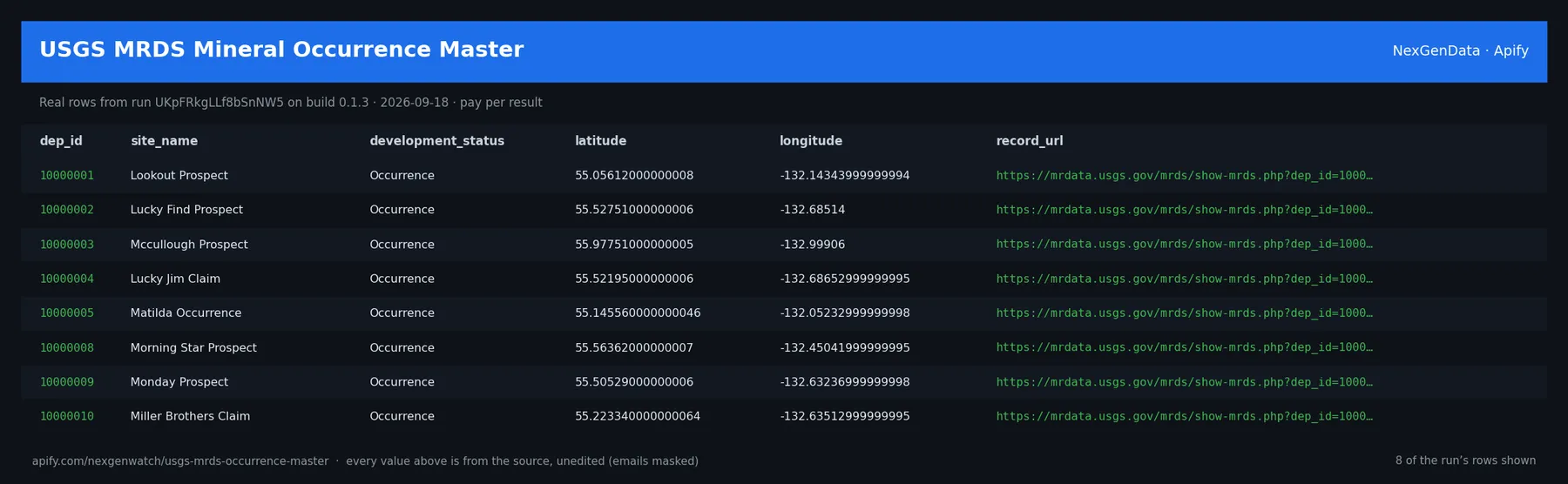
Real rows from run OUuhwweBsz8htqb9m on build 0.1.5 (2026-09-19), the same input as the Quick start below — every value is as the source published it (emails masked, long text shortened):
| dep_id | site_name | development_status | latitude | longitude | record_url |
|---|---|---|---|---|---|
| 10000001 | Lookout Prospect | Occurrence | 55.05612000000008 | -132.14343999999994 | https://mrdata.usgs.gov/mrds/show-mrds.php?dep_id=10000001 |
| 10000002 | Lucky Find Prospect | Occurrence | 55.52751000000006 | -132.68514 | https://mrdata.usgs.gov/mrds/show-mrds.php?dep_id=10000002 |
| 10000003 | Mccullough Prospect | Occurrence | 55.97751000000005 | -132.99906 | https://mrdata.usgs.gov/mrds/show-mrds.php?dep_id=10000003 |
| 10000004 | Lucky Jim Claim | Occurrence | 55.52195000000006 | -132.68652999999995 | https://mrdata.usgs.gov/mrds/show-mrds.php?dep_id=10000004 |
| 10000005 | Matilda Occurrence | Occurrence | 55.145560000000046 | -132.05232999999998 | https://mrdata.usgs.gov/mrds/show-mrds.php?dep_id=10000005 |
| 10000008 | Morning Star Prospect | Occurrence | 55.56362000000007 | -132.45041999999995 | https://mrdata.usgs.gov/mrds/show-mrds.php?dep_id=10000008 |
| 10000009 | Monday Prospect | Occurrence | 55.50529000000006 | -132.63236999999998 | https://mrdata.usgs.gov/mrds/show-mrds.php?dep_id=10000009 |
| 10000010 | Miller Brothers Claim | Occurrence | 55.223340000000064 | -132.63512999999995 | https://mrdata.usgs.gov/mrds/show-mrds.php?dep_id=10000010 |
The run finished with the status message: NORMAL: 50 unique rows (0 duplicates collapsed). billable=50
✅ What you get
Each row is flat JSON with these fields (from the dataset schema and the sample run; a field the source does not publish for a given row is null):
record_type(string/null) — e.g.usgs_mrds_occurrencedep_id(string/null) — e.g.10000001site_name(string/null) — e.g.Lookout Prospectcommodities(string/null) — e.g.CU AU AGdevelopment_status(string/null) — e.g.Occurrencelatitude(number/null) — e.g.55.05612000000008longitude(number/null) — e.g.-132.14343999999994grade(string/null) — e.g.Crecord_url(string/null) — e.g.https://mrdata.usgs.gov/mrds/show-mrds.php?dep_id=10000001staleness_note(string/null) — e.g.MRDS is a static legacy compilation; USGS ceased systematic MRDS maintenance cirsource(string/null) — e.g.usgs-mrds-occurrence-masterrelease_date(string/null) — null in every sample rowsource_url(string/null) — e.g.https://energy.usgs.gov/arcgis/rest/services/MRData/Mineral_Resource_Data_Systemobserved_at(string/null) — e.g.2026-09-19T00:15:22Zlicense(string/null) — e.g.USGS Mineral Resource Data System (MRDS) — U.S. Government public domain.attribution(string/null) — e.g.U.S. Geological Survey, Mineral Resource Data System (https://mrdata.usgs.gov/mrterminal(string/null) — null in every sample rowreported_total(string/integer/null) — null in every sample rowraw_seen(string/integer/null) — null in every sample rowduplicates(string/integer/null) — null in every sample rowunique_found(string/integer/null) — null in every sample rowdelivered(string/integer/null) — null in every sample rowscope(string/null) — null in every sample rownote(string/null) — null in every sample row
✅ What you get
record_type(string/null) — e.g.usgs_mrds_occurrencedep_id(string/null) — e.g.10000001site_name(string/null) — e.g.Lookout Prospectcommodities(string/null) — e.g.CU AU AGdevelopment_status(string/null) — e.g.Occurrencelatitude(number/null) — e.g.55.05612000000008longitude(number/null) — e.g.-132.14343999999994grade(string/null) — e.g.Crecord_url(string/null) — e.g.https://mrdata.usgs.gov/mrds/show-mrds.php?dep_id=10000001staleness_note(string/null) — e.g.MRDS is a static legacy compilation; USGS ceased systematic MRDS maintenance cirsource(string/null) — e.g.usgs-mrds-occurrence-masterrelease_date(string/null) — null in every sample rowsource_url(string/null) — e.g.https://energy.usgs.gov/arcgis/rest/services/MRData/Mineral_Resource_Data_Systemobserved_at(string/null) — e.g.2026-09-18T23:20:26Zlicense(string/null) — e.g.USGS Mineral Resource Data System (MRDS) — U.S. Government public domain.attribution(string/null) — e.g.U.S. Geological Survey, Mineral Resource Data System (https://mrdata.usgs.gov/mrterminal(string/null) — null in every sample rowreported_total(string/integer/null) — null in every sample rowraw_seen(string/integer/null) — null in every sample rowduplicates(string/integer/null) — null in every sample rowunique_found(string/integer/null) — null in every sample rowdelivered(string/integer/null) — null in every sample rowscope(string/null) — null in every sample rownote(string/null) — null in every sample row
Staleness (on every record)
MRDS is a static legacy compilation; USGS ceased systematic MRDS maintenance around 2011. Every record
carries staleness_note so no buyer mistakes an archival occurrence for a current one.
⚙️ Sample inputs
1. Quick start — the Store example (this is what the sample above came from)
The sample run charged exactly: 2 × $0.02 apify-actor-start + 50 × $0.02 occurrence_record = $1.04 on the Free tier — every delivered row was billed.
2. A smaller, narrowed run
Caps the run at 5 rows — about $0.12 on the Free tier ($0.02 start + 5 × $0.02).
3. A full-size run
Up to 2500 rows (the schema default for maxRecords) — about $50.02 on the Free tier ($0.02 start + 2500 × $0.02) if the source has that many.
4. A filtered run
Keeps only rows whose site_name contains Lookout Prospect (a value from the sample run above), matched case-insensitively after the source is read and before the maxRecords cap, so the cap counts matches and only delivered matches are billed. searchText does the same across every column. Zero matches end the run as EMPTY_SELECTION with no row charged — if the source has moved on since that sample run, pick a value you see in your own first run. The source is still read in full — this narrows what you receive and pay for, not what the source serves.
🧾 JSON sample record
One real record from run OUuhwweBsz8htqb9m, exactly as it lands in the dataset (emails masked, long text shortened):
🔧 How it works
Source. The actor reads energy.usgs.gov, mrdata.usgs.gov — endpoints: https://energy.usgs.gov/arcgis/rest/services/MRData/, https://energy.usgs.gov/arcgis/rest/services/MRData/Mineral_Resource_Data_System/MapServer/3/query, https://mrdata.usgs.gov/mrds/. Public pages and feeds only; nothing behind a login.
Transport. Plain HTTPS from the Apify platform, no proxy. robots.txt is read first and a disallowed path is never fetched. Every request carries an identified contact User-Agent. Pacing: CRAWL_DELAY=0.0.
Terminal states. A run ends NORMAL, CAPPED (your cap was reached), PARTIAL (something was withheld and the message says what), GENUINE_EMPTY (the source was read and truly had nothing in scope) or BLOCKED (the source refused or changed shape — the run FAILS loud and bills nothing). A zero-row run is never reported as a silent success.
Charging. Each mrds occurrence record is charged at the moment it is pushed (occurrence_record); a row that fails to charge is not delivered, so the dataset count always equals the charged count.
🔧 How it works
Source
The public USGS ArcGIS REST layer
energy.usgs.gov/arcgis/rest/services/MRData/Mineral_Resource_Data_System/MapServer/3 — bounded
resultOffset paging, honest UA, robots honoured at run time (the host publishes no robots.txt).
What this does NOT report
Never ownership, production, or current operating status. MRDS layer 3 carries only a static
development classification (development_status, e.g. Occurrence/Prospect/Producer), reported as
provenance. Nothing about who owns, operates, or produces at a site — or any production tonnage/volume — is
derived or emitted.
Licence
USGS MRDS is U.S. Government public domain. Every record carries license and attribution
(U.S. Geological Survey, Mineral Resource Data System).
What is not done. No login, no cookie or CAPTCHA bypass, no private or personal-account data, no browser automation.
💰 Pricing example
| Event | Free | Bronze | Silver | Gold |
|---|---|---|---|---|
Actor Start (apify-actor-start) | $0.02 | $0.02 | $0.02 | $0.02 |
MRDS occurrence record (occurrence_record) | $0.02 | $0.018 | $0.016 | $0.0134 |
Worked at the live Free-tier price:
- 8 mrds occurrence records: $0.02 start + 8 × $0.02 = $0.18
- 25 mrds occurrence records: $0.02 start + 25 × $0.02 = $0.52
- 2500 mrds occurrence records: $0.02 start + 2500 × $0.02 = $50.02
A run that delivers zero rows charges the $0.02 start fee only. A BLOCKED run (source refused) fails loud and charges no value event. The start fee is charged once per GB of run memory; the default run memory is 4096 MB.
Yield on the sample run: NORMAL: 50 unique rows (0 duplicates collapsed). billable=50. maxRecords is a hard ceiling on what is delivered and billed, never a target.
⚖️ Legal & ToS
This actor reads public, logged-out pages and feeds published by energy.usgs.gov, mrdata.usgs.gov. It collects only what the source publishes to any visitor, keeps to the source's robots rules (checked on every run), identifies itself with a contact User-Agent, and does not access accounts, private data or anything behind authentication. Use the output in line with the source's terms and your local law; the intended use is B2B research and monitoring.
❓ FAQ
Q: Do I need an API key or a login?
A: No. The source (energy.usgs.gov, mrdata.usgs.gov) is read logged-out; the input schema has no key field and the actor carries no secrets.
Q: Why did my run return 0 rows?
A: Read the run's status message. GENUINE_EMPTY means the source was read and had nothing in scope for your input; BLOCKED means the source refused and the run failed without billing a value event — retry later or narrow the input. A zero-row run bills the start fee only.
Q: How many rows can one run return?
A: Up to maxRecords (default 2500). Raise the cap for a bigger run; you pay per delivered row.
Q: How fresh is the data?
A: Every run reads the source live at run time; nothing is cached between runs. Put it on a schedule for a continuous feed.
Q: What formats can I export?
A: The dataset downloads as JSON, CSV, Excel, XML or RSS from the run's Dataset tab or the Apify API, and any run can push to a webhook or integration.
Q: How is this different from the other NexGen Watch actors actors?
A: Same output shape and billing model; this one covers energy.usgs.gov, mrdata.usgs.gov. The siblings under Related Actors cover the other sources or slices — run several on one schedule for a combined feed.
Q: Are there rate limits?
A: The actor paces itself against the source (CRAWL_DELAY=0.0) and honours its robots rules; there is no per-buyer limit beyond your Apify plan's concurrency.
🆘 Troubleshooting
- Run FAILED with BLOCKED → the source refused the request or changed its page shape → nothing was billed beyond the start fee; retry after a while, and if it persists open an Issue with the run id.
- Status says CAPPED → your cap (
maxRecords) was reached → raise it for a bigger run. - Input validation error on start → a field is outside the schema's allowed values → start from the Quick start block and change one field at a time.
- Run TIMED-OUT → a very wide request on a slow day → raise the run timeout in Run options or narrow the input; what was delivered before the timeout is still in the dataset.
🔗 Related Actors
- USDA FDC Product Update Ledger — One food_update_record per entry in USDA FoodData Central's own product update log — the FDC id, the product description, and the last_updated date,…
- USDA FNDDS Ingredient-Nutrient Matrix — One fndds_nutrient_record per row of USDA FoodData Central's fndds_ingredient_nutrient_value table — a single nutrient value for an FNDDS ingredient…
- USGS Earthquake Events Scraper — Scrape USGS earthquake events (FDSN): magnitude, location, depth, time and event ID. One record per result. Pay per result
- Washington Contractor License Registry — One record per Washington L&I contractor licence/registration (number, type, effective/expiry, licence status + suspension date, UBI, principal) from…
- Washington Transportation-Industry Business Licenses — One record per Washington Department of Licensing transportation-industry business licence (tow-truck operators, vehicle transporters, wreckers, deal…
- Wayback History Evidence API — Resolves each target URL against the public Wayback Machine and returns validated snapshot evidence records — archived playback URL, capture timestam…
- 🏢 About NexGenData — NexGen Watch is NexGenData's fleet of more than 300 public data actors built on official sources, pay-per-result. Browse the catalog at apify.com/nexgenwatch.
⭐ Found this useful?
If this actor saved you a manual check, a quick review on the Apify Store helps other teams find it. Feature request or a source that changed? Open it from the Issues tab — every one is read.


