

Wayback History Evidence API
Pricing
from $33.50 / 1,000 wayback history evidence api verdicts
Wayback History Evidence API
Resolves each target URL against the public Wayback Machine and returns validated snapshot evidence records — archived playback URL, capture timestamp, CDX status/MIME/digest, a live re-check of the playback URL, and the coverage window.
Pricing
from $33.50 / 1,000 wayback history evidence api verdicts
Rating
0.0
(0)
Developer
NexGen Watch
Maintained by CommunityActor stats
0
Bookmarked
2
Total users
1
Monthly active users
2 days ago
Last modified
Categories
Share
🔔 Wayback History Evidence API
Resolves each target URL against the public Wayback Machine and returns validated snapshot evidence records — archived playback URL, capture timestamp, CDX status/MIME/digest, a live re-check of the playback URL, and the coverage window — selected by earliest / latest / nearest. A read-only archive evidence API; it never submits captures.
Output is one archive_snapshot row per result; billing is pay-per-event, the value event being one wayback history evidence api verdict (a $0.02 start fee per run, then $0.05 per wayback history evidence api verdict). Source: archive.org, web.archive.org.
No login, no API key and no CAPTCHA solving are involved: the source is read logged-out with an identified contact User-Agent.
📊 Sample Output
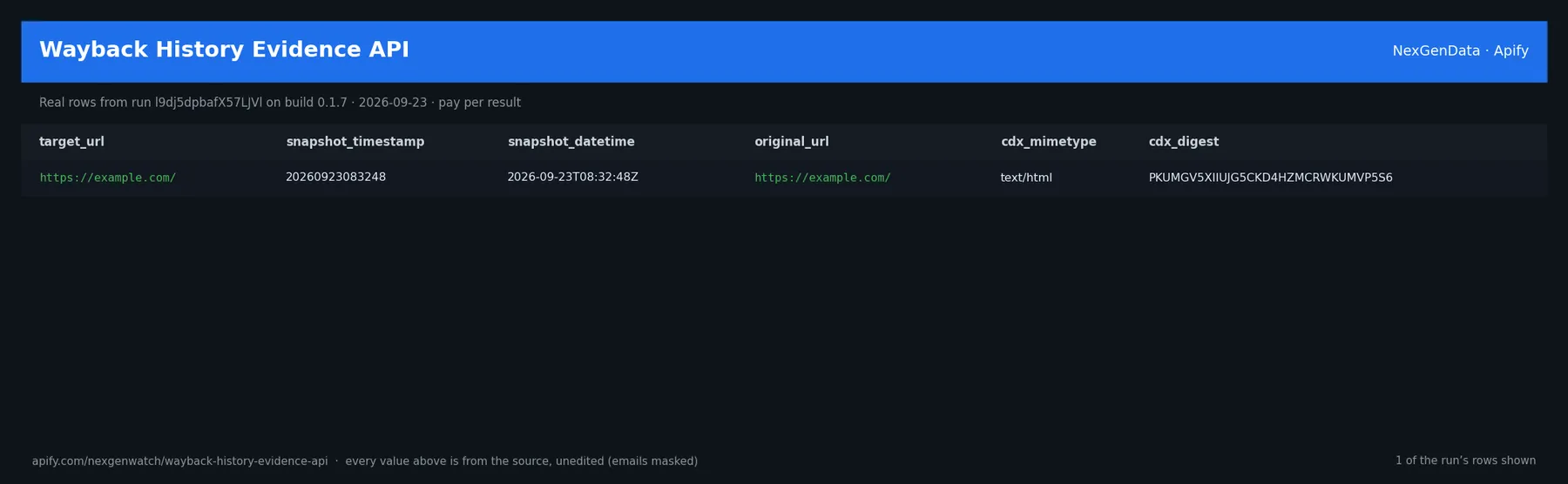
Real rows from run l9dj5dpbafX57LJVl on build 0.1.7 (2026-09-23), the same input as the Quick start below — every value is as the source published it (emails masked, long text shortened):
| target_url | snapshot_timestamp | snapshot_datetime | original_url | cdx_mimetype | cdx_digest |
|---|---|---|---|---|---|
| https://example.com/ | 20260923083248 | 2026-09-23T08:32:48Z | https://example.com/ | text/html | PKUMGV5XIIUJG5CKD4HZMCRWKUMVP5S6 |
The run finished with the status message: 1 snapshot record(s): 1 validated+charged, 0 unbilled (no-coverage/unvalidated/blocked/unreachable/unparseable) | archive_snapshot_check charged=1
✅ What you get
Each row is flat JSON with these fields (from the dataset schema and the sample run; a field the source does not publish for a given row is null):
target_url(string/null) — e.g.https://example.com/selector(string/null) — e.g.latestsnapshot_timestamp(string/null) — e.g.20260923083248snapshot_datetime(string/null) — e.g.2026-09-23T08:32:48Zarchived_url(string/null) — e.g.https://web.archive.org/web/20260923083248/https://example.com/original_url(string/null) — e.g.https://example.com/cdx_statuscode(string/null) — e.g.200cdx_mimetype(string/null) — e.g.text/htmlcdx_digest(string/null) — e.g.PKUMGV5XIIUJG5CKD4HZMCRWKUMVP5S6validated(boolean/null) — e.g.Truevalidation_http_status(integer/string/null) — e.g.200validation_mime(string/null) — e.g.text/htmlcoverage_earliest(string/null) — e.g.2002-01-20T14:25:10Zcoverage_latest(string/null) — e.g.2026-09-23T08:32:48Ztotal_captures(integer/string/null) — e.g.1000+evidence_chain(string/null) — e.g.{"cdx_query":"https://web.archive.org/cdx/search/cdx?url=https%3A%2F%2Fexample.cfaults(string/null) — null in every sample rowrecord_type(string) — e.g.archive_snapshotsource(string/null) — e.g.public Wayback Machine (web.archive.org) CDX indexoutcome(string/null) — e.g.answerinput(string/null) — e.g.https://example.com/outcome_reason(string/null) — null in every sample rowobserved_at(string/null) — null in every sample rowterminal(string/null) — null in every sample row
Output & billing
One row per requested selector per target. A snapshot that is returned by the archive AND whose playback URL live-validates (HTTP 200–399) carries outcome: answer and bills once. Identical capture digests are de-duplicated so one physical snapshot never double-bills. A target with no archive coverage, a returned-but-unvalidated snapshot, or an archive query blocked/unreachable, is an unbilled status. Push-then-charge: every row is delivered before its charge, so a billing hiccup can only ever undercharge.
⚙️ Sample inputs
1. Quick start — the Store example (this is what the sample above came from)
The sample run charged exactly: 1 × $0.02 apify-actor-start + 1 × $0.05 archive_snapshot_check = $0.07 on the Free tier — every delivered row was billed.
2. A smaller, narrowed run
A bounded run for checking the field shape before scheduling. nearTimestamp narrows what the source is asked for.
3. A full-size run
The same input run on a schedule; each run is billed only for what it delivers.
🧾 JSON sample record
One real record from run l9dj5dpbafX57LJVl, exactly as it lands in the dataset (emails masked, long text shortened):
🔧 How it works
Transport. Plain HTTPS from the Apify platform, no proxy. robots.txt is read first and a disallowed path is never fetched. Every request carries an identified contact User-Agent.
Terminal states. A run ends NORMAL, CAPPED (your cap was reached), PARTIAL (something was withheld and the message says what), GENUINE_EMPTY (the source was read and truly had nothing in scope) or BLOCKED (the source refused or changed shape — the run FAILS loud and bills nothing). A zero-row run is never reported as a silent success.
Charging. Each wayback history evidence api verdict is charged at the moment it is pushed (archive_snapshot_check); a row that fails to charge is not delivered, so the dataset count always equals the charged count.
What you submit
urls — target urls to look up in the archive. Target URLs to resolve against the public Wayback Machine CDX index. Per requested selector (earliest / latest / nearest) ONE validated snapshot record: archived playback URL, capture timestamp, original URL, CDX status/MIME/digest, a live validation of the playback URL, and coverage summary (earliest, latest, total captures). Only web.archive.org is contacted (SSRF- and robots-gated per the standing law; identical snapshot digests are de-duplicated so the same capture never double-bills). A validated snapshot record bills; a target with no archive coverage, or an archive query blocked/unreachable, is an unbilled status. No archive submissions are ever made.
The runtime source gate (per submitted target)
You choose the targets, so the source contract is enforced at run time — for every archive query — only web.archive.org / archive.org are ever contacted — per origin, before any page is read:
- robots.txt fetched once per origin and honored; no robots / 404 = permitted, a disallowed path or an unavailable/forbidden robots file = BLOCKED.
- SSRF guard — every host is resolved and must be public; private, loopback, link-local, reserved and cloud-metadata addresses are refused before a socket opens.
- HTTP —
403/429/5xx= BLOCKED; DNS / timeout / connection faults = UNREACHABLE.
A BLOCKED or UNREACHABLE target is delivered as an unbilled status row — never a broken-site verdict, and never charged.
Why this and not the obvious alternative
validated Wayback snapshot evidence records (playback URL, digest, live re-check, coverage window) selected by earliest/latest/nearest — a read-only archive evidence API, not an archive submitter and not a live-site scraper.
What is not done. No login, no cookie or CAPTCHA bypass, no private or personal-account data, no browser automation.
💰 Pricing example
| Event | Free | Bronze | Silver | Gold |
|---|---|---|---|---|
Actor Start (apify-actor-start) | $0.02 | $0.02 | $0.02 | $0.02 |
Wayback History Evidence API verdict (archive_snapshot_check) | $0.05 | $0.04 | $0.04 | $0.03 |
Worked at the live Free-tier price:
- 1 wayback history evidence api verdicts: $0.02 start + 1 × $0.05 = $0.07
- 25 wayback history evidence api verdicts: $0.02 start + 25 × $0.05 = $1.27
- 100 wayback history evidence api verdicts: $0.02 start + 100 × $0.05 = $5.02
A run that delivers zero rows charges the $0.02 start fee only. A BLOCKED run (source refused) fails loud and charges no value event. The start fee is charged once per GB of run memory; the default run memory is 4096 MB.
Yield on the sample run: 1 snapshot record(s): 1 validated+charged, 0 unbilled (no-coverage/unvalidated/blocked/unreachable/unparseable) | archive_snapshot_check charged=1.
⚖️ Legal & ToS
This actor reads public, logged-out pages and feeds published by archive.org, web.archive.org. It collects only what the source publishes to any visitor, keeps to the source's robots rules (checked on every run), identifies itself with a contact User-Agent, and does not access accounts, private data or anything behind authentication. Use the output in line with the source's terms and your local law; the intended use is B2B research and monitoring.
❓ FAQ
Q: Do I need an API key or a login?
A: No. The source (archive.org, web.archive.org) is read logged-out; the input schema has no key field and the actor carries no secrets.
Q: Why did my run return 0 rows?
A: Read the run's status message. GENUINE_EMPTY means the source was read and had nothing in scope for your input; BLOCKED means the source refused and the run failed without billing a value event — retry later or narrow the input. A zero-row run bills the start fee only.
Q: How fresh is the data?
A: Every run reads the source live at run time; nothing is cached between runs. Put it on a schedule for a continuous feed.
Q: What formats can I export?
A: The dataset downloads as JSON, CSV, Excel, XML or RSS from the run's Dataset tab or the Apify API, and any run can push to a webhook or integration.
Q: How is this different from the other NexGen Watch actors actors?
A: Same output shape and billing model; this one covers archive.org, web.archive.org. The siblings under Related Actors cover the other sources or slices — run several on one schedule for a combined feed.
Q: Are there rate limits?
A: The actor paces itself against the source and honours its robots rules; there is no per-buyer limit beyond your Apify plan's concurrency.
🆘 Troubleshooting
- Run FAILED with BLOCKED → the source refused the request or changed its page shape → nothing was billed beyond the start fee; retry after a while, and if it persists open an Issue with the run id.
- Fewer rows than expected → the source had fewer items in scope → widen the input.
- Input validation error on start → a field is outside the schema's allowed values → start from the Quick start block and change one field at a time.
- Run TIMED-OUT → a very wide request on a slow day → raise the run timeout in Run options or narrow the input; what was delivered before the timeout is still in the dataset.
🔗 Related Actors
- USGS MRDS Mineral Occurrence Master — same family, different source
- Washington Contractor License Registry — One structured registryrecord per record from the official public source, logged-out. Public, robots-honoured
- Washington Transportation-Industry Business Licenses — same family, different source
- AccessGUDID Device Release Feed — same family, different source
- 🏢 About NexGenData — NexGen Watch is NexGenData's fleet of 256 public monitoring and lookup actors built on official sources, pay-per-result. Browse the catalog at apify.com/nexgenwatch.
⭐ Found this useful?
If this actor saved you a manual check, a quick review on the Apify Store helps other teams find it. Feature request or a source that changed? Open it from the Issues tab — every one is read.


