
Barcode & ISBN Product Lookup — Open Data, EAN, UPC, GTIN
Pricing
from $4.00 / 1,000 product founds
Barcode & ISBN Product Lookup — Open Data, EAN, UPC, GTIN
Look up product names, brands and book details from barcodes (EAN, UPC, GTIN) and ISBNs using open databases. Codes are validated first. Pay only for products found: $4 per 1,000.
Pricing
from $4.00 / 1,000 product founds
Rating
0.0
(0)
Developer
NEZU SAS
Maintained by CommunityActor stats
0
Bookmarked
1
Total users
0
Monthly active users
a day ago
Last modified
Categories
Features
Share
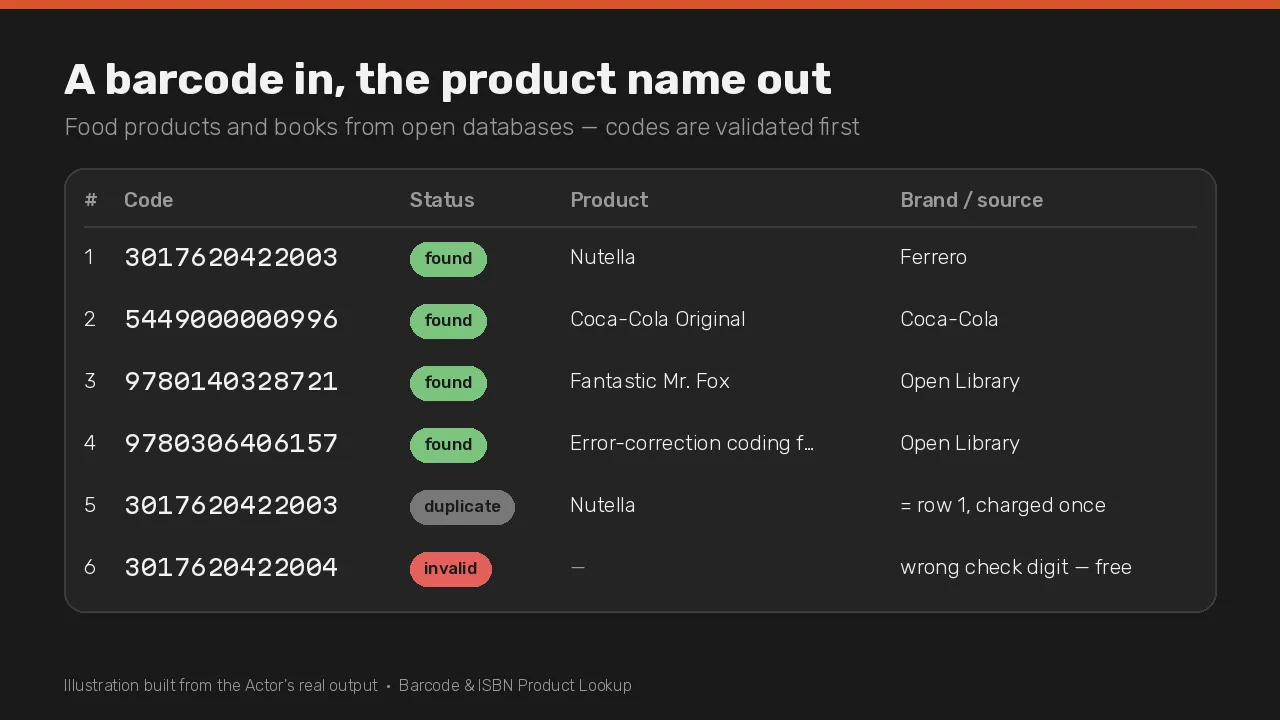
Turn barcodes into product names, brands and book details — and pay only for what is found. Paste your EAN, UPC, GTIN or ISBN codes (or a CSV). Each code is validated first (and repaired when the fix is safe), then looked up in open databases: Open Food Facts, Open Beauty Facts, Open Pet Food Facts, Open Products Facts and Open Library. Every result tells you which database it came from and carries the license and attribution.
| You give | You get |
|---|---|
3017620422003 | Nutella · Ferrero, Nutella · Hazelnut spreads · found in Open Food Facts |
9780306406157 (ISBN-13) | The book title, authors, publisher and cover · found in Open Library |
3017620422004 (typo) | ❌ invalid_check_digit — nothing searched, nothing charged |
36000291452 (lost leading zero) | repaired to 036000291452, then looked up · fixedFrom shows the original |
| a code nobody has catalogued | not_found — free |
Why you'll like it
- 💸 Pay only for products found. Invalid, not found, duplicate and failed rows are free.
- 🛡️ No wasted searches: codes are validated (check digit and length) before any request, and a lost leading zero is repaired for you.
- 🔎 Several open databases in order, food, cosmetics, pet food, general products and books, until one has the code.
- 🧾 Source and license on every row (
source,sourceUrl,license), so you know what you can reuse and whom to credit. - 🔁 Duplicates detected: the same code twice is looked up once and not charged twice.
- 🔒 No scraping, no proxies: it uses the public APIs of the open projects, identifies itself and keeps a polite request rate.
Honest coverage
These databases are community projects. They are strong for groceries, cosmetics, pet food and books, and weak for electronics, hardware or industrial items. A not_found means "not in these databases", not "the code does not exist". Check your first batch to see the hit rate for your own catalog before processing a large list.
Input
| Field | What it is |
|---|---|
codes | EAN-13, UPC-A, EAN-8, GTIN-14 or ISBN-10/13, even with spaces, hyphens or a lost leading zero. |
fileUrl / column | Optional public https CSV and the column to use (detected from names like barcode, ean, upc, gtin, isbn, code). |
sources | Optional. Leave empty to use all: openfoodfacts, openbeautyfacts, openpetfoodfacts, openproductsfacts, openlibrary. |
onlyFound | Return only the products found. |
maxCodes | Safety limit (default 300, up to 3,000). |
Speed: the open services allow roughly 60–80 lookups per minute. A code that is found takes about 1 second; a code that is not found takes 4–5 seconds because every database is tried. So 300 codes take between 5 and 30 minutes. If the databases keep failing or rate-limiting, the Actor stops early and marks the run as partial.
Example:
Output
One dataset row per code: status (found, not_found, invalid, duplicate, error), the code searched, fixedFrom, and when found: productName, brands, categories, quantity, countries, ingredients, allergens, nutriScore, authors, publishers, publishDate, pages, imageUrl, source, sourceUrl, license. In the key-value store: SUMMARY and results.csv.
Use it from code
Every field is documented in the Actor's output schema, so AI agents (through the Apify API or MCP server) can use the results without guessing.
Pricing
Pay per event: $4.00 per 1,000 products found ($0.004 per product), plus a tiny start fee of $0.00005 per run (Apify covers the compute of the first 5 seconds).
- Invalid, not found, duplicate and failed rows are free. The small start fee applies to every run. Only what was charged is delivered if you set a maximum cost per run.
- 100 products found = $0.40.
- You can set a maximum cost per run; the Actor stops cleanly when it is reached and marks the result as
partial.
Using the data
The product data comes from open projects. Open Food Facts, Open Beauty Facts, Open Pet Food Facts and Open Products Facts publish under the Open Database License (ODbL): credit the source and keep the license when you reuse or redistribute the data. The license and sourceUrl fields are there for that. Product images are published under CC BY-SA 3.0 (credit and share-alike) and a found record can be wrong: it is community-edited, so check anything critical. Open Library data comes from its public API; check openlibrary.org for the reuse terms of covers and text. results.csv includes sourceUrl and license for each row. This Actor is not affiliated with those projects.
FAQ
How do I look up a barcode in bulk? Paste the list in codes or give a CSV in fileUrl; every row comes back with its product when it exists in the open databases.
Why is my product "not found"? The open databases do not contain every product. Electronics, hardware and local brands are the most often missing.
Can it fix a code with a missing zero? Yes: a safe correction is applied before the search and the original is kept in fixedFrom.
Is my data stored or sent anywhere? Only the validated codes are sent to the open databases to search them, over HTTPS. Nothing else leaves the run.
Support
Found a bug or need another source? Open an issue on the Actor page: reports are answered quickly.


