

SEC Filings Extractor — 10-K/10-Q Financials & AI (EDGAR)
Pricing
$200.00 / 1,000 company analyzeds
SEC Filings Extractor — 10-K/10-Q Financials & AI (EDGAR)
Pull a public company's SEC filings and key financials from EDGAR, then get an AI summary of its business, risk factors, MD&A highlights and year-over-year changes. Free official data, pay per company.
Pricing
$200.00 / 1,000 company analyzeds
Rating
0.0
(0)
Developer

Fredrik Hansson
Maintained by CommunityActor stats
0
Bookmarked
2
Total users
1
Monthly active users
4 hours ago
Last modified
Categories
Share
Turn a ticker into a research brief. Give this Actor a list of tickers, company names or CIK numbers and it pulls each company's SEC EDGAR filings (10-K, 10-Q, 8-K…) and key financials straight from the official, free SEC APIs — then uses OpenAI to summarize the business, its risk factors, MD&A highlights and year-over-year changes. The numbers come from the government; the narrative comes from AI; you get both in one record.
You bring the tickers. It hands back a fundamentals-ready company brief.
Quick start
- Add your companies — tickers, company names or CIK numbers in the
companiesfield (e.g.AAPL,MSFT,320193). - Pick form types (optional) —
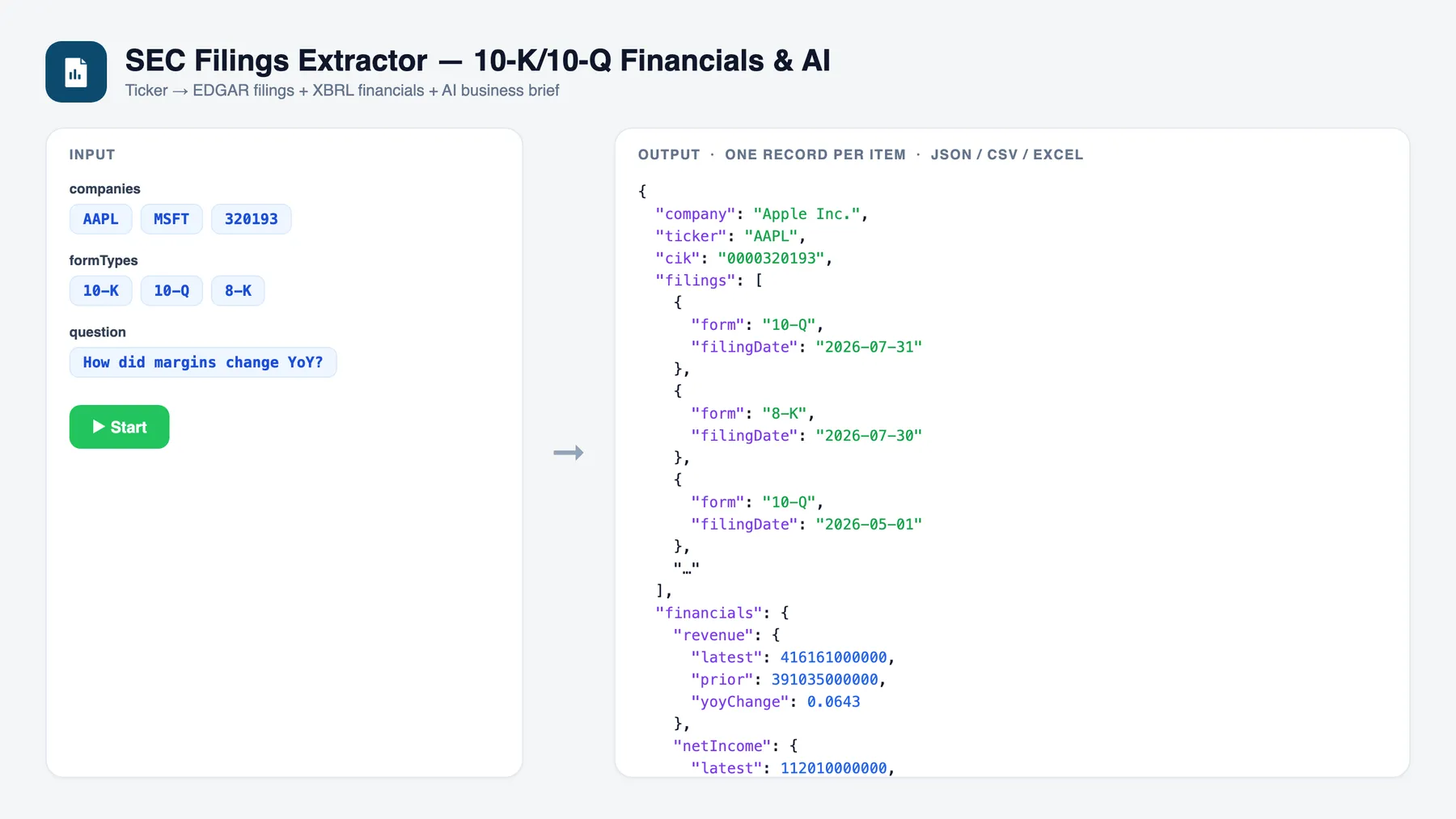
10-K,10-Q,8-K… and optionally aquestionto focus the AI summary. - Click Start — results stream into the dataset, one record per company. Export to JSON, CSV or Excel, or pull them via the API.
The flow
- Resolve — each ticker / name / CIK is matched to its SEC CIK via the official company ticker map (fetched once, cached).
- Filings — read
submissionsfor the company, filter to the form types you asked for (10-K / 10-Q / 8-K…), and capture the latest N with form, filing date and a direct link to the primary document. - Financials — pull US-GAAP XBRL company facts: revenue, net income, operating income, total assets, total liabilities, stockholders' equity, cash, diluted EPS — each with the latest annual value, the prior year, and the YoY change.
- AI layer — OpenAI (
gpt-4o-mini) reads the financials, the filing list and a trimmed slice of the latest 10-K/10-Q and writes a grounded business summary, key risks, MD&A highlights and notable changes — plus an answer to your optional focus question. It never invents numbers.
What you get per company
company,ticker,cik— the resolved identity (10-digit zero-padded CIK).filings— the latest matching filings:form,filingDate, and a directurlto the primary document onsec.gov.financials— eight key metrics, each as{ latest, prior, yoyChange, unit, fy }:revenue,netIncome,operatingIncome,assets,liabilities,equity,cash,epsDiluted. Missing facts come backnull(never fabricated).aiSummary—businessSummary(2–3 sentences),keyRisks[](from the risk-factors section),mdaHighlights[](management discussion),notableChanges[](YoY / recent 8-K-driven), andanswerToQuestionwhen you set aquestion.
Everything is grounded strictly in the extracted SEC data. If a fact isn't there, it's null or an empty array — nothing is made up.
Three ways people use it
- Investment research — go from a watchlist of tickers to a one-glance fundamentals view: revenue and net-income trends, YoY growth, and an AI read on the business and its stated risks. The official SEC EDGAR API as structured financial data, no manual filing-digging.
- Competitive & financial due diligence — profile a target or a competitor's public financials and 10-K/10-Q disclosures, with XBRL numbers and the risk factors surfaced for you. A fast 10-K scraper that also explains what it found.
- Fundamental analysis & screening — batch a sector's tickers, compare revenue/EPS/margin trends, and feed the structured output into a model or dashboard. Built for investor research at scale on free public data.
Input
| Field | Type | Notes |
|---|---|---|
companies | array | Required. Tickers (AAPL), company names, or CIK numbers. One per line. |
filingTypes | array | Form types to include. Default ["10-K","10-Q","8-K"]. |
maxFilingsPerCompany | integer | Latest N matching filings per company. Default 5. |
includeFinancials | boolean | Pull XBRL financials. Default true. |
question | string | Optional. Focuses the AI summary, e.g. "margin trends and competitive risks". Answered only from the extracted data. |
maxResults | integer | Cap how many companies to process. Default 50. |
maxConcurrency | integer | Companies in parallel. Default 3 — SEC rate-limits aggressive clients. |
model | string | Override the OpenAI model. Default gpt-4o-mini. |
Minimal input example
Output example
A company that can't be resolved, or has no XBRL facts, comes back with success: false and an error (filings/financials null) so your pipeline can skip it cleanly.
Pay-per-event pricing
| Event | Price | Charged when |
|---|---|---|
company-analyzed | $0.20 | Once per company whose SEC filings and key financials were extracted and summarized with AI. |
The SEC data itself is free, official public data. The price covers the OpenAI token cost (typically well under a cent per company on gpt-4o-mini); the Actor logs its exact token usage and estimated per-company cost at the end of every run.
Data source
All filings and financials come from the official SEC EDGAR system (sec.gov and data.sec.gov) — free public data published by US registrants. SEC's fair-access policy requires every request to carry a descriptive User-Agent with a contact (or it returns 403), and asks clients to stay under ~10 requests/second; this Actor sends a proper User-Agent, keeps concurrency low and spaces requests out. No login, API key or paid feed is needed for the SEC side.
Setup
The AI summary calls the OpenAI API. Set the environment variable / secret OPENAI_API_KEY on the Actor. The filings and financials are extracted regardless; without the key the run fails before the AI step, so the key is required.
Use it from an AI agent (Apify MCP server)
This Actor is available through the Apify MCP server, so AI agents (Claude, ChatGPT, or anything that speaks MCP) can call it as a tool — hand it a list of tickers and read back structured filings, financials and an AI summary — with no custom integration code.
Run it locally
Related actors
- Equity Analyst — Deeper AI equity analysis and valuation context for public companies.
- AI Company Enrichment — Turn domains into firmographic company profiles with contacts and ICP fit.
- Google News Scraper — Pull the latest news coverage for any company or topic.
- B2B Account Brief — Build a sales-ready account brief for any target company.


