

Grants.gov API & SAM.gov Scraper — Federal Grants Feed
Pricing
from $0.80 / 1,000 opportunity records
Grants.gov API & SAM.gov Scraper — Federal Grants Feed
Monitor federal grants and contract opportunities via the official Grants.gov and SAM.gov APIs, plus recent USAspending awards. Keyword search, normalized JSON, new/updated flags for scheduled runs and webhooks. Pay per opportunity record ($0.001).
Pricing
from $0.80 / 1,000 opportunity records
Rating
0.0
(0)
Developer

Owlabee
Maintained by CommunityActor stats
0
Bookmarked
2
Total users
1
Monthly active users
9 hours ago
Last modified
Categories
Security
Limited permissionsShare
Grants.gov API scraper and SAM.gov feed: search federal grant opportunities on Grants.gov and contract opportunities on SAM.gov by keyword through the official APIs, plus recent USAspending awards, and get normalized JSON with new and updated flags. Schedule it with a webhook and it becomes a daily federal grants and RFP alert feed.
Renamed on 2026-11-07: this Actor's address changed from
owlabee/gov-opportunity-feedtoowlabee/grants-gov-api. Saved tasks, schedules, webhooks and integrations keep working, because they point to the Actor's ID, which did not change. Calls by the old name no longer work, so please update anything that calls it by name: API URLs (owlabee~grants-gov-api), MCP tool lists (owlabee/grants-gov-api) and bookmarks.
What it does
This Actor turns the official US federal opportunity APIs into one clean, keyword-filtered feed. It queries Grants.gov (federal grants, no key needed), SAM.gov (federal contract opportunities, free personal API key) and optionally USAspending.gov (who recently won similar grants and contracts), normalizes every record to the same field names, and flags what is new or updated since your last run so a daily schedule only emits changes.
It is built for grant writers, government-contracting business developers, SBIR/STTR applicants, nonprofits, universities, and anyone who wants an RFP alert feed without logging into three portals. Results land in an Apify dataset you can download as JSON, CSV or Excel, read over the API, push to a webhook, or query from an AI agent through the Apify MCP server.
Only official public APIs are used — no HTML scraping of sam.gov or grants.gov, no proxies, no login.
Coverage
| Level | Jurisdiction | Official source | What it lists |
|---|---|---|---|
| Federal | United States | Grants.gov API | Federal grant opportunities (posted, forecasted, closed, archived) |
| Federal | United States | SAM.gov Get Opportunities API (free key) | Federal contract notices: solicitations, presolicitations, sources sought, awards |
| Federal | United States | USAspending.gov API (optional) | Recent federal grant and contract awards |
| Federal | United States | NIH RePORTER API (nihReporter) | Recent NIH research awards: recipient, amount, project dates, principal investigators (names), abstract |
| Federal | United States | NSF Award Search API (nsfAwards) | Recent NSF awards: recipient, obligated amount, program, principal investigator (name), abstract |
| Federal | United States | Federal Register API (federalRegister) | Notices matching "notice of funding opportunity" and your keyword, which often never reach a Grants.gov keyword search; the deadline stays in datesText as published |
| Local | City of Los Angeles, CA | data.lacity.org hf3r-utnq (RAMP Open Bid Opportunities) | Open bids with close dates and links to the RAMP notice |
| Local | New York City, NY | data.cityofnewyork.us p8e4-uwuv (Anticipated RFP) | School Construction Authority RFPs planned but not yet released, with estimated cost |
| Local | Montgomery County, MD | data.montgomerycountymd.gov eeq6-nnwe (Solicitations) | Active and closed county solicitations with issue and closing dates |
| Local | City of Mesa, AZ | data.mesaaz.gov dfcn-ivuc (Purchasing - Solicitations) | City solicitations (RFB, RFP, RFQ) and their status; no close date in the dataset |
| Local | Cook County, IL | datacatalog.cookcountyil.gov ag43-fvd7 (Procurement - Intent to Execute) | Contracts about to be executed, with recommended vendor and amount (noticeType: "intent-to-award") |
| State | State of Illinois | data.illinois.gov 6rb8-ntpm (Future Solicitations) | Construction solicitations planned for a future bid date, with approximate cost |
| Local (all states) | Every US school and library in E-Rate (opt-in: erate-470) | datahub.usac.org jp7a-89nd + 39tn-hjzv (FCC Form 470 and services requested) | Schools and libraries seeking bids for internet, Wi-Fi, network equipment and telecom; the bid window closes on the allowable contract date. Narrow by state with sledStates |
| State | State of Delaware (opt-in: delaware, delaware-closed) | data.delaware.gov 2hnj-zwix (Open Bids), yhim-4378 (Recently Closed Bids) | Every statewide open bid and recently closed bid, with deadlines, agency codes and UNSPSC codes |
| State | State of California (opt-in: ca-grants) | data.ca.gov California Grants Portal (CKAN datastore, updated daily) | Active and forecasted state grants: deadlines, available funds, eligible applicant types, geography (noticeType: "grant") |
| State | State of New York (opt-in: ny-sucf) | data.ny.gov vtxv-3j2b (SUCF Advertised Procurements) | State University Construction Fund design and construction procurements, with due dates and estimated value ranges |
| State | State of Texas (opt-in: txdot-lettings) | data.texas.gov qh8x-rm8r (TxDOT Official and Unofficial Bid Items) | Highway lettings in the next 42 days, grouped into one record per project, with the bid opening date and the sealed engineer's estimate |
| State | State of Texas (opt-in: txdot-bid-tabulations) | data.texas.gov de7b-7dna (TxDOT Bid Tabulations) | Bids received in the last 24 months, one record per project with the apparent low bidder and bid total (noticeType: "bid-tabulation"; not an award) |
| Local | City of Baton Rouge and East Baton Rouge Parish, LA (opt-in: baton-rouge) | data.brla.gov u9zk-8nix (Bid Openings) | Bid openings with date and time, department, buyer and the bid-results page; postedWithinDays applies to the bid date |
| Local | Cook County, IL (opt-in: cook-county-buying-plan) | datacatalog.cookcountyil.gov cbhc-xvrm (Buying Plan) | Contracts the county plans to buy this year, with value range, term and the anticipated advertisement quarter (noticeType: "forecast") |
| Local | San Diego County, CA (opt-in: san-diego-county) | data.sandiegocounty.gov rrhp-9sw9 (Contracting Opportunities Forecast) | Contracts the county expects to post, with the anticipated posting date and a "good fit for small and local businesses" flag |
| Local | Montgomery County, MD (opt-in: montgomery-md-awards) | data.montgomerycountymd.gov ecp6-b47r (Proposed Awardees) | Proposed awardees per solicitation, with vendor and small-business flag (noticeType: "intent-to-award") |
| Local | New York City, NY (opt-in: nyc-mwbe-upcoming) | data.cityofnewyork.us ww83-bcks (M/WBE Upcoming Procurements) | Small purchases set for M/WBE vendors this fiscal year, with NIGP codes in classifications |
| Local | City of Los Angeles, CA (opt-in: la-city-awards) | data.lacity.org h8mw-iegk (RAMP Awards) | Contract awards with vendor and amount (noticeType: "award") |
State and local (SLED) coverage is the nineteen official open-data datasets above (eighteen read through the Socrata API, the California Grants Portal through its CKAN datastore API), with no login and no key; it is not a nationwide state and local bid feed, apart from E-Rate, which covers schools and libraries in every state. The first six were checked live on 2026-11-01 and the thirteen opt-in datasets on 2026-11-07. An empty sledJurisdictions runs the original six datasets only, and always will: datasets added on 2026-11-07 or later run only when you select them (or select all, which follows the catalog as it grows), so a saved input or schedule never starts running, and paying for, more searches. Checked and left out: New York City "Current RFP" (bzjf-rmtp, every listed due date had passed) and Ramsey County, MN (iu7r-dzmj, not updated since April 2024). Statewide e-procurement portals that need a login or page scraping (Cal eProcure, Texas SmartBuy, NY Contract Reporter) are not covered; the TxDOT, SUCF and Delaware datasets are those agencies' own open-data exports. Every record carries jurisdiction and level (federal, state or local), so one feed can be split by government level. Each state or local dataset and keyword is one search run, charged under the same search-run event as a federal source and keyword, and each record under the same per-record event.
To rank what the feed finds against your own organization, pass its items to Grant Matching & RFP Bid/No-Bid Scorer (AI) — Grants.gov.
Why this Actor
| This Actor | Typical scraper in this category | Do it yourself | |
|---|---|---|---|
| Inputs accepted | Keywords, one or both sources, Grants.gov statuses, a posting window, SAM.gov filters (NAICS, set-aside, state, notice type) and optional USAspending awards | Keywords or filters for a single portal | One API client per portal, written and kept current by you |
| Modes | A full feed, or monitor mode that emits only new or updated records with isNew and isUpdated flags, with an optional detail fetch for grants | A one-shot listing; change detection is left to you | A database of what you have already seen and a diff job |
| Output fields | One normalized shape across three sources: ids, title, agency, status, posted and close dates, url, plus grant details (award ceiling and floor, total funding, eligibilities, agency contact), SAM.gov notice fields (NAICS, set-aside, place of performance, points of contact) and award fields (recipient, amount) | The portal's own field names from one source | Whatever each API returns, mapped by you |
| Pricing unit | Per record saved, per grant detail fetched, and one small search-run charge per source and keyword; unchanged records in monitor mode cost nothing | Per record, sometimes a flat monthly fee | Your time and your rate-limit handling |
| Needs an API key or proxies | No proxies, no login; a free SAM.gov personal key only for SAM.gov | Often browser scraping behind proxies that breaks when the portal changes | A SAM.gov key and your own retry logic |
| Agent/MCP ready | Yes: pin link, fetch-actor-details, pay per run | Sometimes | You write the tool wrapper |
| Limits | Official APIs only: about two Grants.gov requests per second, the SAM.gov daily quota of your key, a one-year posting window; state and local bids, grants and awards from nineteen official open-data datasets only (see Coverage) | Varies by portal | Whatever the portals' quotas allow |
- Three official APIs, one record shape: a grant, a contract notice and an award share the same core fields, so one downstream pipeline reads them all.
- Monitor mode turns a daily schedule into a change feed, and you are charged only for what changed.
- The search-run charge is small and the per-record charge is per record saved, so a keyword that returns nothing costs almost nothing.
- Error items instead of failed runs: a source that is down or a key that is rejected produces one coded item and the other keywords still run.
- Points of contact, set-asides and NAICS codes come straight from the agency's own record, never from a scraped page.
How to use
- Enter your Keywords (one per line), choose Sources (Grants.gov is on by default; add SAM.gov and paste your free SAM.gov API key), and set Posted within (days).
- Optionally turn on Fetch Grants.gov details (award ceiling/floor, funding, eligibilities, description), Include recent USAspending awards, and Only new or updated since last run for scheduled monitoring with a Webhook URL.
- Click Start. Records appear in the dataset as they are saved; schedule the Actor daily to get a change feed.
Quick start input
The same input the Store runs in its daily automated test, so it is cheap and always available; paste it into the JSON tab of the input form or send it as the body of an API or MCP call:
Ready-to-run inputs
Each block validates against the input schema. The key placeholder is a string you replace, never a real key in a README.
A Grants.gov keyword feed with details, in monitor mode
A SAM.gov run for total small business set-asides under one NAICS code, with a webhook
Recent USAspending awards next to the open grants for a keyword
E-Rate bids from schools and libraries in two states, plus Delaware and TxDOT bids (opt-in state and local datasets)
Open California state grants for a program area
Input
| Field | Type | Required | Description |
|---|---|---|---|
keywords | string[] | yes | Search terms; each is searched in every enabled source |
sources | string[] | no | grantsGov, samGov, sled (state and local open-data bids and grants), nihReporter, nsfAwards, federalRegister (default ["grantsGov"]) |
oppStatuses | string[] | no | Grants.gov statuses: forecasted, posted, closed, archived (default ["posted"]) |
postedWithinDays | integer | no | Only records posted in the last N days, 1–365 (default 30) |
maxResults | integer | no | Cap on dataset items per run across all keywords and sources (default 500) |
fetchDetails | boolean | no | Call Grants.gov fetchOpportunity for each emitted grant (default false) |
maxDetails | integer | no | Cap on detail fetches per run (default 100) |
samApiKey | string (secret) | for SAM.gov | Free personal SAM.gov public API key; SAM.gov is skipped when missing |
samFilters | object | no | { "naics", "setAside", "state", "ptype" } passed to SAM.gov as ncode, typeOfSetAside, state, ptype |
sledJurisdictions | string[] | no | State and local datasets to read when sled is on: la-city, nyc-sca, montgomery-md, mesa-az, cook-county-il, illinois, and opt-in erate-470, delaware, delaware-closed, ca-grants, ny-sucf, txdot-lettings, txdot-bid-tabulations, baton-rouge, cook-county-buying-plan, san-diego-county, montgomery-md-awards, nyc-mwbe-upcoming, la-city-awards; all = every dataset including future ones. Empty = the first six only (fixed) |
sledStates | string[] | no | Two-letter state codes that narrow national datasets (today erate-470); other datasets ignore it. Empty = every state |
socrataAppToken | string (secret) | no | Optional free Socrata app token; only raises the open-data portals' rate limits, never required |
includeRecentAwards | boolean | no | Add recent USAspending grant/contract awards for the keywords (default false) |
maxAwards | integer | no | Cap on award records per keyword from USAspending, NIH RePORTER and NSF each (default 50) |
onlyNewSinceLastRun | boolean | no | Monitor mode: emit only new/updated records, flagged isNew / isUpdated (default false) |
stateStoreName | string | no | Named key-value store holding monitor snapshots (default gov-opportunity-feed-state) |
webhookUrl | string | no | POST target for the run summary and emitted items |
Output example
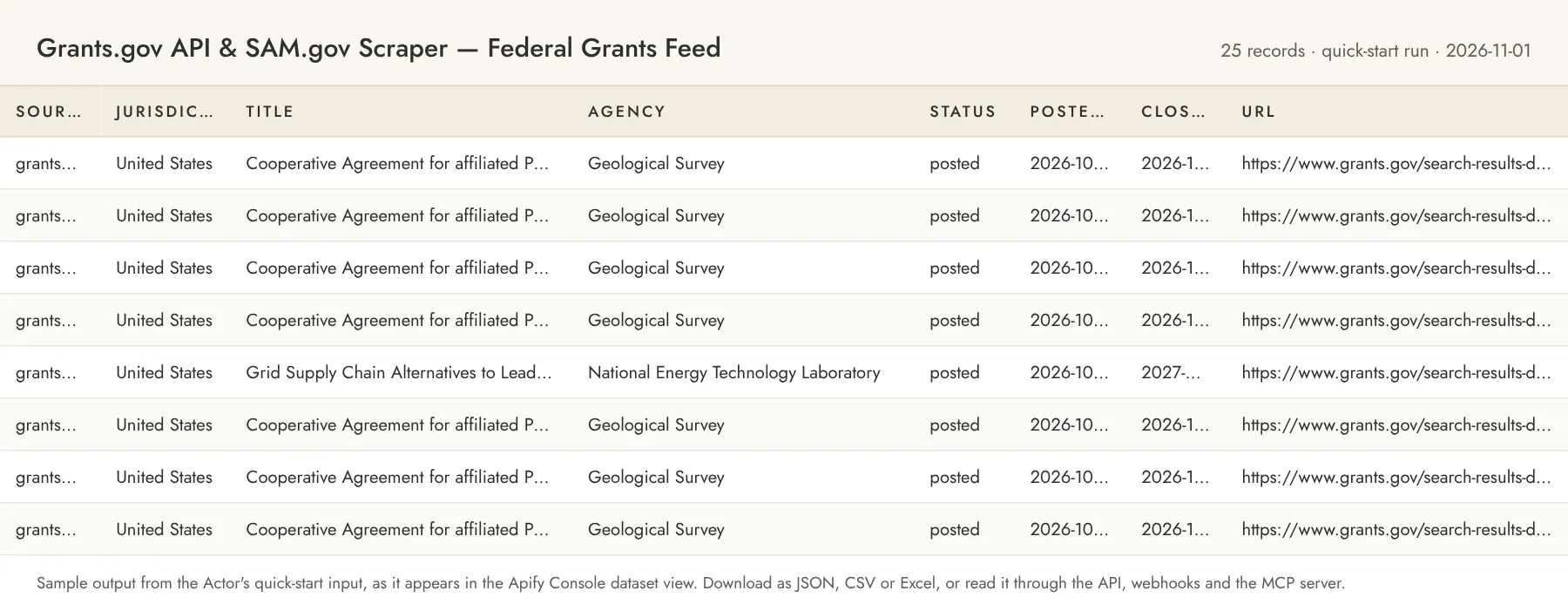
Grants.gov opportunity (with fetchDetails on):
State and local bid (sources: ["sled"], City of Los Angeles):
SAM.gov notices carry noticeId, solicitationNumber, department / subTier / office, type, responseDeadLine, naicsCode, setAside, placeOfPerformance, pointOfContact[] (names, emails and phones exactly as published by the agency), uiLink as url, and descriptionUrl. USAspending awards carry awardId, recipientName, recipientUei, awardAmount, awardType, startDate / endDate and a usaspending.gov url. State and local records carry jurisdiction, level, state, country (US), dataset (the key from sledJurisdictions), datasetId, datasetUrl, noticeType (bid, forecast, intent-to-award, grant, bid-tabulation or award), solicitationNumber, type, category, estimatedValue (a number when the dataset gives one) with the original estimatedValueText, contactName, vendor (Cook County intent to execute, Montgomery County proposed awardees, Los Angeles awards and TxDOT bid tabulations), location, classifications ([{ scheme, code, description }]: Delaware's UNSPSC codes, New York City's NIGP codes), eligibilities (California grants' eligible applicant types) and deadlineText (a deadline published as text, e.g. "Ongoing"); url is the notice link when the dataset has one, otherwise the dataset page. Their source is socrata, or ckan for the California Grants Portal. The datasets without a posting date (nyc-sca, illinois, ca-grants, txdot-lettings, cook-county-buying-plan, san-diego-county, nyc-mwbe-upcoming) return their current listing, so postedWithinDays does not apply to them; for illinois, closeDate is the estimated bid date, for san-diego-county the anticipated posting date, for baton-rouge the bid opening, for erate-470 the allowable contract date (the end of the 28-day bid window), and for txdot-lettings the bid opening. E-Rate records take state and jurisdiction from the applicant (for example "Sacramento, CA") and list the services requested in type and category. TxDOT records are one per project: estimatedValue is the sealed engineer's estimate for a letting and the apparent low bid for a tabulation. Every record shares source, recordType, keyword, opportunityId, title, agency, status, postedDate, closeDate, url, jurisdiction, level and fetchedAt.
NIH RePORTER and NSF records (recordType: "award") carry awardId (NIH project number or NSF award id), recipientName, recipientUei, recipientCity, recipientState (also as placeOfPerformanceState), awardAmount (NIH: the fiscal-year award; NSF: funds obligated to date), startDate, endDate, fiscalYear (NIH), program (NIH activity code or NSF program), assistanceListing, principalInvestigators (names only, never contact details) and the abstract in description; postedDate is the award notice or award date. Federal Register records carry documentNumber, documentType, action, agencies, the abstract in description, datesText (the notice's DATES paragraph, where application deadlines are stated), commentsCloseOn and pdfUrl; closeDate is left empty because the deadline is free text.
Error items look like { "source": "samGov", "keyword": "…", "error": "SAM_AUTH_FAILED", "errorMessage": "…" } and are charged at the opportunity rate, because the work to discover the problem was done.
If the output saves you time, a review on the Store page helps other buyers find this Actor; the Store invites you to leave one after you have run it a few times.
Alerts and delivery
- Schedules. Create a schedule on the Actor page (Console → Schedules) with
onlyNewSinceLastRun: true; a daily schedule withpostedWithinDays: 7catches every new posting and emits only the changes. The first run is the baseline, later runs cost only the search runs plus the records that are new or updated. - The Actor's own
webhookUrl. When set, the Actor sends one POST at the end of the run with a JSON body ofactor,runId,produced(records saved),detailsFetched,keywords(how many were searched),sources,monitor(true in monitor mode),truncated(units stopped by a time budget),charges(count per event),limitReached,finishedAt, thenitems(the emitted records themselves, up to 500) anderrors(the error items). In monitor mode that payload is the alert: only new and updated records are initems. Delivery is attempted once and recorded aswebhookDeliveredon theSUMMARYrecord; it never fails the run. - Apify integrations. The Integrations tab of the Actor page adds Actor webhooks on run events (succeeded, failed, timed out, aborted) with a payload template that can carry
{{resource.defaultDatasetId}}, plus ready-made Slack, Make, Zapier, Google Sheets and email integrations that run on every finished run; in monitor mode an empty dataset means nothing changed, so set the receiving tool to skip empty runs. - API. The latest finished run's items:
GET https://api.apify.com/v2/acts/owlabee~grants-gov-api/runs/last/dataset/items?status=SUCCEEDED&format=json(format=csvfor a spreadsheet,fields=source,title,agency,postedDate,closeDate,setAside,naicsCode,urlfor a short list); its summary:GET https://api.apify.com/v2/acts/owlabee~grants-gov-api/runs/last/key-value-store/records/SUMMARY. A specific run usesGET https://api.apify.com/v2/actor-runs/<runId>/dataset/items. All calls take your API token astokenor a bearer header.
Pricing
Pay per event. You only pay for what the Actor produces; set a maximum cost per run in the run options to cap spend.
| Event | Price | Notes |
|---|---|---|
| Opportunity record | $0.001 | Per dataset item: Grants.gov opportunity, SAM.gov notice, USAspending award, or error item |
| Opportunity detail | $0.002 | Per successful Grants.gov fetchOpportunity call (only with fetchDetails) |
| Search run | $0.004 | Once per source and keyword searched, whatever the number of pages, including searches that return nothing, only already-seen records in monitor mode, or an error |
| Actor start | $0.00005 | Apify platform event |
Example: 1,000 opportunities from one keyword on Grants.gov ≈ $1.00 + 1 search run $0.004 ≈ $1.00. 1,000 opportunities with details ≈ $3.00 + $0.004 ≈ $3.00. In monitor mode the first run is a baseline and is charged for every record it emits; later runs are charged only for new or updated records, plus the search run for each keyword.
Store pricing discounts: users on the Scale plan (Silver) pay 10% less per event, Business (Gold) 20% less.
Limits and fair use
- Requests are rate-limited per host (≤ 2 req/s) with exponential backoff on 429/5xx.
- SAM.gov quotas: a personal, non-federal API key has a small daily request allowance. The Actor asks for up to 1,000 notices per request so one keyword normally costs one request; keep the keyword list short on SAM.gov schedules.
postedWithinDaysapplies to the Grants.gov open date, the SAM.govpostedFrom/postedTowindow (max 1 year) and the USAspending award start date.maxResultscaps records fetched per run; in monitor mode unchanged records are not emitted, so the number of dataset items can be lower.- Grants.gov OR-matches the words of a keyword ("small business" matches "small" or "business"); SAM.gov matches the notice title.
- Time budget. Each keyword on each source (a Grants.gov, SAM.gov or USAspending search plus its detail fetches) gets 10 minutes, and each keyword on each state or local dataset gets 2 minutes with a 15-second request deadline, and a unit that delivers no new records or details for 60 seconds is stopped. Records fetched before the stop are kept and charged as usual and the unit is listed under
truncatedin theSUMMARYrecord (TIME_BUDGET); a unit that produced nothing returns a charged error item (TIME_BUDGETor the source's error code). Requests time out after 20 seconds (30 for SAM.gov, NIH RePORTER, NSF and the Federal Register, 45 for USAspending) including retries, NIH and NSF requests are spaced at least one second apart, andRetry-Afterpauses are capped at 10 seconds. After two keywords in a row fail on the same source, the remaining keywords for that source are not requested and each gets one chargedSOURCE_UNAVAILABLEerror item. InonlyNewSinceLastRunmode, Grants.gov paging stops after two full pages that match the stored snapshot exactly. - Memory: default run memory is 512 MB (256 MB is enough for typical runs, up to 1024 MB allowed).
How to get a free SAM.gov API key
- Create or sign in to an account at sam.gov (any individual can register; no entity registration is needed).
- Open your profile → Account Details.
- Under Public API Key, click Request (or Regenerate), enter your password, and copy the key shown.
- Paste it into the SAM.gov API key field of this Actor. It is stored encrypted as a secret input and never written to logs.
Keys are personal and tied to the daily quota of your account type; federal-agency and entity-associated accounts get larger allowances.
Related Actors
Other pay-per-event Actors from the same account, all limited-permission and agent-friendly:
- Building Permits Scraper — Roofing & Construction Leads — city and county building permits for the same construction and infrastructure leads.
- License Verification API — TDLR, DBPR, DORA, WA DOH, NPI — verify the professional licenses of bidders and awardees from official state records.
- Hiring Signals & ATS Jobs Scraper — Greenhouse, Lever, Ashby — spot contractors staffing up after an award through their public job boards.
Guide and code examples
- Guide: Grants.gov API: Federal Grant Opportunities as JSON, covering the source, its fields and limits, and curl and MCP examples.
- Guide: SAM.gov Contract Opportunities API Feed by Keyword, covering the source, its fields and limits, and curl and MCP examples.
- No-code recipe: New Grants.gov Opportunities to Google Sheets with Zapier, step by step with Apify's official Zapier app and a ready input.
- Runnable examples (curl, Python, Node.js and an MCP config): owlabee/owlabee on GitHub.
Use from AI agents (MCP)
Pin this Actor in the Apify MCP server with one link: https://mcp.apify.com?tools=owlabee/grants-gov-api, or let the agent find it with the search-actors tool. It is pay-per-event with limited permissions, so agents can discover it, inspect the input schema with fetch-actor-details and pay per run through agentic payments. Prompts that map directly onto the input:
- "Find federal grants posted in the last 14 days about rural broadband and tell me the close dates and award ceilings."
- "Every morning, check SAM.gov for new total-small-business set-aside solicitations under NAICS 541512 in Virginia and send the new ones to my webhook."
- "Who won federal grants or contracts mentioning 'workforce development' in the last 30 days, and which agencies currently have related opportunities open?"
- "Which schools and libraries in Arizona posted E-Rate Form 470s for Wi-Fi this month, and when do their bid windows close?"
The agent receives the same dataset records shown in the output example above.
Copy this block to call the Actor through the Apify MCP server with the call-actor tool; the input is the quick-start input above, so it runs at the same low cost, and the tool returns the run's dataset items. Clients that want the schema first call fetch-actor-details with owlabee/grants-gov-api.
FAQ
Does this need proxies or a login? No. Every source is an official public JSON API (the state and local datasets through the Socrata open-data API) that work from Apify's standard datacenter infrastructure. Only SAM.gov requires a (free) API key.
How is cost controlled? Set maxResults, maxDetails and maxAwards, plus the run's maximum total charge. The Actor charges each record the moment it is saved and stops cleanly when any limit is reached.
How does "only new or updated" work? For every source + keyword the Actor stores a compact fingerprint per opportunity in the named key-value store. On the next run, unseen ids are emitted with isNew: true; ids whose title, status, dates, set-aside or award fields changed are emitted with isUpdated: true; unchanged ones are skipped and not charged. Delete the store (or change stateStoreName) to reset.
Can an AI agent use this? Yes; see "Use from AI agents (MCP)" above for the pin link and example prompts. Schedules and webhooks work the same way from the Console or the API.
What happens on errors? A failing source/keyword produces one error item (FETCH_FAILED, NIH_REPORTER_BAD_RESPONSE, NSF_BAD_RESPONSE, NSF_QUERY_FAILED, FEDERAL_REGISTER_BAD_RESPONSE, FEDERAL_REGISTER_QUERY_FAILED, SAM_AUTH_FAILED, SAM_RATE_LIMITED, SAM_HTTP_<status>, TIME_BUDGET, SOURCE_UNAVAILABLE, and for state and local datasets SOCRATA_HTTP_<status>, SOCRATA_RATE_LIMITED, SOCRATA_TOKEN_REJECTED, SOCRATA_QUERY_FAILED, CKAN_HTTP_<status>, CKAN_QUERY_FAILED) instead of failing the run. Each state and local dataset counts as its own source, so one portal being down does not stop the others. A missing SAM.gov key skips that source with a log line.
Why is awardCeiling null for some grants? Grants.gov publishes "none" or leaves it empty when the agency did not set a ceiling; the Actor returns null rather than guessing.
Will my saved state and local input start reading the new datasets? No. An empty "State & local jurisdictions" list means the six datasets of 2026-11-01 and nothing else, so a saved input or schedule makes the same searches at the same cost. Select the new datasets by name, or all, to add them; each dataset and keyword is one search run.
Can I try it for free? Yes. The Apify free plan comes with monthly platform credit, and the quick-start input above costs a few cents per run, so you can test it on your own inputs before paying anything.
How do I find this Actor again? Bookmark it on the Store page (the bookmark icon next to the title); bookmarked Actors are listed in your Console, and the Store page shows new versions as they ship.
Support
Questions, bugs or a source you'd like added? Open an issue on the Actor's Issues tab, or email jacob@owlabee.com.
Changelog
- 2026-11-07 Three more federal sources, opt-in:
nihReporter(NIH research awards),nsfAwards(NSF awards) andfederalRegister(notices of funding opportunity, deadline kept as published text). NIH and NSF are capped per keyword bymaxAwards, like USAspending. No key for any of them; same events and prices. - 2026-11-07 State and local expansion, opt-in: E-Rate FCC Form 470 (every US school and library seeking telecom bids, with a new
sledStatesfilter), Delaware open and recently closed bids (UNSPSC codes), the California Grants Portal, NY State University Construction Fund procurements, TxDOT lettings (one record per project), TxDOT bid tabulations (apparent low bidder), Baton Rouge bid openings, Cook County's buying plan, San Diego County's contracting forecast, Montgomery County proposed awardees, New York City M/WBE upcoming small purchases and Los Angeles RAMP awards. New record fields, additive:country,classifications,eligibilities,deadlineText, andnoticeTypevaluesgrant,bid-tabulationandaward. An emptysledJurisdictionsnow means exactly the six 2026-11-01 datasets, fixed, so saved inputs keep the same searches and cost; the new datasets run only when selected, or with the newallalias. Same events and prices. - 2026-11-07 Renamed from
owlabee/gov-opportunity-feedtoowlabee/grants-gov-apiso the address matches what people search for. Input, output and pricing are unchanged; calls by Actor ID, saved tasks and schedules are unaffected. Calls to the old address no longer work; update API URLs and MCP tool lists. - 2026-10-27 README: comparison table, ready-to-run inputs, alerts and delivery section, this changelog.
- 2026-11-01 State and local bids:
sledsource reading six official Socrata open-data datasets (City of Los Angeles, New York City School Construction Authority, Montgomery County MD, City of Mesa AZ, Cook County IL, State of Illinois),sledJurisdictionsand optionalsocrataAppTokeninputs,jurisdictionandlevelon every record. Uses the existing record and search-run events; federal defaults unchanged. - 2026-10-25 Pricing round: a search-run event charged once per source and keyword (work-based, so empty searches carry their own small charge), pluralized event titles, Store discount tiers for the Scale and Business plans; Console rows confirmed 2026-10-26.
- 2026-10-23 Time budgets per keyword and source with charged
TIME_BUDGETandSOURCE_UNAVAILABLEitems, request deadlines that include retries,Retry-Afterpauses capped, monitor-mode paging stops after two unchanged pages; Store title now names Grants.gov and SAM.gov, SEO fields, quick-start input, the MCP section and a USAspending awards task example added; default run memory lowered from the platform default. - 2026-10-17 Published on the Store; first charged-events check on the platform passed.
- 2026-10-16 First deploy.
Legal
This Actor uses only the official public APIs of Grants.gov, SAM.gov and USAspending.gov; it does not scrape their websites. Use the data in compliance with each source's terms (SAM.gov data is subject to GSA's API terms of service and your own API key agreement) and applicable law. Points of contact are government employees' business contact details as published by the issuing agency. The Actor is not a consumer reporting agency and its output must not be used for employment, credit, insurance, housing or tenant screening decisions (FCRA).


