
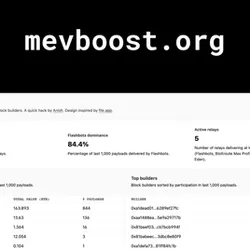
MEV-Boost Relays Scraper
Pricing
from $7.50 / 1,000 results
MEV-Boost Relays Scraper
Fetches the current list of active MEV-Boost relay endpoints and their status from the official monitor feed, returning each relay as a flat row for validator configuration or monitoring.
Pricing
from $7.50 / 1,000 results
Rating
0.0
(0)
Developer

ParseForge
Maintained by Apify PartnerActor stats
0
Bookmarked
2
Total users
1
Monthly active users
a month ago
Last modified
Categories
Share

MEV-Boost Relays Scraper
Scrape every active MEV-Boost relay URL and its latest status, up to one million per run. No signup or API key. Export the list to CSV, JSON, Excel, or XML for validator monitoring or research.
Finding a reliable, up-to-date list of MEV-Boost relays means parsing block explorer pages or piecing together community lists that go stale. This reads the official public relay monitor feed directly and returns the active relays with their URLs and current operational status in one fixed schema. No manual curation, no dead links.
| Who uses it | What they scrape MEV-Boost Relays for |
|---|---|
| Blockchain infrastructure engineers | Checking which third-party relays are live before configuring a validator client |
| MEV researchers | Auditing the diversity and availability of relay endpoints over time |
| Data analysts at staking pools | Building a trusted relay allowlist for validator operations |
What it does
This Actor collects the current list of active MEV-Boost relays and returns each relay's URL and status as a flat row.
- 🔌 Relay URLs: the full HTTPS endpoint for each active relay.
- 📡 Live status check: whether the relay is currently reachable and operational.
- 📊 Structured output: a flat array of relays, one object per row, with a fixed schema.
Results export to CSV, JSON, Excel, or XML, or straight from the API.
What you can do with MEV-Boost Relays data
🔎 Audit relay availability before a merge or hard fork.
An infrastructure engineer fetches the live relay list to confirm which endpoints are reachable and to update the --mev-boost-relays flag in a Lighthouse or Prysm configuration.
📋 Build a relay health dashboard.
A data analyst runs the actor periodically to record the relay URLs and their status, feeding a monitoring dashboard that alerts on relay outages.
🗂️ Populate a validator relay allowlist.
A staking pool operator scrapes the list to seed the allowlist used across thousands of validators, ensuring only active, known relays are permitted.
Why choose this scraper
| What you get | |
|---|---|
| Current relay list | Every run polls the canonical relay monitor to return only the active relays at that moment |
| No stale data | You always get the live snapshot, never a cached or hand-maintained list |
| Validator ready | The output maps directly to the relay URLs your consensus-layer client expects |
How it compares
No other Store actor targets MEV-Boost Relays the same way, so the honest comparison is with the alternatives teams actually weigh.
| MEV-Boost Relays Scraper | Build it in-house | By hand | |
|---|---|---|---|
| Setup | Run it now, zero config | Days of engineering | None, but hours per pull |
| When MEV-Boost Relays changes | Maintained for you | You fix it | You re-learn the page |
| Proxies, retries, anti-bot | Built in | Your problem | Browser only |
| Output | Fixed JSON schema, CSV/Excel export | Whatever you build | Copy-paste |
| Cost | Pay per result | Engineering time | Analyst hours |
Configure the run
Set a limit on the maximum number of relays to collect per run; the actor stops once that count is reached. The Input tab lists every parameter.
A first run with the defaults:
A larger pull:
Pricing
Pay-per-result: $0.0085 per result collected. You pay only for the results written to your dataset.
| Results collected | Approximate cost |
|---|---|
| 100 results | $0.85 |
| 1,000 results | $8.50 |
| 10,000 results | $85.00 |
New Apify accounts start with $5 in free credit.
Free users
Free-plan runs return up to 10 results as a preview. Upgrade your Apify plan to collect up to 1,000,000 results per run.
Run it
- Create a free Apify account with $5 in credit.
- Open the MEV-Boost Relays Scraper.
- Set your inputs and any filters, then click Start.
- Export the results as CSV, Excel, JSON, or XML from the Dataset tab.
Run it programmatically through the Apify API (run-sync-get-dataset-items) or the ApifyClient for JavaScript and Python.
Use with AI agents (MCP)
Give an AI agent live access to MEV-Boost Relays through the Model Context Protocol. Add the Actor to Claude, Cursor, or any MCP client:
Then prompt it in plain language to run the scraper and read back the results.
Troubleshooting
Why am I getting no results?
The monitor feed may be unreachable or may have reported zero active relays at that moment. Check the actor log for HTTP errors and retry after a few minutes.
The list has fewer relays than I expected.
The actor returns only relays the monitor currently considers active. Some relays may be undergoing maintenance or have been delisted; check the monitor UI for historical data.
Can I get historical relay status?
Each run captures a single snapshot. To build a history, schedule the actor and store the output in a key-value store or a time-series database.
The run takes too long.
The actor makes one HTTP request and completes quickly. Delays are usually due to network latency to the monitor endpoint or a slow Apify platform startup.
FAQ
| Question | Answer |
|---|---|
| Where does the relay data come from? | It reads from the public MEV-Boost relay monitor endpoint that tracks the status of relays in the Ethereum ecosystem. |
| Does this actor need an API key or Ethereum node? | No. It fetches the public relay monitor feed directly and does not require any node connection, wallet, or API registration. |
| How often should I run this? | Relay lists change infrequently, but running it daily or before validator key restarts ensures your client uses only active endpoints. |
| What output format does the actor produce? | It returns a dataset you can download as CSV, JSON, Excel, XML, or push directly to an Apify table. |
| Can I get more than the default number of relays? | Yes, set the maxItems input to any number up to one million; the actor stops early if fewer relays are active. |
| Does this scrape relay payload bids or block data? | No, it only collects relay endpoint URLs and their current operational status from the monitor feed. |
| Is the relay list filtered by network? | The public monitor feed is Ethereum mainnet by default; the actor returns whatever relays that feed currently reports as active. |
| Can I export the list for Lighthouse or Teku? | Yes, export the relay URLs as a CSV or text file and reference it in your validator client configuration. |
Related actors
Browse the full ParseForge collection for more scrapers.
🆘 Need help? Email parseforge@protonmail.com with your run ID, your input, and what you expected.
⚠️ Disclaimer. This Actor is unofficial and is not affiliated with, endorsed by, or sponsored by the respective relay operators. It collects only publicly available data. You are responsible for using the collected data in compliance with the source's terms of service and applicable data-protection laws, including GDPR, CCPA, and PIPL. Do not use it to collect personal data unlawfully.


