

Sitemap URL Extractor & Auditor (index-aware, status checks)
Pricing
from $5.00 / 1,000 100 urls extracteds
Sitemap URL Extractor & Auditor (index-aware, status checks)
Extract every URL from XML sitemaps — sitemap-index and gzip aware — with lastmod/changefreq/priority, plus optional robots-respecting HTTP status checks for broken pages. No API key, no code — export CSV/JSON/Excel or pipe to Sheets, Zapier, Make, n8n.
Pricing
from $5.00 / 1,000 100 urls extracteds
Rating
0.0
(0)
Developer

Plotbench Studio
Maintained by CommunityActor stats
0
Bookmarked
3
Total users
2
Monthly active users
2 months ago
Last modified
Categories
Share
Sitemap URL Extractor & Auditor (index-aware, gzip, status checks)
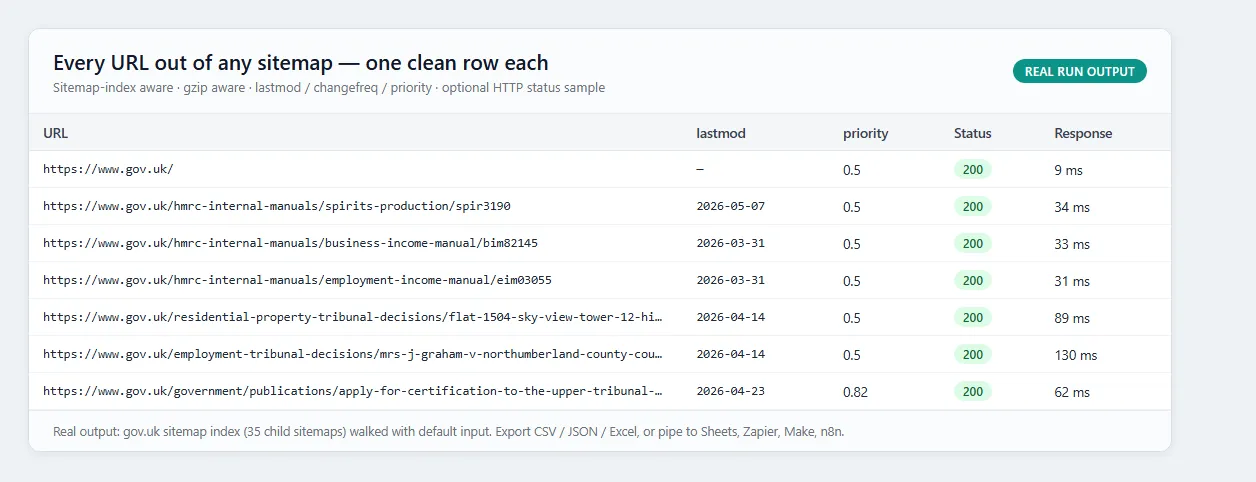
Turn any XML sitemap into a clean URL dataset — sitemap-index aware, gzip aware — with lastmod / changefreq / priority per URL, plus an optional robots-respecting HTTP status sample that finds broken pages and redirect chains hiding in the sitemap.
Built for the SEO / migration / QA workflows that start with "get me every URL":
- SEO agencies & consultants — full URL inventory + freshness (
lastmod) + status codes per client site, on a schedule. - Site migrations — extract the complete old-site URL set for redirect mapping; re-run after launch to catch 404s the sitemap still advertises.
- Content audits — the
lastmoddistribution shows exactly how stale a content estate is. - Competitor content mapping — a competitor's sitemap is their published content inventory.
What it does
- Fetches each sitemap URL you give it — follows sitemap indexes recursively (depth-capped), decompresses .xml.gz, and extracts every
<url>with its metadata, up to yourmaxUrlscap. - Optionally status-checks a sample (HEAD with GET fallback, redirect detection, response-time) — honouring
robots.txtDisallowrules for the checks. - Writes a per-run summary (
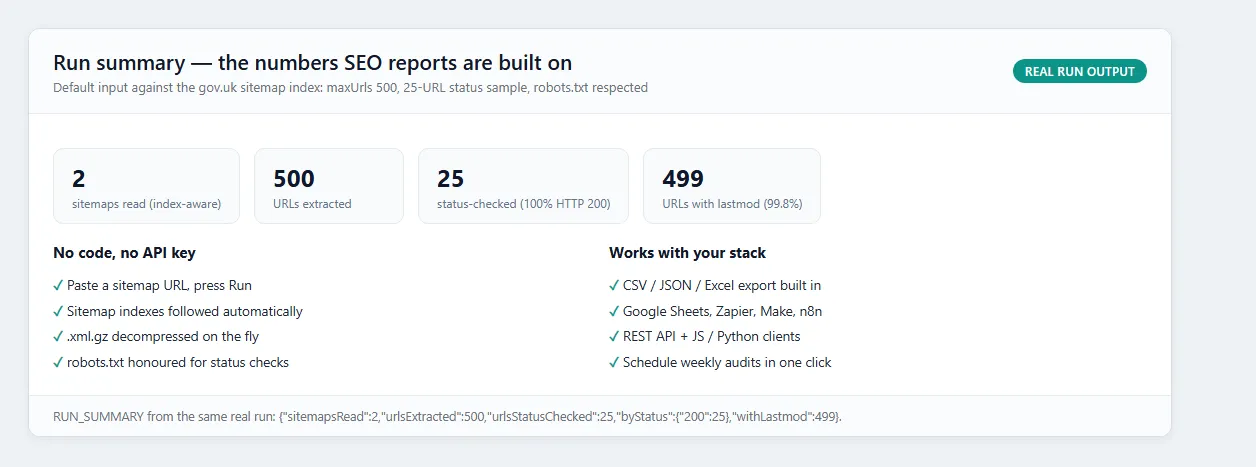
RUN_SUMMARY): sitemaps read, URLs extracted, status breakdown, lastmod coverage.
Proven against real-world scale: the gov.uk sitemap index (35 child sitemaps, 25,000 URLs per child) walks cleanly.
Input
Output (one row per URL)
Pricing (pay per event)
| Event | Price |
|---|---|
| Actor start | $0.02 per run |
| Per 100 URLs extracted | $0.005 |
| Per URL status-checked | $0.0005 |
A 10,000-URL extract with a 500-URL status sample costs about $0.77.
No code, no API key — and it fits your stack
No API key and nothing to install: paste a sitemap URL and press Run. From there:
- Export built in — download results as CSV, JSON, Excel or XML from the dataset view, or read the dataset over the REST API.
- Integrations — pipe URLs to Google Sheets, Slack, Zapier, Make or n8n with Apify's built-in integrations, or fire a webhook when a run finishes.
- API & SDK — call it from the REST API or the JavaScript / Python clients; results are plain JSON.
- Schedules — a weekly sitemap audit per client site is one click (Console → Schedules).
Fair use & crawling ethics
Sitemaps exist specifically for automated consumption — that is their entire purpose under the sitemaps.org protocol. Status checks are lightweight (HEAD-first, ranged GET fallback, low default concurrency) and respect robots.txt Disallow rules by default; disallowed paths are reported as skipped rather than checked. The actor identifies itself with a stable User-Agent.
Limitations (told straight)
- Extraction is capped by
maxUrlsand a 500-sitemap safety cap (sitemap indexes are followed 3 levels deep); enormous estates should be pulled in slices (one child sitemap per run works well). - RSS/Atom feeds-as-sitemaps and non-standard sitemap extensions (image/video/news tags) are passed through by URL only — the extension metadata isn't parsed in v1.
- Status sampling checks the first N URLs in extraction order (deterministic), not a random sample.


