
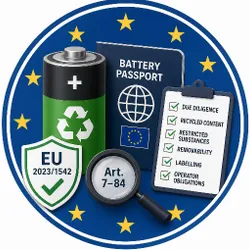
EU Battery Regulation 2023/1542 Compliance & Passport
Pricing
from $5.00 / 1,000 results
EU Battery Regulation 2023/1542 Compliance & Passport
Screen batteries against EU Battery Regulation 2023/1542. Returns category (portable, LMT, EV, industrial, SLI), Battery Passport requirement (mandatory 18 Feb 2027), Article 47-53 supply-chain due diligence, Article 8 recycled-content thresholds, and operator-role-specific obligations.
Pricing
from $5.00 / 1,000 results
Rating
0.0
(0)
Developer

Rafał Chudzik
Maintained by CommunityActor stats
0
Bookmarked
3
Total users
1
Monthly active users
6 months ago
Last modified
Categories
Share
EU Battery Regulation Compliance & Passport Helper
Per-battery rule-based pre-screening against the EU Battery Regulation, Regulation (EU) 2023/1542 (as amended). Send a model name or product description with optional category, capacity, and operator turnover flag; get back a structured pre-screening of likely Battery Passport requirement, supply-chain due-diligence applicability, recycled-content documentation/thresholds, restricted-substance limits, removability and labelling timelines, and operator-role-specific obligations with article-level legal references and manual-review flags.
Use this Actor when: you make, import, distribute, or place on the EU market any battery (EV traction packs, e-bike packs, smartphone or laptop cells, AA / AAA / button cells, industrial UPS, stationary storage, 12 V SLI starter batteries) and you need a quick rule-based screening of which Battery Regulation obligations are likely to apply per SKU before deeper compliance work.
This Actor is not affiliated with or endorsed by the European Commission or any market surveillance authority. Output is preliminary screening, not legal, product-safety, customs, environmental, conformity-assessment, due-diligence or notified-body advice. See the disclaimer at the bottom.
Quick start
That run costs $0.001 + 5 × $0.005 = $0.026. Five categories, five different obligation profiles. The EV pack and the Megapack get Battery Passport flagging (18 Feb 2027) and Article 8 recycled-content thresholds (16/85/6/6 % from 2031, 26/85/12/15 % from 2036), with carbon-footprint phase-in subject to the relevant Commission acts. The e-bike (LMT) gets passport + user-removability + recycled-content documentation now and minimum thresholds from the 2036 phase. The iPhone battery gets mercury / cadmium / lead substance limits + user-removable design. The SLI starter gets Article 8 recycled content but no passport.
What it returns
For each battery row:
- scope and category: yes / no, plus one of
portable,lmt,ev,industrial,sli(inferred from the query, or accepted if explicit) - screening_result: high-level classification (
in_scope_passport_required,in_scope_passport_likely_manual_review,in_scope_no_passport,requires_manual_review) - requires_manual_review flag for ambiguous capacity, unknown turnover, or other cases warranting human verification
- requires_latest_implementing_act_check flag: many Article 7 (carbon footprint) and Article 13 (labelling) triggers depend on Commission delegated/implementing acts and the LATER of calendar date / "X months after entry into force" applies. Verify the active trigger before relying on dates.
- Battery Passport requirement: yes for EV / LMT / industrial > 2 kWh; no for portable / SLI / industrial ≤ 2 kWh. Deadline: 18 February 2027 (Art. 77, Annex XIII)
- supply-chain due diligence: applies to manufacturer / importer / producer roles ABOVE the EUR 40 million turnover threshold for cobalt, natural graphite, lithium, nickel and their compounds (Art. 47-53). In force from 18 August 2027 (date deferred from 18 August 2025 by Reg. (EU) 2025/1561). Below the threshold, Chapter VII does not apply (subject to the group consolidation rule in Art. 47(2)).
- carbon footprint phase-in: declaration → performance class → maximum threshold, nominal dates per category (Art. 7, Annex II), each subject to the "calendar date OR X months after delegated/implementing act, whichever is later" rule
- recycled content (Art. 8): documentation/declaration applies to EV, industrial > 2 kWh, SLI AND LMT batteries. Minimum thresholds: cobalt 16 % → 26 %, lead 85 % → 85 %, lithium 6 % → 12 %, nickel 6 % → 15 % at 2031 / 2036 (LMT minimum thresholds enter into force from the 2036 phase only)
- restricted substance limits: mercury 5 ppm (all categories), cadmium 20 ppm (portable only), lead 100 ppm (portable only): Art. 6(1), in force from 18 August 2024
- removability and replaceability: required for portable and LMT; user-removable for portable, professional-removable for LMT (Art. 11, in force 18 February 2027)
- labelling timeline split into three triggers: separate-collection symbol from 18 August 2025; general Annex VI Part B information from 18 August 2026 (subject to implementing acts); QR code from 18 February 2027
- operator-role obligations: different obligations for manufacturer, importer, distributor, producer
Why this Actor exists
Reg. (EU) 2023/1542 is one of the broadest EU product-compliance regimes ever adopted. Five battery categories trigger different obligations. The phase-in spans more than a decade. The passport requirement intersects with the Digital Product Passport regime. Recycled-content thresholds step up at two milestones (2031 and 2036). Manual scope analysis per SKU is slow and error-prone. This Actor turns the regulation into a rule-based pre-screen so a compliance team can prioritise where the deep work is needed.
It is a screening helper, not a compliance solution. Final classification, obligations and conformity assessment are the operator's responsibility.
Input
| Field | Type | Required | Default | Description |
|---|---|---|---|---|
batteries | array of objects | yes | n/a | Up to 5,000 SKUs per run. |
batteries[].query | string | yes | n/a | Model name, chemistry, or product description. The classifier infers the category from common keywords (Tesla / NMC / LFP / e-bike / AA / UPS / SLI / 12V). For ambiguous inputs, supply category explicitly. |
batteries[].category | enum | no | inferred | One of portable, lmt, ev, industrial, sli. Overrides the classifier. |
batteries[].capacity_kwh | number | no | n/a | Energy capacity in kWh. Drives the > 2 kWh threshold for industrial passport / recycled content. Optional for other categories. |
batteries[].placed_on_market_date | string (ISO date) | no | n/a | Reserved for future deadline-aware checks. |
operatorRole | enum | no | manufacturer | One of manufacturer, importer, distributor, producer. Determines role-specific obligations. |
operatorTurnoverAbove40M | enum | no | unknown | yes / no / unknown. Drives whether Chapter VII due diligence applies. unknown flags the result for manual review. |
Output
One dataset row per battery. EV battery, manufacturer, above turnover threshold:
For a portable battery, the Actor flags restricted-substance limits and Article 11 removability/replaceability, but other product-safety, EPR, labelling and waste-management obligations may still apply depending on the operator role and Member State implementation.
For an SLI starter battery, the Actor flags Article 8 recycled content and labelling but no passport and no Article 7 carbon footprint phase-in (SLI is excluded from Art. 7).
Code examples
Apify Client (Python)
curl (synchronous run)
Use cases
- Pre-launch screening: run a new battery line through the Actor before it ships to flag likely passport, labelling and substance obligations for deeper review
- Catalogue audit: screen the existing battery portfolio to flag which SKUs likely need passport content drafted, recycled-content tracking, removable-design redesign
- Sourcing comparison: Tesla NMC vs BYD LFP vs hybrid traction trigger different supply-chain due-diligence flagging (cobalt vs no cobalt). The Actor surfaces the differences for pre-procurement triage
- Operator-role onboarding: when your role changes (manufacturer adding own-brand line as producer; importer becoming distributor for a sister entity), re-run with the new
operatorRoleto see the diff - AI agent integration: through the ../eu-compliance-mcp, ask Claude "is my e-bike battery likely to need a Battery Passport, and by when?" and get the structured pre-screen with article references
FAQ
What's the difference between portable, LMT, and EV? Per Art. 3 of Reg. 2023/1542:
- Portable: sealed, ≤ 5 kg, hand-portable, NOT designed exclusively for industrial use, NOT EV / LMT / SLI. AA, smartphone, laptop, hearing aid, button cell.
- LMT (Light Means of Transport): wheels + powered by electric motor, ≤ 750 W. E-bike, e-scooter, kick scooter, moped.
- EV (electric vehicle): traction battery for L category vehicles (motorcycles), M category (cars, buses), N category (trucks). PHEV / BEV / HEV traction packs.
- Industrial: anything else used in commercial / industrial / public service. Stationary storage, UPS, telecom backup, forklift.
- SLI (Starting, Lighting, Ignition): typically 12 V lead-acid in cars. Strict-purpose definition.
When a battery falls under more than one category, the regulation requires the most stringent obligations to apply. The Actor flags ambiguous classifications via requires_manual_review.
My battery is "kind of LMT but also kind of portable", which wins?
Provide explicit category. Explicit beats inferred. If genuinely ambiguous, expect to apply the more stringent regime per the regulation.
When exactly does the Battery Passport go live? 18 February 2027 for EV / LMT / industrial > 2 kWh batteries placed on the EU market on or after that date (Art. 77). Existing batteries on the market before that date are not retroactively required to carry a passport.
Why does industrial > 2 kWh need a passport but ≤ 2 kWh doesn't? The 2 kWh threshold separates utility-scale stationary storage / forklift / commercial UPS from small UPS / power-tool batteries. The Commission applied the passport requirement only above the threshold to keep small-industrial design simple.
Why does SLI get Art. 8 recycled content but no Art. 7 carbon footprint? Art. 7 carbon-footprint phase-in is targeted at the highest-impact categories (EV, industrial, LMT). SLI is excluded because the carbon-footprint methodology development for lead-acid is at an earlier stage. Art. 8 recycled content applies to SLI because the lead-acid recycling chain is mature.
Does Art. 8 recycled content apply to LMT batteries? Yes. Article 8 of Reg. 2023/1542 covers EV, industrial, SLI AND LMT batteries. Documentation/declaration obligations apply across all four categories alongside the relevant Commission methodologies. Minimum-percentage thresholds for LMT batteries enter into force from the 2036 phase only; the 2031 phase covers EV, industrial > 2 kWh, and SLI.
Hasn't due diligence been postponed? Yes. Regulation (EU) 2025/1561 amended Article 48 of Reg. 2023/1542 and deferred the Chapter VII due-diligence start date from 18 August 2025 to 18 August 2027. The Actor reflects the 2027 date.
Does the Article 47 obligation apply to all economic operators, regardless of turnover? No. Battery due-diligence obligations under Chapter VII apply only to economic operators with average annual net turnover above EUR 40 million in the previous financial year, subject to the group consolidation rule in Art. 47(2). Operators below the threshold are excluded from Chapter VII unless caught by the group rule. For in-scope operators, independent third-party verification is part of the due-diligence regime, not a separate above-the-threshold rule.
My role is "producer", what does that mean here? Producer is a battery brand owner who places the battery on the market under their own name (Art. 3(43)). Producers carry extended producer responsibility (EPR) under Art. 56-57: register with a Producer Responsibility Organisation in each Member State, finance collection / treatment / recycling of waste batteries, file annual reports. Specific Member State EPR rules vary; verify per Member State.
Are the carbon-footprint dates exact?
The Article 7 dates (declaration, performance class, maximum threshold) are nominal calendar triggers. The actual go-live is the LATER of (a) the calendar date and (b) a fixed period (typically 12-18 months) after entry into force of the relevant delegated/implementing act. Each output entry exposes applicable_from_nominal and applicable_from_rule, with requires_latest_implementing_act_check: true. Always verify the active trigger against the latest Commission acts before treating these dates as binding.
Will the Actor cover Commission delegated acts as they are issued?
Reg. 2023/1542 empowers the Commission to adopt delegated and implementing acts adjusting recycled-content thresholds, conformity-assessment modules, label triggers, etc. The Actor data is best-current at the build date; we update after material acts. For binding decisions, always check the official Commission battery portal listed in verify_at.
Pricing
Pay-per-event. No subscription, no setup fee.
| Event | Price |
|---|---|
| Actor Start (once per run) | $0.001 |
| Battery Screened (per item) | $0.005 |
Screening 1,000 SKUs costs $5.001.
Limitations
- The Actor pre-screens scope and likely obligations. It does not generate the passport's Annex XIII content (technical documentation, supply-chain due-diligence reports, carbon-footprint study): those are separate processes.
- Recycled-content thresholds depend on Commission methodologies still being finalised (calculation rules for "share of recycled content"). Treat dates and percentages as best-current.
- Category inference from free text is conservative; for ambiguous queries set
categoryexplicitly. - The Actor reads
operator_roleandoperatorTurnoverAbove40Mfrom input; it does not validate that the role you declared matches your actual position in the value chain or that your declared turnover is correct. - The Actor does not track Member State implementation of EPR rules, language requirements, or national waste-management specifics.
Sources
- Regulation (EU) 2023/1542 on batteries and waste batteries: consolidated text on EUR-Lex
- Regulation (EU) 2025/1561 amending Article 48 of Reg. 2023/1542 (defers due diligence to 2027)
- Article 6 (Restricted substances) and Annex I: substance limits
- Article 7 and Annex II: carbon footprint declaration
- Article 8: recycled-content thresholds
- Articles 47-53: supply-chain due diligence on cobalt, natural graphite, lithium, nickel
- Article 77 and Annex XIII: Battery Passport
- European Commission, Batteries portal
Related compliance Actors
- ../eu-compliance-mcp: call this Actor (and 3 others) from Claude Desktop, Cursor, or any MCP-compatible AI client
- ../reach-svhc-checker: separate regulation for chemical substances of very high concern
- ../eudr-screener: EU Deforestation Regulation for cattle, cocoa, coffee, oil palm, rubber, soya, wood
- ../cbam-report-helper: Carbon Border Adjustment Mechanism for cement, steel, aluminium, fertilisers, electricity, hydrogen
Disclaimer
This Actor is an unofficial pre-screening tool based on Regulation (EU) 2023/1542 and related EU acts (including Reg. (EU) 2025/1561). It is not affiliated with or endorsed by the European Commission, ECHA, any market surveillance authority, or any notified body. Output is preliminary screening only and is not legal, product-safety, customs, environmental, conformity-assessment, due-diligence or notified-body advice. The Actor's classification, dates and obligation flags may be incomplete, outdated, or wrong, particularly where the regulation is conditional on Commission delegated/implementing acts that may have entered into force after the Actor's last update.
Battery category, capacity, chemistry, operator role, turnover, group status, placed-on-market date, the current state of Commission delegated/implementing acts, and Member State EPR rules must be verified independently before placing batteries (or products containing batteries) on the EU market. Final compliance responsibility under the Battery Regulation rests on the operator. The author and ravch.dev disclaim all liability for any direct, indirect, or consequential loss arising from use of, or reliance on, this Actor's output. Use at your own risk; consult qualified counsel and the official Commission battery portal at https://environment.ec.europa.eu/topics/waste-and-recycling/batteries-and-accumulators_en.


