

UK Planning Applications Monitor: New, Pending & Decided
Pricing
from $3.00 / 1,000 results
UK Planning Applications Monitor: New, Pending & Decided
Track new, pending, and decided UK planning applications (extensions, new builds, change of use, solar) from planning.data.gov.uk. Covers Camden, Worthing, Adur, and Doncaster today, expanding as the register onboards councils. Deduplicated, with change detection and lead alerts.
Pricing
from $3.00 / 1,000 results
Rating
0.0
(0)
Developer

Zach Wallace
Maintained by CommunityActor stats
0
Bookmarked
2
Total users
1
Monthly active users
3 days ago
Last modified
Categories
Share
UK Planning Applications Monitor
Track new, pending, and decided UK planning applications in one clean, deduplicated feed, with automatic change detection between runs. This Actor aggregates planning applications (extensions, new builds, change of use, solar/PV, tree works, and more) from official council and government open data, normalizes them to a single schema, removes duplicates, and reports exactly what changed since the last run.
A new planning application near a location is a high-intent lead signal. Someone is about to build, extend, convert, or install. That is the moment construction suppliers, solar and EV installers, architects, PropTech firms, and estate agents want to reach a property owner. This Actor turns a scattered government register into a monitored feed of those signals.
Current coverage: Manchester, Lambeth, Tower Hamlets, the City of London, Camden, Bradford, Salford, Nottingham, Wigan and Leicester in England, and Aberdeenshire in Scotland, read live from each council's own open data (Bradford alone holds 215,000 applications back to 1974, Manchester 145,000). The government's central register (planning.data.gov.uk), which also carried Worthing, Adur and Doncaster, was emptied in August 2026; those three return automatically if it is refilled. See Coverage.
Watch the 30-second overview:
Why use the UK Planning Applications Monitor?
- Lead generation: surface fresh applications the day they appear, filtered to the category you sell into (solar installers want
solar_pv, builders wantextensionandnew_build, sign firms wantadvertisement). - Change detection built in: the first run builds a baseline, every later run reports only what is new, updated, decided, or withdrawn. No diffing on your side.
- Deduplicated and normalized: one schema across councils, one record per application, stable ids so you can join against your CRM.
- Self-healing source health: every run reports per-council health and flags a
suspicious_zero(a council that returned data last run and nothing this run) so a silent upstream break is caught immediately. - Runs on the Apify platform: schedule it, hit it via API, wire the results into your integrations, and let the platform handle retries and storage.
How to use it
- Click Try for free.
- (Optional) Pick which councils to include and which categories you care about. Leave both empty to get everything.
- (Optional) Turn on Monitor mode (output only changes) and schedule the Actor (for example, daily). The first run captures a baseline, later runs return only changes.
- Click Start. Results appear in the Dataset tab, downloadable as JSON, CSV, Excel, or HTML.
Coverage
| Council | Code | Source | Status |
|---|---|---|---|
| London Borough of Camden | CMD | Camden open data (nightly, Open Government Licence) | Live, ~83,000 applications since 2010 |
| City of Bradford Metropolitan District Council | BRD | Bradford open data (ArcGIS, daily) | Live, ~215,000 applications since 1974 |
| Manchester City Council | MAN | Manchester open data (ArcGIS) | Live, ~145,000 applications |
| Salford City Council | SLF | Salford open data (ArcGIS) | Live, ~42,000 applications |
| London Borough of Lambeth | LBH | Lambeth open data (ArcGIS) | Live, ~115,000 applications, with coordinates and a link to each (no street address published) |
| London Borough of Tower Hamlets | TWH | Tower Hamlets open data (ArcGIS, daily) | Live, ~580 current and ~62,600 decided applications, with addresses and a link to each (no received date published) |
| City of London Corporation | LND | City of London open data (ArcGIS) | Live, ~65,000 applications since 2004, with addresses, site outlines and a link to each |
| Aberdeenshire Council (Scotland) | ABE | Aberdeenshire open data (ArcGIS) | Live, ~83,000 applications with addresses |
| Nottingham City Council | NGM | Nottingham open data (ArcGIS, national LGA schema, daily extract) | Live, the last 10 years (~18,600), with a link to each application |
| Wigan Metropolitan Borough Council | WGN | Wigan open data (ArcGIS, one layer per year) | Live, this year and last; no filed date published |
| Leicester City Council | LCE | Leicester open data (daily, Open Government Licence) | Live, applications currently being considered (~330); no dates published |
| Worthing Borough Council | WOT | planning.data.gov.uk | Paused: register emptied August 2026 |
| Adur District Council | ADU | planning.data.gov.uk | Paused: register emptied August 2026 |
| Doncaster Metropolitan Borough Council | DNC | planning.data.gov.uk | Paused: register emptied August 2026 |
Records carry what each council publishes. Bradford and Wigan: address and postcode, coordinates (the plot's centre), the decision, and a link to the council's planning portal; Bradford adds ward and filed date. Leicester: address, coordinates and application type. Camden records carry the full address and postcode, coordinates, ward, Camden's own application type (Householder Application, Listed Building Consent, Advertisement Consent and so on), status, decision, and a link to the application on Camden's planning portal. A default run (no councils named) leaves the paused councils out; name them to check them anyway. If the central register is refilled they come back with no change on your side, and until then RUN_HEALTH marks them source_withdrawn and the run's status message says so. Every field a source does not provide is returned as null.
Input
All inputs are optional. Configure them in the Input tab or via the API.
| Field | Type | Description |
|---|---|---|
councils | array | Council short codes to include (e.g. ["CMD", "WOT"]). Empty = all covered councils. |
includePending | boolean | Include applications with no decision yet (the highest-intent lead signal). Default true. |
includeDecided | boolean | Include decided and withdrawn applications. Default true. |
categories | array | Filter to derived categories (e.g. ["solar_pv", "extension"]). Empty = all. |
onlyOutputChanges | boolean | Monitor mode: push only new/changed/removed applications. Default false. |
maxRecordsPerSource | integer | Cap of newest records pulled per council. 0 = unlimited. Default 5000. |
suppressInitialChanges | boolean | On the first run, do not emit a change for every application. Default true. |
freshLeadAlertDays | array | Age-since-filed windows for the FRESH_LEADS report. Default [7, 14, 30]. |
webhookUrl | string | HTTPS endpoint that receives change events as a POST after each run. |
testMode | boolean | Cap every council at 3 records and skip the baseline update. A free smoke test. |
Output
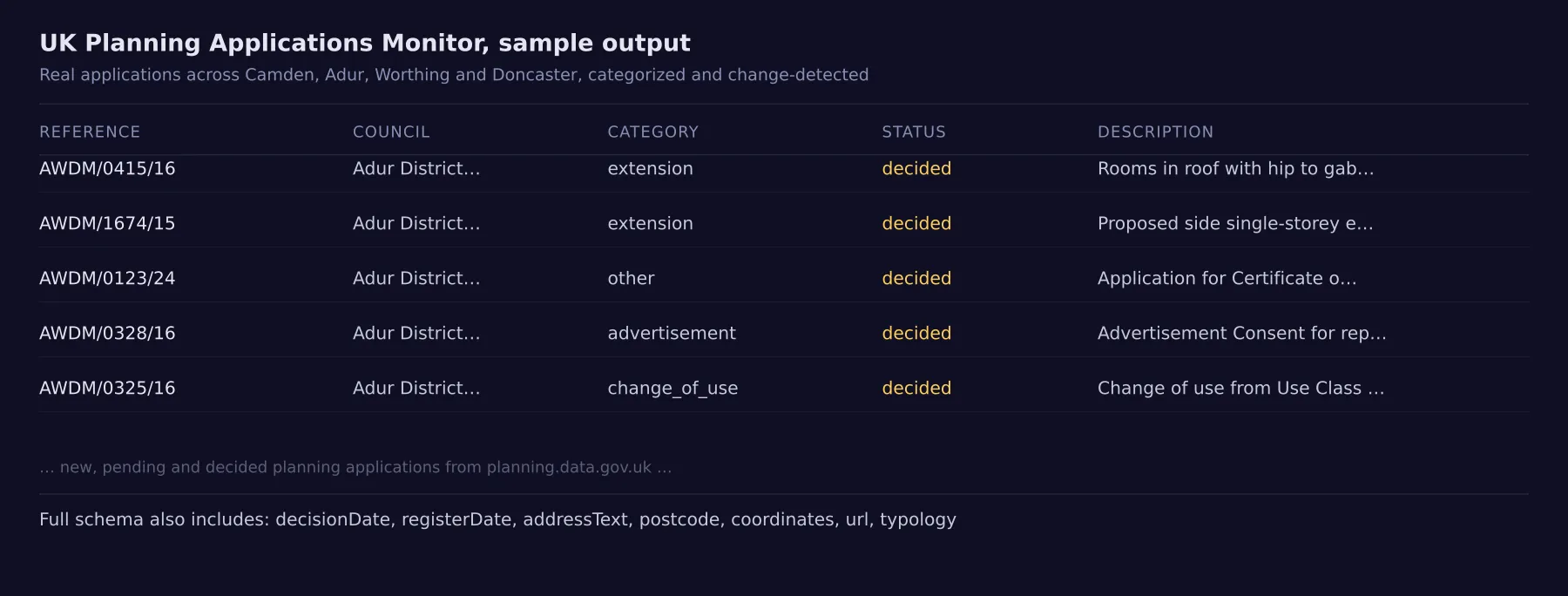
Each record is one planning application:
You can download the dataset in various formats such as JSON, HTML, CSV, or Excel.
Data fields
| Field | Description |
|---|---|
reference | The council's own application reference. |
council / councilId | Council name and its register organisation id. |
description | The proposal text as filed. |
appCategory | Derived category: extension, new_build, change_of_use, solar_pv, trees, listed_building, advertisement, demolition, or other. |
applicationType | The council's own application type where it publishes one (Camden: Householder Application, Listed Building Consent, ...), otherwise null. |
ward | Electoral ward, where published (Camden). |
status | pending, decided, or withdrawn. |
receivedDate / decisionDate / registerDate | When filed, when decided, and when the register first listed it. |
address | Free-text address plus extracted UK postcode, where the council supplies it. |
coordinates | { lat, lng } where the council supplies a location. |
url | Direct link to the council portal page, or the register entry as a fallback. |
Extra outputs (key-value store)
CHANGES: the full change set for the run plus a summary count.RUN_HEALTH: per-council status, including thesuspicious_zerosilent-break flag.FRESH_LEADS: applications bucketed by how recently they were filed.COVERAGE: a check of whether the central register has started carrying a council not yet built in. If it has, the new council ids are listed here (and sent to your webhook), so you know the moment more coverage becomes available.
How change detection works
The Actor stores a compact fingerprint of every application in a named, cross-run store. On each run it compares the current data to that baseline and emits typed events: new_application, decision_made (pending to decided), status_changed, updated, and removed. Run it on a schedule with Monitor mode on and each run returns only what moved. Point webhookUrl at your endpoint to be notified the moment there are changes.
Integrations, plug it into your stack
- Make, Zapier, and n8n, Apify ships official connectors, so a finished run can trigger a scenario and drop the data into Google Sheets, Airtable, a CRM, or Slack with no code.
- Webhooks, set the
webhookUrlinput to POST new-application and decision events in real time, to Slack, your own API, or a no-code webhook trigger. A new planning application near a location is a high-intent lead signal. - API and scheduling, run on a schedule from the Apify Console, or call the Apify API and pull the dataset as JSON, CSV, or Excel.
Pricing
This Actor is pay-per-result: you pay for the applications it returns. Planning data is high volume, so the price per result is set low. In Monitor mode you pay only for the handful of applications that actually changed on each scheduled run, which keeps ongoing monitoring inexpensive. Use testMode for a free smoke test before a full run.
Tips
- For lead generation, keep
includePendingon and setcategoriesto your niche so you only pay for relevant applications. - For a monitoring workflow, turn on
onlyOutputChangesand schedule daily. The first run is your baseline; later runs are small and cheap. - Raise
maxRecordsPerSourceto0when you want the full historical backfill for a council; leave it capped for fast, current-focused runs.
FAQ
Where can I get UK planning application data? This Actor. It aggregates planning applications from UK councils into one structured feed and detects new and changed applications between runs.
Which councils are covered? Manchester, Lambeth, Tower Hamlets, the City of London, Camden, Bradford, Salford, Nottingham, Wigan, Leicester and Aberdeenshire, live from each council's own open data. Worthing, Adur and Doncaster came from the planning.data.gov.uk central register, which was emptied in August 2026; they return automatically if it is refilled.
How do I find new planning applications (solar, extensions, change of use)?
Turn on monitor mode and add a webhookUrl. Each new application is emitted as an event, with a category classifier (solar_pv, extension, change_of_use, and more).
What data does each record include? Application reference, description, category, status (pending, decided, or withdrawn), council, dates, and location where the source publishes it.
Is this official and legal data? It uses public UK planning data published under the Open Government Licence. It accesses no private data.
Disclaimers and support
Where does the data come from? Each council's own open data (Camden on opendata.camden.gov.uk and Leicester on data.leicester.gov.uk, both under the Open Government Licence; Bradford, Manchester, Salford, Nottingham, Lambeth, Tower Hamlets, the City of London, Aberdeenshire and Wigan from their public ArcGIS servers), and the UK government's planning-application register at planning.data.gov.uk. This Actor does not scrape behind logins or bypass access controls, and it never reads the applicant or case officer names those datasets carry.
Is scraping this legal? The register is published as open government data. As with any data product, you are responsible for using the output in line with the source's terms and applicable law, including how you contact any individuals.
Why are some fields empty? Each source carries different fields. Missing fields are returned as null rather than omitted, so your schema stays stable.
A council I need is not covered. More councils are added where they publish an open planning feed. Use the Issues tab to request a council, and to report anything that looks wrong.


