

AI & Tech Jobs Finder | Greenhouse, Lever & Ashby
Pricing
$1.50 / 1,000 matching job saveds
AI & Tech Jobs Finder | Greenhouse, Lever & Ashby
Find AI and tech jobs across curated Greenhouse, Lever and Ashby employers. Filter roles and employment types; export CSV, RSS, JSON Feed and newsletter Markdown. Skip previously saved job keys.
Pricing
$1.50 / 1,000 matching job saveds
Rating
0.0
(0)
Developer

Trần Quốc Việt
Maintained by CommunityActor stats
0
Bookmarked
2
Total users
1
Monthly active users
9 days ago
Last modified
Categories
Share
AI & Data Jobs Finder | HiringSignal
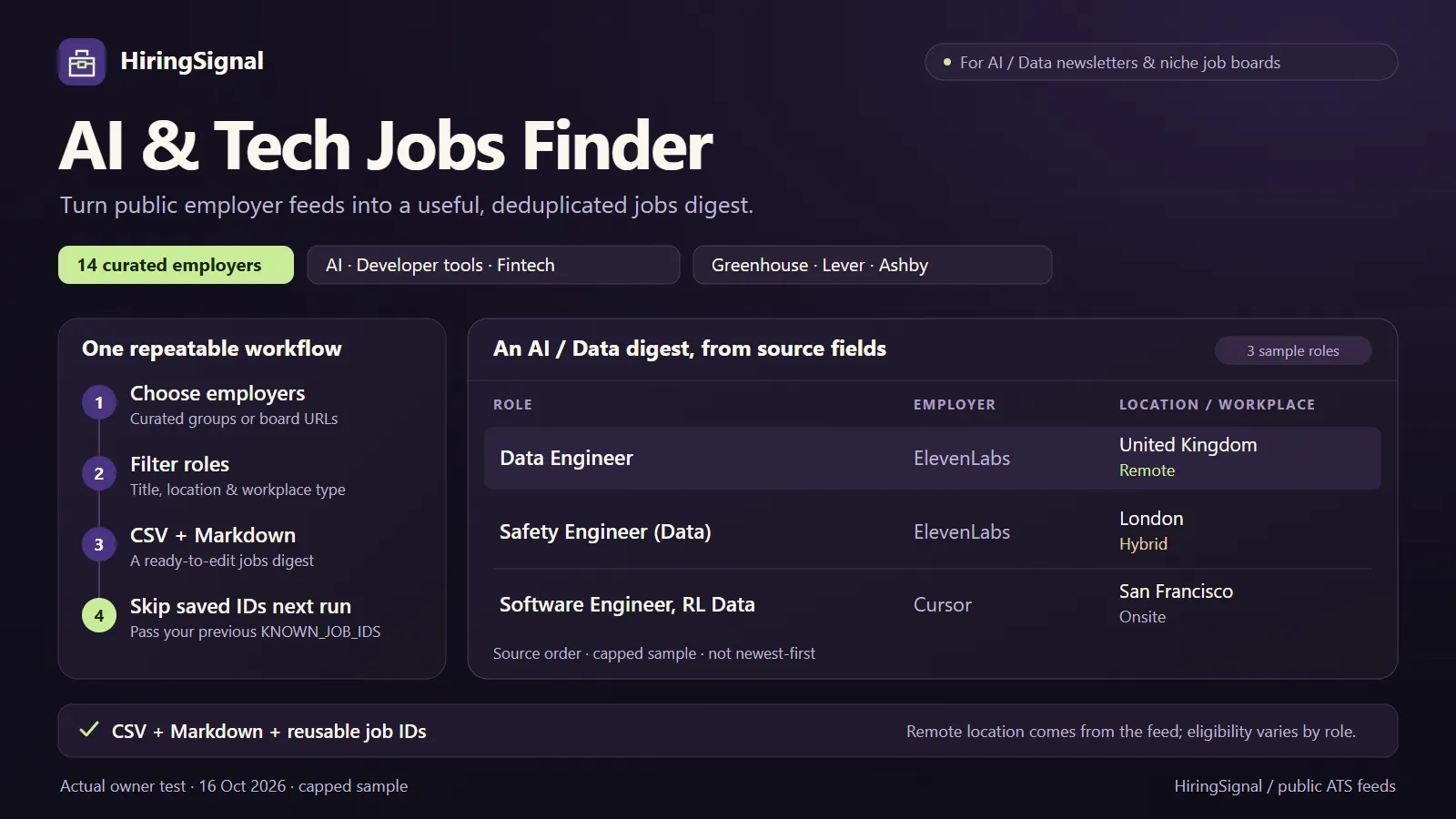
Turn selected public employer job boards into a shortlist for your AI/Data newsletter or niche job board. Choose a curated company group and role preset, then download matching jobs as CSV, JSON, RSS, JSON Feed and a Markdown newsletter draft. Greenhouse, Lever and Ashby feeds share one normalized schema with source links.
Step-by-step first run · Hướng dẫn tiếng Việt
Start with six matching jobs
Run this small input, inspect the jobs and their application requirements, then
open Output → Newsletter jobs shortlist (Markdown) for a draft you can edit. This input saves
at most six matching jobs and at most two per board; availability changes, so it
may return fewer or zero. Six saved rows correspond to $0.009 in job-saved
events at the configured price. Check Pricing and the run's platform charges.
The watchlist is a starting point, not a complete AI-company directory, a global job search or an endorsement by listed employers. The newsletter contains only saved rows in provider order. It is not a newest-first ranking and is not posted anywhere automatically.
Pick your employer watchlist
companyGroup accepts none, ai, developer-tools, fintech or all.
The built-in catalog associates selected employer display names with public ATS
board keys. Inspect the current EMPLOYER_CATALOG output or run the standalone
CLI's hiringsignal catalog command for the actual roster and preset terms.
See the catalog notes
for scope and verification context.
You can also supply boards:
When both are supplied, explicit boards run first and the company group's boards
are added without duplicates. Use companyGroup: "none" for only your own
boards. The combined selection must contain 1–30 unique boards. To try only the
AI preset, clear any older explicit boards input.
Supported board forms include greenhouse:stripe, lever:leverdemo,
lever-eu:yourboard, ashby:ashby, and HTTPS public board URLs on
boards.greenhouse.io, job-boards.greenhouse.io, jobs.lever.co,
jobs.eu.lever.co and jobs.ashbyhq.com. Ashby capitalization is preserved.
Arbitrary API endpoints, custom careers domains and redirects are not accepted.
HiringSignal reads official public JSON feeds. It needs no ATS API key or proxy. It does not submit applications, read private candidate data, bypass access restrictions or support LinkedIn, Indeed or social-media scraping.
Refine matching jobs
rolePreset accepts all, data-ai, engineering, product-design or
sales-marketing. Presets match case-insensitive title words or phrases from
the catalog; they are practical title filters, not an AI assessment of the role.
The all preset adds no role restriction.
Optional includeTitleKeywords, excludeTitleKeywords and locationKeywords
use case-insensitive substring matching. Terms within each list are OR; different
filter lists and the role preset combine with AND. Exclusion takes priority.
All filters apply before saving and billing.
employmentTypes is an optional OR list of full-time, part-time, contract,
temporary, internship, freelance, apprenticeship and unknown. An empty
list adds no restriction. employmentTypeNormalized maps only unambiguous
explicit provider labels such as Lever categories.commitment and Ashby
employmentType; the original label remains in employmentType and provenance
in fieldSources. Missing/ambiguous labels stay unknown. Greenhouse jobs
usually have no explicit employment type and are excluded when you select only
known types. The title and description never determine employment type.
remoteOnly requires an explicit provider remote field, excluding hybrid and
unknown jobs. A remote-looking title or location is not enough. Greenhouse's
list feed generally has no explicit workplace field, so its jobs usually do not
pass this filter. Remote does not mean eligible to work from every country.
Check each source posting's location, work authorization and application terms.
publishedAfter is an inclusive ISO date or timestamp. When set, jobs with an
unknown publication date are excluded. Greenhouse updated_at is a modification
date and never substitutes for publication. Lever public jobs generally lack a
documented publication date. Ashby publishedAt means last published, not
necessarily first posted. publishedAtMeaning preserves that distinction.
Defaults companyGroup: "none" and rolePreset: "all" preserve existing manual
watchlist workflows. The displayed starter input chooses AI/Data explicitly.
Output you can use
The dataset has one row per normalized, filtered job actually saved:
| Fields | Meaning |
|---|---|
id, jobKey, source, boardKey | Source ID and stable provider/board/job identity |
company, companySource | Employer board slug and its source |
companyDisplayName, companyDisplayNameSource | Curated display label when known, otherwise the board slug, with provenance |
title, locations, department, team | Published job fields when available |
workplaceType, workplaceTypeSource | Explicit remote/hybrid/onsite value or unknown |
employmentType, employmentTypeNormalized, descriptionText | Original employment label, exact normalized label or unknown, and cleaned job content |
jobUrl, applyUrl | Source job/application links when exposed |
publishedAt, publishedAtMeaning, updatedAt | Publication and modification dates kept distinct |
salary | Source compensation only; null when absent |
fieldSources, requestUrl, observedAt | JSON field mapping, source API and observation time |
The Output tab also links spreadsheet-safe CSV, newsletter.md, SUMMARY,
DIAGNOSTICS, KNOWN_JOB_IDS, EMPLOYER_CATALOG and complete OUTPUT JSON.
The Markdown draft includes titles, employer labels, locations, workplace labels
and source application/job links. Review it before republishing.
jobs.rss (RSS 2.0) and jobs.feed.json (JSON Feed 1.1) export only the
saved rows, in provider order, with stable jobKey item IDs and source job
links. Missing source publication dates are omitted; observation time never
becomes a publication date. Ashby's last-publication meaning is labeled in the
content. Feed descriptions are shortened to 2,000 source description characters;
open the posting or use dataset JSON for more content. RSS source markup is
escaped and JSON Feed uses plain text. These are static per-run exports, not
an automatically updated hosted subscription or an unlimited job archive. See
the integration guide.
Diagnostics report per-board fetched/filtered/invalid/saved counts, errors and completion flags. Summary signals use only saved rows, not total employer hiring. A board name in the catalog does not guarantee its feed is currently available or contains matching roles.
If every attempted employer feed fails, the run reports failure with
sourceFailureFatal: true after writing diagnostics, empty exports and unchanged
known IDs. A nonempty feed in which no listed job can be normalized is a source
schema failure. Successful empty feeds and zero filter matches are valid results;
mixed failures and successes remain partial and are visible in diagnostics.
Repeat without paying for known keys
Copy the KNOWN_JOB_IDS JSON array into the next run's knownJobIds. Only
previous keys and jobs actually saved in this run enter this rolling union.
Filtered, failed or unpaid jobs are not marked seen. Keys are checked before
saving and billing.
Up to 10,000 keys are retained; the oldest are dropped and
knownJobIdsTruncated is true if the union grows larger. An evicted key can
appear again. This is a bounded seen-list, not an unlimited history database.
Scheduling the same input does not automatically copy state: your workflow must
save the new array and supply it in the following run.
An unknown key means not in your supplied seen-list, not newly published. Previously saved jobs with changed descriptions remain skipped by key. An absent job is never labeled closed. Capped, filtered, rate-limited or failed boards cannot establish a full employer snapshot or hiring growth.
The standalone CLI can load a previous export directly:
The combined input seen-list must still fit the 10,000-key bound.
Pricing and limits
The configured Actor fee is $0.0015 per saved job ($1.50 per 1,000). The
Store Pricing tab controls current terms. In pay-per-event mode, job-saved
occurs once per successfully normalized, filtered, saved dataset row. Errors,
empty boards, filtered jobs and known keys do not generate this event. Check
displayed platform charges as well as the Actor price; infrastructure may still
be used when no row is saved. Your spending limit bounds persisted results.
Limits: 30 selected boards, 1,000 saved jobs per run, 1,000 per board, 8 MiB decoded JSON per response, 80 HTTP attempts per run, 20 Lever pages per board, 5,000 processed source records per board and 12,000 description characters per saved job. Transient requests receive at most one retry with paced requests and a bounded retry wait. No JavaScript pages or private ATS endpoints are read.
Source fields may be absent or change. Salary is not estimated; currencies and compensation intervals remain as published. Check source links and diagnostics before making hiring or research decisions. Respect source content terms when republishing jobs.
Support
Open the Actor's Issues tab with the provider, public board, run ID, expected field and observed result. Remove tokens and private data from reports.


