

Meetup Events Scraper: Groups, Members, RSVPs, Venues
Pricing
from $0.69 / 1,000 events
Meetup Events Scraper: Groups, Members, RSVPs, Venues
Scrape Meetup events by city, keyword and topic category, or from group and event links. Each row: start and end with time zone, venue and coordinates, group with member count and rating, going count, fee, topics and description. Past group events too. No login.
Pricing
from $0.69 / 1,000 events
Rating
0.0
(0)
Developer

The Mine Works
Maintained by CommunityActor stats
0
Bookmarked
1
Total users
0
Monthly active users
21 days ago
Last modified
Categories
Features
Share
From The Mine Works, makers of Threads Scraper and B2B Leads Finder, with over 290,000 runs across 310+ public actors.
Last verified 29 Oct 2026: a live test run on Apify returned 40 events in 10 seconds.
Why choose this actor?
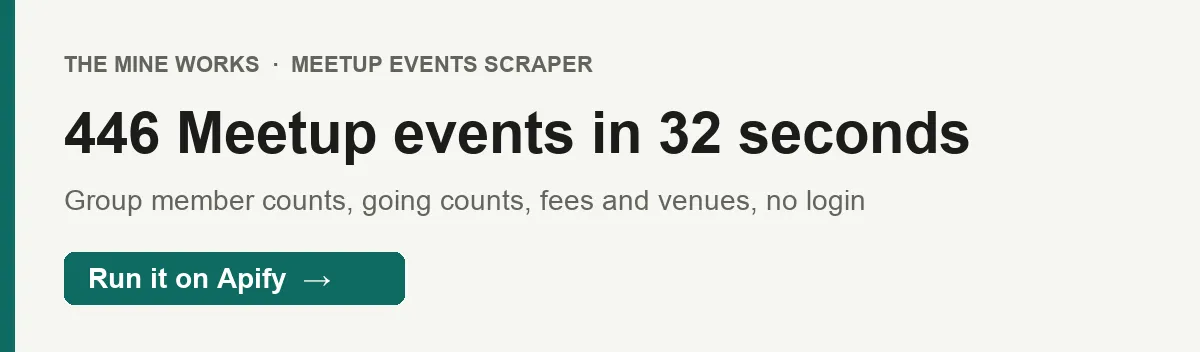
- Every event comes with the group behind it. Each row carries the group's name, link, member count, rating and topic category next to the event's date, venue, going count and fee, so you can rank organizers by audience size without a second scrape. Our proof run returned 446 events from San Francisco, New York, London, Berlin and one group's past events in 32 seconds, with the member count and going count filled on all 446. No Meetup account, no API key.
- Cities, keywords, topic categories and groups in one input. Search any city by name or coordinates, narrow by keyword, Meetup's 20 topic categories, in person or online, distance and dates, or read a group's upcoming and past events from its link. Dates come with the time zone (
2026-10-07T17:30:00-07:00) and in UTC. - You pay only for events you receive. One charge per event saved to your dataset, plus a flat start fee per run. An event found by two searches is delivered once, places and groups that do not exist cost nothing, and on a schedule you can switch on "only events not delivered before".

Part of The Mine Works Food and local services family: NoBroker Scraper, Swiggy Restaurant Scraper, Zomato Scraper.
Guide and FAQs: Meetup Events Scraper on themineworks.com.
Try it in one minute
Paste this input and press Start. It returns 20 upcoming tech events near San Francisco, each with its group, member count, going count and venue, in about 10 seconds:
You can give the actor what to read in several plain forms, and mix them in one run:
- Locations: a city with its country or US state (
Berlin, Germany,Austin, TX,London, United Kingdom), coordinates aslatitude,longitude(52.52,13.405), oronlinefor online events. - Keywords: plain text the way you would type it in Meetup's search box (
python,startup,product management). Leave them out to list every event near each location. - Topic categories: any of Meetup's 20 categories, such as Technology or Career & Business.
- Meetup links: group pages (
https://www.meetup.com/golangsf/or justgolangsf), a group's past events page (https://www.meetup.com/golangsf/events/past/), event pages (https://www.meetup.com/golangsf/events/316571580/) and find pages (https://www.meetup.com/find/?location=us--ca--San%20Francisco&keywords=python).
Apify's free plan includes $5 of credit every month, which covers about 3,700 results at this actor's price.
Copy to your AI assistant
Key features
- About 55 fields per event: title, link, start and end in local time with offset and in UTC, status, in person, online or hybrid, venue name, street, city, state, postal code, country and coordinates, directions, going count, capacity, RSVP state, fee and currency, description, topics, image, the series it repeats in, and the group's name, link, city, member count, rating, number of ratings and topic category.
- Four ways in: city searches, keyword searches, Meetup's 20 topic categories, and links (groups, past events pages, single events and find pages). Every location runs with every keyword and category, so three cities times two keywords is six searches in one run.
- Up to 5,000 events per search and per group. Meetup lists 50 events a page; the actor follows the list to your cap or to its end. In our deep test New York (25 miles, any date) ran to 517 events and Berlin by coordinates to 406.
- Past events of any public group, newest first, for organizer research and attendance history: in our proof run the 50 most recent past events of GoSF came back with the going count on each.
- Filters that match Meetup's own: in person or online, distance in miles, today, tomorrow, this week, this weekend, next week, this month or your own dates, worked out in each city's time zone.
- No browser, no login: plain requests to the same data Meetup's own pages load, over Apify's datacenter proxy, which the run includes. Attendee names are never collected; only the going count.
How to use it
Basic: events near one city
You get the next 100 events within 25 miles of Austin, soonest first, each with its group and venue. Leave out keywords and categories to see everything Meetup lists near the place.
Several cities, keywords and categories at once
Every location runs with every keyword and category: here that is 8 searches, each with its own cap of 200. Every row says which search found it (search_input, search_location, search_keyword, search_category). An event that two searches find is delivered and charged once, under the first.
Sponsor and speaker prospecting: the biggest groups in your field
Export to a sheet and sort by group_member_count and going_count: the groups at the top have the audience a sponsor pays for, and group_url takes you straight to the group's page. Run it monthly with a schedule (Console: Schedules, Add schedule) to keep the list current.
Organizer research: a group's history
Upcoming events first, then past ones, newest first, up to 300 per group, each with the going count. Use it to see how often a group meets, how many people come and where they hold events before you pitch a venue or a partnership.
Daily feed of new events for a city
Schedule it daily. With onlyNewEvents each run returns, and charges for, only events no earlier run of yours delivered, so a newsletter, a Slack channel or a CRM gets just what was added since yesterday.
This weekend's online events on a topic
Online events have no venue; their rows carry event_type: "online" and leave the address and coordinates out.
Input parameters
| Parameter | Type | Default | What it does |
|---|---|---|---|
locations | array of strings | none (prefilled with San Francisco, CA and London, United Kingdom) | Cities with country or US state, latitude,longitude, or online. When locations and links are all left out, the run searches tech near San Francisco as an example. |
searchTerms | array of strings | none (prefilled with tech) | Keywords. Each runs in each location. Leave empty for every event. |
categories | array of strings | empty | Meetup topic categories (technology, career-business, art-culture and 17 more). Each runs in each location. |
startUrls | array of strings | empty | Group links or urlnames, group past events links, event links, find links. |
eventType | string | any | any, in_person, online or hybrid. |
radiusMiles | integer | 25 | Distance from each location, 1 to 100 miles. |
dateFilter | string | any | any, today, tomorrow, this_week, this_weekend, next_week, this_month or custom, in each location's time zone. |
startDate | string | none | First day for custom, YYYY-MM-DD. A start or end date on its own also switches to custom. |
endDate | string | none | Last day for custom, YYYY-MM-DD. |
sortBy | string | date | date (soonest first) or relevance (Meetup's order). |
groupEvents | string | upcoming | For group links: upcoming, past (newest first) or both. |
maxEventsPerGroup | integer | 100 | Events per group link, 20 to 5,000. |
maxEventsPerSearch | integer | 100 | Events per location, keyword and category, 20 to 5,000. |
onlyNewEvents | boolean | false | Skip, and do not charge for, events an earlier run of yours delivered. |
Plain London is read by Meetup as London, Ontario. Add the country (London, United Kingdom or London, UK) to names several places share; the place each search used is in every row as search_location.
What data do you get?
One row per event ("record_type": "event"). A field with no value is left out of that row rather than sent empty.
- The event:
event_id,event_url,title,description(Meetup's own formatting),topics,image_url,status(ACTIVE, PAST, CANCELLED),series_descriptionfor repeating events ("Every week on Monday ..."). - When:
startandendin local time with the UTC offset,start_utc,end_utc,start_date,timezone. - Where:
event_type(in_person, online, hybrid),is_online,venue_name,venue_address,venue_city,venue_state,venue_postal_code,venue_country,latitude,longitude,how_to_find_us. Online events leave the venue out. - Attendance and price:
going_count,capacity(when the organizers set a limit),rsvp_state,is_free,fee_amount,fee_currency,fee_required. - The group:
group_id,group_name,group_urlname,group_url,group_city,group_state,group_country,group_member_count,group_rating,group_rating_count,group_category,group_is_private. - Where the row came from: searches add
search_input,search_location,search_keyword,search_category,position,page; group links addgroup_input,group_events(upcoming or past),position,page; event links addinput. Every row hasscraped_at.
Stable fields for automations
These fields were present in every row of our proof run, and their names will not change:
| Field | What it holds |
|---|---|
record_type | Always event on event rows |
event_id | Meetup's event id, stable across runs; use it to dedupe |
event_url | Link to the event page |
title | Event title |
start | Start in local time with offset |
start_utc | Start in UTC |
timezone | Time zone of the group |
status | ACTIVE, PAST or CANCELLED |
event_type | in_person, online or hybrid |
going_count | People going |
is_free | True when there is no fee |
group_name | Group name |
group_url | Group page |
group_member_count | Members of the group |
scraped_at | When the row was read |
Output examples
Real rows from our proof run on 6 Oct 2026, with the description shortened.
An in person event from a city and category search:
An event with a fee:
An online event (no venue, no coordinates):
A past event from a group link:
Rows keep titles and descriptions exactly as Meetup has them, emoji and formatting included.
Pricing
Pay per event: you pay for each event delivered to your dataset, plus a flat $0.005 per run, whatever memory you choose. Prices by Apify plan:
| Event | Free plan | Bronze (Starter) | Silver (Scale) | Gold and above (Business) |
|---|---|---|---|---|
Event delivered (event-scraped), per 1,000 | $1.29 | $1.09 | $0.89 | $0.69 |
Run start (run-start), once per run | $0.005 | $0.005 | $0.005 | $0.005 |
Every field, including the group's member count and rating and the full description, comes at the same price per event; there is no add on for organizer data.
What is never charged:
- Places Meetup does not know, groups that do not exist, event links that are gone.
- Requests Meetup refused, even after retries.
- The same event found by two searches or listed twice: the second copy is skipped.
- Events an earlier run already delivered, when Only events not delivered before is on.
- The information row at the end of the dataset (it has
"_type": "info").
Proxy traffic goes through Apify's datacenter proxy, which is included in the price; there is no separate proxy fee.
FAQ
What does this actor read? Public Meetup events and groups, logged out, the way any visitor sees them on meetup.com: search results near a place, a group's event list, single event pages. It asks Meetup for the same data its own pages load. It does not use a Meetup account, an API key or your cookies.
How many events can I get? Up to 5,000 per search and per group link. Meetup lists 50 events a page; the actor follows the list to your cap or to the point where Meetup's list ends. How far a list goes depends on the place and filters: in our test New York within 25 miles ran to 517 upcoming events and Berlin to 406, while a narrow keyword in a small city may have a few dozen.
Why did my city return events from somewhere else?
Meetup matches place names loosely. Plain London is London, Ontario; London, United Kingdom or London, UK is the London you probably mean. Add the country or US state to the location, or give coordinates (51.507,-0.128). The place each search used is in every row as search_location, and in the run summary.
Does it collect attendee names or contact details? No. It returns the going count, never the attendee list, and it does not read member profiles. Group facts (name, link, member count, rating, category) are what Meetup shows publicly on each group page.
How fresh is the data?
Live. Each run asks Meetup at that moment, so going counts, RSVP state and fees are as shown when the row was read (scraped_at).
Can I get past events?
Yes, from group links: set groupEvents to past (newest first) or both, or paste the group's /events/past/ link. Searches by place cover upcoming events, as Meetup's own search does.
Do I need a Meetup account, cookies or a proxy of my own? No. Nothing to log in to and nothing to set up. The actor uses Apify's datacenter proxy, which the run includes; in our proof run all 17 requests were answered on the first try.
What happens with a wrong group name, a deleted event or an unknown place?
It gets status not_found in the run summary (the OUTPUT record) and costs nothing; the rest of the run goes on as normal.
Can I run it on a schedule and get only new events?
Yes. Turn on onlyNewEvents and add a schedule in Console (Schedules, Add schedule, daily or weekly). Each run delivers and charges only events no earlier run in your account delivered.
What formats can I export?
JSON, CSV, Excel, XML, RSS and HTML from the dataset tab, or through the API. In CSV and Excel, the topics list is spread over numbered columns (topics/0, topics/1).
I need the organizer's business contact, not just the group page. This actor stops at what Meetup shows publicly. If a group or its sponsor lists a website, our Website Contact Finder reads the business email and phone the site publishes, and LinkedIn Company Details adds company facts.
Can I use it from Claude, ChatGPT or Cursor (MCP)? Yes, through Apify's MCP server.
- Connector URL: https://mcp.apify.com/?tools=themineworks/meetup-events-scraper
- Claude: Settings > Connectors > Add custom connector, paste the URL, sign in with Apify.
- ChatGPT: developer mode, add an MCP connector with the URL, sign in with Apify.
- Cursor or VS Code: add it as an HTTP MCP server with that URL.
- Claude Code:
claude mcp add -t http meetup-events-scraper "https://mcp.apify.com/?tools=themineworks/meetup-events-scraper"
Is it legal to scrape Meetup? The actor reads only public pages and returns what any visitor can see, and it leaves attendee lists out. You are responsible for how you use the data, including Meetup's terms and data protection law such as GDPR and CCPA.
Integrations
- Google Sheets: add the Google Sheets integration to the actor or a schedule, and new events land in a sheet after each run.
- Make, Zapier and n8n: use the Apify app to start a run and read the dataset, for example to post next week's new events in your city to Slack.
- Webhooks: call your own endpoint when a run finishes.
- API: start runs and read results from any language; the Python and JavaScript clients are a few lines each.
- MCP clients: Claude, ChatGPT, Cursor, VS Code and Claude Code, as in the FAQ above.
More from The Mine Works
Food and local services
Social media and video
Leads and business directories
Marketing, SEO and reviews
Real estate
Science, health and government data
Jobs and hiring
Company and business data
E-commerce and marketplaces
Developer and AI tools
More tools
Support
Found a city, group or field that does not come through? Open an issue on the Issues tab and include the input you used; we answer there. For a new site or source, email dmineworks@gmail.com.
Meetup Events Scraper turns cities, keywords and group links into a clean table of events with their groups, venues, going counts and fees, with a charge only for the events you get.


