
Google AI Overview & Perplexity Visibility Tracker
Pricing
from $7.00 / 1,000 prompt checks
Google AI Overview & Perplexity Visibility Tracker
Track Google AI Overviews and Perplexity answers for chosen prompts. Export answer status, available source domains, brand and competitor mentions, and dated evidence for AI search visibility reports.
Pricing
from $7.00 / 1,000 prompt checks
Rating
0.0
(0)
Developer

Tugelbay Konabayev
Maintained by CommunityActor stats
0
Bookmarked
46
Total users
9
Monthly active users
15 days ago
Last modified
Share
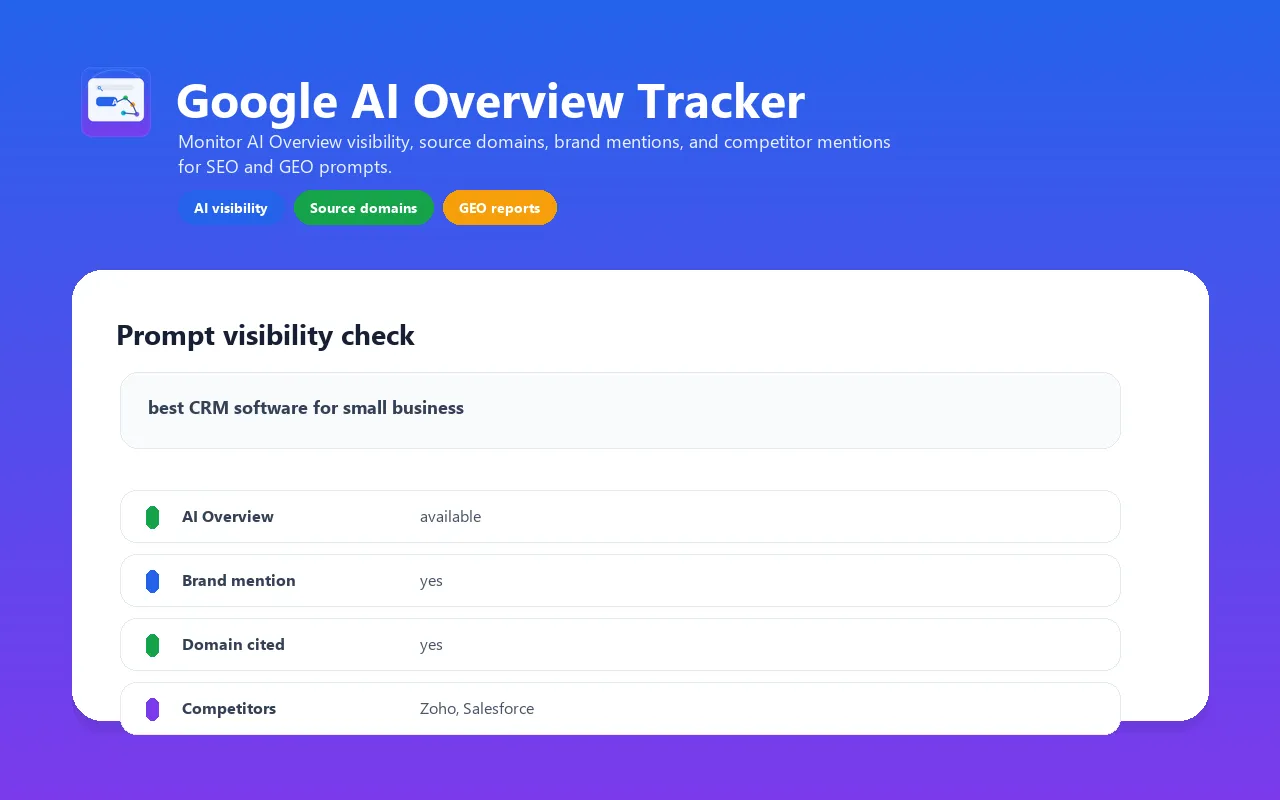
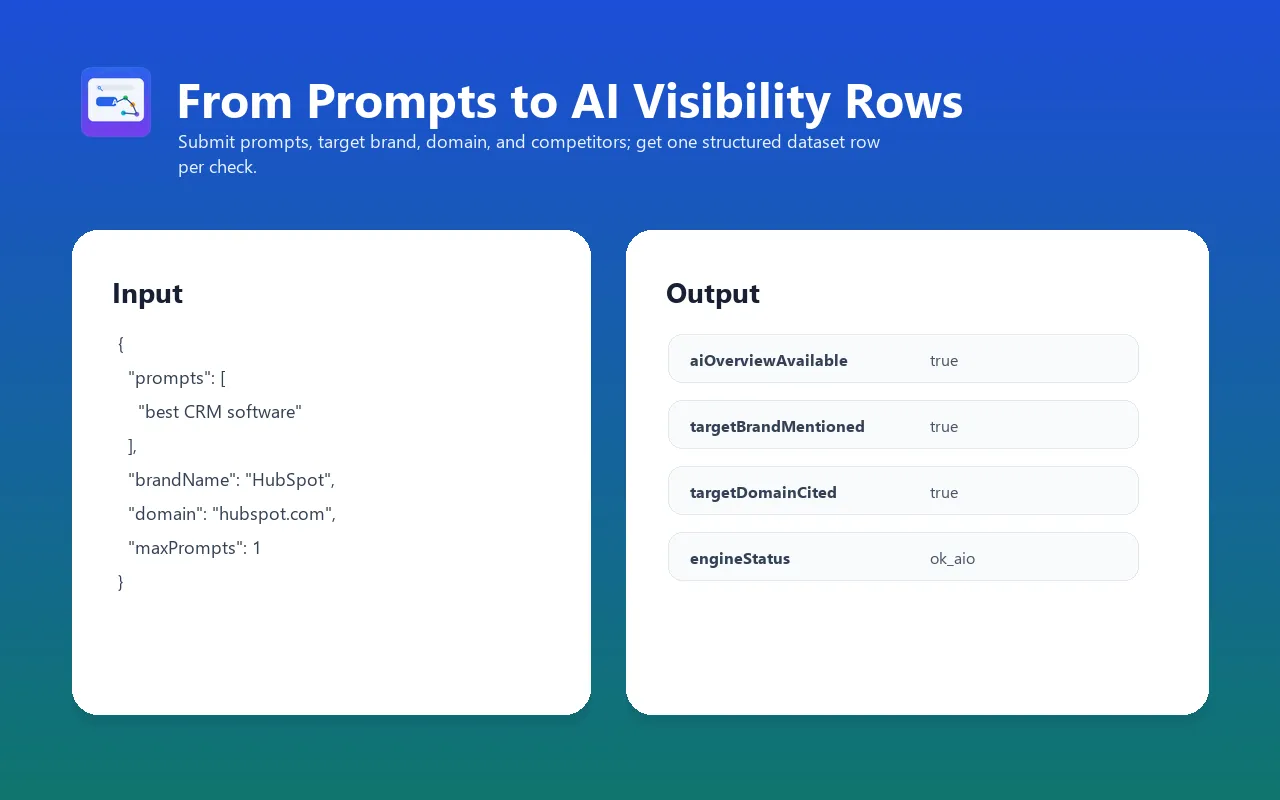
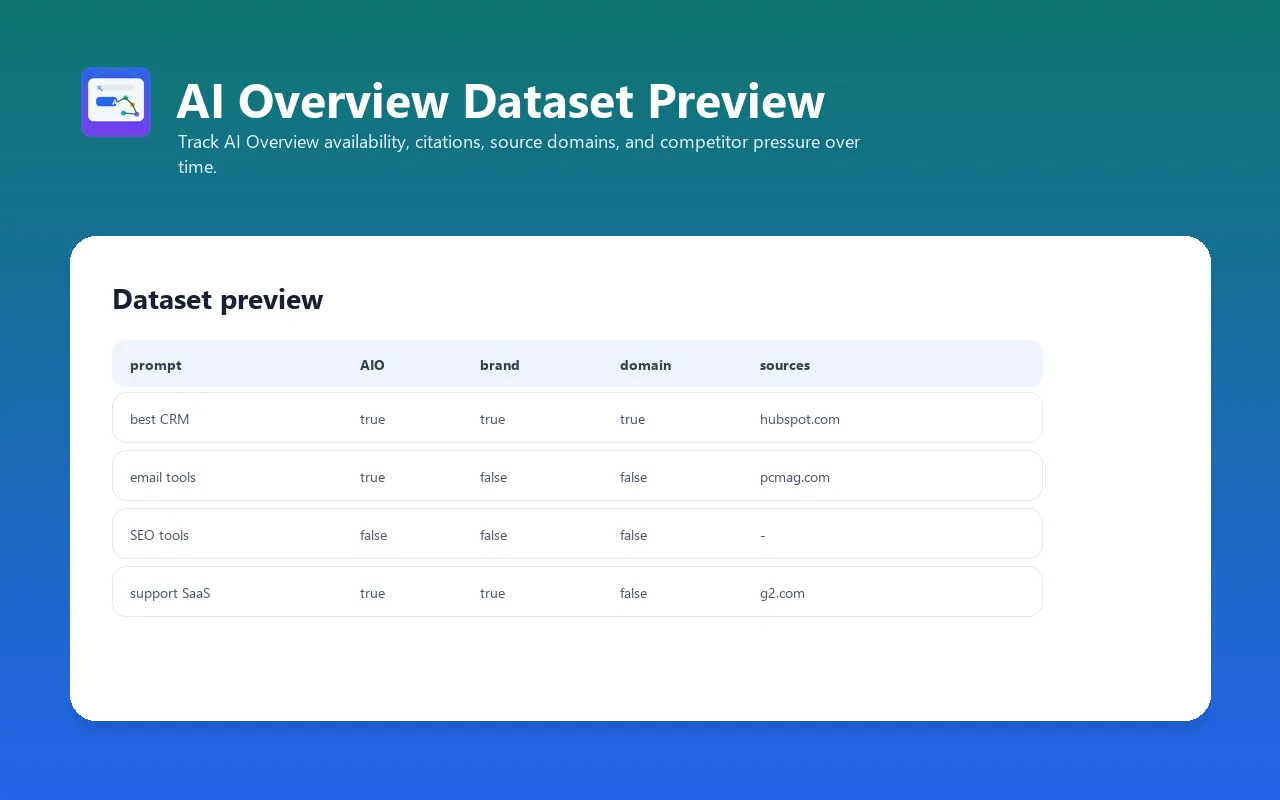
Google AI Overview & Perplexity Visibility Tracker checks selected prompts in either Google AI Overviews or Perplexity. It records answer status, available source domains, and brand, domain, or competitor mentions for SEO, GEO, AEO, and AI search visibility reports.
Use it as a lightweight Google AI Overview visibility tracker: prompt in, AIO status out, with answer text, source domains, brand mentions, domain citation checks, competitor mentions, and a clean aiOverviewAvailable=false result when Google does not show an AI Overview.
This actor supports Google AI Overview and Perplexity, selected with the engine input field. It does not claim ChatGPT, Gemini, Claude, Copilot, Grok, or Meta AI coverage — those engines are not yet validated for reliable, login-free extraction.
For implementation notes, examples, and SEO/GEO use cases, see the Google AI Overview Tracker guide.
Use when: weekly AI visibility monitoring for commercial prompts, client reporting, SEO/GEO dashboards, and source-domain gap analysis. Default run: a 5-prompt monitoring pack that produces one row per prompt, with visibility status and score fields ready for dashboards. Pricing: pay per prompt checked. Each delivered prompt-check row uses the SDK store-then-charge operation for one
prompt-checkevent. Run spending limits can stop delivery; failed persistence is not charged by this operation. An unresolved check may still produce a diagnostic row and event. Plan parity: free and paid Apify users use the same prompt limits, fields, timeout and retry policy. There is no Actor monthly quota. Run spending limits and the shared maximum of 50 prompts still apply. Upstream blocking can prevent an observation on either plan; inspect engineStatus and RUN_REPORT.
An explicit upstream block is not retried. After delivering the current concurrency batch, the Actor stops later checks and records stoppedReason=source_refused, requested and undelivered check counts in RUN_REPORT. A blocked check is unavailable, not evidence that your brand has zero visibility. At most the already-started concurrency batch can finish after a refusal.
Why use this AI search visibility Actor?
- Monitor a fixed prompt set on a schedule instead of checking answers manually.
- Separate
no_ai_overview, source gaps, competitor visibility, blocks, and timeouts in structured rows. - Preserve
checkedAt, source domains, target-brand detection, and run status for auditable reporting. - Export the same schema to datasets, webhooks, spreadsheets, and BI tools.
How to run a monitoring check
- Start with one to five commercial prompts, a target brand, and target domain.
- Keep concurrency at
1, inspectengineStatus,visibilityStatus, and source links, then refine the prompt set. - Schedule the validated prompt set and compare dated rows; do not interpret one volatile SERP as a durable ranking.
Engines
Set the engine input field to choose which AI answer surface to check:
| Engine | engine value | Country/language | Notes |
|---|---|---|---|
| Google AI Overview | google_ai_overview | Uses country and language | Default. Dedicated Apify SERP HTTP service; scoped AIO and deferred continuation. |
| Perplexity | perplexity | Ignored — always English | Rendered perplexity.ai/search?q=... answer page. |
Both engines share the same output shape (answerText, sourceLinks, targetBrandMentioned, visibilityStatus, and so on), so existing dashboards and reports work unchanged when you add Perplexity prompts — only queryUrl/answerUrl and the absence of country/language targeting differ. Run Google and Perplexity checks for the same prompt list as two separate actor runs (one per engine value) to compare visibility across both surfaces.
Commercial Workflows This Targets
Use this actor when AI visibility, answer engine optimization, or Google AI Overview reporting maps to a real workflow:
- weekly Google AI Overview checks for commercial prompt lists
- answer engine optimization and AI search visibility reporting
- source-domain analysis for readable links inside Google AI answers
- client SEO/GEO dashboards for agencies and consultants
- brand/domain/competitor visibility monitoring across a stable prompt set
Fast Answers
What is a Google AI Overview tracker?
A Google AI Overview tracker checks specific Google search prompts and records whether an AI Overview appears, what answer text was visible, which external source domains were extracted from its answer block, and whether your brand, target domain, or competitors appeared.
Google text and links are limited to the supported AI answer container. The Actor restores deferred answer fragments embedded in the response, including supported “Show more” content, without executing Google's JavaScript. Organic results, query text, citation labels and source-card snippets do not count as answer mentions. Unknown layouts fail explicitly. A continuation that cannot be recovered produces partial_aio, not a complete measurement.
Google uses one Apify Google SERP request per prompt, without a Google login or a separate provider key. There are no automatic Google search retries. proxyConfiguration applies only to the Perplexity browser. Citation destinations are resolved through Google redirect responses without fetching the external articles, with at most 30 unique links and a 15-second total redirect budget. An explicit refusal stops further resolution and later prompt batches.
Google rows add answerTextComplete, citationLinksComplete, unresolvedCitationCount and measurementComplete. citationLinksComplete describes resolution of the recognized links in the retrieved AIO, not independent proof that Google exposed every possible citation. Filter Google reports to measurementComplete=true. A false mention/citation flag on an incomplete row means “not observed”, not “absent”. Partial observations have visibilityStatus=partial_aio and score 0; this is a collection-quality status, not zero brand visibility. Answer text is bounded at 50,000 characters; hitting that limit also marks the row incomplete.
When recognized citation destinations remain unresolved, error includes reason counts such as timeout, time_budget, candidate_limit, network_error, http_500, unsupported_redirect, or invalid_response. These distinguish retrieval and parsing limits without exposing redirect URLs or raw response bodies. They do not change the completeness flags or request limits.
After normal dataset delivery, the default key-value store's RUN_REPORT records delivered checks, engine-status counts, completed versus unresolved checks, answer texts found and answers without extracted citation links. The final status also summarizes these counts. A SUCCEEDED run can contain blocked, timeout or error rows: inspect engineStatus and this report before using visibility scores. completedChecks includes a successfully observed absence of an answer; it does not mean every check produced an AI answer. Citation completeness is not independently verified. A run stopped by a billing or storage exception may not have a final report.
Brand and competitor matching is case-insensitive and requires the complete configured name at word boundaries: Apple does not match Pineapple. Whitespace is normalized. It is a literal-name heuristic, not entity recognition: aliases, translations and names embedded in unsegmented text may be missed.
Can this track AI visibility for SEO and GEO reports?
Yes. This actor is built for SEO, GEO, AEO, and AI visibility reporting where you need repeatable prompt checks, brand mention tracking, domain citation checks, competitor mention detection, and CSV/API-ready datasets.
Does it track ChatGPT, Gemini, or Claude?
Not yet. This actor tracks Google AI Overview and Perplexity, set via the engine input field. ChatGPT, Gemini, Claude, Copilot, Grok, and Meta AI are conversational UIs without a simple URL-query pattern, so they are not supported yet — that narrower scope keeps the output honest instead of mixing reliable and unvalidated engines.
Starter monitoring run
Start with the 5-prompt monitoring pack below. Each Google prompt uses one SERP request and returns a dated observation with explicit completeness fields.
What it returns
For each prompt, the actor returns one dataset item with:
aiOverviewAvailable- whether Google displayed an AI OverviewanswerText- extracted AI Overview text when availablesourceLinksandsourceDomains- external citation destinations from the supported AI answer blocktargetBrandMentioned- whether your brand appears in the AI Overview texttargetDomainCited- whether your domain appears in source linkscompetitorMentions- which competitor names appearedvisibilityStatusandvisibilityScore- dashboard-ready classification for owned, competitor, source-gap, no-AIO, blocked, timeout, or error outcomessourceCountandcompetitorCount- quick numeric fields for BI tools and weekly reportingengineStatus-ok_aio,ok_no_aio,partial_aio,blocked,timeout, orerror
If Google does not show an AI Overview for a prompt, the run still succeeds and returns aiOverviewAvailable=false.
Larger input example
For a quick validation, reduce maxPrompts to 1. For a useful production report, keep the default 5 prompts or run 10-50 prompts weekly.
Free and paid Apify users have the same prompt limits and fields. There is no Actor monthly quota; the shared 50-prompt maximum and run spending limits still apply.
Production monitoring workflow
Use the default 5-prompt pack to verify completed observations for your country/language and that the output fields fit your report. For production monitoring, use 10-50 prompts per run and schedule the task weekly.
Useful paid prompt sets usually come from:
- Google Search Console queries with commercial intent
- commercial search terms from ads, CRM notes, or sales calls
- category and reporting queries such as
answer engine optimization,ai search visibility, andllm visibility - "best X", "X alternatives", and "X vs Y" category prompts
- sales objections and buyer questions
- competitor pages and comparison pages
For agencies, create one Apify Task per client and send the dataset to Google Sheets, BigQuery, Slack, or a reporting webhook.
RSS feed for no-code monitoring
Every finished run can expose a lightweight RSS feed directly from its dataset. Replace DATASET_ID and use a scoped read-only token when the dataset is private:
This maps prompt to the RSS title and queryUrl to the link, so Feedly, Slack RSS apps, Zapier, Make, or n8n can watch new AI visibility checks without a custom integration. Never put an admin token into a public feed URL.
The actor processes prompts in concurrency-sized batches. If Apify reports that the run spending limit was reached, it stops charging and delivering immediately and does not launch another browser batch. Up to maxConcurrency checks from the current batch may already have finished internally, but unchargeable checks are not returned after the limit signal.
Output example
Output field reference
Each dataset item is one prompt check. The schema is intentionally flat enough for CSV, Google Sheets, webhooks, and BI dashboards, while still keeping source links and competitors as arrays for automation.
| Field | Type | Description |
|---|---|---|
prompt | string | The search prompt/query that was checked. |
engine | string | google_ai_overview or perplexity, matching the input engine field. |
queryUrl | string | Google Search with country/language parameters, or the Perplexity search URL. |
answerUrl | string | Google search URL, or final Perplexity browser URL. |
country | string | Google country code used for the check, for example US. Not applied for Perplexity. |
language | string | Google interface language, for example en. Not applied for Perplexity. |
aiOverviewAvailable | boolean | Whether an AI Overview block was detected. |
answerText | string | Extracted AI Overview text when present; empty when no AIO was shown. |
sourceLinks | array | External citation destinations from the supported AI answer block; Google redirects are resolved within a bounded budget. |
sourceDomains | array | Deduplicated domains from sourceLinks. |
targetBrand | string | Brand name supplied in input. |
targetDomain | string | Normalized target domain supplied in input. |
targetBrandMentioned | boolean | Whether the brand name appears in the extracted AI Overview text. |
targetDomainCited | boolean | Whether the target domain appears among extracted source domains. |
competitorMentions | array | Competitor names detected in extracted answer prose; organic SERP text is excluded. |
visibilityStatus | string | Dashboard status such as owned_visibility, competitor_visible, source_gap, no_ai_overview, blocked, timeout, or error. |
visibilityScore | integer | 0-100 score for quick sorting and weekly trend dashboards. |
sourceCount | integer | Number of unique extracted source domains. |
competitorCount | integer | Number of detected competitor mentions. |
engineStatus | string | ok_aio, ok_no_aio, partial_aio, blocked, timeout, or error. |
error | string | Short error message when rendering or parsing fails. |
blockMarkers | array | Detected block/CAPTCHA phrases when Google blocks the session. |
checkedAt | string | UTC timestamp for the check. |
runtimeSeconds | number | Runtime for that prompt attempt. |
Use cases
- AI visibility tracking for target prompts
- GEO / AEO monitoring for target prompts
- AI Overview source tracking
- Brand visibility checks
- Domain citation checks
- Competitor visibility checks
- SEO source-gap research
- Weekly prompt monitoring for marketing teams
Who should use it
This actor is useful when the question is not "what rank do I have in classic organic search?" but "does Google's AI answer show up, which brands are mentioned, and which external domains appear around that AI answer?"
Typical users:
- SEO teams tracking AI Overview exposure for commercial prompts
- content teams checking whether their domain appears near answer-style SERPs
- agencies monitoring client and competitor visibility across prompt lists
- SaaS teams watching category prompts such as "best CRM for small business"
- affiliate teams checking which publisher domains are surfaced for buyer-intent queries
- internal growth teams building weekly AEO/GEO dashboards
Suggested monitoring workflow
- Start with 5-20 high-intent prompts from Search Console, paid-search terms, sales calls, or competitor pages.
- Run the actor with
maxConcurrency=1andtimeoutSeconds=30. - Export the dataset to Google Sheets, BigQuery, or a webhook.
- Track these weekly fields:
aiOverviewAvailable,targetBrandMentioned,targetDomainCited,sourceDomains, andcompetitorMentions. - Split prompts into buckets:
- AIO exists and your brand/domain appears: maintain and monitor.
- AIO exists but competitors appear: improve topical coverage and citation-worthy pages.
- AIO exists but only publishers/tools appear: identify source-gap opportunities.
- No AIO: monitor less often or test related prompt variants.
Prompt list examples
For SaaS:
For local services:
For affiliate/content sites:
Comparison with classic SERP rank tracking
| Need | Classic rank tracker | Google AI Overview Tracker |
|---|---|---|
| Track organic position | Yes | No |
| Detect whether AI Overview appears | No | Yes |
| Extract answer text | No | Yes, when AIO is present |
| Track brand mention in AI answer | No | Yes |
| Track domains surfaced near AI answer | Limited | Yes |
| Monitor competitor mentions in generated answer | No | Yes |
| Best cadence | Daily/weekly rankings | Weekly prompt visibility checks |
Use both when you need classic organic rankings and AI Overview visibility in the same reporting stack.
API usage
Python
JavaScript
Webhook / scheduled monitoring
Create an Apify Task with your prompt list, then schedule it weekly. Use a webhook on run success to send the dataset to:
- Google Sheets
- BigQuery
- Slack
- Make/Zapier
- your internal dashboard
Integrations
Plug this actor into your AI, automation, and workflow stack.
LangChain
As an agent tool:
As a RAG document loader:
n8n
- Add the Apify community node (
@apify/n8n-nodes-apify). - Choose operation Run Actor.
- Authenticate with your Apify API token.
- Actor:
tugelbay/google-ai-overview-tracker. - Input JSON:
{"prompts": ["{{ $json.keyword }}"],"brandName": "My Brand","domain": "mysite.com","country": "US","maxPrompts": 1}
- Pipe output to Google Sheets, Airtable, Slack, or a webhook.
Make (Integromat)
- Add the Apify app → Run an Actor module.
- Connect your Apify API token.
- Actor:
tugelbay/google-ai-overview-tracker. - Map your keywords to
prompts, setbrandNameanddomain. - Route dataset items to any Make app (Slack, Microsoft 365, Notion, webhook, etc.).
Zapier
- Create a Zap, add Apify action → Run Actor.
- Choose
tugelbay/google-ai-overview-tracker. - Map trigger data into
prompts,brandName,domain. - Send results (
aiOverviewAvailable,targetBrandMentioned,visibilityStatus,answerText) to any Zapier app (email, Airtable, CRM, Google Sheets, webhook).
MCP (Claude, ChatGPT, OpenAI Agents SDK)
Every Apify actor is exposed via the Apify MCP server at https://mcp.apify.com (Streamable HTTP). Any MCP-compatible client can discover and invoke tugelbay/google-ai-overview-tracker as a native tool.
Agents receive structured output: prompt, aiOverviewAvailable, answerText, targetBrandMentioned, targetDomainCited, visibilityStatus, visibilityScore, sourceDomains, competitorMentions.
Validation
Validation snapshot from 2026-04-25. This actor was built only after a 20-prompt stability probe:
- 20/20 clean headless Google SERP checks
- 19/20 prompts showed an AI Overview
- 1/20 prompts cleanly returned no AI Overview
- Median local probe runtime: 3.0 seconds. Apify runtime varies with proxy/session state.
Related validation file:
docs/research/google-ai-overview-tracker-validation-results.md
Official references rechecked on 2026-07-14:
- Google's AI features and your website documentation explains that normal Search technical requirements and SEO fundamentals apply to AI features.
- Google's Terms of Service remain authoritative for use of Google surfaces; users must also respect rate limits, robots/access controls, and applicable client-reporting obligations.
The validation proves bounded extraction behavior, not stable AI Overview availability, ranking, traffic, or citation by another answer engine.
Limitations
- Google decides whether AI Overview appears. Some queries, countries, or sessions may return no AI Overview.
- Google SERP layouts change. The actor returns
engineStatusanderrorfields so monitoring jobs can detect layout or block changes. - Perplexity always answers in English and ignores
country/language— it has no equivalent regional-targeting parameters. - Google uses the dedicated HTTP SERP service. Perplexity uses browser rendering.
- Keep concurrency low. The default is
1, maximum is3. - The default input checks 5 prompts so the first run produces a useful monitoring report. Reduce
maxPromptsto1only for a tiny validation run.
Pricing
Pay per event:
prompt-check— $0.01 per checked prompt on the FREE plan as of 2026-07-14, with Store-plan discounts down to $0.007.- Apify's standard synthetic Actor start event is currently $0.00005.
Use the public Pricing tab as the source of truth for the current plan-specific prompt-check rate. Actual platform cost also depends on Apify compute/runtime and your account plan. Keep prompt batches small until you know how often AIO appears for your niche.
Troubleshooting
| Issue | Likely cause | What to do |
|---|---|---|
aiOverviewAvailable=false | Google did not show an AI Overview for that query/session/country | This is a valid result. Try related prompts or another country/language. |
engineStatus=blocked | The source explicitly refused the request | Stop the affected batch; inspect the report. The Actor does not retry refusals. |
engineStatus=timeout | SERP or AIO did not finish rendering within timeout | Increase timeoutSeconds to 45-60 for harder prompts. |
engineStatus=partial_aio | Continuation or citation resolution is incomplete | Exclude this row from visibility-rate calculations; inspect completeness fields. |
| Competitor not detected | Name spelling differs from input | Add short brand variants to competitors, for example Salesforce and Salesforce CRM. |
| Target domain not cited | Domain does not appear in extracted external source links | Use sourceDomains to identify which domains are currently surfaced. |
FAQ
Does this track ChatGPT, Gemini, Claude, Copilot, Grok, or Meta AI?
Not yet. This actor supports Google AI Overview and Perplexity via the engine input field. The remaining engines require separate validation because login, browser mode, rendering behavior, and source extraction differ.
Is sourceLinks exactly the same as AI Overview citations?
No. The Actor extracts links only from the supported AIO block and resolves recognized Google redirects. It reports unresolved destinations, but does not fetch the cited articles or prove that Google's response exposed every citation card. Check citationLinksComplete and unresolvedCitationCount on Google rows.
Why does the same prompt sometimes return different results?
Google personalizes and experiments with SERP layouts. Country, language, time, browser session, proxy, and Google's own AIO rollout can change whether an AI Overview appears.
Should I run this daily?
For most teams, weekly is enough. AI Overview visibility can move, but daily checks may add noise and cost before you have a stable prompt set.
Can I use this for client reporting?
Yes, if you explain the metric correctly: it tracks AI Overview availability, answer text, brand/domain visibility, and extracted external source domains for specific prompts at a specific time.
What is a good first prompt set?
Start with 10-20 prompts that already matter to the business: high-impression Search Console queries, paid search terms, "best X" category searches, sales objections, and competitor-comparison prompts.
Data quality notes
- No-AIO is a valid output, not a failed run.
- For Google, calculate visibility rates only from
measurementComplete=true; excludepartial_aio,blocked,timeout, anderror. - Use exact brand names and common short variants in
competitors. - Keep prompt wording stable over time if you want trend charts.
- Store raw datasets for repeatable historical reporting.
Reporting template
For a weekly report, group the dataset by prompt and track these columns:
| Metric | How to calculate |
|---|---|
| Visibility score | Average visibilityScore across valid rows, or trend it by prompt week over week. |
| AIO coverage | Count rows where aiOverviewAvailable=true divided by total valid rows. |
| Brand visibility | Count rows where targetBrandMentioned=true divided by rows with AIO. |
| Domain visibility | Count rows where targetDomainCited=true divided by rows with source domains. |
| Competitor pressure | Count prompts where competitorMentions is not empty. |
| Source diversity | Count unique sourceDomains across the prompt set. |
| Block/error rate | Count blocked, timeout, and error statuses divided by total rows. |
Keep the report honest by separating visibility changes from collection quality. A week with many blocked or timeout rows should be marked as a data-quality issue, not as a real visibility drop.
Good prompt hygiene
- Use searcher language, not internal product jargon.
- Avoid changing prompt wording every week if you need trend lines.
- Include buying-intent prompts, comparison prompts, and problem-aware prompts.
- Keep country/language stable for each tracked prompt set.
- Do not mix unrelated markets in one dashboard; separate SaaS, local, ecommerce, and affiliate prompts.
- Add competitor aliases when brand names have common abbreviations.
- Review no-AIO prompts monthly and replace prompts that never trigger useful AI Overview data.
Operational guardrails
Large prompt lists are supported, but small batches are easier to debug. A practical operating pattern is:
- run the default 5-prompt starter monitor;
- inspect
visibilityStatus,visibilityScore, andengineStatusdistribution; - expand to 25-50 prompts;
- schedule weekly;
- alert only on valid rows, not on blocked/error rows.
If you need hundreds of prompts, split them into multiple Tasks by category, country, or client. That keeps datasets easier to inspect and reduces the chance that one transient block affects the whole report.
Changelog
-
2026-09-21 — Google uses the dedicated SERP service, restores supported inline answer continuations, excludes citation labels from brand matching, resolves source redirects, and flags incomplete observations. One Google search request per prompt; PPE event names and prices unchanged. Perplexity rendering is unchanged.
-
Unreleased (2026-07-14) - reduces paid transient prompt attempts from three to two while preserving the free plan's single fresh-session retry. Attempt outcome logs record a run-local prompt index, tier, attempt number, status, retry decision, and usable-measurement recovery without logging the user's prompt; output fields, PPE events, pricing, and Store schemas are unchanged.
-
0.1.40 (2026-07-02) - added Perplexity as a second selectable
enginealongside Google AI Overview, validated hands-on before implementation. Same output shape; Perplexity ignorescountry/languageand always answers in English. Answer detection reads the<main>content area (falls back to full body) so nav/tab-bar chrome can't be mistaken for a rendered answer, and block detection now also catches Cloudflare challenge pages. -
0.1.38 (2026-07-02) - prompt retries now trigger on any transient result (blocked, timeout, or error) with backoff between attempts, instead of only on "blocked" — timeouts and operational errors used to skip the retry path entirely.
-
0.1.28 (2026-05-16) - removed dated demand/CPC and fixed-price README claims, added the Konabayev guide reference, and kept runtime, input schema, and pricing behavior unchanged.
-
0.1.23 (2026-05-11) - switched the Store/input example to a 5-prompt paid monitoring pack and added dashboard-ready visibility status, score, source count, and competitor count fields.
-
0.1.10 (2026-04-26) - expanded README, clarified source-link semantics, and kept one-prompt first-run path.
-
0.1 (2026-04-26) - initial Google AI Overview-only MVP.
Support & Feedback
If this actor saves you time, please leave a review on its Store page — it takes under a minute and is the main trust signal that helps other users find a reliable tool.
Hit a bug or missing a feature? Open a ticket on the Actor's Issues tab — issues are typically answered within 24-48 hours and fixes ship fast.
Related Actors
- keyword-rank-tracker — Track organic keyword positions separately from AI-answer visibility.
- google-serp-checker — Check page indexation before investigating ranking or AI citations.


