

Court Records Scraper [💰$1.5/1K] | Evictions | Cases | Filings
Pricing
from $1.47 / 1,000 results
Court Records Scraper [💰$1.5/1K] | Evictions | Cases | Filings
Extract court records and eviction data from public sources — case numbers, filing dates, parties, dispositions and property addresses. Screen tenants and research legal cases.
Pricing
from $1.47 / 1,000 results
Rating
0.0
(0)
Developer

Ahmed Jasarevic
Maintained by CommunityActor stats
0
Bookmarked
2
Total users
1
Monthly active users
a month ago
Last modified
Categories
Features
Share
Court Records Scraper - Public Eviction and Civil Case Data
The Court Records Scraper extracts public court and eviction records from official open-data APIs. Collect case numbers, parties, filing dates, case status, judgment amounts, court locations, hearing dates, attorneys, source links and optional raw rows.
Use it for legal research, housing and eviction research, public-record analysis, due diligence or data journalism. The Actor queries Socrata SODA endpoints directly - no browser and no login. It ships with two built-in sources: District Court of Maryland eviction enforcement data and NYC Law Department civil litigation. You can also connect any compatible public Socrata court dataset through a field mapping.
This is a record retrieval tool, not a people-search engine or a complete national court index. Read the source limitations below before treating a record as a filing, a judgment or proof of eviction.
Main Use Cases for Court Record Data
- Legal and public-record research - retrieve case numbers, parties, statuses and amounts from official datasets.
- Housing and eviction research - analyze Maryland eviction enforcement events by county and year.
- NYC litigation analysis - examine civil cases involving the NYC Law Department.
- Due diligence - check whether a property, company or matter appears in a public dataset.
- Data journalism - build reproducible extracts from government open-data portals.
- Policy analysis - measure eviction and litigation activity across locations and time.
- Custom Socrata research - query another public court dataset with your own column map.
How It Works
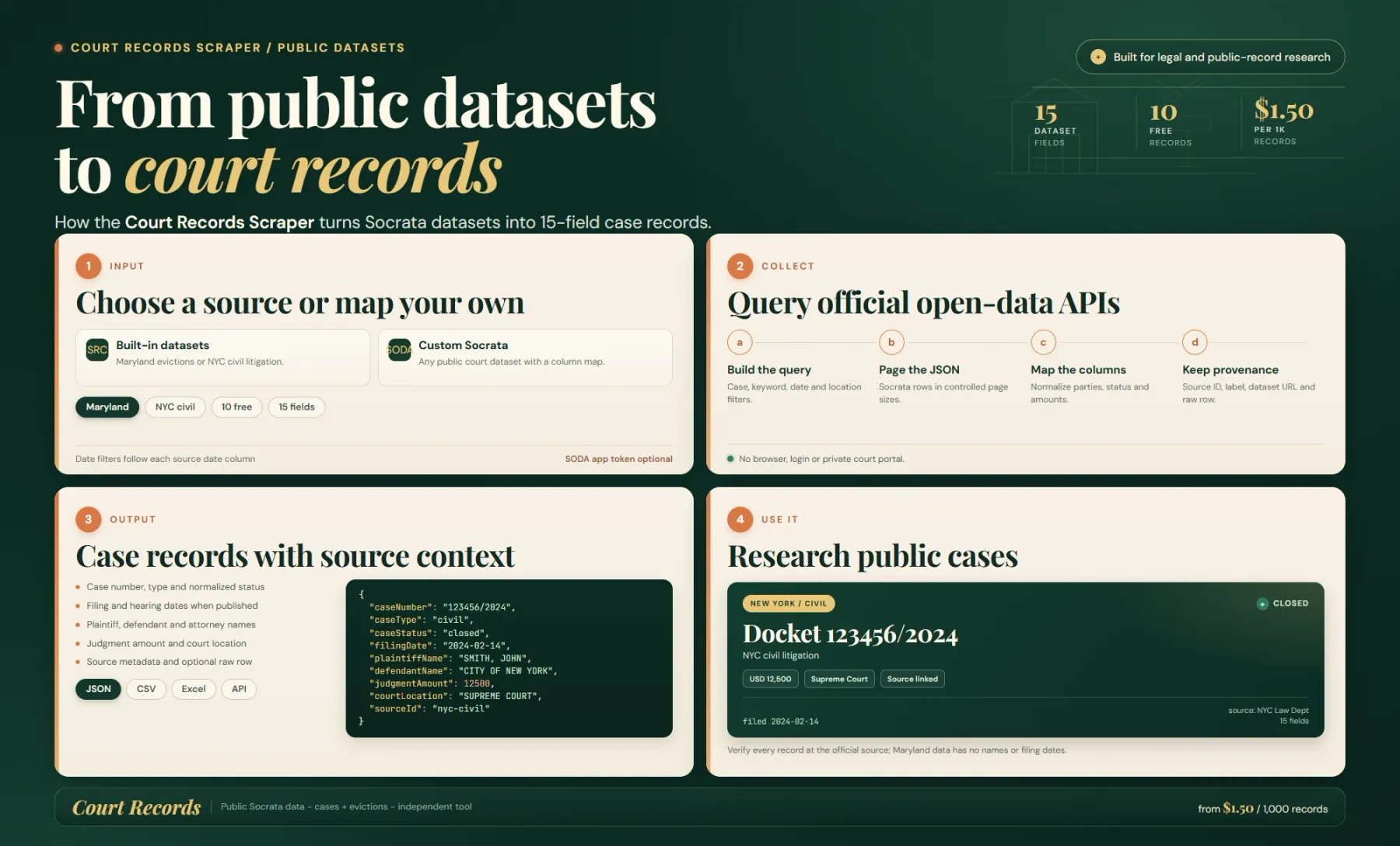
The Actor builds a Socrata query for each selected source, including optional case-number, keyword, date and location filters. It fetches JSON rows in pages, maps the source-specific columns into a normalized schema, and records the source ID, label and dataset URL. Requests run through Apify Proxy by default, with up to three concurrent requests and retries.
Pagination stops at the shared maxItems budget, 100 pages per source, 10,000 rows per source or 300 requests, whichever comes first. A free run is capped at 10 output records. pageSize controls how many rows are requested per API call, not how many records are returned.
The two built-in datasets are not equivalent:
- Maryland evictions is event-level enforcement data. It contains case numbers, event dates, event types, counties and tenant city/state/ZIP, but no plaintiff or defendant names and no filing date. An "Evicted" event indicates an enforcement stage, not the original filing.
- NYC civil litigation covers matters involving the NYC Law Department. It can include matter names, docket numbers, start dates, court names, dispositions and amounts. It is not a complete index of every civil case in New York.
Custom sources must be public Socrata resources with a case-number column and a usable date column. The Actor does not scrape HTML court portals or log in to restricted systems.
Input
| Field | Type | Required | Default | What it does |
|---|---|---|---|---|
sources | string[] | No | Both built-ins | maryland-evictions, nyc-civil-litigation, or both. Unknown IDs are skipped. |
customSoda | object | No | - | Custom Socrata source: domain, resourceId, caseType, dateField and a fieldMap. |
caseNumber | string | No | - | Contains-match on the source's case or docket number. |
keyword | string | No | - | Full-text search across all columns using Socrata $q. |
filedAfter | string | No | - | Lower date bound, YYYY-MM-DD, applied to the source's date column. |
filedBefore | string | No | - | Upper date bound, YYYY-MM-DD, applied to the source's date column. |
locationFilter | string | No | - | Contains-match on the source's location column, such as a county or court. |
maxItems | integer | No | 100 | Shared record budget, 1-5,000. Free accounts are capped at 10. |
pageSize | integer | No | 50 | Rows requested per API call, 10-200. |
includeRaw | boolean | No | true | Attach the original Socrata row as rawRow. |
sodaAppToken | string | No | - | Optional Socrata app token for higher rate limits. |
proxyConfiguration | object | No | Apify proxy | Proxy settings. Proxy use is recommended. |
Date filters use each source's configured date column. For Maryland that column is the event date, not a filing date, because the dataset does not publish a filing date. Always interpret a date filter in the context of the selected source.
Output
The normalized dataset schema contains 15 fields, plus optional rawRow when includeRaw is enabled.
| Field group | Fields | What you get |
|---|---|---|
| Case | caseNumber, caseType, caseStatus | Case or docket number, normalized type and status. |
| Dates | filingDate, hearingDate | Filing and hearing dates when the source publishes them. |
| Parties | plaintiffName, defendantName, attorneyName | Party and attorney names when available. |
| Outcome | judgmentAmount, courtLocation | Amount and court or county label. |
| Source | sourceId, sourceLabel, sourceUrl, recordUrl | Source identity and public dataset URL. |
| Details | details | Source-specific object with event data or extra litigation fields. |
| Optional raw | rawRow | Original Socrata row when includeRaw is true. |
caseStatus is normalized to pending, closed or null based on the source text. details is always present and may contain eventDate, eventType, evictedDate, tenantCity, tenantState and tenantZipCode for Maryland, or disposition, closedDate, division and payout fields for NYC. recordUrl points to the dataset endpoint, not to a unique public case page.
Pricing
The Actor uses pay-per-event pricing: a start event per run and one result event per court record.
| Event | FREE | BRONZE | SILVER | GOLD | PLATINUM | DIAMOND |
|---|---|---|---|---|---|---|
| Actor start, per run | $0.00005 | $0.00005 | $0.00005 | $0.00005 | $0.00005 | $0.00005 |
| Court record | $0.0015 | $0.00149 | $0.00148 | $0.00147 | $0.00147 | $0.00147 |
That is $1.50 per 1,000 records on the FREE tier. Free accounts receive the first 10 records as a preview, and preview rows are still billed. The shared maxItems budget applies across all selected sources.
Example Input
Example Output
Integrations and Automation
Run the Actor through the Apify API, Apify MCP server, Zapier, Make, n8n or a schedule. Export records to Google Sheets, Airtable, a database, a research notebook or a BI tool. Save the run input alongside the dataset so every extract is reproducible.
A sensible workflow is to keep sourceId plus caseNumber as the key, store details separately from the normalized columns, and compare snapshots for status or disposition changes. For custom sources, preserve the fieldMap because the raw columns differ between portals.
Related Actors
- Lawyers Justia Scraper - attorney and law-firm directory data.
- Skip Trace People Finder - public contact and address research.
- Bizapedia Scraper - company registration and corporate records.
FAQ
Does this Actor search every US court?
No. It supports two built-in official datasets plus any compatible public Socrata court dataset you configure. Many courts do not publish machine-readable data or require separate access. Do not describe a run as a national background check.
Why are names and filing dates missing for Maryland?
The official Maryland dataset is event-level eviction enforcement data. It does not publish landlord or tenant names and does not include a filing date. The Actor returns null rather than inventing values. details.eventType and details.eventDate describe the enforcement event.
Is a Maryland event proof that a tenant was evicted?
No. Treat it as a record of an event in the dataset, not as a legal conclusion. Records can be incomplete, updated or removed, and the dataset does not contain full case filings. Verify with the court before relying on it.
Can I use this for tenant screening?
Court records used for tenant screening can trigger FCRA or state screening rules. This Actor is not a consumer reporting agency product and does not guarantee completeness or accuracy. If you use it in a screening workflow, obtain legal advice, provide required notices and do not rely on a single record for an adverse decision.
How do I query another Socrata dataset?
Provide customSoda.domain, a 4x4 resourceId, a fieldMap with at least caseNumber, and dateField or filingDate. Optional mappings include plaintiffName, defendantName, caseStatus, judgmentAmount, courtLocation, hearingDate and attorneyName. The resource must be public.
What does recordUrl link to?
It links to the source dataset endpoint, not to an individual case page. The Actor does not construct case URLs that it cannot verify. Use caseNumber and the source's own portal if you need a per-case page.
For AI Agents and LLM Apps
The Actor is callable through the Apify API and Apify MCP server and returns one normalized record per source row.
Minimal input
Behavior an agent should know
- One item represents one source row, not a verified complete case file.
- Maryland records have no names and no filing date;
detailscarries event data. - NYC records are limited to NYC Law Department civil litigation.
caseStatusis normalized and can be null.recordUrlis a dataset URL, not a unique case page.- Free runs are capped at 10 records.
Suggested tool description: "Retrieve normalized public court and eviction records from official Socrata datasets, with optional custom source mapping."
Legal and Compliance
This Actor is an independent tool and is not affiliated with any court, the State of Maryland, the City of New York or Socrata. It accesses public open-data APIs and does not bypass logins or access restricted records.
Court data can be incomplete, delayed or corrected. You are responsible for complying with applicable law, including the FCRA when records are used for tenant, employment or credit screening, and with state and local fair-chance rules. Do not use this Actor for unauthorized background checks, harassment, or decisions that require a legally compliant consumer report. Verify every record at the official source.
SEO Keywords
court records scraper, public court records, eviction records, eviction data, Maryland evictions, NYC civil litigation, court case data, docket data, case number search, public records API, Socrata court data, legal research tool, tenant screening data, housing research, court dataset, civil cases, court records API, open data court records, eviction dataset, judgment amounts, attorney data, court case lookup, public records research


