
Shopify Scraper [💰$2.35/1K] | Tech Stack | Apps | Themes
Pricing
from $2.32 / 1,000 results
Shopify Scraper [💰$2.35/1K] | Tech Stack | Apps | Themes
Analyze any Shopify store — detect installed apps, theme, tech stack, social links and contact info. Extract product counts, collection structure and page speed for ecommerce intelligence.
Pricing
from $2.32 / 1,000 results
Rating
0.0
(0)
Developer

Ahmed Jasarevic
Maintained by CommunityActor stats
0
Bookmarked
2
Total users
1
Monthly active users
a month ago
Last modified
Categories
Features
Share
Shopify Scraper - Store Tech Stack, Theme and Commerce Intelligence
The Shopify Scraper turns public Shopify storefront URLs into structured store-level intelligence. Detect the active theme, Shopify identifiers, currency, country, language, installed apps and scripts, social links, public contact details, collections, product availability signals and page-delivery hints - one row per store.
Use it for ecommerce competitor research, agency prospecting, tech-stack audits, DTC market mapping or enriching an account list with platform details. This is a store-profile Actor, not a full product scraper: it reads the storefront homepage, a small product sample and the public collections endpoint to build a compact commerce profile.
Main Use Cases for Shopify Store Intelligence
- Ecommerce competitor research - compare themes, apps and storefront sophistication across a niche.
- Agency and freelancer prospecting - find stores using a specific review, chat or analytics stack.
- Tech-stack audits - detect analytics, marketing, payments, reviews and upsell tools from public scripts.
- DTC market mapping - group stores by country, currency, language and collection structure.
- Partnership qualification - check whether a prospect runs on Shopify and what tools they already use.
- Affiliate and creator research - collect public social links and contact channels for brand outreach.
- AI commerce analysis - give an LLM a normalized store profile instead of raw HTML.
How It Works
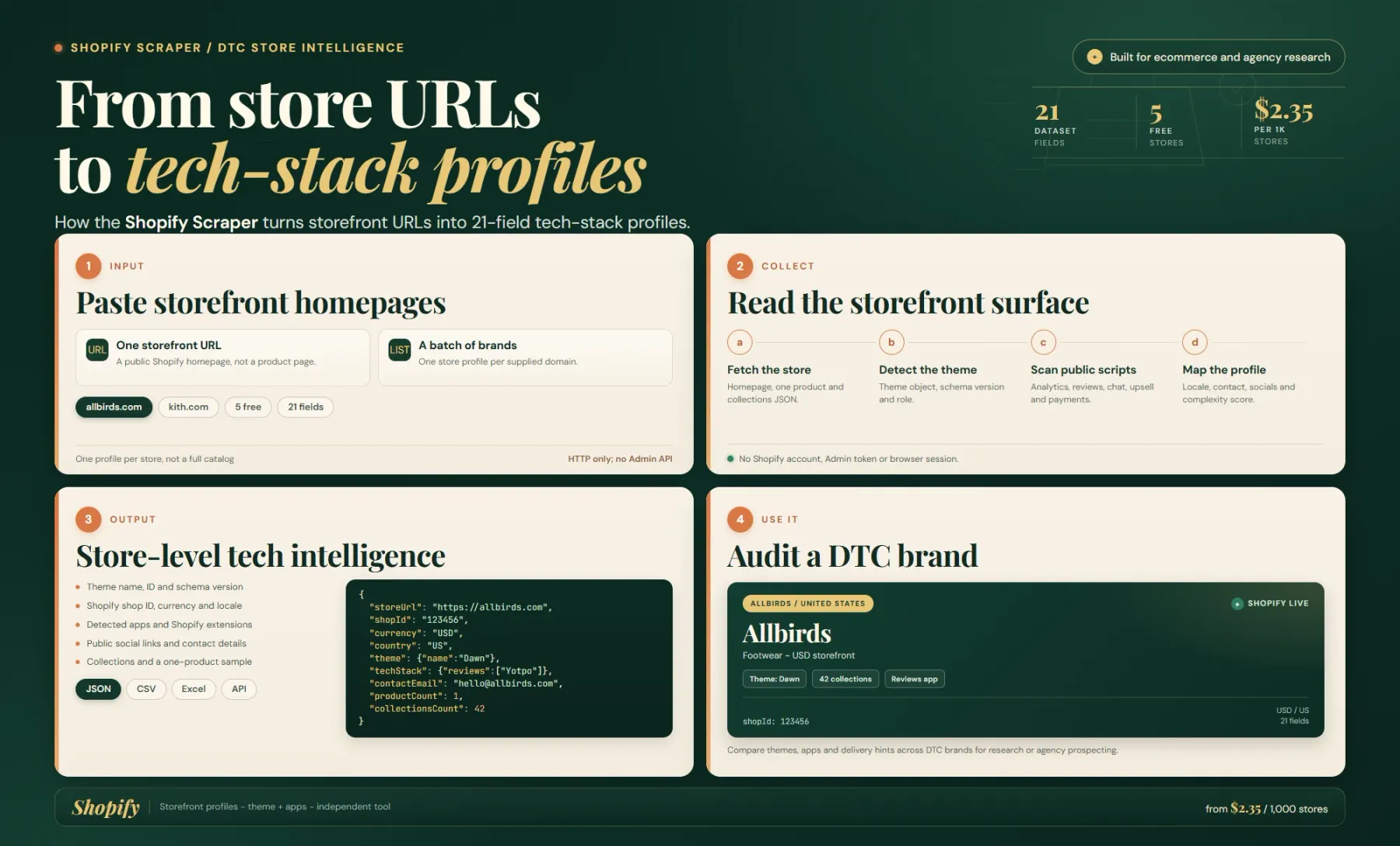
The Actor requests each storefront homepage over plain HTTP. It then reads the public /products.json?limit=1 endpoint for a minimal product sample and /collections.json?limit=100 for collection names, handles and counts. Script tags, meta tags, the checkout configuration and page headers provide the theme, app and delivery signals.
The storefront output is intentionally store-level. It is useful for understanding what platform and tools a brand uses, not for extracting a full catalog. productCount is a lightweight availability signal from the one-product sample and is normally 0 or 1; it is not the total number of products in the store. collectionsCount reflects the public collections response, capped at 100 by the request.
The Actor processes supplied store URLs with a small concurrency limit and standard retries. It does not require a Shopify account, Admin API token or browser. A non-Shopify URL can still produce a sparse record instead of failing, so validate shopId, theme and the tech-stack fields when platform certainty matters.
Input
| Field | Type | Required | Default | What it does |
|---|---|---|---|---|
storeUrls | string[] | Yes | - | Public Shopify storefront homepages, for example https://www.allbirds.com. |
maxStores | integer | No | 10 | Reserved in the current build. Supply only the stores you want processed. |
includeSitemapData | boolean | No | true | Reserved in the current build; sitemap parsing is not used. |
includeTechStack | boolean | No | true | Detect scripts and public signals for analytics, chat, reviews, upsell, payments and marketing. |
includeSocialContact | boolean | No | true | Extract social links and public contact email or phone from the storefront. |
includePageSpeed | boolean | No | true | Reserved flag; delivery timing headers are always captured when present. |
proxyConfiguration | object | No | Apify proxy group | Proxy settings for storefront requests. |
maxRequestsPerCrawl | integer | No | 200 | Global request ceiling for the run, not a per-store sitemap limit. |
Free accounts can process at most the first 5 stores in a run. Paid runs can process the supplied list subject to the request ceiling. Put the most important stores first when running on a free plan. Use the homepage URL with its normal protocol; a product or collection URL is not a substitute for the storefront root.
Output
The dataset contains up to 21 top-level fields per store. Only storeUrl and scrapedAt are always present; the rest depend on what the public storefront exposes.
| Field group | Fields | What you get |
|---|---|---|
| Identity | storeUrl, scrapedAt | Source URL and extraction timestamp. |
| Theme | theme | {name, id, schemaName, schemaVersion, themeStoreId, role} when detectable. |
| Store metadata | pageTitle, metaDescription, shopId, checkoutApiToken | Public page metadata and Shopify identifiers. |
| Locale | currency, country, language | Storefront currency and locale settings. |
| Contact and social | contactEmail, contactPhone, socialLinks | Public contact details and links for Instagram, Facebook, X, TikTok, YouTube, Pinterest and LinkedIn. |
| Tech stack | techStack, shopifyExtensions | Arrays of detected analytics, chat, reviews, upsell, payments and marketing tools, plus extension strings. |
| Delivery | pageSpeedHints, shopifyComplexityScore | Server timing hints and a simple storefront complexity score. |
| Catalog signals | productCount, sampleProduct, collections, collectionsCount | One-product availability signal, a sample title/vendor/type, collection objects and count. |
techStack is an object of string arrays, not a list of confidence scores. A tool appears when its script or public marker is found; absence means it was not detected, not that the store definitely does not use it. theme can be null when the storefront hides or customizes the standard theme metadata.
Pricing
The Actor uses pay-per-event pricing: a start event per run and a result event per store profile.
| Event | FREE | BRONZE | SILVER | GOLD | PLATINUM | DIAMOND |
|---|---|---|---|---|---|---|
| Actor start, per run | $0.0005 | $0.0005 | $0.0005 | $0.0005 | $0.0005 | $0.0005 |
| Store profile | $0.00235 | $0.00234 | $0.00233 | $0.00232 | $0.00232 | $0.00232 |
That is $2.35 per 1,000 stores on the FREE tier. Free accounts receive a preview of the first 5 stores, and returned preview rows are still billed as results. Failed requests do not create a result event.
Example Input
Example Output
Integrations and Automation
Trigger the Actor through the Apify API, the Apify MCP server, Zapier, Make, n8n or a scheduled task. Send store profiles to Google Sheets, Airtable, HubSpot, a database or an internal dashboard. Export the dataset as JSON, CSV, Excel, XML or HTML.
A common workflow is to keep a list of prospect domains, run the Actor weekly, and diff techStack, theme and collectionsCount between snapshots. Use shopId as the stable store key when available and storeUrl as the fallback. Join the output with product, traffic or ad data to prioritize accounts by commerce sophistication.
Related Actors
- Wayfair Scraper - product prices, SKUs, ratings and availability.
- 1stDibs Scraper - luxury and antique marketplace catalog data.
- Target Scraper - mass-market retail product and price data.
FAQ
Is this a Shopify product scraper?
No. It returns one store-level profile, not every product in the catalog. The product endpoint is used only for a one-item sample and an availability signal. Use a dedicated product scraper when you need the full catalog.
Does the Actor verify that a site runs on Shopify?
It detects Shopify identifiers and stores them when found, but the current build does not reject non-Shopify URLs. A sparse record with no shopId, theme or checkout token is a sign that the URL is not a standard Shopify storefront. Validate before treating a record as a Shopify account.
Why is productCount 0 or 1?
The Actor requests /products.json?limit=1 to keep runs light. The field reflects that sample, not the full catalog size. Do not use it as a total product count. Use collectionsCount and the sample product as lightweight merchandising signals instead.
Are sitemap counts supported?
The input includes a sitemap flag for compatibility, but the current build does not parse sitemaps. includeSitemapData therefore does not change the output. The same applies to includePageSpeed: delivery hints are captured when present, but the flag is reserved.
How many stores can one run process?
Free accounts are capped at the first 5 stores. Paid runs process the supplied storeUrls subject to the global request ceiling. maxStores is currently reserved rather than an active slicing control, so do not rely on it to truncate a list.
What contact data is collected?
Only public storefront contact information, such as an email or phone number in the footer or contact page, plus links to public social profiles. The Actor never logs in or accesses customer data.
For AI Agents and LLM Apps
The Actor is available through the Apify API and Apify MCP server and returns one JSON object per storefront.
Minimal input
Behavior an agent should know
- One item represents one storefront URL.
storeUrlandscrapedAtare always present; most other fields are optional.productCountis a 0/1 availability signal, not a catalog count.techStackvalues are arrays keyed by category.includeSitemapDataandincludePageSpeedare reserved flags in the current build.- Free accounts are capped at 5 stores, and preview rows are billed.
Suggested tool description: "Profile Shopify storefronts with theme, Shopify identifiers, installed apps, social links, contact details, collections and delivery signals."
Legal and Compliance
This Actor is an independent tool and is not affiliated with, endorsed by or sponsored by Shopify. It reads publicly available storefront pages and public JSON endpoints. Shopify's terms, store terms and applicable data-protection law still apply.
Detected apps and scripts are inferences from public page markers, not statements from the merchant. Public social links and contact details can be personal data; use them only with a lawful basis and honor anti-spam rules. Do not use the Actor to access admin data, customer records, private endpoints or protected themes.
SEO Keywords
Shopify scraper, Shopify store data, Shopify tech stack, Shopify apps detector, Shopify theme detector, Shopify store intelligence, DTC brand research, ecommerce competitor analysis, Shopify API alternative, Shopify store profile, Shopify Plus detection, installed apps, ecommerce tech stack, Shopify analytics, Shopify social links, Shopify contact data, Shopify collections, storefront audit, Shopify complexity score, ecommerce lead generation, Shopify dataset


