

Lobsters Stories Scraper: Front Page, Tags & Scores
Pricing
from $0.37 / 1,000 story scrapeds
Lobsters Stories Scraper: Front Page, Tags & Scores
Scrape Lobsters: story titles, URLs, scores, tags, comment counts and submitter. A smaller, higher-signal alternative to Hacker News for technical content.
Pricing
from $0.37 / 1,000 story scrapeds
Rating
0.0
(0)
Developer

Arman Hossain
Maintained by CommunityActor stats
0
Bookmarked
2
Total users
1
Monthly active users
19 days ago
Last modified
Categories
Share
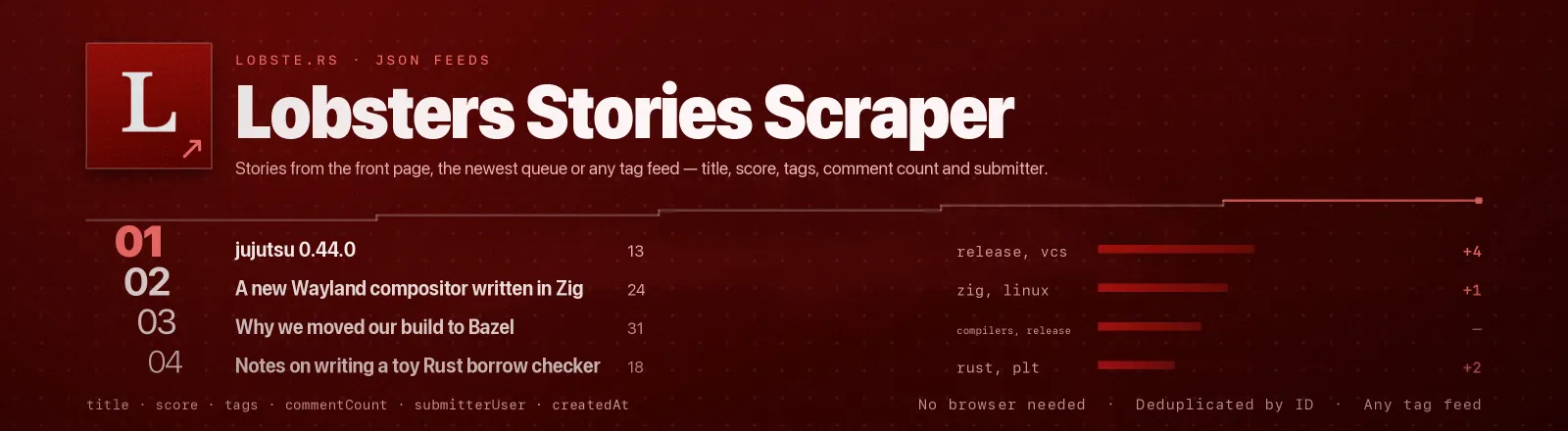
Pulls stories from the public JSON feeds behind lobste.rs. You get the title, the outbound URL, score, tag list, comment count, submitter and the comments permalink, from the front page, the newest queue, or any tag feed you name.
Lobsters is an invite-only technical community: a fraction of Hacker News' volume with a much higher hit rate per story. This Actor reads structured data directly, so there's no browser, no proxy, no login and no HTML parsing.
Agent skill: SKILL.md
What you get
| Field | What it holds |
|---|---|
feed | Which feed the story came from (hottest, newest, t/rust) |
shortId | Lobsters' short identifier, the stable key for deduplication |
title | Story title |
url, isTextPost | The outbound link, or null with isTextPost: true for discussion-only posts |
score, flags | Net score and flag count |
commentCount | Comments at the time of the run |
createdAt | Submission time, ISO 8601 with the site's US/Central offset |
submitterUser, userIsAuthor | Who submitted it, and whether they wrote the linked thing |
tags | Every tag on the story |
shortIdUrl, commentsUrl | Short permalink and the full comments URL |
description, descriptionPlain | Submitter's note as HTML and as plain text. Usually empty, which Lobsters reports as "" and this Actor stores as null |
scrapedAt | Run timestamp |
RUN_SUMMARY in the key-value store holds per-run counts, the filters you used, and any feed page that failed.
Use cases
- Engineering digest. Pull the front page every morning above a score threshold and post it into Slack.
- Niche topic tracking. Watch
t/rust,t/nixort/compilersfor anything that clears 10 points. - Hacker News complement. The same story often lands on both, and joining on the outbound URL shows which communities care about what.
- Release monitoring. The
releasetag is a clean firehose of version announcements for tools that matter. - Newsletter sourcing. A scored, tagged, deduplicated candidate list without reading a single web page.
Quick start
The current front page, nothing else:
Two tag feeds plus the newest queue, only stories worth reading:
A deep sweep of a quiet tag. The score filter throws most of it away, so page further:
Input
| Field | Type | Default | Notes |
|---|---|---|---|
feeds | array | ["hottest"] | hottest, newest, or a tag feed written as rust, t/rust, or rust,go for a combined feed. Full lobste.rs URLs are accepted and normalised. |
tags | array | [] | Keep only stories carrying one of these tags. Applied after fetching, so it filters hottest and newest too. Empty means all. |
minScore | integer | 0 | Drop anything scoring below this. |
maxStories | integer | 100 | Total cap across all feeds. 0 means no limit, bounded only by maxPagesPerFeed. |
maxPagesPerFeed | integer | 4 | Pages to walk per feed, 25 stories each. Max 100. |
Nothing is required. Running with no input returns the current front page.
maxStories and maxPagesPerFeed bound the run from two directions, and whichever is hit first stops it. With strict tags or minScore filters, raise maxPagesPerFeed or the run finishes early with very little.
Output example
A real record from the hottest feed:
Where a submitter added a note, the two description fields carry it:
About 5% of stories carry one.
Writing a feed name
Everything below resolves to the same three feed shapes:
| You write | Actor reads |
|---|---|
hottest, or nothing at all | https://lobste.rs/page/1.json |
newest | https://lobste.rs/newest/page/1.json |
rust, t/rust, https://lobste.rs/t/rust | https://lobste.rs/t/rust/page/1.json |
rust,go | https://lobste.rs/t/rust,go/page/1.json |
A comma-separated tag feed is a single request returning stories carrying any of the tags. Listing tags separately in feeds instead gives you one request per tag and a feed field that tells them apart.
API example
JavaScript example
Notes
- Stories are deduplicated by
shortId. A story on bothhottestandt/rustis saved once, tagged with whichever feed reached it first. The per-feed log line therefore shows a lower "saved" than "matched" on overlapping feeds, which is dedup working rather than a filter. - Pagination is irregular, and handled for you. The front page pages as
/page/N.jsonwhile every other feed appends/page/N.jsonto its own path. Both forms are built from the feed name you give. - Paging stops early when a page returns fewer than 25 stories, or when
maxStoriesis reached. - Requests are spaced 300 ms apart. Lobsters is run by volunteers on modest hardware and advertises no rate limit, so this Actor stays deliberately quiet rather than finding the ceiling.
- A bad tag is a 404, recorded in
RUN_SUMMARY.failureswhile other feeds carry on. The run only errors out if every feed fails. - Scores move. Score and comment count are a snapshot at
scrapedAt, not final values. Re-scrape the sameshortIdlater to build a trajectory.
FAQ
Do I need a Lobsters account? No. You supply no credentials.
How far back can I go? Deep pages work, and newest page 50 still returns stories. Lobsters has no date-range parameter though, so historical collection means paging and stopping on createdAt yourself. For a rolling archive, run daily on newest and dedupe on shortId.
Why are scores so low compared with Hacker News? Lobsters is invite-only and much smaller. A score of 10 is a solid story and 50 is a front-page hit, so set minScore accordingly.
Does it fetch the linked articles? No. It returns the url so you can. Fetching every outbound link is a different job with different politeness requirements.
Can I get comments? Not from this Actor. Comment counts are included and commentsUrl points at the thread, but the per-story comment JSON is a separate endpoint.
Can I plug it into something else? Yes. Apify API, the client libraries, webhooks, scheduled runs, dataset exports to JSON, CSV or Excel, or MCP. The output is structured JSON.


