

Matson Vessel Schedules: Sailings & Cargo Cut-offs
Pricing
from $2.00 / 1,000 sailing scrapeds
Matson Vessel Schedules: Sailings & Cargo Cut-offs
Scrape Matson O/D sailings for Hawaii, Alaska, Guam, Micronesia, South Pacific and China: dates, transit time, vessel/voyage, port rotation and every cargo cut-off (dry, reefer, hazmat, docs).
Pricing
from $2.00 / 1,000 sailing scrapeds
Rating
0.0
(0)
Developer

Arman Hossain
Maintained by CommunityActor stats
0
Bookmarked
2
Total users
1
Monthly active users
2 months ago
Last modified
Categories
Share
Matson Vessel Schedules Scraper: Sailings & Cargo Cut-offs
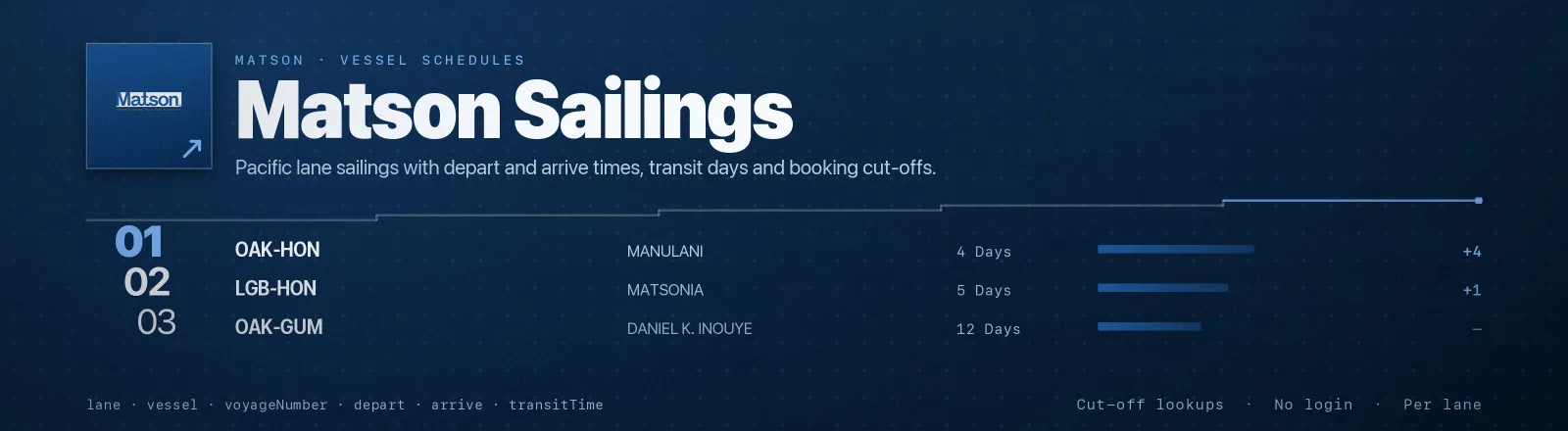
Pulls Matson's own O/D vessel schedule: sailing dates, transit time, vessel and voyage, port rotation, and the full cargo cut-off matrix (dry, reefer, hazmat, hazmat paperwork, documentation, ITN, AMS, VGM, oversize and China-service customs), for any origin-destination pair on Matson's network.
Matson's Jones Act and Pacific trades have almost no independent schedule transparency: Hawaii, Alaska and Guam shippers mostly work from the carrier's own site, one lane at a time. This Actor reads the same structured data the interactive schedule tool itself uses and returns it as one record per sailing, across as many lanes as you give it in a single run: US mainland and inland points, Hawaii, Alaska, Guam, Micronesia, South Pacific and the China/CLX express strings.
Agent skill: SKILL.md
What you get
One record per sailing.
| Field | What it holds |
|---|---|
lane | The requested lane, as ORIGIN-DESTINATION |
originCode, originName | Matson's origin location code and name |
destinationCode, destinationName | Matson's destination location code and name |
destinationRegionCode, destinationRegion | Matson's own region grouping for the destination (HI Hawaii, NI Hawaii neighbor island, AK Alaska, GU Guam, FM/GO Micronesia, SP South Pacific, CN China service, ML US mainland, IR US inland) |
vessel, voyageNumber, direction | Parsed out of Matson's own vessel/voyage/direction code |
vesselCode, vvd | Matson's short vessel code and the vessel-voyage-direction key |
rowNumber | The sailing's position in Matson's own result order |
depart, arrive | Departure and arrival, as Matson's site states them (its own local port time, not normalised to UTC) |
transitTime | Transit time as Matson states it (e.g. "4 Days") |
cutoffsIncluded | Whether the cut-off matrix below was fetched for this sailing |
totalTransitDays, departureDetail, arrivalDetail, availability | The same sailing described from the cut-off lookup: transit days, a fuller departure/arrival string, and cargo availability at destination |
dryCutoff, reeferCutoff, hazCutoff, hazPaperCutoff, inlandCutoff, docCutoff, itnCutoff, amsCutoff, vgmCutoff, oversizeCutoff, chinaCutoff | Every cargo cut-off Matson publishes for the sailing. "N/A" where Matson itself has nothing to state (most lanes don't carry a China-service or hazmat cut-off, for example) |
cutoffNote | Any free-text note Matson attaches to the cut-offs, usually null |
portRotation | The sailing's leg-by-leg rotation: [{ leg, from, to, vesselVoyage, transitTime, departureDate, arrivalDate }, …]. One leg for a direct sailing, several for an indirect one (e.g. Honolulu to Ebeye via Guam) |
scrapedAt | Run timestamp |
RUN_SUMMARY in the key-value store holds per-lane counts, the filters you used, and any lane that failed.
Use cases
- Cargo cut-off tracking. The whole reason to call this Actor: know exactly when dry, reefer or hazmat cargo has to be at the terminal for a given sailing, across every lane you book.
- Jones Act capacity monitoring. Hawaii and Alaska shippers watching vessel assignments and transit times week to week, where alternative sources are thin.
- CLX/CCX expedited China tracking. Transpacific e-commerce and retail supply chains that need China-service transit times and cut-offs specifically.
- Booking deadline alerts. Feed
dryCutoff/reeferCutoff/hazCutoffinto a reminder a few hours ahead of the deadline for cargo already booked on a knownvvd. - Lane comparison. Pull several origin-destination pairs into one run and compare transit time and cut-off timing across them.
Quick start
The default: Oakland to Honolulu for the next 30 days, cut-offs included.
One lane per named region, over a specific window:
A fast schedule-only pull, no cut-off lookups, for a lane you already know:
Input
| Field | Type | Default | Notes |
|---|---|---|---|
lanes | array | ["OAK-HON"] | One entry per lane, as ORIGIN-DESTINATION using Matson's own location codes (OAK-HON, TAC-ANK, LAX-GUM…). /, >, , and the word to also work as separators. An origin Matson doesn't recognise, or a destination it doesn't serve from that origin, is recorded in RUN_SUMMARY.failures rather than stopping the run. |
startDate | string | today (UTC) | Earliest sailing to include, as YYYY-MM-DD. |
endDate | string | startDate + 30 days | Latest sailing to include, as YYYY-MM-DD. Capped at 180 days after startDate; a longer request is clamped and RUN_SUMMARY.filters.dateRangeClamped is set to true. |
includeCutoffs | boolean | true | Look up the full cut-off matrix and port rotation for every sailing found. One extra request per sailing; turn it off for a faster, cheaper schedule-only pull. |
maxSailingsPerLane | integer | 15 | Cap on sailings saved (and charged for) per lane, from 1 to 100. This endpoint doesn't paginate, so this is the only thing bounding a busy lane. |
Nothing is required. Running with no input returns Oakland to Honolulu for the next 30 days.
Output example
A real record, cut-offs included:
An indirect sailing carries more than one leg in portRotation, Honolulu to Ebeye via Guam, for example, comes back as two legs rather than one.
Writing a lane
lanes accepts a range of separators for the same pair:
| You write | Actor reads |
|---|---|
OAK-HON | Oakland → Honolulu |
OAK/HON, OAK,HON, OAK>HON | Oakland → Honolulu |
OAK to HON | Oakland → Honolulu |
Codes are Matson's own 3-4 letter location codes, case-insensitive. The full origin list spans US mainland ports (OAK, LAX, SEA, TAC…), US inland points served by rail (ATLA, CHIC, DALL…), Hawaii (HON, HIL, KAH…), Alaska (ANK, DUT, KDK…), Guam (GUM), Micronesia (EBY, KWJ, MAJ, UUK…), the South Pacific (APW, PPG, SUV…) and the China/CLX-CCX string (SHA, NGB, XMN, PUS…). The Actor reads this list fresh from Matson's own schedule tool on every run, so a lane naming a real but currently-unserved pair is recorded in RUN_SUMMARY.failures rather than guessed at.
API example
JavaScript example
Notes
depart/arriveand every cut-off are Matson's own strings, in the port's local time, exactly as its schedule tool states them. They are not normalised to a single timezone or parsed into a machine date, since the source itself mixes date formats between the sailing list and the cut-off matrix ("Tuesday 08/25/2026 02:00"vs"Mon 23:00 08/24")."N/A"in a cut-off field is Matson's own answer, not a missing value: most lanes carry only a handful of the eleven cut-off types.- Cut-off lookups are per-sailing. A lookup that fails for one sailing is recorded in
RUN_SUMMARY.failuresand that sailing is still saved, withcutoffsIncluded: falseand its cut-off fieldsnull, one bad lookup never drops the row. - Destinations are validated against Matson's own served-destination list for that origin before a lane is searched, so a real code paired the wrong way (e.g. asking Guam for a destination it doesn't ship to) is reported by name rather than silently returning nothing.
- Requests are serialised, one at a time, across the whole run.
- The origin code list is read fresh from Matson's schedule page every run rather than hard-coded, since the carrier adds and drops ports.
FAQ
Do I need a Matson account? No. You supply no credentials.
How far ahead can I search? Matson runs fixed weekly (or less frequent) strings and only loads sailings a few months out. endDate is capped at 180 days after startDate.
Why does a lane I know is real return nothing? Two different things produce an empty result, and RUN_SUMMARY tells them apart. A destination not in RUN_SUMMARY.failures for that lane means the pair is valid but has no sailing scheduled in your window, widen startDate/endDate. A lane named in failures means the origin or destination code itself wasn't recognised or served.
Can I get rates or bookings? No. This is schedule and cut-off data only, read the same way Matson's own interactive tool does.
What does portRotation add over depart/arrive? For a direct sailing, nothing new. For an indirect one, it's the only place the intermediate port and its own transit leg show up, depart/arrive only ever describe the first and last leg.
Can I plug it into something else? Yes. Apify API, the client libraries, webhooks, scheduled runs, dataset exports to JSON, CSV or Excel, or MCP. The output is structured JSON.


