
PubMed Scraper: Biomedical Literature & Abstracts
Pricing
from $0.56 / 1,000 article scrapeds
PubMed Scraper: Biomedical Literature & Abstracts
Search 35M+ PubMed citations and get complete records: title, structured abstract, authors and affiliations, journal, MeSH terms, keywords, DOI and PMC ID. Straight from NCBI E-utilities, no key required.
Pricing
from $0.56 / 1,000 article scrapeds
Rating
0.0
(0)
Developer

Arman Hossain
Maintained by CommunityActor stats
0
Bookmarked
1
Total users
0
Monthly active users
2 months ago
Last modified
Categories
Share
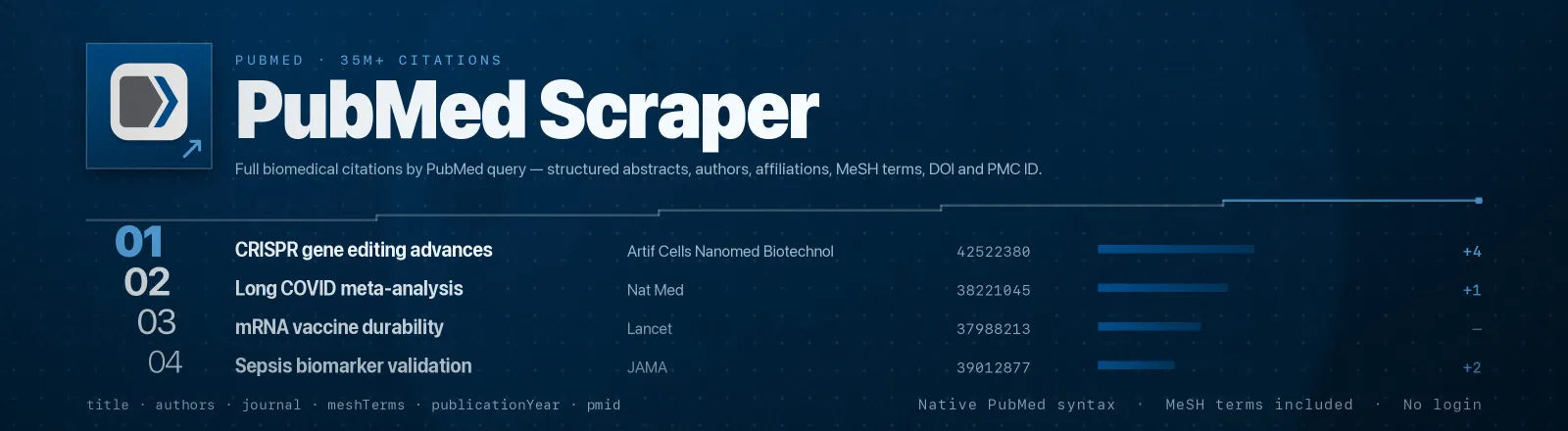
PubMed Scraper searches the 35M+ citations in PubMed and returns one flat record per article, title, full abstract with its section labels intact, authors and their affiliations, journal placement, MeSH terms, keywords, DOI and PMC ID.
It reads the data the NIH publishes specifically for programmatic access: no browser, no proxies, no login, no scraping of HTML pages. An optional free NCBI key triples throughput; without one the Actor paces itself automatically.
Agent skill: SKILL.md
What you get
| Output field | Meaning |
|---|---|
pmid, doi, pmcId, url | PubMed ID, publisher DOI, PubMed Central ID and the PubMed page |
title | Article title, inline <i>/<sup> markup stripped |
abstract | Full abstract. Structured abstracts keep their headings, BACKGROUND: … METHODS: … |
authors | Author names in order; consortium authors appear under their collective name |
affiliations | Every distinct affiliation string on the record |
journal, journalAbbrev, issn | Full journal title, its ISO abbreviation and ISSN |
volume, issue, pages | Issue placement |
publicationDate, publicationYear | Most precise date the record supports, 2020-12-31, 2026-12 or 1929 |
meshTerms | NLM Medical Subject Headings assigned by indexers |
keywords | Author-supplied keywords |
publicationTypes | Journal Article, Review, Randomized Controlled Trial, Published Erratum… |
language, languages, country | Primary publication language, every language the record lists, and the journal's country of origin |
scrapedAt | Run timestamp |
A RUN_SUMMARY record in the key-value store holds per-run counts, the filters used, every query that failed or matched nothing, and the PMIDs that were unusable or resolved to no record.
Common use cases
- Systematic reviews. One query per PICO arm, filtered to
ReviewandMeta-Analysis, exported to CSV for screening. - Biomedical RAG corpora.
title+abstract+meshTermsis a chunk with its own controlled vocabulary attached. - Institutional output tracking. Search
"Karolinska Institutet"[Affiliation]and count by year. - Pharmacovigilance and horizon scanning. Schedule a daily run sorted by publication date and diff on
pmid. - DOI reconciliation. Feed in PMIDs and get DOIs and PMC IDs back for joining onto other sources.
Quick start
One topic, the 100 best matches:
Recent English-language reviews and meta-analyses:
Enrich a list of PMIDs you already have, metadata only:
Input
| Field | Type | Default | Notes |
|---|---|---|---|
searchQueries | array | [] | PubMed query syntax. Field tags work: [Title], [Author], [Journal], [MeSH Terms], [Affiliation]. Combine with AND / OR / NOT. |
pmids | array | [] | Specific articles. Bare PMID, PMID: 33301246, or a pubmed.ncbi.nlm.nih.gov URL. |
fromDate / toDate | string | - | Publication date bounds as YYYY-MM-DD, YYYY-MM or YYYY. Applied as PubMed's own pdat filter. A partial toDate closes on the real last day of the period, so 2024-02 ends on the 29th in 2024 and the 28th in 2023. |
articleTypes | array | [] | Publication types, ORed together and ANDed onto every query. |
language | string | - | Three-letter code, eng, fre, ger, spa. |
sortBy | string | relevance | relevance (Best Match), pub_date, Author or JournalName. |
includeAbstract | boolean | true | Include the full abstract. Off makes the dataset several times smaller. |
maxResults | integer | 100 | Articles saved per source — each search query is a source, and the whole pmids list is one more. Hard ceiling 9,999, see Limits. |
email | string | - | Passed to NCBI so it can contact you rather than block you. Recommended. |
apiKey | string | - | Free NCBI key. Raises the rate limit from 3 to 10 requests/second. |
At least one of searchQueries or pmids is required, PubMed has no "return everything" mode. Both can be used in the same run; results are de-duplicated by pmid.
Output example
A real record from the run above:
meshTerms is empty for very recent records, NLM indexers assign headings weeks to months after publication, so a paper from last week has keywords but no MeSH. pmcId is only present when a free full text exists in PubMed Central.
Writing a PubMed query
The searchQueries field is passed to PubMed untouched, so anything that works in the search box works here:
| Goal | Query |
|---|---|
| Word in the title | CRISPR[Title] |
| Specific author | Doudna JA[Author] |
| Specific journal | Nature[Journal] |
| Controlled vocabulary | "gene editing"[MeSH Terms] |
| One institution | "Karolinska Institutet"[Affiliation] |
| Combined | (CRISPR[Title] OR Cas9[Title]) AND therapy NOT review[Publication Type] |
Plain keywords work too, PubMed's term mapping expands cancer into a large synonym set on your behalf. RUN_SUMMARY.filters records exactly what was sent.
API example
Limits and behaviour
- Two steps per query. esearch returns PMIDs, then efetch pulls the records 200 at a time. A 1,000-article run is one esearch plus five efetch calls, so cost per article falls sharply as runs get bigger.
- 9,999 results per query is PubMed's ceiling. esearch refuses
retstartabove 9998 and clampsretmaxto 9999. Slice a broader sweep withfromDate/toDaterather than raising the cap. - Rate limits are respected. 3 requests/second without a key, 10 with one. The Actor paces itself to stay under whichever applies, and NCBI's
Retry-Afteris honoured on the rare 429. - XML is parsed without a dependency. efetch answers XML, read here by a small purpose-built extractor. Presentational markup is stripped before entities are decoded, so
αarrives as α and an escaped<i>stays visible text. - Books are handled too. PubMed indexes NCBI Bookshelf entries such as GeneReviews as
PubmedBookArticlerecords with a different structure. They are parsed rather than dropped, but carry fewer fields, no volume, issue or MeSH. - Unknown PMIDs are named, not swallowed. efetch returns an empty set rather than an error for an ID that does not exist, so the run diffs what came back against what you asked for: entries that hold no ID at all land in
RUN_SUMMARY.invalidPmids, IDs that resolve to no record inRUN_SUMMARY.unresolvedPmids. - A query that matches nothing is a recorded outcome. A zero-result search is not an error on the wire, so the run reads PubMed's own warning list and writes the reason into
RUN_SUMMARY.failureswithkind: "empty"instead of finishing quietly with no rows. - A failing query never aborts the run. It is logged and recorded in
RUN_SUMMARY.failureswithkind: "error"; the rest continue. The run only errors out if every source fails outright. - Public data only. PubMed citations are public records. No authentication beyond the optional rate-limit key, no personal data, no access-control bypass.
FAQ
Do I need a proxy? No. Proxy configuration is not required to run this Actor.
Do I need an NCBI account? Not to run it. The API key is optional and only affects speed.
Why should I fill in email? NCBI asks automated clients to identify themselves and contacts the address before blocking anything that looks abusive. It is never used by this Actor for anything else.
What happens if a query fails? It is reported in RUN_SUMMARY.failures and the run continues with the rest.
Can I schedule it? Yes. Pair fromDate with sortBy: pub_date and diff on pmid for a "what's new this week" feed.
Does it fetch full text? No, the abstract only. When pmcId is present the full text is free at ncbi.nlm.nih.gov/pmc/articles/{pmcId}/.
Why is abstract null? Some records have none, editorials, errata, letters and many older papers. Nothing is invented.
Can I search MEDLINE only, or exclude preprints? Yes, with normal PubMed syntax: append NOT preprint[Publication Type] or AND medline[Subset] to your query.
Can I integrate it with something else? Yes, Apify API, client libraries, webhooks, scheduled runs, dataset exports (JSON/CSV/Excel) or MCP. Output is structured JSON.


