

Google Trends Scraper & Breakout Monitor
Pricing
from $4.00 / 1,000 completed keyword groups
Google Trends Scraper & Breakout Monitor
Export Google Trends interest over time, regions, related queries, rising searches and Trending Now topics. Schedule a keyword watchlist to track new rising and Breakout signals. No Google account or source API key is needed.
Pricing
from $4.00 / 1,000 completed keyword groups
Rating
0.0
(0)
Developer

Vadim Bezrukov
Maintained by CommunityActor stats
0
Bookmarked
9
Total users
5
Monthly active users
4 days ago
Last modified
Share
Planning an article, comparing product ideas or keeping an eye on a topic? Start with the words your audience searches for. This Actor collects Google Trends interest over time, regional interest, related queries, Breakouts and Trending Now in a Dataset you can inspect and export.
Run a snapshot for today's research, or keep a watchlist to see which signals appear on later checks. Search interest is relative, not a count of searches.
A small first run: one completed keyword group costs $0.004, including platform usage. Trending Now costs $0.002 per completed country feed. Failed and partial checks are not charged. Keyword data uses an Apify proxy; the quick start below includes that setting. You do not need a Google login.
See an example result
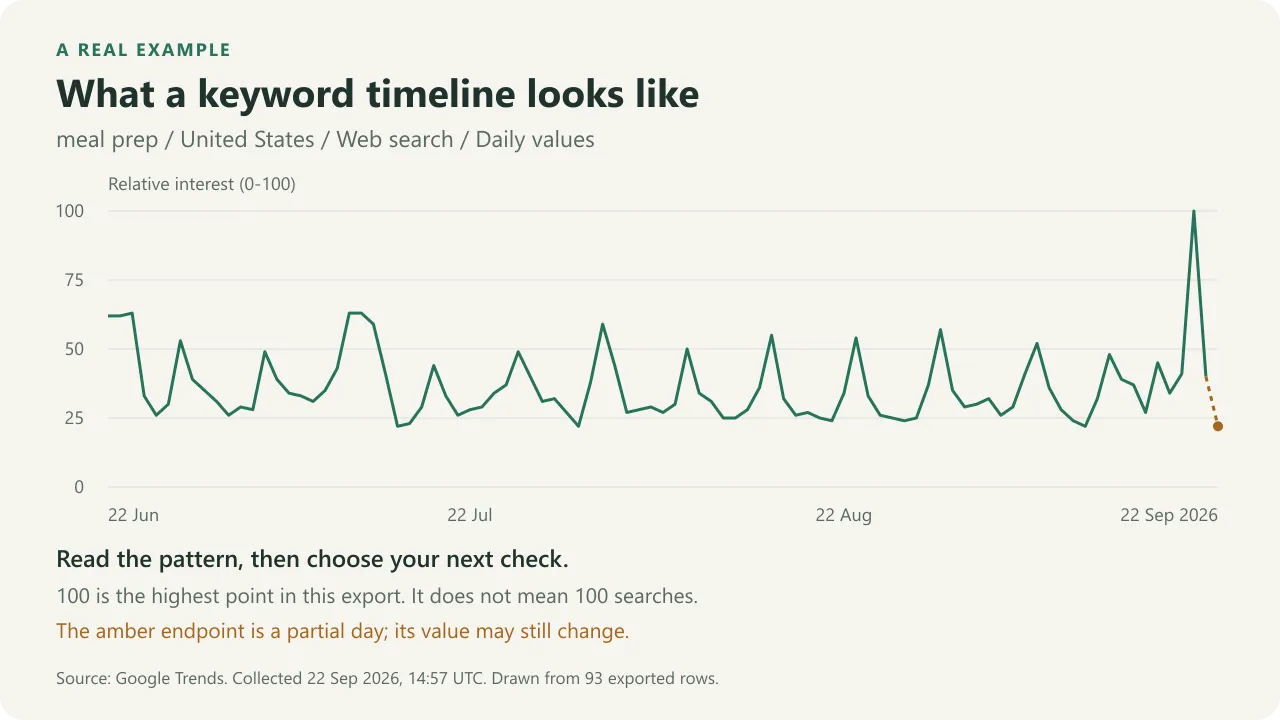
This chart uses 93 daily rows from a real public-keyword demo collected on
22 September 2026 at 14:57 UTC. It shows meal prep, US, Web search, for
22 June to 22 September. The amber endpoint is an incomplete day and may change.
100 marks the highest interest in this export, not 100 searches.
Download the plotted data.
The quick start collects related queries. Add interest_over_time to
dataTypes when you want a timeline like this one. The chart is drawn from
Actor output; it is not an additional dashboard or a screenshot of the Console.
Start in 2 minutes
- Replace
meal prepwith a topic your audience searches for. - Keep Snapshot + All records to get useful rows on the first run.
- Keep the default Apify proxy for keyword data.
- Click Start and open the Related queries dataset view.
The Store form is prefilled with meal prep; replace it with your own keyword.
The equivalent copy-paste input is:
This returns Google's current top, rising, and Breakout related searches. To
turn the same configuration into an alerting workflow, switch to monitor +
changesOnly. The first successful monitor run creates a baseline; later runs
emit newly rising queries, new Breakouts, meaningful growth-band changes, and
new Trending Now topics.
API examples and workflows
Use the Google Trends API recipes to call this Actor from Python or Node.js, or connect a watchlist through n8n or Make. The guide covers input previews, result statuses and spending limits. Start with a preview before running a paid collection.
Latest updates
11 October 2026 (1.10.15): CSV exports of API and scheduled runs keep
every column again. Larger runs stored by 1.10.13 and 1.10.14 could miss
nested columns such as source_scaling_context/... in CSV; their JSON export
with unwind=rows is complete. The README now has an
Output contract: what an integration can rely on and how
the output may change.
11 October 2026 (1.10.14): API and scheduled runs now store rows in
compact pages. The Output tab, the results link and JSON exports with
unwind=rows return the same flat rows as before. If your integration reads
raw Dataset items, add unwind=rows to its request, or set datasetFormat
to flat to keep one item per row. Runs started in Console or by AI agents
through Apify MCP keep one item per row. The previous version stays
available as build old until November 10, 2026; it rejects inputs that
contain datasetFormat. Re-import the n8n workflow below if you imported it
earlier. See Output.
10 October 2026: When Google refuses or does not answer a check in time,
your run now ends SUCCEEDED instead of FAILED. Each refused check is still
a row with status FAILED and its reason, never a zero, and it is not
charged. Read each group's status before using the values. If your
integration retries failed runs, set failRunOnRefusal to true to keep the
previous behavior.
From 20 October 2026: a keyword group still costs $0.004 and includes its first 250 data rows; each further row in the same group costs $0.00002. Most groups stay under 250 rows and cost the same as before.
In development
These are next on my list. There are no dates yet, and plans can change: the Changelog says what actually shipped. If one of them matters to you, say so in Issues; that moves it up.
- A one-row summary per keyword. Direction of interest (up, down or stable), the change between two comparable recent periods of the same chart, the peak and the top rising query, plus a plain sentence for people and AI agents. Built from data the run already collects, so it adds no source requests.
- Fewer repeated alerts. A query already reported at a growth level is not reported again just because its growth moves back and forth around a band edge.
- A completeness line for every run. How many groups got fresh data, how many came from the cache and how old it is, and which ones could not be checked.
- A stable event ID for every signal, so reading a run again or a repeated webhook updates the same row in your table instead of adding a duplicate.
- A ready daily digest for n8n and Google Sheets. Your topic list in a sheet, new signals and summaries written to their own tabs, one notification per run.
Start with one of three examples
SEO keywords · Shopping demand · Trending Now
For recurring signals, save monitor + changesOnly and keep the same Task and settings:
| Check | Example outcome | What reaches the change feed |
|---|---|---|
| First successful check | Existing rising queries are BASELINE | No new-change alert |
| Same results next time | Successful group status, no new signals | No change row |
| A query newly becomes a Breakout | BREAKOUT_NEW observation | One signal with the original source and scaling context |
| Google fails or answers only partly | FAILED or PARTIAL | Source status; last good state retained |
This is an illustrative state sequence, not a claim that the demo keyword changed. Search interest is normalized: do not calculate percentage growth by comparing independently scaled exports. Google's related-query growth labels and typed change events serve that purpose.
Where to go next
- Google Autocomplete: find phrases from topic prefixes, then compare your selected suggestions together in Trends. Match country and search property; suggestion rank is not search volume.
- Shopify Products, Price & Stock Monitor: check catalogues, prices and availability at store URLs you choose. Search interest does not tell you how much a store sells.
- Website SEO Audit: check the website you publish for noindex, canonical and broken-link issues. It checks technical conditions, not keyword rankings.
- App Store & Google Play Metadata Monitor: put branded interest alongside app releases, prices and aggregate ratings. Supply app URLs or IDs; neither release timing nor search interest proves downloads or causation.
Choose the keywords or URLs for the next tool and pass them in yourself or through your workflow. Each Actor runs separately and has its own pricing.
Pick the result and budget before running
| Existing example | Replace | First useful output | Cost at the current tariff |
|---|---|---|---|
| Country comparison | Keyword and country codes inside queries | Three timelines and related-query lists; compare shapes, not independently scaled scores | Three completed groups: $0.012 per run; $0.36 for 30 daily runs |
| Exact date window | Keyword, country and YYYY-MM-DD YYYY-MM-DD timeframe | A timeline for your campaign or season | One completed group: $0.004; rerun when the research window changes |
| Breakout signals | Keywords, market and your own stable monitorId | First run establishes a baseline; later runs return new signals plus status rows | One completed group: $0.004; $0.12 for 30 daily checks, including quiet days |
These examples include platform usage and assume every scheduled group completes. The saved spending cap is a ceiling, not the expected bill. An empty New signals view on the first monitor run is expected: inspect Group status, then repeat the same configuration. Use the workflow below to send verified changes to Sheets; export the timeline view as CSV for historical or country research.
Send verified changes to Google Sheets with n8n
Download the inactive n8n workflow and CSV sheet headers. Import the JSON into n8n, then:
- In Configure run, paste a completed run ID from your own Actor run.
- On all three HTTP Request nodes, select an HTTP Header Auth credential with header
Authorizationand valueBearer YOUR_APIFY_TOKEN. Save the real token only in n8n credentials. - In Upsert Google Sheets, select your Google credential and spreadsheet. Create a tab named
Changeswith the downloaded header row. - Execute manually. Change rows and source failure statuses are written separately; successful quiet checks and baselines do not become alerts.
The template reads an existing run; it does not start or schedule Actors. Only SUCCEEDED runs of this Actor are accepted. A run can succeed with a failed input: those rows are retained as row_kind=source_status, including the error in details_json. Reprocessing the same run uses event_key to update its existing rows. Serialize executions targeting the same sheet to avoid concurrent insert races. Values use RAW cell formatting, so source text is not evaluated as a formula.
The consumer stops before writing if the Dataset is empty, incomplete, or larger than 10,000 stored items. Add pagination for larger exports. This bound counts stored items before filtering: status rows, and row_page items of a few dozen rows each. API or Sheets failures stop the workflow and can be retried with the same run ID. Node code and failure/replay cases are verified offline; select and test your own credentials before using it regularly.
Choose a workflow
| Goal | Recommended setup | Result |
|---|---|---|
| Look up one keyword from your app or agent | snapshot + all, one entry in keywords, call the API | A ~5-10 second run with timeline, regions, related queries and one status row |
| Discover rising SEO keywords | snapshot + all, collect related_queries | Top, rising, and Breakout related searches with Google's growth labels |
| Compare one keyword across countries | queries with a geo per group | One run, one group per country, each with its own scaling context |
| Study a season or campaign | timeframe: "2025-11-01 2026-01-31" | Daily or weekly buckets for exactly that window |
| Monitor AI or market breakouts | monitor + changesOnly, keep a stable monitorId | Only newly rising queries, new Breakouts, and meaningful growth-band changes |
| Compare ecommerce demand | snapshot + all, use property: shopping | Jointly normalized timelines, related searches, and regional demand |
| Track Trending Now | collect trending_now and set trendingGeos | Newly appearing topics by country with approximate traffic and related news |
Data returned
| Data type | What you get |
|---|---|
interest_over_time | Relative interest per keyword per time bucket, with is_partial |
related_queries | Top and rising queries, including Breakout entries |
interest_by_region | Relative interest per region, with has_data |
trending_now | Today's trending searches per country, with news headlines |
Use the purpose-built dataset views to inspect New signals, Related queries, Interest over time, Interest by region, Trending now, or Group status without manually selecting fields.
Related topics is deliberately not offered. Google currently answers that endpoint with HTTP 200 and an empty list for every keyword tested, including high-volume ones. Shipping it would report "no related topics" for every keyword on earth, which is exactly the kind of confident-looking false zero this Actor exists to prevent. If Google starts serving it again, it will be added.
What makes this different
Most Google Trends scrapers hand you a fresh full export every run and leave you to diff it. This one is built to be scheduled:
- Bulk keyword groups. Up to 200 comparison groups per run, each with up to
5 keywords, each with your own
externalId. - Breakout and rising detection. Repeat runs return only the queries that newly joined Google's rising list, became a Breakout, or crossed a growth band.
- Deterministic monitoring state. The diff is always last successful check against this successful check.
- Explicit failure semantics.
NO_RESULTSandSOURCE_FAILEDare different, always. A throttled request can never come back as "interest = 0". A group Google refuses with HTTP 400 for its own geo, timeframe, category or keyword combination is a per-groupREQUEST_REJECTEDrow, not a failed run; only a batch of five or more such groups reads as a source condition. - A refused check is a row, not a broken run. When Google refuses or does
not answer any check in time, the run still ends
SUCCEEDED: every check is aFAILEDstatus row with its reason (THROTTLED,SOURCE_UNAVAILABLEorRUN_DEADLINE), nothing is charged, and the status message says Google gave no data. Always read each group'sstatus. SetfailRunOnRefusaltotrueif your integration retries failed runs. A changed Google response format or an error in the Actor still fails the run. - Budget-aware delivery. The complete export must fit the effective event budget before its group is charged. An insufficient limit never produces a silently truncated export.
Input reference
| Field | Default | Notes |
|---|---|---|
queries | - | Up to 200 groups, 1-5 keywords each (5 is Google's limit). A group may override geo, timeframe, category and property |
geo | US | US, DE, US-CA, … Empty string (or worldwide) for worldwide; UK is accepted as an alias of GB |
timeframe | today 3-m | now 1-H, now 4-H, now 1-d, now 7-d, today 1-m, today 3-m, today 12-m, today 5-y, all, or a custom YYYY-MM-DD YYYY-MM-DD window |
category | 0 | Google Trends category ID; 0 is all |
property | web | web, images, news, shopping, youtube |
dataTypes | timeline + related + region | Fewer types means fewer requests and less throttling |
mode | snapshot | monitor remembers the last successful check |
outputMode | all | changesOnly returns only new signals plus status rows |
trendingGeos | run's geo | Countries for trending_now |
monitorId | - | Separates independent watchlist histories |
cachedResultOnRefusal | true | When Google refuses a fresh check, deliver your account's last verified result of that check, marked CACHED and not charged (snapshot mode) |
failRunOnRefusal | false | When Google answers no check, end the run FAILED instead of SUCCEEDED with FAILED status rows |
datasetFormat | empty: compact; flat for Console and AI agent runs | compact stores rows in pages that unwind=rows turns back into flat rows; flat stores one item per row |
Per-group overrides
The run-level geo, timeframe, category and property are defaults. Any
advanced group can override them, which is how one run checks the same keyword
in several countries or windows:
Each group is still scaled independently by Google, so the three rows above are three separate charts, not one ranking of countries. An invalid override rejects only its own row; the rest of the watchlist runs.
Modes
snapshot- what Google says right now. Nothing is stored, nothing is diffed.monitor- remembers the last successful check per configuration.
Output modes
changesOnly- new and changed rising/breakout queries, new trending topics, plus a status row per group. This is the alerting shape.all- additionally every timeline point and region score. Timelines are measurements rather than events, sochangesOnlydoes not include them.
Pricing
Completed groups are delivered as they finish, so their dataset rows survive a
later source failure. RUN_SUMMARY is updated after each delivered group;
isFinal: false means the run is still in progress or was interrupted before its
final report. Concurrent groups can appear in completion order; use the group
identity fields when joining output to your input.
The Actor reserves up to 30 seconds before Apify's configured timeout to finish
output and diagnostics. Checks it cannot complete are FAILED with an explicit
RUN_DEADLINE, RUN_ABORTED, BUDGET_LIMITED, or SOURCE_CIRCUIT_OPEN error, never
zero interest.
After three consecutive matching source failures it pauses, admits one recovery
probe, and stops that source path if the probe also fails. Keyword and RSS outage
decisions are independent. These safeguards operate within one run.
The last successfully charged group is delivered in full even when its charge
reaches the spending limit. A stopped run retains its previous monitoring
baseline. If a run is restarted or resurrected, existing output is retained and
the Actor reports PREVIOUS_ATTEMPT_INTERRUPTED instead of replaying work that
may already have been charged. Start a new run to check again. A hard platform
kill can still interrupt an in-flight write; already stored rows and the most
recent progress report remain available.
The live Store Pricing tab is authoritative. From October 20, 2026, 22:18 UTC, a completed keyword group includes its first 250 data rows, and each further row in the same group costs $0.00002. Until then every group includes all its rows. Groups with one or a few data types usually stay under 250 rows and cost the same as before.
| Event | Price | What it covers |
|---|---|---|
| Completed keyword group | $0.004 | One fully answered group and its first 250 data rows (all rows until October 20, 2026) |
| Expanded export row (from October 20, 2026) | $0.00002 | Each further timeline, region or related-query row in that group; 1,000 extra rows cost $0.02 |
| Completed Trending Now feed | $0.002 | One country's trending feed and its topics |
These prices include Apify platform usage, including compute and the default Residential proxy traffic. You do not receive a separate platform-usage charge for a standard pay-per-event run.
You are never charged for retries, PARTIAL groups, throttled requests,
failed groups, or input rows rejected as invalid. A group that Google fully
answered with no data is charged, because checking it was the work.
100 fully completed keyword groups of up to 250 data rows each cost $0.40. A five-keyword comparison with every data type (about 950 rows) costs about $0.018 from October 20, 2026. Joint normalization is unchanged. A quiet monitoring check still incurs the group check price: the source must be checked to know it is quiet.
The Actor checks the whole export budget before charging its group. If it cannot
fit, it emits BUDGET_LIMITED, does not charge that group, writes no
partial export and retains monitoring state. Source work may already have been
performed to determine the row count. The early admission check still avoids
fetching a group when even its base charge cannot fit. A remaining $0.002 can still
pay for a Trending Now feed when it cannot pay for another keyword group.
Schedule alerts
The reason to run this twice: with mode: monitor and
outputMode: changesOnly, a repeat run returns only signals that are new since
the last successful check.
For example, run it daily and send new Breakouts to Slack, Make, Zapier, or your own webhook:
- Actor -> Schedule -> daily. Pick a minute away from the top of the
hour (for example
17 6 * * *): in the owner's own half-hourly checks, 24 of 30 Google refusals hit the runs that started at :00 and only 6 hit :30, so a cron line ending in0competes with everyone else's. - Actor -> Integrations -> Webhook on
ACTOR.RUN.SUCCEEDED. - Filter the dataset for
change_typeinBREAKOUT_NEW,RISING_QUERY_NEW.
Python:
Webhook-friendly output
Filter observation rows by change_type. The most useful alert values are
BREAKOUT_NEW, RISING_QUERY_NEW, RISING_QUERY_CHANGED, and
TRENDING_TOPIC_NEW. Keep the group_status rows in operational workflows so
that a failed check is visible instead of looking like “nothing changed”.
Use with AI agents through Apify MCP
Expose this Actor as a typed tool in any MCP-compatible client:
Example prompt:
For a scheduled agent, use mode: monitor, outputMode: changesOnly, and a
stable monitorId. Runs started through Apify MCP or Apify AI store one
Dataset item per row unless the input sets datasetFormat, so the MCP
dataset tool pages through rows. Values from different comparison groups,
locations, properties, or timeframes are not directly comparable.
One important rule about Google Trends numbers
Google Trends values are relative, not absolute search volume. A value of 100 means "the highest point on this chart", and the chart is renormalized for every request.
A score of 70 in one group is not comparable to a score of 70 in another.
This is the most common way Trends data gets misreported. Every row therefore
carries a source_scaling_context that identifies the measurement settings:
Matching source_scaling_context.id values are necessary, but do not prove
comparability between separate requests. The id changes when keywords,
location, timeframe, category, property or bucket size changes. A relative
timeframe such as today 3-m keeps the same id while its calendar window moves.
Google can also sample and scale separate requests independently. Treat each
request as its own snapshot; do not join the scores into one continuous scale.
What follows from that, and what this Actor therefore refuses to do:
| Compare keywords inside one group | Valid - Google normalizes them jointly. That is what a comparison group is for. |
| Compare values across groups | Not valid. Different scaling basis. |
| Compare US against DE, or 7d against 12m | Not valid. Different scaling basis. |
| Claim absolute search volume | Never. Google does not publish it. |
| Report "interest up 34% since last week" | Not emitted. Two independently normalized 0-100 series cannot be subtracted. |
Partial periods
The newest bucket in any timeline is usually still accumulating, and Google
flags it isPartial. It looks exactly like a collapse in interest, and it is
the classic source of fake "traffic is crashing" alerts. Rows carry
is_partial: true, and partial buckets are excluded from every signal this
Actor emits.
Missing data is not zero
Where Google has too little data it returns a 0 alongside hasData: false.
Those rows are published as value: null with has_data: false, never as 0.
Monitoring semantics
The first successful check of a configuration is a BASELINE - it records
what is already there without alerting on the whole backlog. From then on:
change_type | Meaning |
|---|---|
BASELINE | First successful check of this configuration |
RISING_QUERY_NEW | A query joined Google's rising list |
BREAKOUT_NEW | A query became a Breakout (rising past Google's reportable ceiling) |
RISING_QUERY_CHANGED | A rising query's growth crossed a band |
TRENDING_TOPIC_NEW | A new topic in the Trending Now feed |
UNCHANGED | Already reported; suppressed in changesOnly |
OBSERVATION | A timeline point or region score - a measurement, not an event |
Growth bands. Google's rising percentages jitter run to run, so a change is
reported only when growth crosses a band: <100%, 100-249%, 250-499%,
500-999%, 1000%+, breakout. Without this, every run would alert that
+240% became +250%.
There is no "breakout ended" event. Related queries are a top-N ranked list, not an inventory. A query dropping off it means something else outranked it - Google never says the rise ended. Reporting that as an event would be inventing information, so this Actor does not.
Monitor identity includes the full normalized configuration: keywords,
location, timeframe, category, property and data type. chatgpt in US over
today 3-m and chatgpt in DE over today 12-m are separate monitors and
never share state.
State is only advanced by runs that can stand behind it. A run that was
throttled, whose payloads stopped parsing, or that was cut short by a charging
limit leaves the previous state untouched. A verified NOT_FOUND answer is
valid state, never a source failure. Overwriting state after a failed check
would record signals as delivered that you never received, and silence them
forever.
Output
One flat row shape, discriminated by record_type and data_type, so the whole
run reads as one table. For CSV of API and scheduled runs, see the note below.
How rows are stored. By default (datasetFormat: compact; runs started
in Console or by AI agents through Apify MCP use flat) each keyword group
is one group_status item followed by row_page items of a few dozen rows
each, every row unchanged in the page's rows field. A page is sized so that a
CSV export keeps every column. Apify charges storage per item, so this keeps a
large export cheap to run. You always get the flat rows
shown below:
- the Output tab and its views show flat rows;
- Console's Export button saves stored items as they are. Runs started
in Console store one item per row, so their export is flat; for an API or
scheduled run, use the
unwind=rowslink below instead; - the API returns them with
unwind=rows, for examplehttps://api.apify.com/v2/datasets/<DATASET_ID>/items?unwind=rows&format=jsonfor every row of the run in one response; - the same link with
format=csvgives one CSV of the whole run. Larger runs stored by 1.10.13 and 1.10.14 (10-11 October 2026) can miss nested columns such assource_scaling_context/...in CSV; use their JSON export instead; limitandoffsetcount stored items, not rows. Do not page withunwind=rows: clients that advance the offset by the rows they received skip items. Read the whole run in one request withunwind=rows, or page through raw items and read eachrow_page'srowsyourself;datasetFormat: flatstores one item per row, as before October 2026, for integrations that read raw items and cannot passunwind=rows.
A breakout signal:
Every requested group also gets exactly one group_status row, including the
ones that failed - 200 groups in always means 200 status rows out:
Statuses
status | Meaning |
|---|---|
SUCCESS | Google answered with data |
NOT_FOUND | Google answered and genuinely had nothing. A real, verified absence |
PARTIAL | Some requested data types succeeded, others did not |
FAILED | We could not find out. Never means zero interest |
CACHED | Google did not answer a fresh check; your account's verified result of the same check from an earlier run was delivered instead (see below). Not charged |
Output contract
What an integration can rely on, and how it changes:
- Record types. Filter rows by
record_type.group_statusis one row per requested keyword group or Trending Now feed, always, including failed ones.observationis a timeline point, region score, related query or trending topic;data_typesays which. In compact storage a stored item can also be arow_page, which only wraps rows. New record types may be added, so do not treat every row other thangroup_statusas a signal. - Fields on every row:
record_type,source,source_id,scraped_at,schema_version,fingerprintandstatus. Missing data isnull, never0. - Identity.
source_idnames one entity within its measurement settings and stays the same across runs.fingerprintchanges when the measured content changes.external_idis your own label from the input. Join rows to your input byexternal_idand to earlier runs bysource_id. - Order. Groups arrive in completion order, not input order. Within a group, its status row comes first, then its observations.
- Paging.
limitandoffsetcount stored items, not rows; see above. - Changes are additive. Fields, record types and enumeration values are
only added. A published field is never renamed, removed or given a new
meaning. A change to how rows are stored ships with a way back (such as
datasetFormat: flat), the previous build under theoldbuild tag for at least 30 days, a CHANGELOG entry marked "Action needed" and a message to users.
When Google refuses: the last verified result
Google Trends sometimes refuses requests for a few minutes at a time, for
every connection at once. A run with a short timeout cannot wait that out. In
snapshot mode the Actor then delivers your account's last verified result of
the same check (same keywords, country, timeframe, category, property and data
types), instead of failing the run:
- every delivered row keeps its original
scraped_atand carriesfreshness: "CACHED"andcache_age_seconds; - the group's status row says
CACHED, withcached_scraped_atand anerrorof codeSERVED_FROM_CACHEthat names why the fresh check failed; - the group is not charged, and the run ends with
terminalReasonCACHED_RESULT; - results up to 24 hours old are used (1 hour for
now 1-d, 6 hours fornow 7-d, never fornow 1-Hornow 4-H); - a changed Google response format, a rejected request or your spending limit is never answered from the cache.
Verified results are kept in the named key-value store
google-trends-monitor-cache in your Apify account, one record per check that
the next verified run of the same check replaces. Each record is a few
kilobytes, you can delete the store at any time, and the Actor starts a new
one on its next run. Set
cachedResultOnRefusal to false if you only want fresh data and prefer a
FAILED status row when Google refuses. monitor mode never uses the cache, so a
cached result cannot create a false change.
Run metrics land in the key-value store under RUN_SUMMARY: group counts by
status, requests, retries, 429s, session bootstraps, proxy bytes, rows by type,
new breakouts, source health, and whether state was saved.
dataTypeOutcomes counts completion separately for each requested keyword data
type. operational provides a common health status, while stage, terminalReason,
build/run IDs and endpointCounters explain where a handled failure occurred.
The summary is saved before the Actor closes on input, proxy or source failures.
After HTTP 429, or an HTTP 200 HTML interstitial such as Google's Sorry page,
workers share a cooldown and subsequent requests run one at a time on a new
exit IP. Once one widget of a comparison has spent its recovery window,
each remaining sibling widget (for example the related queries of the other
keywords) gets a single attempt instead of another window; later data types
still run on the rotated session. CAPTCHA is not solved. After 20
consecutive valid payloads, concurrency increases by one, up to the original
three workers. Another failure resets that recovery streak.
Retry-After is respected for 429 and 503 responses when it fits the remaining
request and run time, reserving up to 10 seconds for a response. The related
queries widget, which Google refuses more often than the timeline and region
widgets, gets two extra exit-IP rotations within the same deadline and budget. A longer pause
fails the check explicitly without retrying early. Each logical request,
including bootstrap, retries and waiting, has a 90-second deadline; the maximum
of four attempts and run-wide retry budget remain.
If the run deadline interrupts a later widget, verified data from earlier widgets
is retained as an uncharged PARTIAL result. Pending checks remain FAILED with
RUN_DEADLINE. When at least one check was verified, the run finishes as
SUCCEEDED with terminalReason: RUN_DEADLINE, stopReason: RUN_DEADLINE and a
status message naming how many checks it could not complete. When the budget
ran out before any check was verified, it still ends SUCCEEDED with a
FAILED RUN_DEADLINE row per check and no charge, or FAILED with
failRunOnRefusal. Prior monitoring state is retained either way, so the next
run still diffs against the last full pass.
If you abort a run gracefully (the API's gracefully=true), the Actor stops
asking Google at once, marks unfinished checks RUN_ABORTED, keeps every saved
row with its charge and writes the final summary (
terminalReason: RUN_ABORTEDProxy is required for keyword data
This Actor is not affiliated with, endorsed by, or connected to Google. "Google" and "Google Trends" are trademarks of Google LLC. It reads publicly available Google Trends data.
Google Trends rate-limits its data endpoints per IP address, and it is tight. Measured on 2026-08-31 from a single clean address:
- roughly a handful of widget requests before refusal;
- a fresh cookie and a freshly-minted widget token from the same address are still refused, so the block is on the IP, not the session;
- once blocked, the address stayed blocked for over 33 minutes of once-a-minute polling, and had still not recovered when we stopped watching;
- a 5-group run direct from one address: 0% success, 50% of requests 429.
So the Actor rotates proxy sessions rather than repeatedly using a refused IP,
and proxyConfiguration is required when you request keyword data.
The default is Apify's Residential pool. On 2026-09-01, both Residential and
datacenter completed 10/10 benchmarks, but a later production run through the
default auto pool exhausted four rotated sessions with HTTP 429. A later
production check also exhausted four Residential sessions when country selection
was automatic, while RESIDENTIAL@US succeeded immediately. US-targeted
Residential therefore became the reliability-first default; a custom proxy
remains available for controlled deployments. Saved inputs that still contain
only {"useApifyProxy": true} are automatically migrated at runtime.
Trending Now alone works without a proxy. For a Trending Now-only run, the Actor ignores the proxy setting so the public RSS feed does not incur proxy traffic. The RSS part of a mixed keyword/Trending Now run also uses a direct connection.
No CAPTCHA solving, no Google login, no browser, and no access-control
circumvention is involved. The Actor uses plain HTTPS against publicly
available endpoints and honours Google's robots.txt: it never requests
/trends/explore or /explore, the two paths
trends.google.com/robots.txt disallows.
That constraint is enforced in code, not by convention.
Limitations
- Values are relative and unitless. Google does not publish absolute volume.
- Google decides the bucket size from the timeframe; it is reported per row, and daily and weekly series are not comparable.
- Maximum 5 keywords per comparison group. That is Google's limit, not ours.
- Related topics is not returned (see above).
- Trending Now is per country; there is no worldwide feed.
- Rising and breakout lists are top-N rankings, so absence from them carries no information and is not reported as an event.
- Throughput is bounded by Google's per-IP rate limit, not by this Actor.
- Search suggestions are a different surface. To collect the autocomplete phrases Google shows for a prefix and then submit the relevant ones here, use the Google Autocomplete Scraper & Rank Change Monitor.
Support
I maintain this Actor as part of automa-flow.
If a run fails or a result looks wrong, open an Issue
and include the link to the run. Apify shares that run with me automatically,
even when your account restricts resource access, so there is no need to paste
your input. Its RUN_SUMMARY record already says what failed, for example
UPSTREAM_429 when Google kept refusing requests or RESOURCE_TIMEOUT when the
run's own time limit ran out. Never post API tokens, proxy URLs or cookies.
An unavailable source stays marked as partial or failed, so you can distinguish it from a verified empty result. Check the update history for recent fixes.
Fewer failed runs
- Keep the default run timeout, or at least 10 minutes. Many Google refusals clear within a few minutes, and the Actor only waits as long as your run allows. A short timeout can end the run before any check completes.
- Put several keyword groups into one run instead of starting many one-keyword runs at the same moment. The Actor paces requests within a run; separate runs cannot see each other's pace. A refused group in a batch is reported on its own row while the other groups still deliver.
Bounded recovery diagnostics (September 2026)
A redirected request is never followed; it is repeated on a new session, and a
redirect to Google's unusual-traffic or consent page counts as a refusal like
HTTP 429. After the explore request or a widget receives HTTP 429 or an HTML
refusal, the retry allowance is spread across a recovery window and the final attempt is scheduled at the end
of that window, provided the request/run budget permits it. The envelope
follows the budget the run has left: the window is the remaining run time
minus 30 seconds, at most 300 seconds, and the logical request deadline is 30
seconds after it. A run with less than about 95 seconds left compresses the
same attempts into its last seconds, so even a very short timeout gets several
tries on different connections. Such a run cannot wait out a longer refusal;
its status message says so and suggests a longer timeout. A refused request gets four attempts (six for
related queries), or five (seven) from a 180-second window, so three groups
checked at the same time stay within the shared retry budget for a whole wave.
Google's refusals arrive in short waves that affect every connection at once
and usually pass within one to five minutes, so the window outlasts the wave
instead of failing the group. Successful widgets are retained, not fetched
again. The authoritative Retry-After and the shared retry budget still apply.
An insufficient remaining budget produces an explicit partial/failed result
rather than an early retry or a billed incomplete check.
RUN_SUMMARY.requestDiagnostics retains the last 128 HTTP attempts, including
bootstrap. Each record contains operation, attempt, numeric session ordinal,
run-relative start time, duration, status/error type, nidSent, nidPresent,
tokenFromCurrentSession and parsed retryAfterSeconds. Session ordinals identify
client sessions, not measured exit IPs. requestDiagnosticsDropped reports
truncation. No cookie values, proxy addresses, search terms or widget tokens are
stored in these diagnostics. RUN_SUMMARY also carries status, an error
object with the failure family for a FAILED run, failureFamilyCounts,
target counts (requestedTargets, successfulTargets, negativeTargets,
failedTargets and so on), the circuit breaker state and runOptions with
the run's timeout and memory. Recovery may still fail. Check the group and component statuses before using
the results; a completed run can contain incomplete groups.


