

Jumia Products Scraper
Under maintenancePricing
from $1.00 / 1,000 results
Jumia Products Scraper
Under maintenanceThe whole Jumia catalogue of a country through its sitemaps: hundreds of thousands of products with price, discount, stock, brand, seller and specs. Incremental mode reopens only what changed, so a daily refresh takes minutes not hours. Example: Morocco, 1,000 products, then schedule it.
Pricing
from $1.00 / 1,000 results
Rating
0.0
(0)
Developer

Badr Bouargan
Maintained by CommunityActor stats
1
Bookmarked
1
Total users
1
Monthly active users
2 days ago
Last modified
Categories
Share
Jumia All Products Scraper
Extract the entire product catalog of Jumia across 8 African countries — prices, discounts, stock, ratings, sellers, categories, images, specifications and customer reviews — with price tracking between runs and optional e-mail alerts.
Countries: Morocco · Côte d'Ivoire · Senegal · Nigeria · Kenya · Egypt · Ghana · Uganda
Why this Actor
- Complete catalog, not a keyword sample: it reads Jumia's official product sitemaps, up to roughly 1.1 million products for Kenya.
- Rich product data: price, old price, discount %, currency, stock, rating, review count, categories and breadcrumbs, badges, Jumia Express, seller name and score, images, specifications.
- Price tracking: previous price, change in value and percent, new products and stock changes, remembered from one run to the next.
- Ethical by design: identified bot, Jumia's
robots.txtrespected, speed limited, no fake browser identity and no proxy needed — which also makes runs cheap and stable.
What you can do with it
- Mirror a whole market: up to roughly 1.1 million products for a single country, in one dataset.
- Run price intelligence: previous price, change in value and percent, on every product, every run.
- Fill a product database: SKU, brand, categories, images, specifications and seller for each item.
- Catch stock movements: back-in-stock and new-product flags, with optional e-mail alerts.
- Compare countries: the same brand's pricing in Morocco, Nigeria and Kenya side by side.
Four ways to read a catalog
A million-product catalog does not have to be read the same way every day. Pick the mode that matches what you need:
| Mode | What it does | Measured |
|---|---|---|
| Full crawl | Opens every product page for complete data | the default |
| Incremental | Jumia dates each product in its sitemap; only what changed since your last run is reopened | a daily refresh becomes minutes instead of hours |
URL index (listUrlsOnly) | Lists every product URL with its modification date, without opening a single page | 300 URLs in 10 seconds for $0.002 |
Sampling (sampleEveryNth) | Keeps one product out of N, to study a huge catalog cheaply | 10 products sampled across 310,000 in 18 seconds |
Searching a brand without reading the whole catalog
Product URLs on Jumia contain the product name, so usually the brand. With Brand contains set to samsung, the Actor skips every page whose address does not carry the word. Measured on the Moroccan catalog: 23 Samsung products found in 4 minutes, where the same search without the URL pre-filter scanned 400 pages in 8 minutes and found none.
Switch Search keywords in the URL first off if you would rather open every page — slower, but it catches products whose address omits the brand.
How it works
- The Actor downloads Jumia's public sitemaps for the countries you selected.
- Each product page is read and parsed from its structured data, not from fragile CSS classes.
- Prices are compared with the previous run, stored in a named key-value store that survives runs.
- Filters are applied before saving, so you only pay for rows you asked for.
Step-by-step tutorial
- Pick one or more Countries.
- Set Max products per country —
0means the whole catalog. Start with1000to see the shape of the data. - Optionally add Filters: price range, minimum discount, in stock only, category keywords, name keywords, excluded words.
- Optionally switch on Reviews or E-mail alerts.
- Press Start, then export as Excel, CSV or JSON.
Daily price monitoring
Switch on Only changed products and E-mail alerts, then create an Apify Schedule (for example every day at 08:00). Keep the same Max products value on every run so comparisons stay meaningful.
Input example
A daily price watch on one brand, in two countries, reading only what moved since yesterday.
Output example
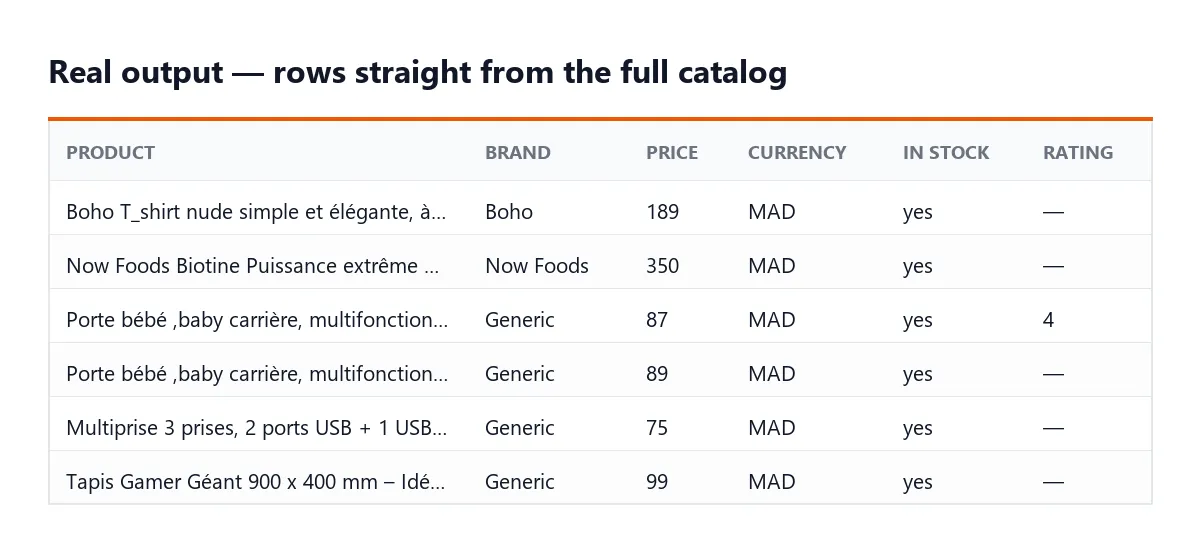
Every row as JSON:
Pricing
Pay per product returned, shown on the Actor's pricing tab. Proxy and compute are included — nothing else to pay. Because the Actor reads sitemaps and needs no proxy, it is one of the cheapest ways to watch a large catalog: a 1,000-product run finishes in a couple of minutes.
FAQ
How do I refresh a big catalog every day without paying for it twice? Switch on Incremental resume. The first run reads everything and remembers the newest date Jumia published; the next runs only reopen products that changed.
I set a brand filter and got nothing. Max products per country caps the pages the Actor opens, not the rows it saves. With a narrow filter and a small cap, everything can be filtered out. Raise the cap, or keep the URL pre-filter on so the budget is spent only on matching products.
Can I just get the list of products without the details? Yes — List URLs only. You get every product URL with its modification date, for a fraction of a cent per thousand. Useful to size a catalog, or to detect new products before deciding what to open.
Can I get the whole catalog? Yes — set Max products per country to 0. Expect a long run and a large dataset; start smaller to size it first.
Does it need a proxy? No. Jumia allows identified crawlers on product pages, and the Actor stays under the rate limit.
How does price tracking work? Each product's last price is stored under its SKU in a named key-value store. On the next run, the Actor fills previousPrice, priceChange and priceChangePercent, and can e-mail you only what moved.
Why did an e-mail alert not arrive? Actors started from Apify Store run with limited permissions and cannot send mail on your behalf. Copy the Actor into your account and switch it to full permissions, or connect a Slack, webhook or Zapier integration; the changed products are always in the dataset regardless.
Do you collect customer names? No. Reviews are returned without the reviewer's name.
Integrations
- Schedules: a nightly catalog refresh, with Only changed products to keep datasets small.
- API: JSON, CSV or Excel exports, or a direct pull into your warehouse.
- Webhooks: fire your pipeline the moment the catalog is refreshed.
- No-code tools: Google Sheets, Slack, Zapier and Make from the Integrations tab.
Support
Open an issue on the Actor's Issues tab for bugs, missing fields or a new country.
Did this Actor do the job? Leaving a short review on its Store page takes a minute and helps other people find it — and tells me which feature to build next.
Legal
This Actor reads public product pages and sitemaps, follows Jumia's robots.txt, identifies itself honestly in its user agent, and limits its request rate. It collects product data, not personal data. How you reuse prices and product information is your responsibility.
En français
Extrait tout le catalogue Jumia dans 8 pays africains : prix, promotions, stock, notes, vendeurs, catégories, images, caractéristiques et avis clients. L'Actor lit les sitemaps officiels de Jumia, respecte son robots.txt, se présente sous une identité de robot honnête et limite sa vitesse — d'où un coût faible et des runs stables. Il mémorise les prix d'un run à l'autre et peut n'envoyer que ce qui a changé, avec alertes e-mail. Filtres : prix, remise minimum, en stock, mots-clés de catégorie ou de nom, exclusions.


