

Google SERP Scraper — Organic, AI Overviews & Leads
Pricing
from $0.002 / search page
Google SERP Scraper — Organic, AI Overviews & Leads
Scrape Google Search without an API key: ranked organic results, People Also Ask, related searches, shopping, knowledge panel and local pack, plus the AI Overview with every cited source resolved to a domain and citation index.
Pricing
from $0.002 / search page
Rating
0.0
(0)
Developer

Yuliia Kulakova
Maintained by CommunityActor stats
0
Bookmarked
4
Total users
3
Monthly active users
24 days ago
Last modified
Categories
Share
Scrape Google Search at scale — organic results, ads, People Also Ask, knowledge panel, local pack, shopping, and the AI Overview block with parsed source domains and citation index.
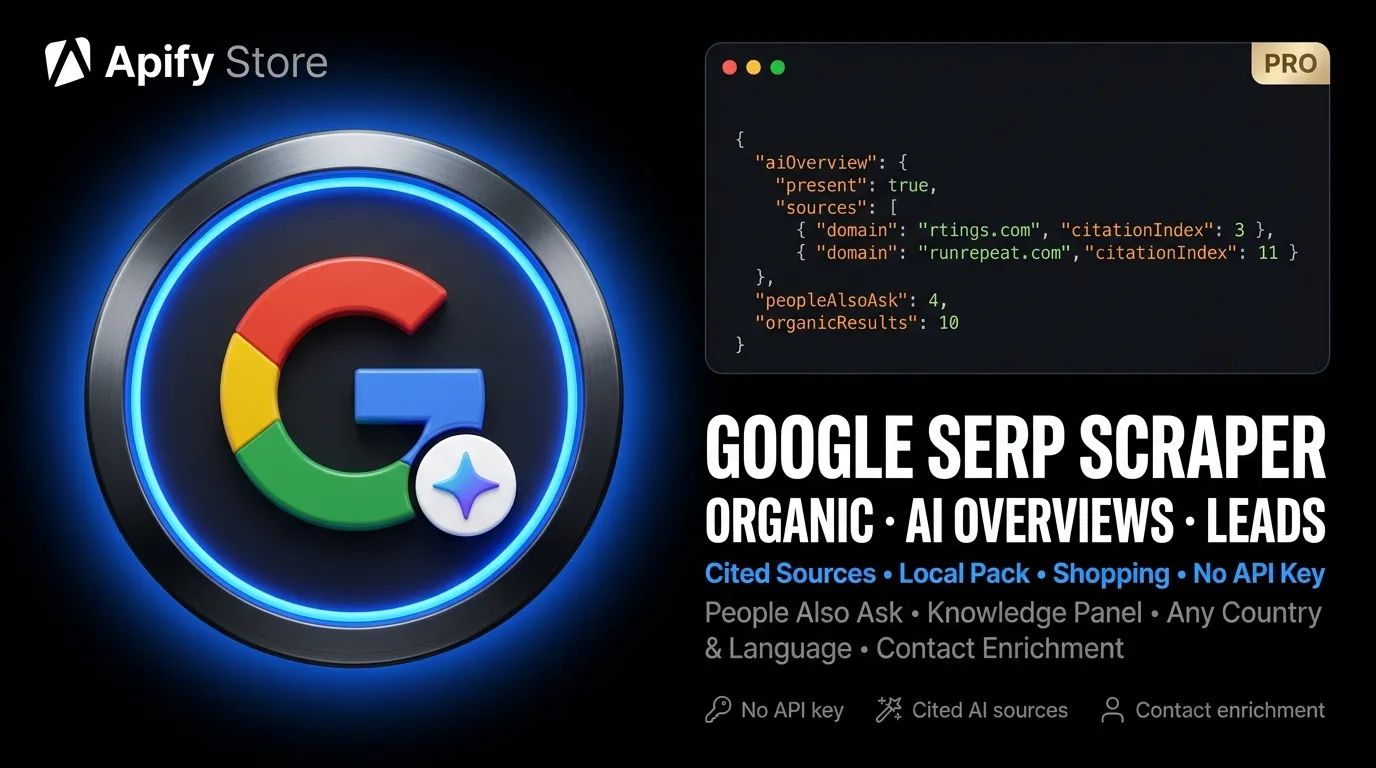
Google SERP Scraper turns any search term (or raw Google URL) into structured JSON: ranked organic results, SERP-feature blocks, and — its main differentiator — the AI Overview with each cited source parsed into a real domain plus its citation index, the exact data Google Search Console does not expose. It is built for SEO teams tracking rankings, AEO/GEO teams measuring which domains AI Overviews actually cite, and lead-gen teams turning result domains into published contacts. No Google API key is required.
Key features
- AI Overviews with parsed sources — the
aiOverviewblock returns the answer text plus asources[]array where every citation is resolved to a realdomain, fullurl,title, andcitationIndex, with an orderedsourceDomains[]roll-up. Most competitors return only raw AIO text (or nothing); this actor exposes which domains Google's AI cited and in what order. - Full SERP-feature coverage — independently toggleable blocks for
organicResults,ads,shopping(Popular Products carousel),peopleAlsoAsk,relatedSearches,suggestedResults("People also search for"),featuredSnippet,knowledgePanel, andlocalPack. - Rank & position monitoring — every organic result carries a
position, andresultsTotalis parsed per query, so you can diff runs to track movement and new-vs-last-run changes over time. - Optional lead enrichment — with
enrichLeads, the top organic result domains are crawled for named people, emails, phones and socials.emailholds only an address the site actually publishes. When a person has none, a name-derived candidate is offered separately asemailGuess(withemailGuessPatternanddomainAcceptsMail) and is clearly labelled as a guess — it is never presented as a confirmed address. Results attach to the query item and mirror into separateleadsandlink-prospectsdatasets. - Rich localization & operators — country, language, precise location targeting, Google TLD, device (desktop/mobile), SafeSearch, date filters, and the full set of search operators (
site:,intitle:,filetype:, exclusions, and more). - Keyless by default — no Google or SerpApi key to manage, and no account to keep alive. Proxying is configured automatically; leave the default in place.
- Optional multi-engine answers (BYO key) — add answers from Gemini, Perplexity, or ChatGPT for the same query when you supply your own API keys, for cross-engine AEO comparison.
- Pay-per-result pricing — you are billed for results produced, with a cheap organic-only
fastmode and afullmode for every enabled block.
Input
queries is the only required field. Everything else has sensible defaults. Full parameter list is in the input schema; the main parameters:
| Field | Type | Default | Description |
|---|---|---|---|
queries | array (required) | — | Search terms or raw https://www.google.com/search?q=... URLs (used verbatim, missing params filled in). |
maxResultsPerQuery | integer | 10 | Target organic results per page (Google num). Google deprecated num=100 in Sep 2025; values ≤ ~20 are reliable. Alias: num. |
maxPagesPerQuery | integer | 1 | SERP pages to paginate per query. |
countryCode | string | "us" | Country of search (Google gl). Alias: gl. |
languageCode | string | "en" | Interface / results language (Google hl). Alias: hl. |
locationName | string | — | Human location (e.g. "New York,New York,United States"), encoded for you. Advanced users can pass a pre-computed locationUule instead. |
googleDomain | string | "google.com" | Google host to query (e.g. google.co.uk). |
device | enum | "desktop" | desktop or mobile layout / header fingerprint. |
safeSearch | enum | "off" | off | active | nfpr (no spelling auto-correct). |
includeOrganic | boolean | true | Organic results block. |
includeAiOverview | boolean | true | Parse the AI Overview (text + source domains + citation index). |
includeAds / includeShopping / includePeopleAlsoAsk / includeRelatedSearches / includeFeaturedSnippet / includeKnowledgePanel / includeLocalPack / includeAiMode | boolean | false | Toggle each SERP-feature block independently. |
aiOverviewMode | enum | "http" | http (cheap, opportunistic) or render (Playwright — reliably renders/expands the AI Overview). |
enrichLeads | boolean | false | Crawl top result domains for published contacts. See maximumLeadsEnrichmentRecords, leadsEnrichmentDepartments, verifyLeadsEnrichmentEmails, linkProspecting. |
includeWebsiteContent | boolean | false | Fetch each organic URL and extract title / description / text (+ websiteContentMaxPages). |
geminiSearch / perplexitySearch / chatGptSearch | boolean | false | Add cross-engine answers (require geminiApiKey / perplexityApiKey / openaiApiKey or the matching env var). |
proxyConfiguration | object | preconfigured | Leave as is. The default is the configuration this Actor is tuned for; other networks are refused by Google. |
mode | enum | "full" | fast (organic only, cheapest) or full (all enabled blocks incl. AIO). |
saveHtmlToKVS | boolean | false | Persist raw SERP HTML to the key-value store for debugging / re-parsing. |
Example input
Output
One dataset item per query-page. Trimmed real-shape sample:
Output fields
searchQuery— request metadata: resolvedterm, canonicalurl,device,page, Googledomain,countryCode,languageCode,locationUule, andscrapedAttimestamp.resultsTotal— Google's "About N results" count (integer, ornullwhen Google omits it).organicResults[]—position,title,url,displayedUrl,snippet,domain,type(organic/product/video/news),emphasizedKeywords[],siteLinks[]({title, url}),date,richSnippet({rating, reviews, price}),productInfo({price, currency, rating, reviews, availability}). WhenincludeWebsiteContentis on, each result also gets awebsiteContentobject.ads[]—position,title,url,displayedUrl,description,extensions[].shopping[]— Popular Products carousel:position,title,url,price,oldPrice,discount,merchant,rating,reviews.peopleAlsoAsk[]—question,answer,sourceUrl,sourceTitle(see limitations on answers).relatedSearches[]/suggestedResults[]—{query, url}and{title, url}.featuredSnippet—{type, text, sourceUrl, sourceTitle}ornull.knowledgePanel—{title, type, description, attributes{}, links[]}ornull.localPack[]—name,rating,reviews,address,phone,category,hours.aiOverview—present,text,sources[]({url, title, sourceName, domain, description, citationIndex}),sourceDomains[](ordered),position(above/below/null), andcaptureType.aiMode— same shape asaiOverviewplusqueryFanOut[],url, andcaptureType/blockReason;nullunlessincludeAiModeis on.geminiResult/perplexityResult/chatGptResult/copilotResult— optional per-query:{engine, present, skipped, blocked, blockReason, answerText, citedSources[], model}.meta—statusCode,resolvedUrl,proxyUsed,blocked,blockReason,htmlKvsKey.
aiOverview.captureType values: static_html (parsed from the HTTP response), rendered (Playwright), async_pending (Google deferred it behind a JS/async token), not_present, disabled, or error.
Pricing
Billed per event — you pay for what actually arrives, and platform usage (compute and proxy) is billed to your Apify account on top.
| Event | Price | Charged when |
|---|---|---|
| Search page | $0.002 | one search page is delivered, with every block you enabled |
| AI Overview | $0.005 | the page really contained an AI Overview |
| Contact | $0.010 | one named contact is found (enrichLeads) |
| Result page content | $0.002 | one result page is fetched and its text extracted |
| Actor start | $0.010 | per GB of run memory, when the run starts |
So a search with no AI Overview costs $0.002, and one with an overview $0.007.
Not charged, ever:
- a search page Google refused to serve — you see the failure, you do not pay for it;
- an AI Overview that did not arrive (Google serves it inconsistently — see the limitations);
- a result page that refused the request or returned no readable text;
- AI Mode, ads, and email verification — they cannot work here and are never billed (the limitations section explains why).
Use mode: "fast" for organic-only runs when you do not need the extra blocks.
Use cases
- SEO rank tracking — monitor
positionandresultsTotalfor your keywords across countries, languages, and devices; diff runs to detect ranking movement. - AEO / GEO citation tracking — measure which domains Google's AI Overview actually cites (
aiOverview.sourceDomains+citationIndex) for your target queries, and whether your own domain appears. Optionally compare against Gemini / Perplexity / ChatGPT answers. - Lead generation — turn the domains that rank for a commercial query into published contacts (
enrichLeads), with department and seniority filtering, exported to a dedicatedleadsdataset. - Competitor & SERP monitoring — watch competitors' organic positions, ad presence, shopping listings, knowledge panels, and local pack rankings over time.
Proxy
Leave proxyConfiguration at its default. It is preconfigured for this Actor, and Google
refuses most other networks on the search endpoint — a custom proxy will simply return
captcha pages. The Actor warns you in the log if a non-default configuration is supplied.
Honest limitations
We would rather you know these up front than be surprised by empty fields:
- Paid
ads[]are effectively always empty. Google does not serve ads to this Actor's sessions, so the block stays empty even in render mode. Organic "Popular Products" still come through inshopping[], and organic results, AI Overview, knowledge panel and local pack all work fully. - People Also Ask answers often stay
null. The questions are always captured; the answers load separately and are only available in render mode (aiOverviewMode: "render"). - Google AI Mode requires a signed-in Google account, which this Actor does not use. It is reported honestly as
aiMode.captureType: "not_present"with a reason, never faked. - AI Overview over pure HTTP is opportunistic. Google inlines the AIO inconsistently. When it does, you get fully parsed sources + domains (
captureType: "static_html"); otherwise the actor honestly reportsasync_pendingornot_present. For a reliable AIO on every query, useaiOverviewMode: "render"(Playwright — slower, more CPU/memory). - Combining several search operators can make Google drop them. An over-constrained query (exact phrase +
site:+excludeWords, say) returns too few matches, so Google quietly relaxes the restriction and serves loosely related results instead. Each operator works on its own —site:alone returns only that domain. Narrow one filter at a time. - Organic result URLs are the site root, not the deep page. Google does not expose the destination of a result link in a resolvable form, so
urlis the site origin anddisplayedUrlkeeps the breadcrumb Google shows. A link that cannot be resolved is reported asnullrather than handed back as an unusable Google address.includeWebsiteContenttherefore fetches the site's landing page, not the ranked page. AI Overview sources are different — their citations usually carry the full deep URL. - The AI Overview is served opportunistically. The same query can return one on one run and none on the next; this is Google's behaviour, not a failure.
captureTypereports exactly what happened (static_html,rendered,async_pending,not_present). - AI Mode (
includeAiMode) is gated behind a Google login and returnsai_mode_not_generated_logged_outfor anonymous sessions. It is reported honestly rather than faked. - Shopping product links are not available. Google does not expose them, so
shopping[].urlisnull; the title, price, old price, discount, merchant label, rating and review count all come through. suggestedResults[]repeatsrelatedSearches[]on most SERPs — Google merges the two blocks and both keys are emitted for schema parity with other SERP actors.- Contact crawling depends on the target site. Company sites throttle repeated visits, and a site that serves only its homepage has no team page to read — the run then reports
leadsCount: 0with the crawled page count visible in the log. The crawl goes through Apify Proxy to spread the load. - Email verification is MX-only on the Apify platform. Outbound port 25 is filtered there, so the SMTP handshake cannot run and
emailStatusstaysunknownwithsmtpBlocked: true. An MX record proves the domain accepts mail — it does not prove the address exists. - Multi-engine answers need your own API keys.
geminiSearch/perplexitySearch/chatGptSearchrequire yourgeminiApiKey/perplexityApiKey/openaiApiKey(or the matching env var); without a key the actor emits an honestskippedrecord. Microsoft Copilot has no public bring-your-own-key answer API, socopilotSearchalways returns anunsupportedrecord.
FAQ
Do I need a Google or SerpApi API key? No. The Actor reads public Google Search pages directly; proxying is preconfigured. You only need your own keys if you opt into the multi-engine answers (Gemini / Perplexity / ChatGPT).
How is this different from other Google SERP scrapers?
The AI Overview block is parsed into real source domains with a citation index and ordered sourceDomains[], not just raw text — the data you need for AEO/GEO work and that Search Console does not expose. It also ships every SERP-feature block over the cheap HTTP path and can chain into lead enrichment.
Can I target a specific city or country?
Yes. Set countryCode (gl) and languageCode (hl), pick a googleDomain, and use locationName for city-level targeting (it is encoded for you), or pass a pre-computed locationUule.
Why is the AI Overview sometimes missing or async_pending?
Google serves the AI Overview inconsistently in the cheap HTTP mode. Set aiOverviewMode: "render" to run Google's JS in headless Chromium and reliably render/expand it (slower and more resource-intensive, so it is opt-in).
Legal / ToS
This actor scrapes only public Google Search output — no logins, paywalls, or personal-data harvesting beyond what Google publicly renders. Respect Google's Terms of Service and rate limits, and comply with the laws of your jurisdiction. Google has litigated against SERP scrapers; use this actor responsibly and at your own discretion.


