
TikTok Shop Scraper: Winning Products & Sales Tracker
Pricing
from $2.80 / 1,000 product scanneds
TikTok Shop Scraper: Winning Products & Sales Tracker
TikTok Shop scraper for product research. Search any keyword to get products with sold count, price and a 0-100 winning score, then track sales velocity, movers and price changes between runs. A pay-per-use Kalodata alternative.
Pricing
from $2.80 / 1,000 product scanneds
Rating
0.0
(0)
Developer

MooreIQ
Maintained by CommunityActor stats
0
Bookmarked
17
Total users
4
Monthly active users
23 days ago
Last modified
Categories
Share
TikTok Shop Winning Products Finder & Sales Tracker
Type a niche, get the top-selling TikTok Shop products ranked by a transparent 0-100 opportunity score; schedule weekly runs to track real sales velocity.
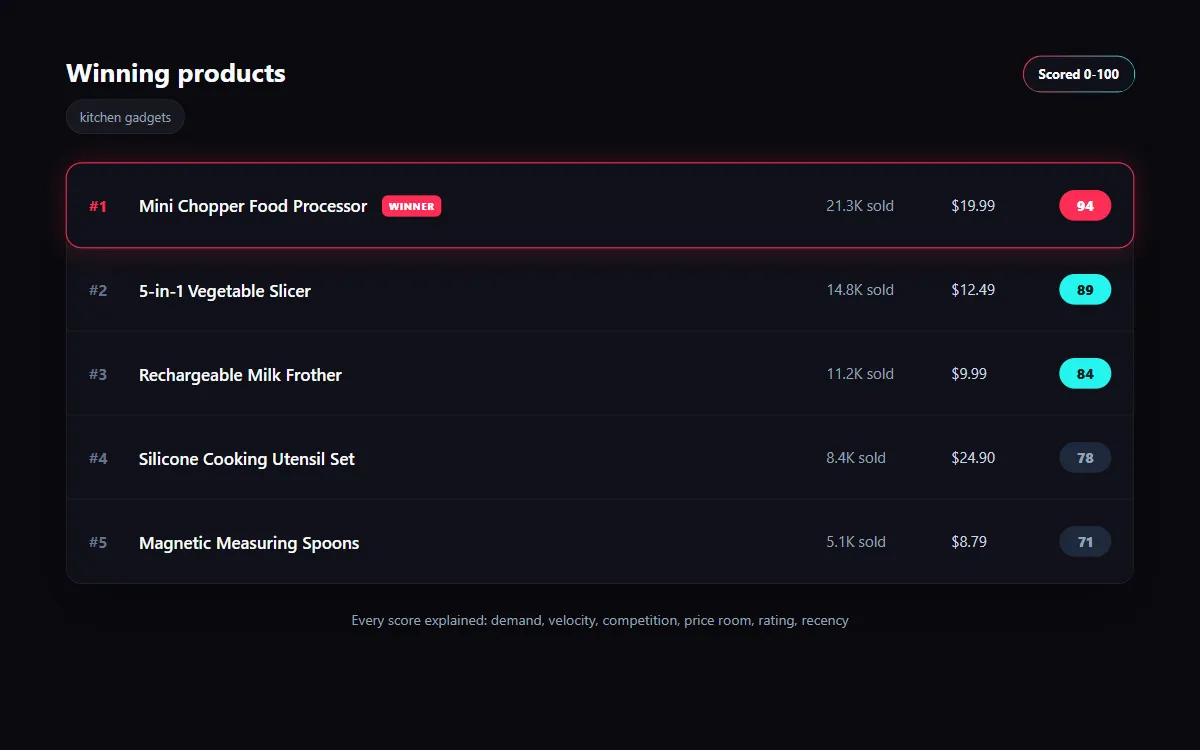
Use it for TikTok Shop product research, winning products, best sellers, dropshipping product research, and repeatable TikTok Shop sales tracker reports. Results include public sold count data and direct product links.
Type a niche and run
Add one or more product searches such as kitchen gadgets, pet accessories, or skincare tools. The actor searches the US TikTok Shop storefront, combines duplicate products, applies your filters, scores each result, and ranks the products.
The default collects up to 50 products per keyword. Detail enrichment and repeat-run tracking are optional.
What you get
Each product record contains the fields needed to compare demand, velocity, price, quality, and seller competition.
| Field | What it tells you |
|---|---|
| Rank | Position after sorting by opportunity score. |
| Score | Transparent opportunity score from 0 to 100. |
| Sold count | TikTok's public cumulative sales figure. |
| Sold per day | Estimated daily sales since the previous run. |
| Price | Current listed product price. |
| Rating | Public product rating. |
| Reviews | Public review count. |
| Seller | Seller name and identifier. |
| Mover flag | Whether sales velocity qualifies the product as a mover. |
| New entry flag | Whether the product is new since the previous snapshot. |
| Product url | Direct TikTok Shop product page. |
Records also include title, product ID, original price, currency, sold delta, price change, brand, image, matched keywords, and the complete score breakdown. Optional enrichment can add description, breadcrumbs, gallery images, and seller statistics.
How the score works
Every product receives a 0-100 opportunity score built from 6 components:
| Component | Weight |
|---|---|
| Demand | 30 |
| Momentum | 20 |
| Quality | 15 |
| Impulse price band | 15 |
| Competition | 10 |
| Discount depth | 10 |
Demand rewards established sold count. Momentum uses tracked sold per day when history is available. Quality uses rating and review evidence. The impulse price band measures fit with a purchase-friendly price range. Competition accounts for seller concentration. Discount depth measures the gap between original and current price.
Every record includes the component breakdown, so the final score can be audited instead of treated as a hidden ranking.
Sales velocity tracking
The first run creates a baseline snapshot. Every later run with the same trackingName computes sold per day, price changes, new entries, dropouts, and movers.
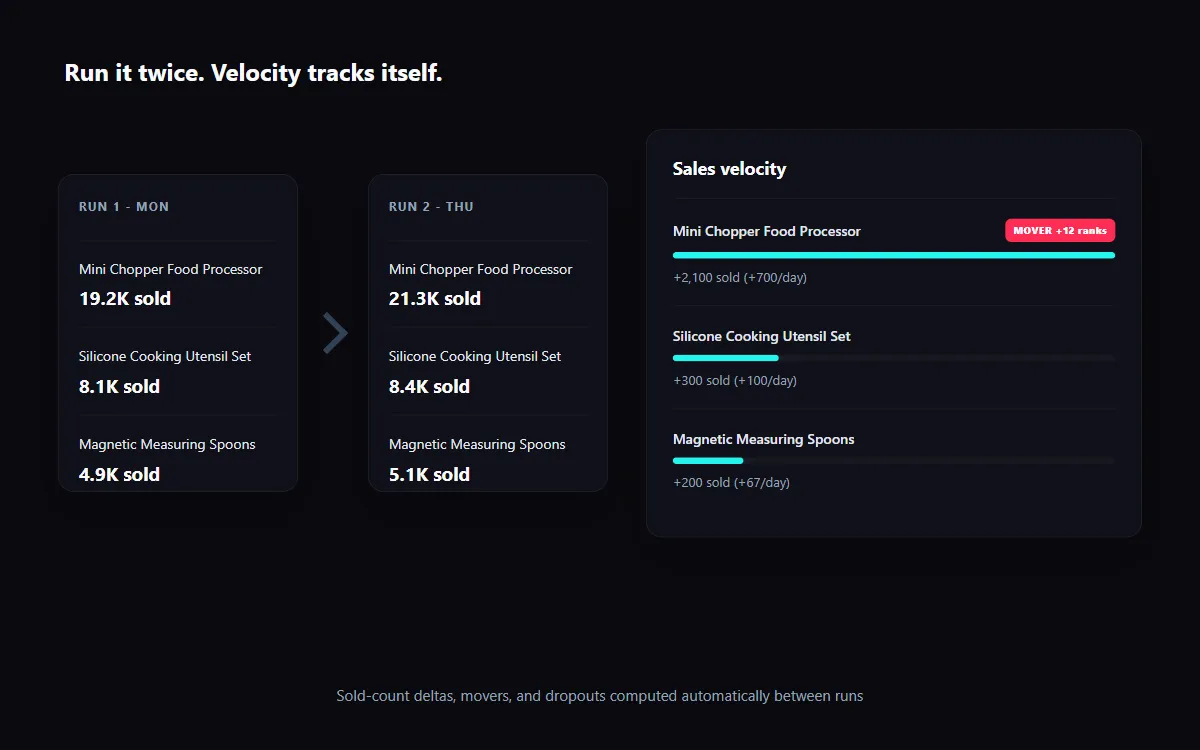
This works with Apify Schedules. Schedule the actor weekly, keep the same input, and you are done.
The summary record identifies first runs, reports changes, and lists products that dropped out. This turns a one-time winning products search into a repeatable TikTok Shop sales tracker.
Input
Only keywords is required. The fields below match the actor input schema.
| Field | Required | What it is |
|---|---|---|
keywords | Yes | Array of niches or product searches. Enter at least 1 non-empty keyword. Prefill: kitchen gadgets. |
maxProductsPerKeyword | No | Maximum products collected per keyword. Minimum 1, maximum 200, default 50, prefill 20. |
enrichDetails | No | Fetch each product's full detail page. Default and prefill: false. |
trackingName | No | Name of the sales-velocity tracking store. Leave empty to derive it from the keywords. Reuse the same value for tracked comparisons. |
minRating | No | Include only products at or above this rating. |
priceMin | No | Include only products priced at or above this amount. |
priceMax | No | Include only products priced at or below this amount. |
region | No | Storefront region. The only supported and default value in v1 is US. |
Example input
Pricing example
At $0.004 per product scanned, with platform usage included, 3 keywords times 50 products costs $0.60 per run before optional events. Apify Silver and Gold plans pay less per product. Detail enrichment costs $0.002 per enriched product. Tracked deltas cost $0.005 per product when a previous snapshot makes a delta available.
Kalodata plans are listed at about $46 to $110 per month. This actor is not a Kalodata clone. It covers keyword-level winner discovery and sales velocity, not creator analytics. It can serve as a focused Kalodata alternative when the task is finding products by keyword and tracking their public sales changes without a monthly research suite.
Actual product counts can be lower because TikTok search depth varies and duplicate products across keywords are combined.
Who uses it
- Ecommerce operators researching TikTok Shop best sellers by niche
- Dropshipping teams doing product research with sold count and price filters
- Analysts comparing transparent opportunity scores across product searches
- Sellers tracking weekly sales velocity, movers, new entries, and dropouts
- Agencies exporting ranked product data to JSON, CSV, or Excel
FAQ
Which storefront is supported?
The US storefront only is supported in v1.
Where do sold counts come from?
Sold counts are TikTok's public figures shown in its storefront data. They are not private merchant sales records.
How many products can one keyword return?
Keyword search usually caps around 30 to 60 products per keyword because of TikTok SERP depth. Setting maxProductsPerKeyword above that limit cannot create additional search results.
Does this actor use a TikTok login or cookies?
No. It uses no login or user-provided cookies.
What happens on the first tracked run?
The first run stores a baseline snapshot. Sold per day and change fields become available on later runs that use the same trackingName.
Can I schedule tracking?
Yes. Create an Apify Schedule, run weekly with the same input and trackingName, and review each dataset for deltas and movers.
Is this a full Kalodata replacement?
No. It handles keyword-level TikTok Shop product research, opportunity scoring, and public sales velocity. It does not provide creator analytics or the full feature set of a subscription analytics platform.
Also by this developer
See more actors by this developer at crashlattice57 on Apify, including the geo-grid rank tracker.


![TikTok Shop Scraper [NO COOKIES] ✅ avatar](https://images.apifyusercontent.com/19hg3d40D0AYRrOpNZsFNdyRHHdIZBNmXd51M9i64RI/rs:fill:76:76/cb:1/aHR0cHM6Ly9hcGlmeS1pbWFnZS11cGxvYWRzLXByb2QuczMudXMtZWFzdC0xLmFtYXpvbmF3cy5jb20vc0NDU2R3bm1LTUoxUTJzVG4tYWN0b3ItQzk3U1VpTWxiWjc1eDZ1MjItTTRLdXpqR2FERi10aWt0b2stbG9nby1wbmctZmlsZS0xMTY2MTYzNzYyNng0cTF3c2djc3kucG5n.webp)


