

VGHF Search
Pricing
from $0.10 / 1,000 results
VGHF Search
Find video game reviews, articles, ads, and historical references in the Video Game History Foundation Digital Archive.
Pricing
from $0.10 / 1,000 results
Rating
0.0
(0)
Developer

Marco Dal Borgo
Maintained by CommunityActor stats
0
Bookmarked
2
Total users
1
Monthly active users
a month ago
Last modified
Categories
Share
Search the Video Game History Foundation Digital Archive and rank matching magazines and documents by the Text Match count reported by the archive.
VGHF Search is useful when a normal archive search returns many documents and you want to quickly identify the issues where a game, company, person, console, publication, or other topic is discussed most extensively.
Why use this Actor?
The Video Game History Foundation Digital Archive can return many matching documents for a search.
VGHF Search collects the complete result set and ranks documents by the Text Match count exposed by the archive, making it easier to identify results where your search term appears most often.
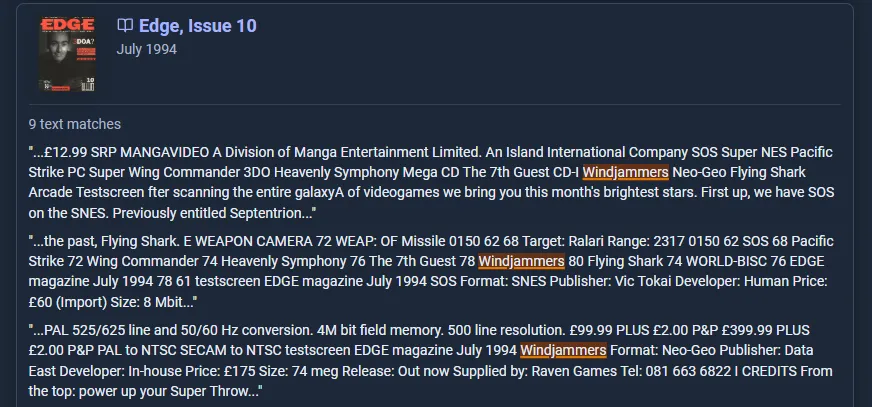
For example, searching for windjammers quickly surfaces Edge, Issue 10 (July 1994) with 9 text matches:
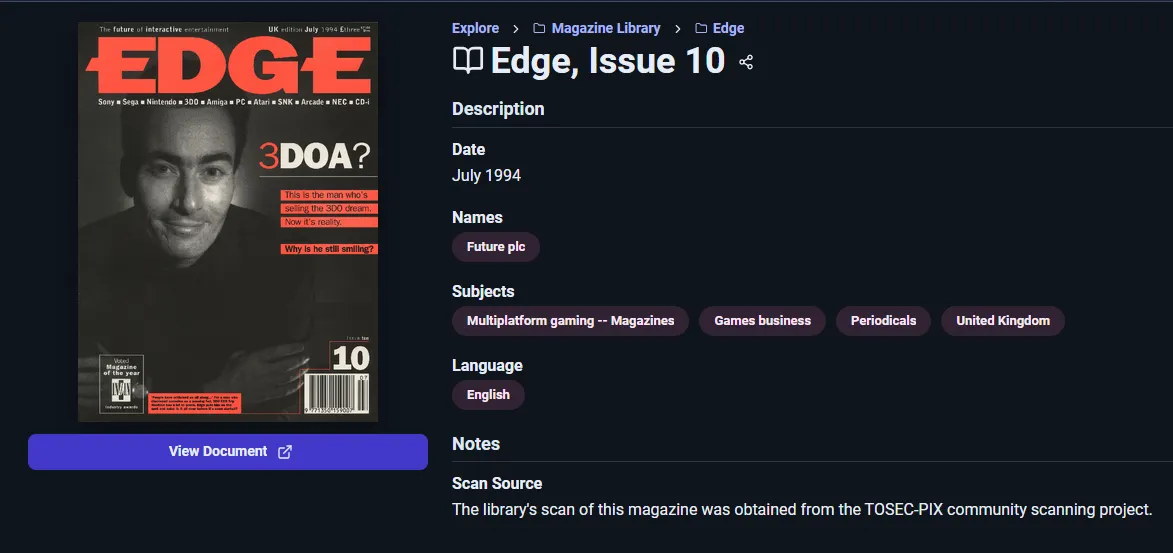
Each result includes a direct link to the original VGHF archive record, so you can continue exploring the source material and open the scanned document:
This makes it easier to distinguish between:
- magazines containing a full review or feature
- magazines containing only a short mention
- catalogs or promotional material
- documents where the archive does not expose a Text Match count
It is particularly useful for retrogaming enthusiasts, researchers, collectors, and video game historians looking for references in vintage magazines.
Features
- Search the VGHF Digital Archive
- Full-text or all-fields search
- Exact phrase search
- Optional publication year range
- Automatically follows all result pages
- Extracts document title and publication date
- Extracts VGHF Text Match counts
- Extracts matched-text snippets when available
- Ranks results by Text Match count
- Keeps documents without a Text Match count instead of discarding them
- Handles searches containing thousands of documents
- Deduplicates results by document URL
- Stores intermediate progress for large searches
Input
Search term
The game, company, person, console, publication, or other term you want to find.
Example:
Search mode
Two search modes are available.
Full text
Searches inside the full text of documents in the archive.
This is the recommended mode when you want to find occurrences inside magazines, catalogs, press material, and other scanned documents.
All fields
Uses the archive's general keyword search and may include matches from other indexed fields in addition to document text.
Exact phrase
When enabled, the Actor searches the term as an exact phrase.
For example:
becomes:
This is recommended for game titles, people, companies, and other proper names.
Start year
Optional first publication year to include.
Example:
End year
Optional last publication year to include.
Example:
Both year fields are optional.
Example input
Output
Each result contains:
| Field | Description |
|---|---|
title | Magazine issue or document title |
date | Publication date shown by the archive |
textMatches | Number of occurrences of the search term reported by the VGHF Digital Archive |
snippet | Matched-text excerpt when available |
url | Direct URL to the VGHF document record |
Results are ordered from the highest textMatches value to the lowest, making documents with more text matches easier to identify.
If VGHF does not expose a Text Match count for a document, the Actor keeps the result with:
Results without a reported Text Match count are placed after documents with a reported count.
Example output
Example use case
Suppose you are researching the history of Windjammers.
A normal archive search may return dozens of magazines and documents.
With:
VGHF Search collects every matching archive result in that period and ranks the documents by how many Text Matches the archive reports.
This can help distinguish substantial coverage from passing references.
Large searches
Broad search terms can return thousands of documents.
The Actor follows every result page before producing the final ranking. This is necessary because the complete result set must be collected before documents can be globally sorted by Text Match count.
For faster and cheaper searches, consider using:
- Exact phrase
- A publication year range
- A more specific search term
Very broad searches can take several minutes and consume more compute than focused searches.
Reliability
The Actor stores intermediate progress while processing large searches.
Pagination failures are retried locally, results are deduplicated by document URL, and the final Dataset is written only after the complete result set has been collected successfully.
If the archive temporarily fails to load a result page, the Actor retries that page before stopping.
What this Actor does not do
VGHF Search does not download magazine or document PDFs.
It extracts search-result metadata exposed by the Video Game History Foundation Digital Archive and links back to the original document records.
Resource usage
The Actor uses Playwright to interact reliably with the archive's search pagination.
Focused searches usually complete quickly. Large searches containing hundreds of result pages can take several minutes.
The recommended default memory configuration is:
Notes
VGHF Search depends on the current structure and availability of the Video Game History Foundation Digital Archive.
If the archive changes its search interface or result markup, the Actor may require an update.
This Actor is an independent tool and is not affiliated with or endorsed by the Video Game History Foundation.


