

Redirect Chain & Migration Map Checker
Pricing
$0.50 / 1,000 url traced (redirect chain determined)s
Redirect Chain & Migration Map Checker
Trace each redirect hop of your URLs (301, 302, 307, 308, meta refresh; up to 10 hops by default, 30 max), flag chains, loops, temporary redirects and http/https mix-ups, and check an old-to-new migration map against what the server really returns. $0.0005 per URL, no start fee.
Pricing
$0.50 / 1,000 url traced (redirect chain determined)s
Rating
0.0
(0)
Developer

DigiVibeTech
Maintained by CommunityActor stats
0
Bookmarked
2
Total users
1
Monthly active users
2 days ago
Last modified
Categories
Features
Share
Redirect Chain & Migration Map Checker — trace each redirect hop of your URLs (301, 302, 307, 308, meta refresh; up to 10 hops by default, 30 max), flag chains, loops, temporary redirects and http/https mix-ups, and check an old-to-new migration map against what the server really returns.
Try it free: press Start — the prefilled input runs a small real job (up to 1 × url traced, about $0.0005 in events). Apify's free plan includes monthly platform credit, so a first test costs you nothing. You can also set a maximum cost per run.
- What you get:
url,state,hops,firstStatus,finalStatus,finalUrl - Who it's for: SEO teams and developers running site migrations
- Price: $0.0005 per url traced
- Data source: Requests only the URLs you supply.
What is Redirect Chain & Migration Map Checker?
Paste a list of URLs or your old -> new redirect plan and see exactly what each server does: each hop (up to maxHops, default 10) with its status code and Location, the final URL and status, and a plain list of problems. Built for site migrations, domain moves, https switches and redirect clean-ups.
✅ Why this one
- Checks an old -> new migration map: each old URL (up to
maxUrls, default 10,000) is traced and compared with the planned new URL, withmatchesExpectedand a plainmapProblem. - Finds redirect loops, chains, meta refresh redirects, temporary 302/307 hops, https to http downgrades and redirects that end in 404 or 5xx.
- $0.0005 per URL with no start fee.
- MAP_REPORT (CSV) opens in any spreadsheet, and ISSUES lists only the URLs with problems.
Migration map check
Give each old URL the new URL you planned (old -> new lines, or paste a two-column CSV). Each old URL is traced (up to maxUrls, default 10,000; hops disallowed by robots.txt are skipped and not charged) and its final URL is compared with your plan. Each row gets matchesExpected and, when it does not match, a mapProblem: old URL does not redirect, ends in HTTP 404, or redirects to a different URL than planned. Options let you ignore a trailing slash, the query string, http vs https or upper/lower case. Use baseUrl to write short paths such as /old-page.
The MAP_REPORT record (CSV) is ready to open in a spreadsheet, and ISSUES lists only the URLs with problems.
📸 Real-run screenshots
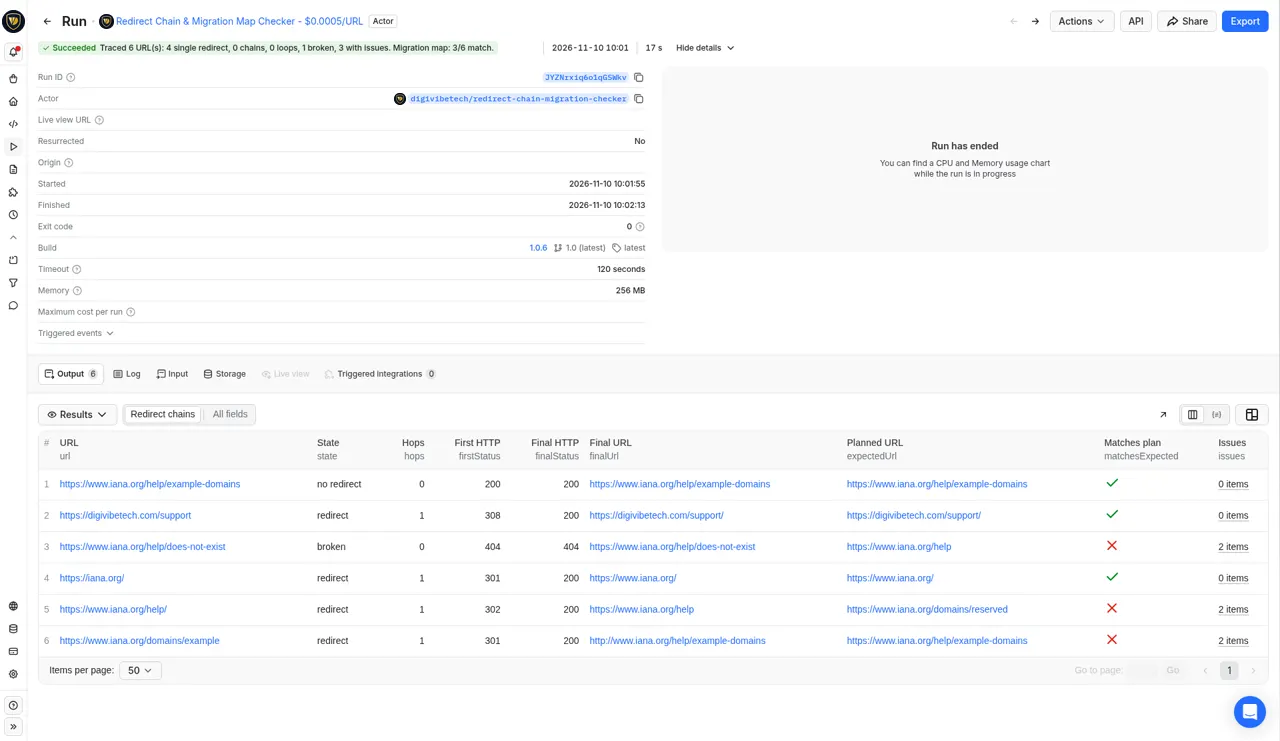
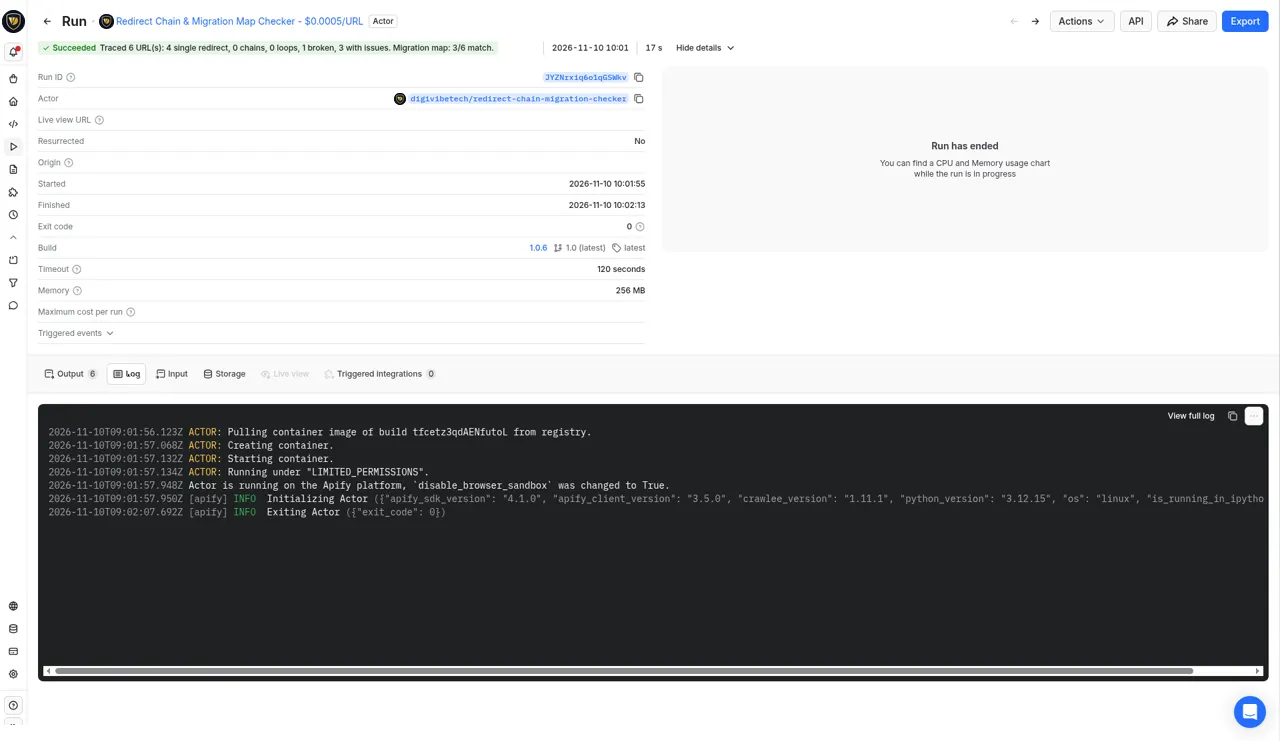
Apify Console views of a 10 November 2026 cloud run of the example input above.
⬇️ What data you get
- Chains: more than one hop before the final page (each extra hop costs crawl budget and speed). You choose the length that counts as a chain.
- Loops: A -> B -> A, or a URL redirecting to itself.
- Temporary redirects (302, 303, 307) where a permanent 301/308 is usual.
- https to http downgrades and mixed http/https hops.
- Cross-domain redirects and dropped query strings.
- Meta refresh redirects (
<meta http-equiv="refresh">), followed like normal hops. - Broken targets: redirects that end in 404, 410 or 5xx.
🎯 Use cases
- Check an old-to-new URL map after a migration
- Find redirect chains, loops and 302s that should be 301s
- Catch http/https mix-ups
▶️ How to use
- Open the actor; the input is prefilled with a small real example.
- Replace it with your own input and set
maxChainHopsto control the cost. - Press Start. Results appear in the Output tab (Overview view).
- Download JSON, CSV or Excel, call the results via API, or schedule the actor.
⚙️ Input
| Field | Default | Meaning |
|---|---|---|
urls | URLs to trace | |
migrationMap / migrationMapCsv | Old -> new pairs to verify | |
baseUrl | Base for relative paths | |
ignoreTrailingSlash | true | Compare /page and /page/ as equal |
ignoreQuery, ignoreScheme, ignoreCase | false | Looser comparison |
detectMetaRefresh | true | Follow meta refresh (reads at most 64 KB of the final page) |
maxChainHops | 1 | Flag redirects with more hops than this |
maxHops | 10 | Stop after this many hops |
maxUrls | 10000 | Most URLs per run |
Example input
⬆️ Output
One row per URL: url, state (no redirect, redirect, chain, loop, too many hops, broken, unreachable), hops, firstStatus, finalStatus, finalUrl, chain (each hop followed, up to maxHops: url, status, location, kind http or meta), issues, ok, and for map rows expectedUrl, matchesExpected, mapProblem. SUMMARY has the counts.
Example output
Real rows from an Apify cloud run on 10 November 2026, using the example input above with all other settings at their defaults (meta refresh detection on). Two rows were planned to fail on purpose: /help/ is mapped to a different page, and /help/does-not-exist is a page that does not exist. All 6 URLs were traced and charged as 6 url-traced events. SUMMARY reported 3 map matches and 3 mismatches, 1 broken URL and 3 URLs with issues. The /domains/example row was not planned to fail: on that date the server sent it to the http:// address, so it is reported as an https to http downgrade that does not match the planned https:// URL.
The downgrade row as it appears in the dataset:
These rows show what those servers returned on that date. Redirects can change, so run the actor again for a current result.
💵 Pricing and cost estimate
| Event | Price |
|---|---|
| URL traced (redirect chain determined) | $0.0005 |
All hops of a URL are included in one charge. URLs skipped by robots.txt are free and there is no start fee. A 2,000-URL migration map costs at most $1.00 (URLs skipped by robots.txt are free). Set a maximum cost per run and the actor stops before going over it; URLs it did not trace are not charged.
Cost estimate
| Url traceds | Cost |
|---|---|
| 100 | $0.050 |
| 1,000 | $0.50 |
| 10,000 | $5.00 |
You pay only for these events: no subscription.
🔌 Integrations and API
Run it from n8n, Make, Zapier, Clay or any tool that can call an HTTP endpoint, connect a webhook to get notified when a run finishes, or let AI agents call it through the Apify MCP server (mcp.apify.com).
Run it and get the results in one call:
Python (pip install apify-client):
Use it with Make, Zapier or a webhook
Run it after each deploy with your redirect map, then read MAP_REPORT (/key-value-stores/{id}/records/MAP_REPORT) or ISSUES and alert your team when it is not empty.
⚠️ Limits
- It reads HTTP responses and meta refresh tags, not JavaScript redirects (
window.location), which need a browser. - Each host gets about one request per second, so 1,000 URLs on one site take roughly 15-30 minutes; many hosts run in parallel.
- Servers that block automated requests may answer 403 or 429 instead of their real redirect.
- A URL in both lists is traced once, with its map check.
🛡️ Data source, privacy and legality
Requests only the URLs you supply.
Responsible use
Each hop it follows (up to maxHops) is checked against that site's robots.txt (disallowed hops are not requested and not charged), each host gets about one request per second, the User-Agent is honest (RedirectChainChecker/1.0), and the actor never logs in, uses proxies or bypasses bot protection. Check sites you own or are allowed to check. Only URLs, status codes and redirect targets are stored, not page content. URLs and query strings can contain personal data, so do not submit personal or confidential values.
Data processing
- What it requests: each URL you submit, and each redirect target it leads to, one hop at a time. Requests are HEAD, or GET when
detectMetaRefreshis on; then at most 64 KB of an HTML page is read to find a meta refresh tag, and the page body is not saved. Before the first hop on a site it reads that site'srobots.txtand skips any hop it disallows. Every request this actor sends to a checked site, both each hop and each robots.txt fetch, uses the User-AgentRedirectChainChecker/1.0 (Apify Actor; check requested by the run's user; +https://apify.com), so each checked server sees the requested URL and that User-Agent; its calls to the Apify platform for storage and billing go through the Apify SDK. URLs containing login credentials and URLs that point to private or local network addresses are refused and not requested. - What it stores: one dataset row per traced URL (URLs, each followed hop's status code and Location, final URL and status, issues, map fields and a
checkedAttime), plus the key-value records SUMMARY and OUTPUT (counts), ISSUES (rows with problems), ERRORS (skipped or failed inputs) and MAP_REPORT (CSV, when a map is given). No page content is stored. - Personal data: URLs and query strings are stored as you submit them and as servers return them, and they can contain personal data. Do not submit credentials, private URLs or confidential values.
- Where it runs and how long data is kept: on Apify, which processes the input, run metadata, logs, dataset, key-value store and pay-per-event accounting. Results go to the run's default storage; the actor sets no deletion period of its own, so retention follows your Apify plan and settings (Apify storage and retention). Download what you need and do not share storage IDs or access links.
- Billing: one
url-tracedevent at $0.0005 per URL, charged after its row is saved. URLs skipped by robots.txt are not charged. See pay-per-event. No seven-day free actor-run window or separate product key applies. - Questions and privacy requests: DigiVibeTech support. The DigiVibeTech website privacy policy covers the website and support; this section covers what the actor itself processes.
❓ FAQ
How much does Redirect Chain & Migration Map Checker cost?
$0.0005 per url traced. See the cost estimate table above. There is no monthly fee.
Can I try it for free?
Yes. Press Start with the prefilled input: it runs a small real job (up to 1 × url traced, about $0.0005 in events). Apify's free plan includes monthly platform credit, which covers a first test.
Is it legal to use Redirect Chain & Migration Map Checker?
Requests only the URLs you supply. Use the results lawfully (terms of the source, GDPR where it applies). This is not legal advice.
Can I use it through the API or an MCP server?
Yes. Every run is available through the Apify API and the official client libraries, and AI agents can call the actor through the Apify MCP server. See Integrations and API above.
Something does not work. Where do I get help?
Open an issue on the Issues tab or use digivibetech.com/support. Include the run ID so we can reproduce it.
📝 Changelog
20 Nov 2026 — listing refresh
- README, listing text and input form restructured to the DigiVibeTech Apify quality standard v1. No feature or price change.
1.0 — builds 1.0.1 to 1.0.6
- First build 2026-10-26, latest build 2026-11-10 (6 successful builds).
🧩 More DigiVibeTech actors
- Website SEO & AI Search Audit (GEO/AEO)
- Broken Link & Image Checker - Sitemap or Crawl
- Bulk WHOIS & DNS Lookup - Domain Expiry, RDAP, SPF, DMARC
- Schema Markup Extractor & Validator - JSON-LD, Open Graph
Maintained by DigiVibeTech. Questions or bugs: use the Issues tab or digivibetech.com/support; we reply within 2–5 business days.


