
Shopify Scraper
Pricing
from $1.60 / 1,000 results
Shopify Scraper
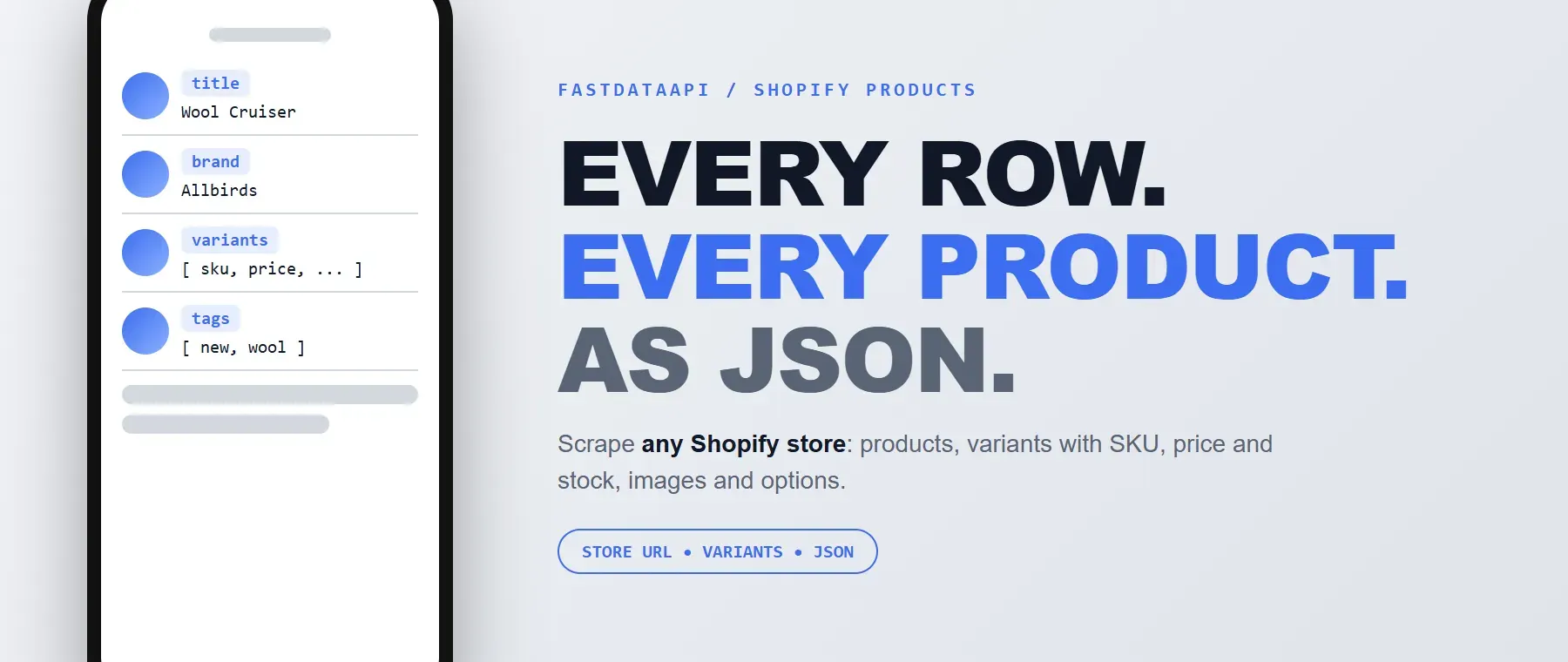
Shopify Scraper scrapes products from any Shopify store, collection or product page: title, brand, tags, every variant with SKU, price and stock, images and options.
Pricing
from $1.60 / 1,000 results
Rating
0.0
(0)
Developer

Fast Data API
Maintained by CommunityActor stats
0
Bookmarked
2
Total users
1
Monthly active users
4 days ago
Last modified
Categories
Features
Share
Shopify Scraper — Products, Variants, SKUs, Prices and Stock
Shopify Scraper pulls product data from any public Shopify store: a whole store, one collection or a single product page. Each product comes back with its title, brand, category, tags, HTML description, every variant with SKU, current and compare-at price and stock status, plus images and options. Every response is structured JSON — ready to pass directly to an LLM, index into a vector store, or feed a price monitoring pipeline. No Shopify account, API key or login needed. Start with one competitor's store, then add every brand you track.
What data can I extract with Shopify Scraper?
Using this Shopify Scraper, you will be able to extract the following Shopify store data:
| 🏷️ Product title | 🏢 Brand (vendor) | 🗂️ Category (product type) | 🔖 Tags |
|---|---|---|---|
| 📝 Description (HTML) | 🆔 Product ID | 🔗 Product page link | 🌐 Store domain |
| 💱 Currency (ISO code) | 📅 Created, updated and published times | 🧩 Variants with ID and title | 🔢 SKU per variant |
| 💰 Current price per variant | 💸 Compare-at price (if on sale) | 📦 Stock status (in stock / out of stock) | 🎛️ Variant options |
| 🖼️ Product images with alt text | 🎯 Variant IDs each image shows | 📐 Option names and values (Size, Color) |
How to use Shopify Scraper
This actor is for e-commerce teams, dropshippers and analysts who want a store's full product list with prices and stock in one run.
Copy to your AI assistant:
Shopify Scraper MCP Server: use these Actors from ChatGPT, Claude or Cursor
Point your AI assistant at this actor and it can read Shopify stores on its own: whole catalogues, collections and single products with variants, prices and stock. No glue code, no scraping logic in your prompts.
Step by step
- Create a free Apify account.
- Open Shopify Scraper in the Apify Store.
- Paste the Shopify store, collection or product URL (one per line).
- Click Start (or send your API request).
- Download or stream your results in JSON, CSV or Excel.
How to scale Shopify Scraper to bulk
Put every store, collection and product URL into the URL list of one run: the actor reads up to three URLs at the same time on paid plans and saves each product the moment it is read. Set the max products per URL to 0 to take each store's whole public catalogue. For daily price checks, save the input as a task and schedule it in Apify, or call the API from your own job and loop over your store list.
✨ Features
Shopify Scraper fetches clean, structured products from any Shopify store ⚡. It's ideal for competitor price tracking, catalogue exports, shopify dropshipping research and product data for AI shopping agents.
It extracts, per product:
- Variants – every variant's ID, title, SKU and options.
- Prices – current price and compare-at price per variant, in cents, with the store's currency.
- Stock status – in stock or out of stock for each variant.
- Title, brand and category – the product name, the vendor and the store's product type.
- Tags and description – the store's own tags and the full HTML description.
- Images – every image link with its alt text and the variants it shows.
- Timestamps – when the product was created, last updated and published.
⚡ No login, no cookies and no browser: it reads the same public product data every store visitor gets, and connects through a proxy only when a store refuses the request.
Use cases 💡
- Pricing analyst — track competitors' shopify product prices and sale prices every morning.
- Dropshipper — check suppliers' variants, SKUs and stock before listing products.
- E-commerce agency — run a shopify catalogue export of a client store into a spreadsheet.
- Brand manager — run shopify competitor research on new launches by publish date and tags.
- AI engineer — feed product titles, descriptions and prices into a RAG shopping assistant.
Building an AI agent? Connect Shopify Scraper over MCP and let it call the actor on its own.
Why choose this actor?
- Two stores, 120 products, about 3 seconds. A recorded run read 60 products from a store homepage and 60 from a collection page in 3.1 seconds, each with its full variant list.
- Every variant, priced and stocked. A recorded product came back with 13 size variants, each with its own SKU, a price of 12000 cents in USD and a stock flag (3 in stock, 10 out of stock).
- Three kinds of URL, one actor. A store homepage gives the whole catalogue, a collection URL gives that collection, and a product URL gives one product — mix them in one list.
⬇️ Input
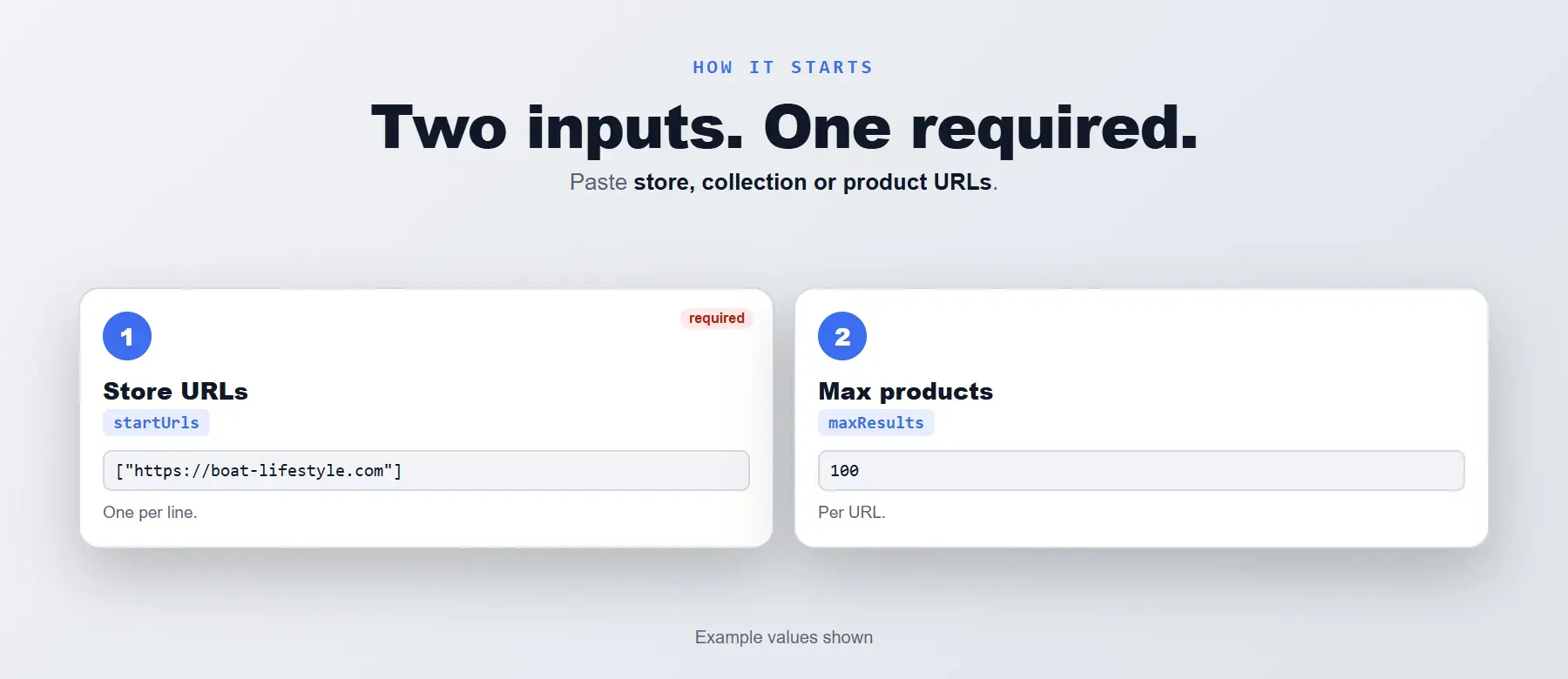
The actor takes a list of Shopify URLs — store homepages, collections or single products. The URL list is required; everything else is optional.
| Parameter | Required | Type | Description | Example value |
|---|---|---|---|---|
startUrls | Yes | array | Store, collection or product URLs, one per line. A bare domain works too. | ["https://www.allbirds.com"] |
maxResults | No | integer | Max products saved for each URL. 0 = the whole catalogue (a store lists at most 25,000 products publicly). Default 100. | 50 |
proxyConfiguration | No | object | Optional. Empty = automatic: direct connection, moving to Apify Proxy only when a store refuses the requests. Set your own proxy to use only that. | {"useApifyProxy": true} |
Accepted URL formats:
- Store homepage:
https://www.allbirds.comorallbirds.com(all products) - Collection:
https://kith.com/collections/mens-apparel - Product:
https://kith.com/products/44kif261o72-001
Free plan limits
Users on the Apify free plan can fetch up to 20 products per run (all URLs together) and 200 products per month. When the limit is reached, the run finishes successfully with a status message explaining the limit. Upgrade to any paid Apify plan to remove these limits.
Example input
⬆️ Output
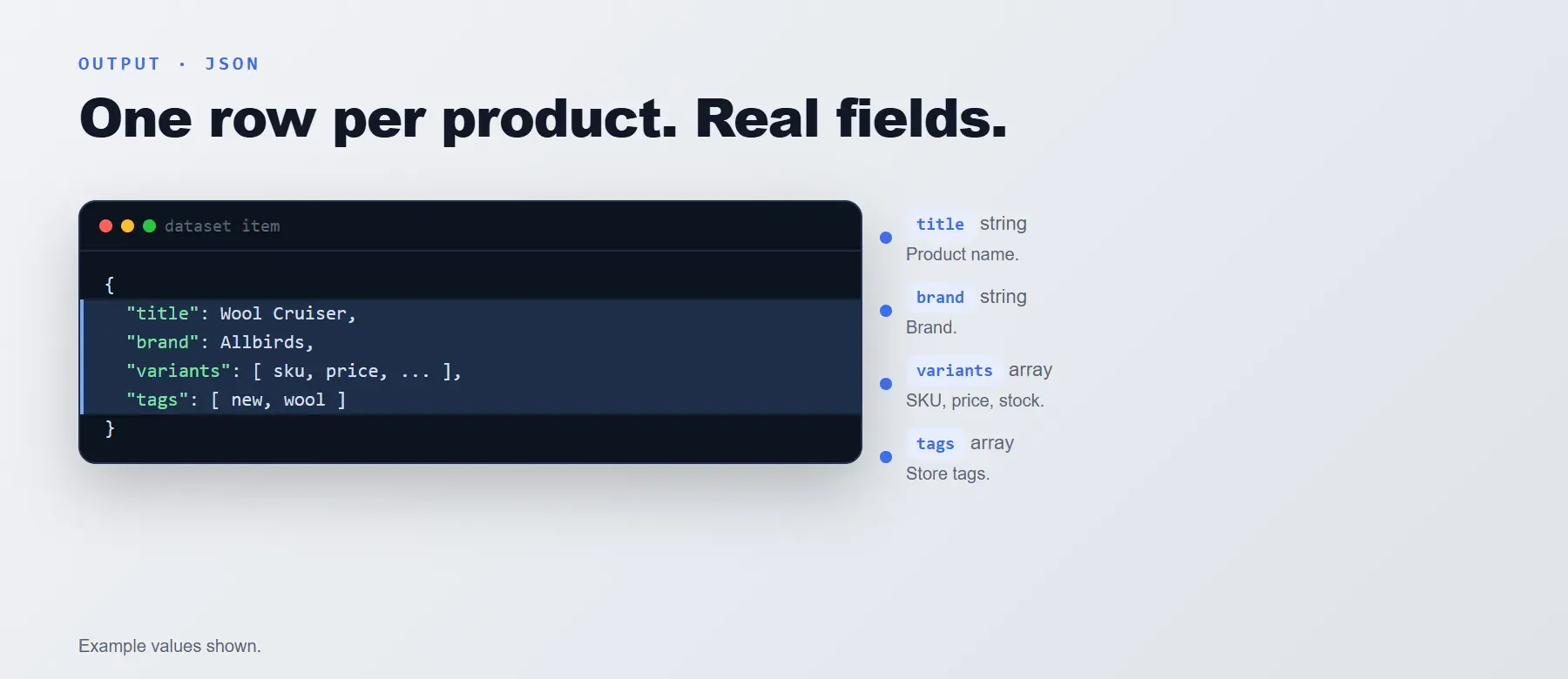
Every product is one typed, normalized JSON item with the same schema on every run, and URLs that give no products save no row. You can export the dataset as JSON (default), CSV or Excel.
Example output
Prices are integers in the smallest currency unit: 12000 with currency USD is $120.00. The compare-at price is null when the product is not on sale. A single product URL does not include the stock flag, so stock status is null there.
How does it work?
The actor reads the public product data a Shopify store already shows to every visitor — no Shopify account, store login or API key. It works with plain HTTP requests, without a browser, and paces its requests so stores answer normally. When a store refuses a request, the actor retries and switches to Apify Proxy on its own (datacenter first, then residential), or uses only your own proxy if you set one. It returns only publicly visible data, and each product is saved to the dataset the moment it is read, so the table fills while the run is going. The output schema is normalized and stays the same for every store, whatever theme or apps the store uses. Stores that are password protected, not on Shopify, or missing get a clear reason in the log and the run's status message instead of a row.
How do you integrate Shopify Scraper into your stack?
This actor works with what you already use: the REST API from any language, MCP for AI agents, and no-code tools.
Using Shopify Scraper with the Apify API
Works in Go, Ruby, Node.js, cURL — any language that can make an HTTP request.
MCP integration for AI agents
Give your agent live Shopify store data with one command. Add the Apify MCP server with this actor preloaded:
This registers the actor as a tool your agent can call directly. It works in Claude Code, Cursor and Windsurf, and any MCP-compatible client can pass store URLs and get product JSON back.
No-code tools (n8n, Make, LangChain)
- n8n — use the Apify node's "Run an Actor" operation with
fastdataapi/shopify-scraper, or the HTTP Request node pointed at the run-sync endpoint with your token. - Make — add the Apify app's "Run an Actor" module, then "Get Dataset Items" to pass each product to Google Sheets or your database.
- LangChain — install
langchain-apifyand callApifyActorsTool("fastdataapi/shopify-scraper")so your chain can fetch store products on demand.
Is it legal to scrape Shopify data?
Scraping publicly available Shopify store data is generally legal. The actor returns only public product information — titles, prices, variants, stock flags and images that any visitor sees without logging in — and never touches order, customer or checkout data. Product data rarely contains personal data, but if you store anything personal, GDPR and local data-protection law still apply to how you keep and use it. Respect each store's terms for how you reuse its content. Consult legal counsel if your use case involves bulk storage of personal data.
Frequently asked questions
What fields does Shopify Scraper return?
It returns the product title, brand, every variant with its SKU, the current and compare-at price, and the stock status, plus tags, category, description, images and options. See the data fields section for the full list.
Does Shopify Scraper require a Shopify account or login?
No. Only public product data is extracted, so no Shopify account, store login, API key or cookies are needed.
How fast does Shopify Scraper run?
A recorded run saved 120 products from two URLs (a store homepage and a collection) in 3.1 seconds. Data is read live from the store on every run, never from a cache.
What happens if a store is private or doesn't exist?
No row is saved and nothing is charged for that URL. The log line for the URL and the run's status message say why: the store needs a password, the page does not exist (404), there is no public Shopify catalogue at that address, or the store did not answer. The other URLs in the run keep going.
Can I scrape multiple Shopify stores at once?
Yes. Put every store, collection and product URL in the URL list; on paid plans the actor reads up to three at the same time, and the max products setting applies to each URL.
Does Shopify Scraper work with Claude, ChatGPT, and other AI agent tools?
Yes — it is available as an MCP tool. Register it in Claude Code, Cursor or Windsurf with claude mcp add --transport http apify "https://mcp.apify.com?tools=fastdataapi/shopify-scraper". Any agent that can call an HTTP endpoint can use the REST API directly.
Does Shopify Scraper return data in a format LLMs can use directly?
Yes. Every product is typed, normalized JSON with consistent field names. No HTML parsing, no selectors. Pass it straight to an LLM, index it into a vector store, or feed it to an agent tool — no transformation step.
What happens when Shopify changes its layout or updates its anti-bot system?
The actor is maintained. When Shopify changes, the actor is updated — your calls keep returning the same JSON schema with no changes on your end.
Can I use Shopify Scraper without managing proxies or browser infrastructure?
Yes. Retries and the switch to Apify Proxy run on the actor's side, and no browser is needed. You send one request and get structured JSON back. No proxy accounts, no headless browser setup, no maintenance.
Which Shopify product fields work best for AI training data and RAG indexing?
For RAG: the product title, description, tags and category, which hold the most text. For training data: the prices, compare-at prices, stock status and publish dates. All values are typed — strings, integers and arrays — so no normalization is needed.
Does Shopify Scraper get product images?
Yes. Each product lists all its shopify product images with the image link, alt text and the variants each image shows, so you can match a color variant to its photo.
Can I use it as a Shopify store scraper for whole catalogues?
Yes. Paste a store homepage and set the max products per URL to 0: the actor works as a full shopify store scraper and returns the whole public catalogue, up to 25,000 products. Use it as a shopify collection scraper by pasting a collection URL instead, or to scrape shopify products one by one from product URLs. All of it is shopify store data that any visitor can see.
Related scrapers
| Scraper | What it extracts |
|---|---|
| Shopify Products Scraper | Shopify products with price ranges, stock counts and a coverage row per store |
| Amazon Product Scraper | Amazon product details, prices and ratings |
| Walmart Search Scraper | Walmart search results with prices, sellers and stock |
| Shein Search Products Scraper | Shein products by keyword with prices and images |
| Ebay Product Details Scraper | eBay listing details, prices and seller info |
Your feedback
Found a bug or missing a field? Let us know on the Issues tab of the actor's Apify Store page. Every report is read, and fixes ship as new versions of the actor.


