

Target Reviews Scraper
Pricing
from $0.67 / 1,000 results
Target Reviews Scraper
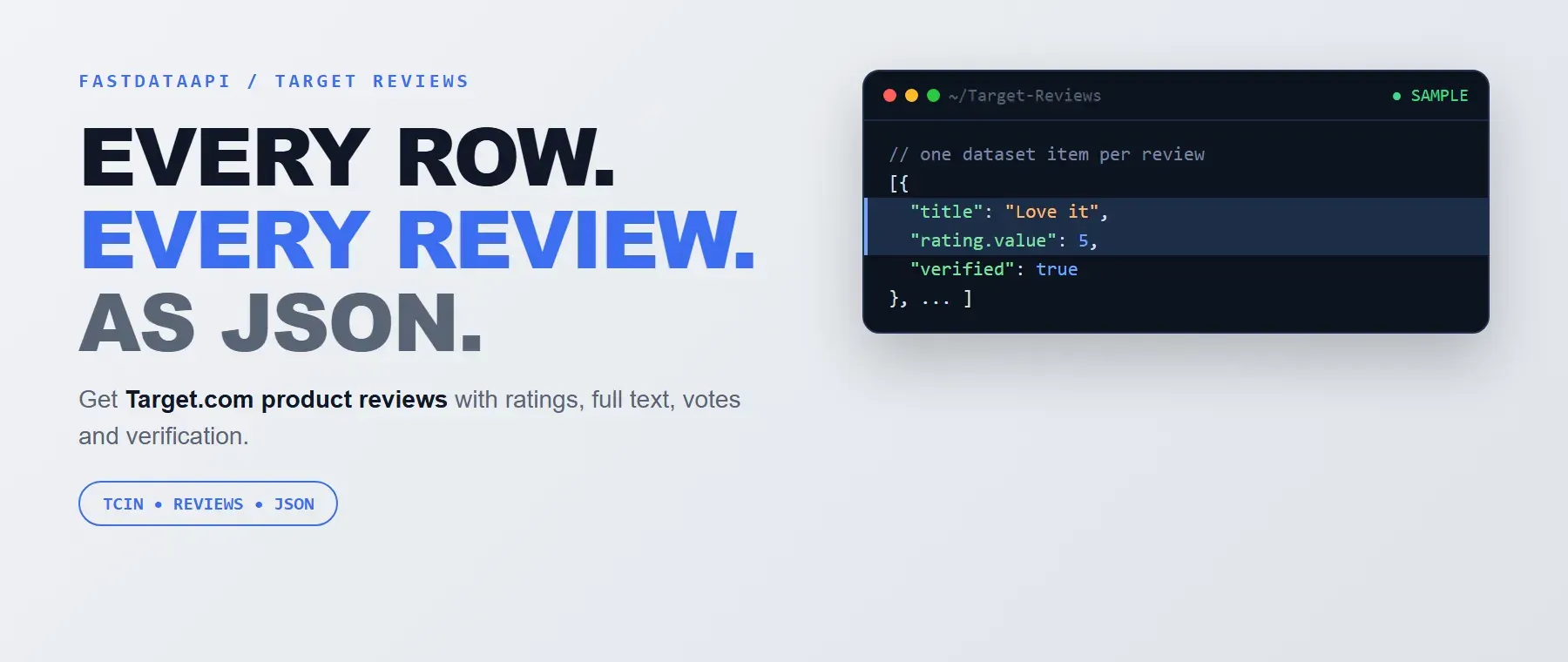
Target Reviews gets Target.com product reviews by TCIN or URL: rating, title, full text, author, helpful votes, verification, photos and videos, sentiment and issue labels, plus product rating totals. Export JSON, CSV or Excel, or use the API.
Pricing
from $0.67 / 1,000 results
Rating
0.0
(0)
Developer

Fast Data API
Maintained by CommunityActor stats
0
Bookmarked
2
Total users
1
Monthly active users
7 days ago
Last modified
Categories
Features
Share
Target Reviews — Full Review Text, Ratings and Product Totals from Target.com
Target Reviews returns every public review Target.com shows for the products you list: rating, title, full text, author nickname, helpful votes, verification status, photos/videos, and the product's own rating totals (average, recommend %, star distribution). It also adds free sentiment and issue-type labels on every review. Every response is structured JSON — ready to pass directly to an LLM, index into a vector store, or feed a review-monitoring pipeline. No Target account or login needed. Start with one TCIN or product link, then track as many products as you need in one run.
What data can I extract with Target Reviews?
Using this Target Reviews API, you will be able to extract the following data:
| 🆔 Review ID & product TCIN | ⭐ Rating & max rating | 📝 Title & full review text | 👤 Author nickname & reviews count |
|---|---|---|---|
| ✅ Verified purchase flag | 👍 Helpful / unhelpful / inappropriate votes | 🖼️ Photos & videos | 📅 Submitted & last-modified dates |
| 🏷️ Recommended, syndicated, ratings-only flags | 🏅 Badges & per-attribute secondary ratings | 📊 Product rating totals (average, recommend %, star distribution) | 🙂 Free sentiment & issue-type labels |
How to use Target Reviews
Review analysts, brand monitors and AI-agent builders get one clean JSON row per review, for as many Target TCINs or product links as they list in one run.
Copy to your AI assistant:
Target Reviews MCP Server: use this Actor from ChatGPT, Claude or Cursor
Point your AI assistant at this actor and it can read Target product reviews on its own: rating, text, sentiment and product totals for any TCIN or link. No glue code, no scraping logic in your prompts.
Step by step
- Create a free Apify account.
- Open Target Reviews in the Apify Store.
- Paste one or more Target TCINs or product URLs into Product TCIN(s) or URL(s).
- Click Start (or send your API request).
- Download or stream your results in JSON, CSV or Excel.
How to scale Target Reviews to bulk
Put every TCIN or product link you track into Product TCIN(s) or URL(s) — each gets up to Max reviews per product rows of its own (not a shared total). For daily review monitoring, save your list as an Apify task and schedule it, or call the API from your own code with a new list each time. Every stored review is billed as one row_result event.
✨ Features
Target Reviews fetches clean, structured review data from Target.com by TCIN or link. It's ideal for review monitoring, sentiment tracking, and catalog/VOC enrichment.
It extracts, per review:
- Full review content — rating, title, text, submitted/modified dates, and whether it's a star-only rating with no written text.
- Author details — nickname and the author's total review count, when Target exposes it.
- Trust signals — verified-purchase flag, recommended flag, syndicated-review flag, and Target's own quality badges.
- Engagement — helpful, unhelpful and inappropriate vote counts.
- Media — photo and video URLs attached to the review.
- Product rating totals — average rating, recommend %, written-review count, and the 1-5 star distribution, attached to every row for that product.
- Free analysis — sentiment (0-1 score + confidence) and issue type (defect, sizing/fit, shipping, customer service, price/value, missing feature) on every review by default; optional topic search, incentivized-review detection and prompt-injection detection.
⚡ Reviews are paginated 10 at a time and pushed to the dataset the moment each page is ready.
Use cases 💡
- Brand/review monitor — track new reviews, sentiment shifts and recurring issue types across a catalog.
- Market researcher — compare rating distribution and recommend % across competing products.
- Catalog manager — pull verified-purchase and photo/video review signals to enrich listings.
- Trust & safety — flag incentivized reviews or prompt-injection attempts in review text.
- AI-agent builder — feed review text and sentiment into a RAG pipeline or VOC summarizer.
Building an AI agent? Connect Target Reviews over MCP and let it call the actor on its own.
Why choose this actor?
- Product totals included for free. One extra upstream parameter (no extra request) surfaces average rating, recommend %, and star distribution on every row — a field competing review scrapers return by making a second call, or not at all.
- Richer raw fields. Modified date, syndication flag, ratings-only flag, unhelpful/inappropriate vote counts, video URLs, badges and per-attribute secondary ratings are all mapped — fields several comparable review actors leave out.
- Free sentiment & issue labels on every review, plus optional topic search, incentivized-review and prompt-injection checks — no separate NLP step needed.
⬇️ Input
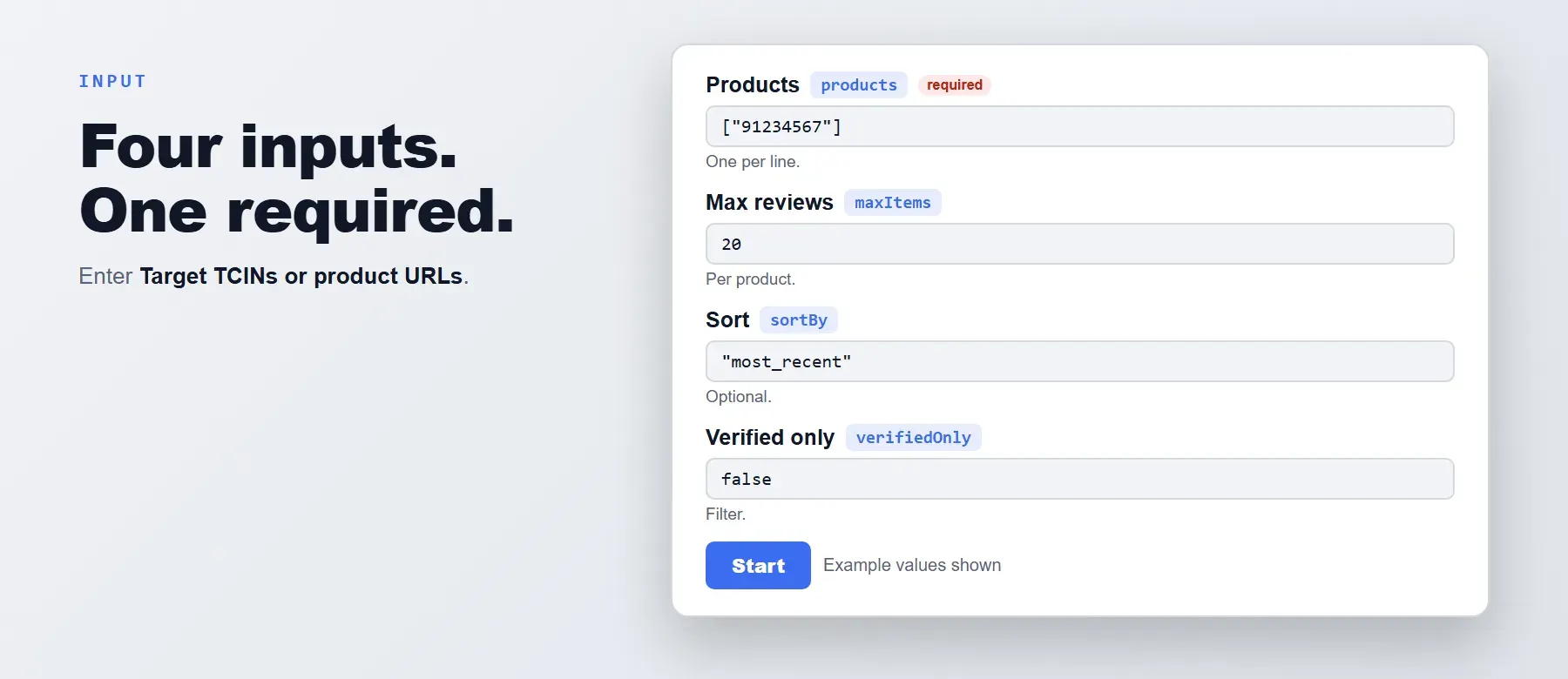
The actor takes a list of TCINs or product URLs in Product TCIN(s) or URL(s) (required). Every other field is optional.
| Parameter | Required | Type | Description | Example value |
|---|---|---|---|---|
products | Yes | array | Target TCINs (92148487, A-92148487) or target.com product URLs; each gets its own reviews. | ["92148487"] |
maxItems | No | integer | Max reviews PER product above. Default 20. | 20 |
sortBy | No | string | most_recent (default), helpfulness_desc, highest_rating, lowest_rating. | "most_recent" |
ratingFilter | No | string | Only reviews with this star rating ("0" = all). Default "0". | "5" |
verifiedOnly | No | boolean | Only verified purchases. Default false. | false |
photosOnly | No | boolean | Only reviews with photos. Default false. | false |
includeRatingsOnly | No | boolean | Keep star-only reviews with no text. Default true. | true |
submittedAfter | No | string | ISO date/datetime cutoff; only works with sortBy="most_recent". | "2026-01-01" |
labels | No | array | sentiment/issue on by default; add reports, incentivized, injection, or none to turn labels off. | ["sentiment","issue"] |
judgments | No | boolean | Toggle the default sentiment+issue labels. Default true. | true |
reportsQuery | No | string | Plain-words topic to search for (needs reports in labels). | "battery drains fast" |
labelEvidence | No | boolean | Include the quote each label was based on. Default false. | false |
dryRun | No | boolean | Preview row counts only, 0 charge. Default false. | false |
cursor | No | string | Resume one product's pagination from a previous run. | "3" |
proxyConfiguration | No | object | Optional starting proxy. Default: direct connection. | {"useApifyProxy": false} |
Free plan limits
Users on the Apify free plan can fetch up to 20 reviews per run (all products together) and 200 reviews per month. When the limit is reached the run finishes successfully with a status message explaining the limit. Upgrade to any paid Apify plan to remove these limits.
Example input
⬆️ Output
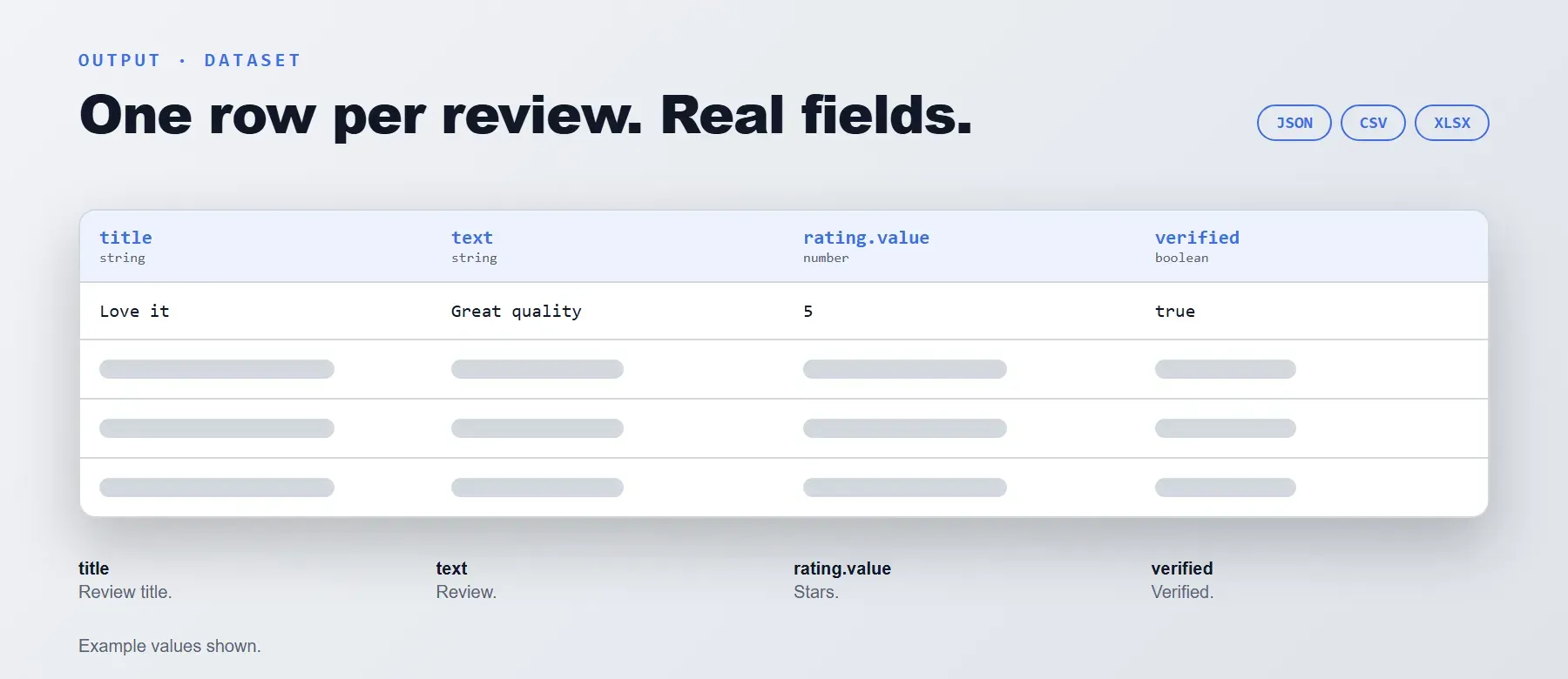
Every review is one typed, normalized JSON item — one row per review. Export the results as JSON (default), CSV or Excel, or open the Overview, Author, Labels and Product totals views in the Output tab.
Example output
How does it work?
Target Reviews reads public Target.com product-review data — the same reviews any visitor sees without logging in — so no Target account, cookies or browser setup is needed on your side. You send TCINs or product links; the actor fetches 10-review pages at a time and saves each one as soon as it is ready. If a request fails, it retries, and if Target blocks the requests it switches to a proxy by itself. Sentiment and issue-type labels are computed offline from the review text — no third-party AI call. Products with no reviews, or no public product found, are skipped with a clear message in the log and the run status.
How do you integrate Target Reviews into your stack?
It works with what you already use: the REST API from any language, MCP for AI agents, and no-code tools.
Using Target Reviews with the Apify API
Works in Go, Ruby, Node.js, cURL — any language that can make an HTTP request.
MCP integration for AI agents
Add the actor to your agent with one command:
This registers Target Reviews as a tool your agent can call directly. It works in Claude Code, Cursor, Windsurf and any other MCP client: ask for a product's reviews or sentiment and the agent runs the actor and reads the JSON it returns.
No-code tools (n8n, Make, LangChain)
- n8n — use the Apify node with "Run an Actor" and pick
fastdataapi/target-reviews-scraper, or point the HTTP Request node at the run-sync endpoint with your token. - Make — add the Apify app's "Run an Actor" module, then "Get Dataset Items" to map the reviews into your sheet or CRM.
- LangChain — install
langchain-apifyand useApifyActorsTool("fastdataapi/target-reviews-scraper")as a tool in your agent.
Is it legal to scrape Target review data?
Scraping publicly available Target.com data is generally legal when you collect only what any visitor can see. Target Reviews returns only public review data — what any shopper sees without logging in. Under GDPR, scraping public data is generally permissible; consult legal counsel for your specific use case.
Frequently asked questions
What fields does Target Reviews return?
Rating, title, text, author nickname, verification, votes, media, dates, flags and product rating totals for every review. See the data fields section for the full list.
Does Target Reviews require a Target account or login?
No. Only public review data is extracted, and no credentials are needed.
What happens if a TCIN has no reviews or doesn't exist?
It is skipped: no row is saved and nothing is billed for it, the log shows the reason for that entry, and the run's status message counts how many could not be loaded.
Can I scrape reviews for multiple Target products at once?
Yes. Add as many TCINs or links as you need to Product TCIN(s) or URL(s); each gets its own maxItems reviews.
Does Target Reviews work with Claude, ChatGPT, and other AI agent tools?
Yes — it is available as an MCP tool. Register it in Claude Code, Cursor or Windsurf with claude mcp add --transport http apify "https://mcp.apify.com?tools=fastdataapi/target-reviews-scraper". Any agent that can call an HTTP endpoint can use the REST API directly.
Does Target Reviews return data in a format LLMs can use directly?
Yes. Every review is typed, normalized JSON with consistent field names. No HTML parsing, no selectors: pass it straight to an LLM, index it into a vector store, or feed it to an agent tool — no transformation step.
Can I use Target Reviews without managing proxies?
Yes. Retries and the switch to a proxy when Target blocks a request run on the actor's side. You send one request and get structured JSON back. No proxy accounts, no headless browser setup, no maintenance.
Which fields work best for sentiment-tracking pipelines?
computed.labels.sentiment.score_0_1 and .level for trend tracking, computed.labels.issue.label for recurring-complaint breakdowns, and product_totals.recommended_percentage for a product-level health number.
Your feedback
Found a bug or missing a field? Let us know in the actor's Issues tab. Every report is read, and fixes ship as updates to this actor.


