

AI Visibility Tracker: ChatGPT, Perplexity, Gemini, AIO
Pricing
from $16.00 / 1,000 ai answer checks
AI Visibility Tracker: ChatGPT, Perplexity, Gemini, AIO
AI visibility tracker and AI rank tracker: check if ChatGPT, Perplexity, Gemini, Google AI Overview and AI Mode mention and cite your brand. LLM brand mentions, rank, citations, competitors, share of voice, plus GEO recommendations to grow your AI search visibility. $0.02 per check.
Pricing
from $16.00 / 1,000 ai answer checks
Rating
5.0
(1)
Developer

Gaël GERARD
Maintained by CommunityActor stats
0
Bookmarked
3
Total users
1
Monthly active users
6 days ago
Last modified
Features
Share
AI Visibility Tracker tells you whether ChatGPT, Perplexity, Gemini, Google AI Overviews and Google AI Mode mention and cite your brand when people ask the questions your customers ask. For each prompt and engine you get one row:
- is your brand named, and in which position;
- is your website one of the sources;
- which competitors are named or cited;
- your share of voice;
- which websites the engine relied on;
- what changed since your previous run.
Each run ends with recommendations built from the answers: the sites to get onto, the engine to work on, the competitor ahead.
Built for AI visibility tracking (also called generative engine optimization, GEO, or AI search optimization) by marketers, SEO teams, agencies and AI agents. $0.02 per check, with no subscription: 2 to 4 times less than typical AI rank trackers. Free Apify plans get the same data for 2 prompts per run.
Try it in one minute: the form opens on Notion, a note-taking app. Type your brand, your website and your category instead: the Actor writes 4 buyer questions and asks them to 4 engines (16 answers, about $0.41 with the start fee). Run it again next week to see what changed.
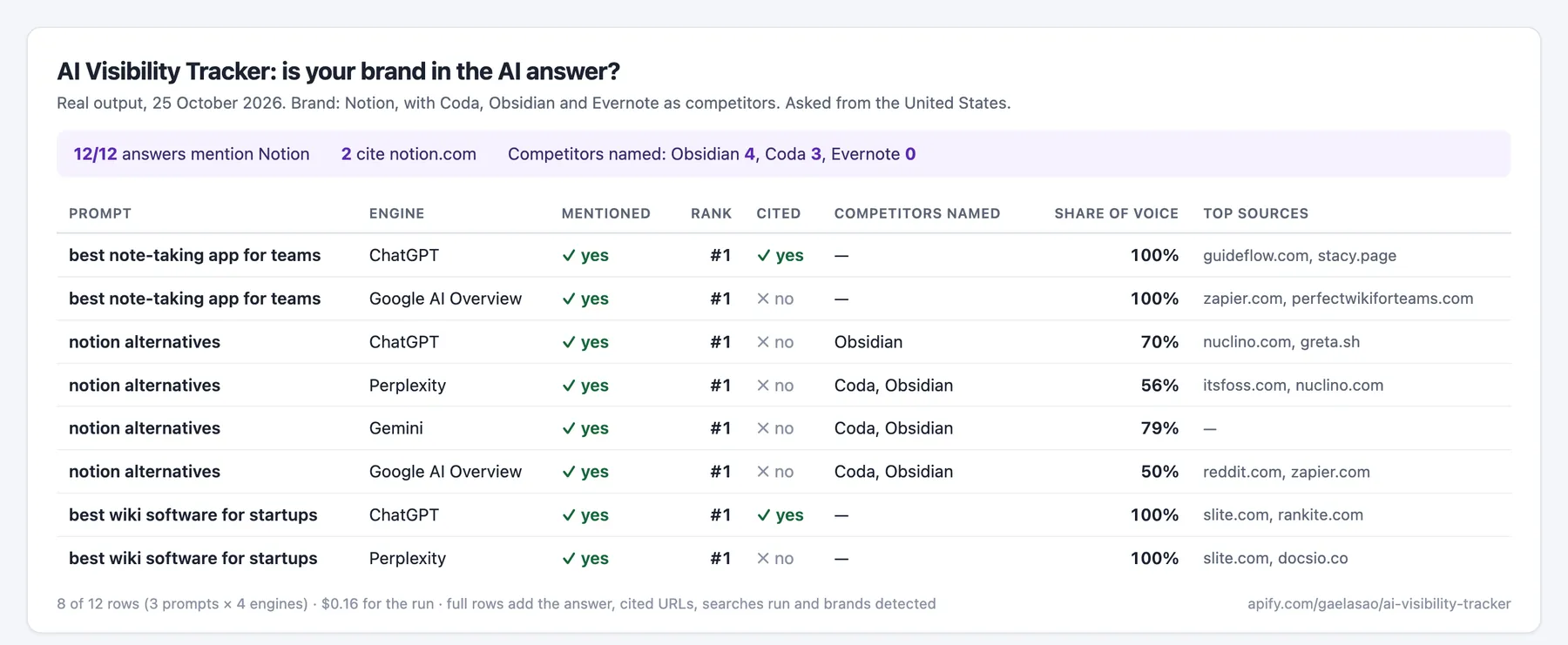
Ready-to-run examples
Open an example, then replace the brand, competitors and prompts with yours. Each asks 2 prompts and has a $0.25 spending limit, except the weekly one, which writes 4 questions from a category ($0.50 limit).
| Example | What is already configured |
|---|---|
| Check if ChatGPT mentions your brand | ChatGPT with web search, HubSpot against Salesforce, Pipedrive and Zoho |
| Track your citations in Perplexity | Perplexity, Shopify against WooCommerce, BigCommerce and Wix |
| Is your brand in Google AI Overviews? | Google AI Overview, Mailchimp against Klaviyo, Brevo and MailerLite |
| Your brand's visibility in Gemini | Gemini, Canva against Figma, Adobe Express and Visme |
| Your brand in Google AI Mode | Google AI Mode, Airbnb against Vrbo, Expedia and Tripadvisor |
| AI share of voice against competitors | 4 engines, Asana against Trello, ClickUp, Jira and Wrike |
| AI visibility audit for a SaaS brand | 4 engines, Slack against Microsoft Teams, Google Chat, Discord and Zoom |
| Track your brand in AI answers every week | Shopify against WooCommerce, BigCommerce and Wix: 4 questions written from the category, then what changed since the last run |
| The websites AI engines cite in your niche (GEO) | ChatGPT, Perplexity and AI Overview, Semrush against Ahrefs, Moz and Similarweb |
| Visibilité de votre marque dans ChatGPT (France) | 4 moteurs depuis la France, Doctolib face à Maiia, Qare et Livi |
What does AI Visibility Tracker do?
You enter your brand, your website and the prompts to check, for example best note-taking app for teams, or just your category, for example note-taking app, and the Actor writes the buyer questions. It asks each selected engine every prompt, from the country you choose, and analyses the answer:
| Field | What it tells you |
|---|---|
brand_mentioned, brand_mention_count | Whether the answer names your brand (or one of its other names), and how often |
brand_rank | Order of your first mention among the brands named: 1 means your brand comes first |
brand_cited, brand_citation_rank, brand_cited_urls | Whether one of your pages is a source of the answer, its position among the sources, and which pages |
competitors_mentioned, competitors_cited | The competitors you listed that the answer names or cites, in order |
share_of_voice | Your mentions divided by all mentions of you and your competitors, from 0 to 1 |
top_cited_domains, sources | The websites the engine used, in order: the pages to win a mention on |
brands_detected | ChatGPT only: every brand ChatGPT marked in its answer, a quick way to spot competitors you did not list |
fan_out_queries | The searches the engine ran to build its answer, when it reports them |
answer_excerpt, answer_text | The text around your first mention, and the full answer (up to 6,000 characters) |
change_since_last_run | What changed since the last answer to the same prompt on the same engine: now mentioned, rank 3 → 1, no longer cited, no change… |
previous_brand_mentioned, previous_brand_rank, previous_brand_cited, previous_share_of_voice, previous_checked_at | The values of that earlier check, and when it ran |
status | ok, no_ai_answer (Google showed no AI answer for that query) or error (failed check, not charged: the reason is in error) |
The run also writes a SUMMARY record, linked in the Output tab:
- mention rate, citation rate, average rank and share of voice, overall and for each engine;
- what changed since your previous run (
since_last_run); - each competitor's mention rate;
- the most cited domains;
- what was charged.
A RECOMMENDATIONS record, also in the Output tab, says what to do next: see What to do next.
Because it runs on Apify, you can also schedule it, call it from the API, export the rows as JSON, CSV or Excel, and send them to Slack, Make, Zapier or n8n with integrations.
Which AI engines are covered?
| Engine | How it is asked | Checks per prompt |
|---|---|---|
| Google AI Overview | Google search from the chosen country, with the AI Overview loaded | 1 |
| Google AI Mode | Google AI Mode answer (available in fewer countries) | 1 |
| ChatGPT | ChatGPT with web search | 1 |
| Gemini | Gemini answer | 1 |
| Perplexity | Perplexity sonar with web search | 2 |
By default the Actor asks Google AI Overview, ChatGPT, Perplexity and Gemini. Pick the engines you need in the input. All five engines were tested on 25 October 2026 from the United States and from France. The answers come from DataForSEO's SERP and AI Optimization APIs, collected live at run time.
How to use it
- Enter your brand and your websites (for citation checks).
- Add the prompts to check: up to 100 per run, as a buyer would type them. Or leave them empty and enter your category, such as CRM software or dentist in Lyon: the Actor asks 4 buyer questions, such as best CRM software and which CRM software do you recommend? (in French when the language is French).
- Optionally list up to 10 competitors, as a name or as
name | domain, to measure share of voice. - Choose the engines and pick the country in the list, then start.
- Open the Output tab: the Visibility overview, Changes since the last run, Citations and sources and Full answers views. Download the rows as JSON, CSV or Excel, or read the
SUMMARY.
Input examples
The shortest input: your brand, your website and your category. The Actor writes the prompts.
Your own prompts, with competitors to measure share of voice:
Every field of the form, with the same names in the API:
| Field | What to enter | Limit or default |
|---|---|---|
brand | The brand or product name to look for (required) | 100 characters |
brandDomains | Your websites, for citation checks | 5 domains |
brandAliases | Other spellings or product names that count as a mention | 10 names |
category | What your brand is: the Actor writes 4 buyer questions from it | 100 characters |
prompts | Your own questions: they replace the 4 written from the category | 100 prompts of 500 characters |
competitors | A name, or a name and its domain as in the example above | 10 competitors |
engines | google_ai_overview, chatgpt, perplexity, gemini, google_ai_mode | All but Google AI Mode |
country | A country from the list, an ISO code such as US, GB, DE or FR, or a country name | US |
language | A language from the list, or a code such as en, fr or de | The country's main language |
Enter a category or prompts.
An entry the Actor cannot use, such as a website without a dot or a competitor listed twice, is left out and listed in the status message and in the SUMMARY warnings: the run still goes ahead. The form flags most of them before you start. What a check needs is never replaced by something else: without prompts or a category, or with a country or engines the Actor does not know, the run stops at once, charges nothing and says what to add. A run stopped by your maximum cost per run or by its timeout ends normally, with what it checked.
Output example
A real row from a Notion run like the one above, on 25 October 2026: ChatGPT, asked from the United States, for the prompt best note-taking app for teams. The answer text and the source list are shortened here.
Track your AI visibility every week
AI answers change from week to week, so one run is a snapshot. Each run compares every check with the last answer to the same prompt on the same engine, for the same brand, country and language:
- each row gets
change_since_last_run, for example now mentioned, rank 3 → 1 or no longer cited, and the values of the earlier check; - the
SUMMARYgetssince_last_run, and the status message ends with a line such as Since 2026-10-30 (same 8 checks): mentioned in 6 (+2), cited in 3 (unchanged), share of voice 24% (+5 pts).
To run it every week:
- Enter your brand, competitors and prompts (or category), then click Save as a new task at the top right of the page.
- In Schedules, click Create new, set it to run once a week in Schedule setup, then add your task with the Add menu.
- Every run then shows what changed since the week before. The Changes since the last run view of the output puts the new and the earlier values side by side.
The n8n template runs it every Monday and adds the rows to Google Sheets.
The earlier answers are kept in a key-value store named ai-visibility-tracker-history in your own Apify account, a few kilobytes per brand. Delete it to start over.
Free Apify plans get the same data, analysis, recommendations and weekly comparison, for 2 prompts per run. Paid Apify plans check all your prompts, up to 100 per run.
What to do next: recommendations
Each run ends with recommendations built from its own answers, in a RECOMMENDATIONS record linked in the Output tab and in the SUMMARY. The status message names the most urgent one, for example Top recommendation: Make your website a source: cited in 4 of 16 answers naming Notion (3 in RECOMMENDATIONS).
| Recommendation | When it appears | What it gives you |
|---|---|---|
lost_since_last_run | An answer no longer names or cites you | The pages those answers cite now |
not_named, missing_sources | Answers that do not name your brand | The sites they cite, most cited first, with an example page on each: where to get listed, reviewed or compared |
engine_gap | One engine names you far less often than the others | What that engine relies on: Google search pages and YouTube videos for AI Overviews, OAI-SearchBot for ChatGPT, PerplexityBot for Perplexity |
competitor_ahead, named_late | A competitor is named more often than you, or before you | The answers and the pages to read |
named_not_cited | You are named, but your website is not a source | The pages used instead, and what to publish |
search_queries | The engines reported the searches they ran | The searches your pages should answer |
other_brands | ChatGPT named brands you do not track | Competitors to add |
Each recommendation has a priority (high, medium or low), a title, a finding with the numbers, an action, and the engines, prompts, domains, urls, queries and brands it is based on. They cost nothing extra, free plans get the same ones, and they are written in French when the language is French.
A real one, from a run on 2 November 2026 with the form's default input (Notion, 16 answers; prompts and one page left out here):
The same run also listed the 4 searches ChatGPT ran, and 5 brands it named that were not tracked: Microsoft OneNote, Apple Notes, Google Keep, Joplin and Goodnotes.
How much does it cost?
$0.02 per check, where a check is one prompt asked to one engine. A Perplexity answer counts as 2 checks, because Perplexity charges more for each answer. There is also a $0.01 start fee per run that returns at least one answer. Higher Apify plans pay less per check: $0.019 on Starter (Bronze), $0.018 on Scale (Silver) and $0.016 on Business (Gold).
| Run | Checks | Price |
|---|---|---|
| 10 prompts × Google AI Overview, ChatGPT, Gemini | 30 | $0.61 |
| 10 prompts × the 4 default engines | 50 | $1.01 |
| 100 prompts × the 4 default engines | 500 | $10.01 |
- Failed checks are free. They are stored with
status: "error"and the reason, and left out of every rate. - An engine error message is not an answer. When Gemini or ChatGPT replies only "Sorry, something went wrong" or a similar message, the Actor asks again once. If the engine fails again, the check counts as failed: free, and not counted in the mention rate.
- Google showing no AI answer is a result, so it is charged like an answer:
status: "no_ai_answer". - Your maximum cost per run is never exceeded. Checks are booked before the Actor asks the engines. When the limit is reached, the run stops cleanly and its status message says how many checks are left.
Free plan vs paid plans
Every Apify plan gets the same data: the same engines, the same fields and the same analysis. Only the quantity differs.
| Apify free plan | Paid Apify plans | |
|---|---|---|
| Prompts per run | 2 | up to 100 |
| Engines, countries and languages | all | all |
| Data, analysis, recommendations and weekly comparison | same | same |
With a category, a free run asks the first 2 of the 4 questions. With your own prompts, it checks the first 2 and says what a paid plan would do, for example 2 of 10 prompts checked; paid plans check them all, with the same data. Free runs are paid from the monthly credit of your Apify account.
How does it compare?
| This Actor | Single-engine scrapers | AI rank trackers | |
|---|---|---|---|
| Engines in one run | 5 | 1 | 3 to 5 |
| Brand mention, rank, citation and share of voice | Yes | No: raw answers only | Yes |
| Competitors | Up to 10 | No | Yes |
| Recommendations built from the answers | Yes, included | No | Varies |
| Typical price per prompt and engine | $0.02 | $0.002 to $0.013 | $0.04 to $0.09 |
Use it from your code
Run it and get the rows in one request with the run-sync-get-dataset-items endpoint:
With the JavaScript client, which can also read the SUMMARY:
For many prompts, start the run asynchronously and read the dataset when it finishes; the synchronous endpoint waits up to 5 minutes.
Use it from an AI agent (MCP)
The Actor is available as a tool through the Apify MCP server. In Claude, Cursor, VS Code or any MCP client, connect to:
Then ask, for example: "Check whether ChatGPT, Perplexity and Google AI Overviews mention Notion for these 10 prompts in the US, and compare with Coda and Obsidian."
What 200 AI answers show
We asked ChatGPT, Perplexity, Gemini and Google AI Overviews 50 buying questions in 10 categories with this Actor (26 October 2026, United States):
- on 32 of 41 open questions, at least 3 of the 4 engines named the same brand first;
- famous brands are not always recommended: Mailchimp was named in 4 of 15 email-marketing answers;
- each engine reads different websites: Google's AI Overviews cite YouTube in 44 of 48 answers, while 43% of ChatGPT's sources are brand websites.
Full results: Which brands do AI assistants recommend?
Related Actors
| Actor | What it adds |
|---|---|
| Keyword Research API | Google, Bing and AI search volume, CPC, difficulty and intent, to find the prompts worth tracking |
| Building Permits API | Construction leads from official building permits in 18 US cities and counties, with project value and contractor |
FAQ
How is a mention detected?
The Actor looks for your brand name and its other names as whole words, ignoring case, in the text of the answer. Link targets and bare URLs are ignored, so a link to your site is not counted as a mention; it counts as a citation if it is a source. Names that are common words, such as Apple, can match in other senses. Use specific names or aliases.
How is a citation detected?
A citation is a source of the answer whose domain is one of your websites or one of their subdomains, for example help.notion.so for notion.so. Without websites in the input, citation fields stay empty.
How are the recommendations made?
From this run's answers only: which answers name you and in which position, which pages they cite, which searches the engines ran, and what changed since your previous run. No other AI is asked, so they cost nothing and the same answers always give the same advice. They show where to act; no tool can guarantee that an engine will name you.
Why is there no AI Overview for some prompts?
Google shows AI Overviews for some queries only, and less often for brand or shopping queries. Those rows have status: "no_ai_answer". This also tells you which prompts have no AI Overview to win.
Will I see the same answers in my browser?
Not exactly. AI answers vary between runs and users, and depend on location, language, signed-in history and the model version. The Actor asks from the country and language you choose, without a personal history. Run the same prompts regularly and compare rates rather than single answers.
Which countries and languages are supported?
Every country DataForSEO serves for each engine. Pick one of the 94 countries in the list, or enter an ISO code such as US, GB, DE or FR, or a country name. A name with a typo or in the country's own language (Frnace, Deutschland) is understood; an unknown one stops the run at once, without charging, and the status message says how to fix it. The language defaults to the country's main language. Google AI Mode and some engines are available in fewer countries; an unsupported combination returns a free error row.
Can I find out how many people ask these questions?
Yes, with Keyword Research API. It returns the Google search volume and the AI search volume of each prompt or keyword, so you can pick the prompts worth tracking.
Is the data source reliable?
The answers come live from DataForSEO, a data provider for SEO tools, through its SERP and AI Optimization APIs. Each row keeps the time of the check and the model when reported, and the SUMMARY reports what the source charged.
Do I need an OpenAI, Perplexity or DataForSEO account?
No. The price per check covers the answers of every engine: an Apify account is all you need.
Can I send the results to other tools?
Yes. Schedule the Actor, then use Apify's integrations or a webhook to send the rows to Slack, Make, Zapier or n8n.
Feedback
Found a wrong value or a missing field? Open an issue on the Issues tab with the run ID, and we will look at it. If the Actor is useful to you, an honest review helps other users decide whether it fits their needs.


