
sspai Scraper — Tech Articles & Stats (少数派)
Pricing
from $0.001 / article scraped
sspai Scraper — Tech Articles & Stats (少数派)
Scrape sspai (少数派) tech & digital-lifestyle articles: title, summary, author, likes, comments, tags, type and banner.
Pricing
from $0.001 / article scraped
Rating
0.0
(0)
Developer

hiper soft
Maintained by CommunityActor stats
0
Bookmarked
2
Total users
1
Monthly active users
2 months ago
Last modified
Categories
Share
sspai Scraper — Articles, Authors, Tags & Engagement Stats (少数派)
Scrape sspai (少数派), a leading Chinese tech and digital-lifestyle content community, into clean JSON, CSV, Excel or XML. This sspai scraper extracts article titles, summaries, authors, tags, post types, banners, publish dates, likes and comments from the main article feed — structured data points ready for research, dashboards and LLM pipelines. Fast and reliable, with no code and no setup required.
Most people copy sspai articles by hand, one post at a time. This Actor turns the whole feed into a downloadable dataset in a single run — a cheap, no-code way to collect Chinese tech-content data at scale.
What does the sspai Scraper do?
The sspai Scraper crawls and extracts public sspai (少数派) article data from the community's main feed. It returns structured data points for every article — title, summary, author and author slug, post type, tags, banner image, release date, plus engagement metrics like likes (点赞) and comments — exported as clean JSON, CSV, Excel or XML for analytics, datasets, content intelligence or trend research.
What data can you scrape from sspai?
| Group | Fields |
|---|---|
| 📝 Article | id, title, summary, post type, banner image, release date, canonical URL |
| ✍️ Author | author name, author slug (profile handle) |
| 📊 Engagement | likes (点赞), comments count |
| 🏷️ Tags & access | article tags, free vs paid flag |
| 🕒 Collection | timestamp of when each item was collected |
Use cases
- China tech-trend research — track what topics, apps and gadgets the sspai community is publishing over time.
- Content intelligence — build a dataset of digital-lifestyle articles for editorial planning and gap analysis.
- Creator & author analytics — measure which authors and post types earn the most likes and comments.
- Topic & keyword discovery — mine tags and titles to find rising themes in the Chinese tech space.
- Recommendation & LLM pipelines — feed clean article metadata into RAG knowledge bases and models.
- Competitive monitoring — watch new releases and engagement to benchmark your own content.
- Market & academic research — study engagement patterns and topics from public data at scale.
- Build a content dataset — titles, authors, tags and stats for thousands of articles in JSON or CSV.
How to scrape sspai data
- Click Try for free / Start to open the sspai Scraper.
- Set
maxItems— how many articles you want from the feed. - Review the input options in the Apify Console.
- Click Run.
- Download the results as JSON, CSV, Excel or XML, or pull them from the API.
Input
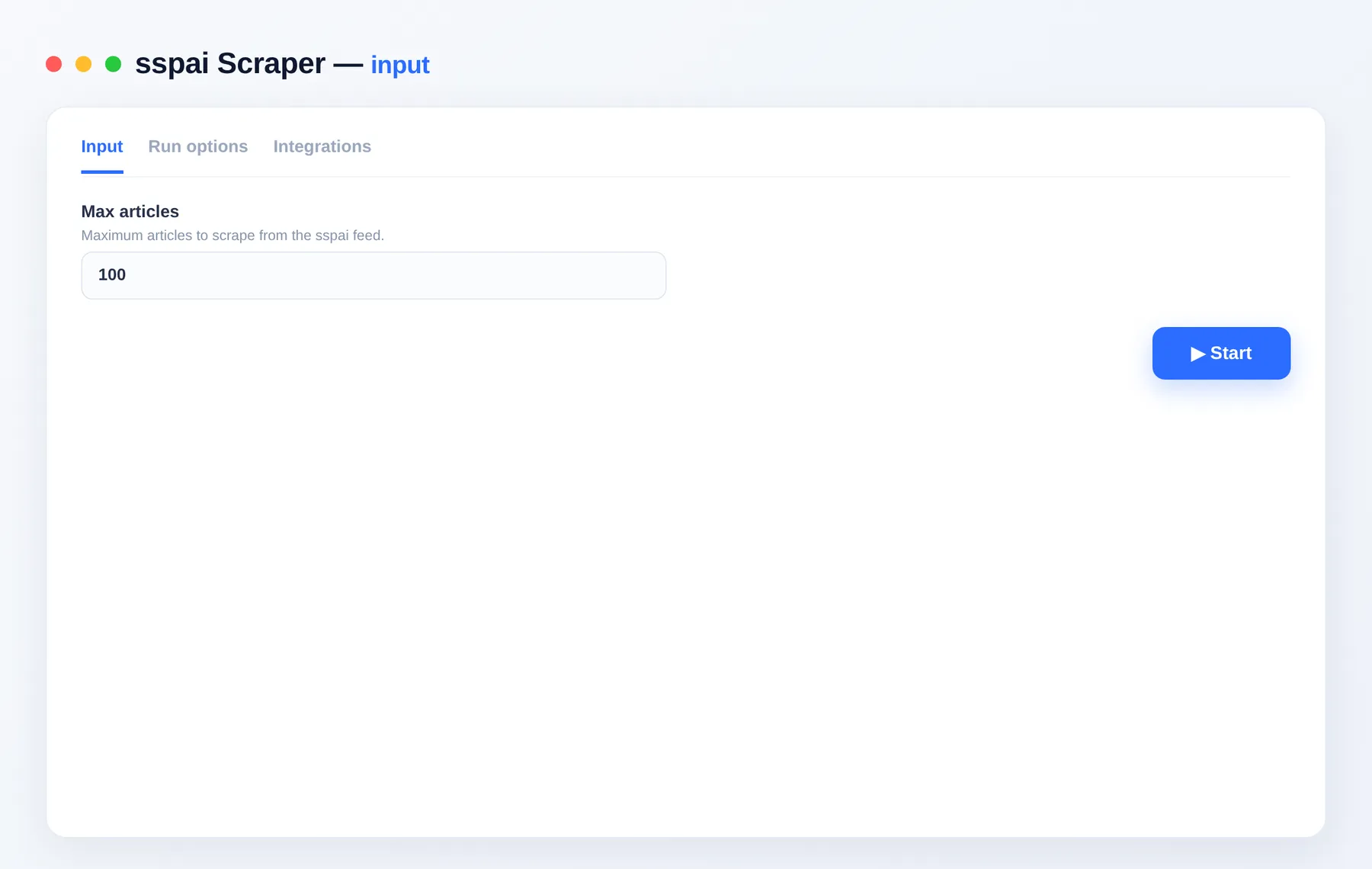
The sspai Scraper needs no login and no code — just set how many articles to collect and run.
| Field | Type | Description |
|---|---|---|
maxItems | integer | Maximum number of articles to scrape from the sspai feed (default 100). |
Output
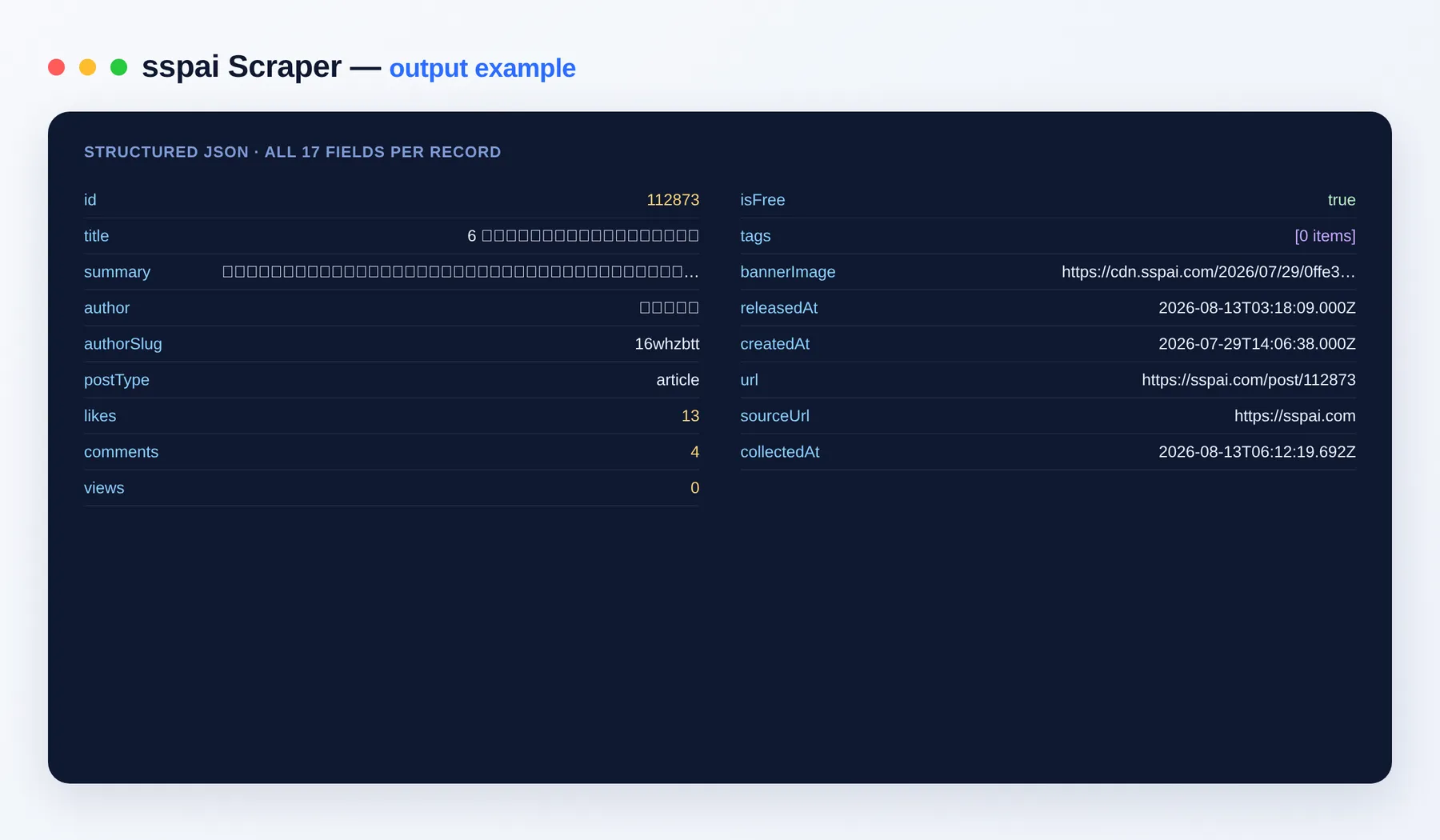
Each article is one dataset item:
Output schema
| Field | Type | Description |
|---|---|---|
id | integer | Unique sspai article ID. |
title | string | Article title. |
summary | string | Short article summary or excerpt. |
author | string | Display name of the author. |
authorSlug | string | Author profile handle used in the profile URL. |
postType | string | Type of post, e.g. article. |
likes | integer | Number of likes (点赞) on the article. |
comments | integer | Number of comments on the article. |
isFree | boolean | Whether the article is free to read. |
tags | array | Tags attached to the article, where available. |
bannerImage | string (URL) | URL of the article's banner image. |
releasedAt | string (ISO date) | When the article was published. |
url | string (URL) | Canonical URL of the article on sspai. |
collectedAt | string (ISO date) | When this item was collected. |
Need more Chinese tech and community data?
Pair the sspai Scraper with our other scrapers to build a wider Chinese tech-content dataset:
- Juejin Scraper — developer articles, authors and engagement from 掘金.
- Guokr Scraper — science and knowledge articles from 果壳.
- IThome Scraper — tech news headlines and articles from IT之家.
- Bilibili Scraper — videos, creators and stats from 哔哩哔哩.
FAQ
Do I need an account or login to scrape sspai?
No. There's no setup and no login — just set maxItems and run. It's a no-code way to collect sspai article data.
How many articles can I scrape per run?
As many as you like. Set maxItems to control how many articles are pulled from the feed, up to large batches.
What data does the sspai Scraper return? Title, summary, author and author slug, post type, tags, banner image, release date, likes and comments, plus the article URL and collection timestamp.
What export formats are supported? JSON, CSV, Excel and XML, plus webhooks and the Apify API.
How much does it cost? You pay only per item you get, which makes it one of the cheapest ways to collect sspai data at scale.
Can I automate or integrate the sspai Scraper? Yes. The sspai Scraper can be connected with almost any cloud service or web app thanks to integrations on the Apify platform. It works with Make, Zapier, Slack, Airbyte, GitHub, Google Drive and many more, plus the Apify API, JavaScript/Python clients and MCP. Or use webhooks to trigger an action whenever a run finishes — get a notification, or kick off another process such as loading your data downstream.
Is scraping sspai legal? The Actor collects only public data. You are responsible for how you use it and for complying with sspai's terms and applicable laws.
How fresh is the data? Each run reads the current feed, so results reflect the articles published at the time you run it.
Related Actors
- Juejin Scraper — developer articles and engagement from 掘金.
- Guokr Scraper — science and knowledge articles from 果壳.
- IThome Scraper — tech news from IT之家.
- Bilibili Scraper — videos and creator stats from 哔哩哔哩.
Notes
Original clean-room implementation. Collects only public sspai data; you are responsible for how you use the data and for complying with sspai's terms. This is an independent tool and is not affiliated with or endorsed by sspai (少数派).


