

UUID, ULID & NanoID Generator
Pricing
from $0.00015 / ids generated
UUID, ULID & NanoID Generator
Generate batches of UUID v4/v7, ULID or NanoID with a chosen count and format. Export as a dataset and a ready-to-use text/CSV file for seeding databases and test data.
Pricing
from $0.00015 / ids generated
Rating
0.0
(0)
Developer

hiper soft
Maintained by CommunityActor stats
0
Bookmarked
2
Total users
1
Monthly active users
a month ago
Last modified
Categories
Share
Generate batches of unique identifiers on demand — UUID v4, time-ordered UUID v7, sortable ULID or short NanoID — with your chosen count and format. Every run returns the IDs as a dataset and a ready-to-use text file for seeding databases, test data and primary keys.
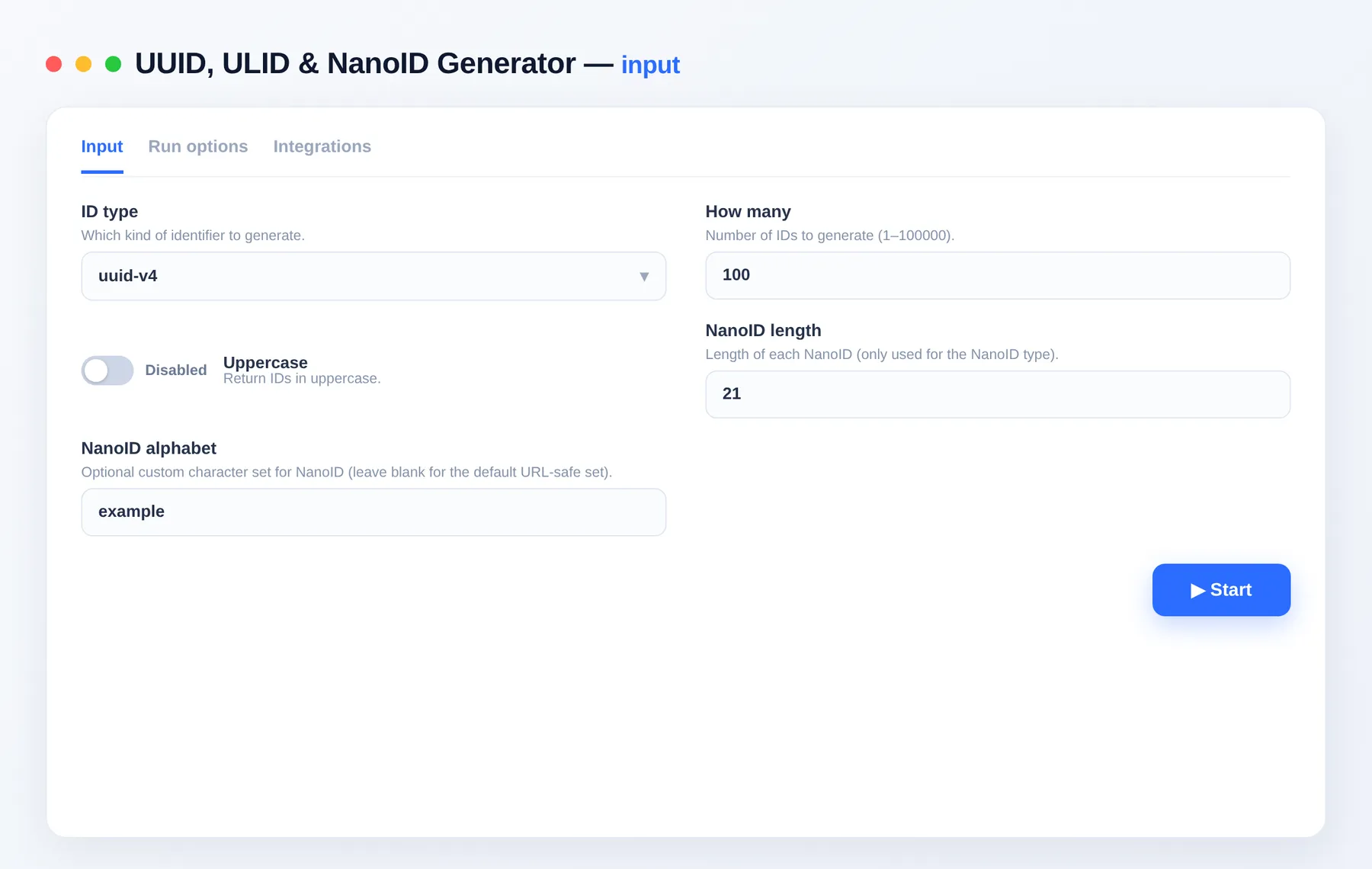
What it does
- Generates UUID v4 (random), UUID v7 (time-ordered), ULID (lexicographically sortable) or NanoID (short, URL-safe).
- Any count from 1 to 100,000 in a single run.
- Optional uppercase, custom NanoID length and alphabet.
- Exports a dataset plus an
ids.txtfile.
Use cases
- Database seeding — pre-generate primary keys or test fixtures in bulk.
- QA & load testing — create large batches of unique IDs.
- Migrations / backfills — assign IDs to existing rows.
Input
| Field | Type | Description |
|---|---|---|
type | string | uuid-v4, uuid-v7, ulid or nanoid. |
count | integer | How many IDs (1–100000). |
uppercase | boolean | Return IDs uppercase. |
nanoidLength | integer | Length of each NanoID. |
nanoidAlphabet | string | Optional custom NanoID character set. |
Output
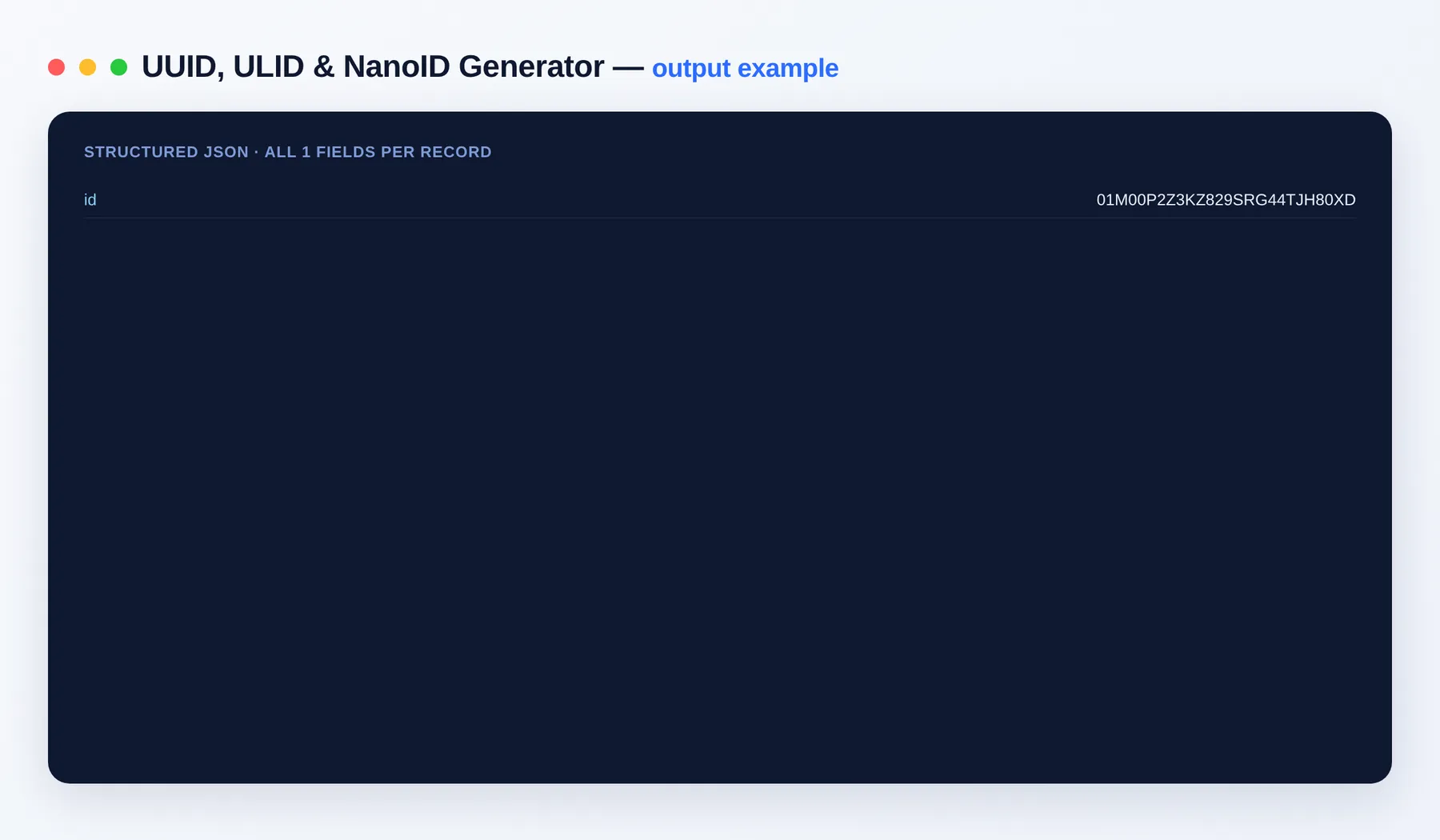
One row per ID, plus ids.txt in your key-value store.
Output schema
| Field | Type | Description |
|---|---|---|
id | string | A generated identifier. |
FAQ
Which type should I use? UUID v4 for random keys, UUID v7/ULID when you want IDs that sort by creation time, NanoID for short URL-safe IDs.
How many can I generate? Up to 100,000 per run.
Can I automate it? Yes — via integrations on the Apify platform and the Apify API.
Notes
Original clean-room implementation.


