

LinkedIn Profile Posts & Company Posts Scraper, No Login
Pricing
from $1.00 / 1,000 posts
LinkedIn Profile Posts & Company Posts Scraper, No Login
LinkedIn posts with no login or cookie: profile posts, company and showcase posts, a post by its link, keyword search, topics and newsletters. Text, author and headline, exact date, reactions, comments, images, video, PDF, reposts, quote posts and first comments. Misses free.
Pricing
from $1.00 / 1,000 posts
Rating
0.0
(0)
Developer
Hyperbach
Maintained by CommunityActor stats
0
Bookmarked
2
Total users
1
Monthly active users
6 days ago
Last modified
Categories
Features
Share
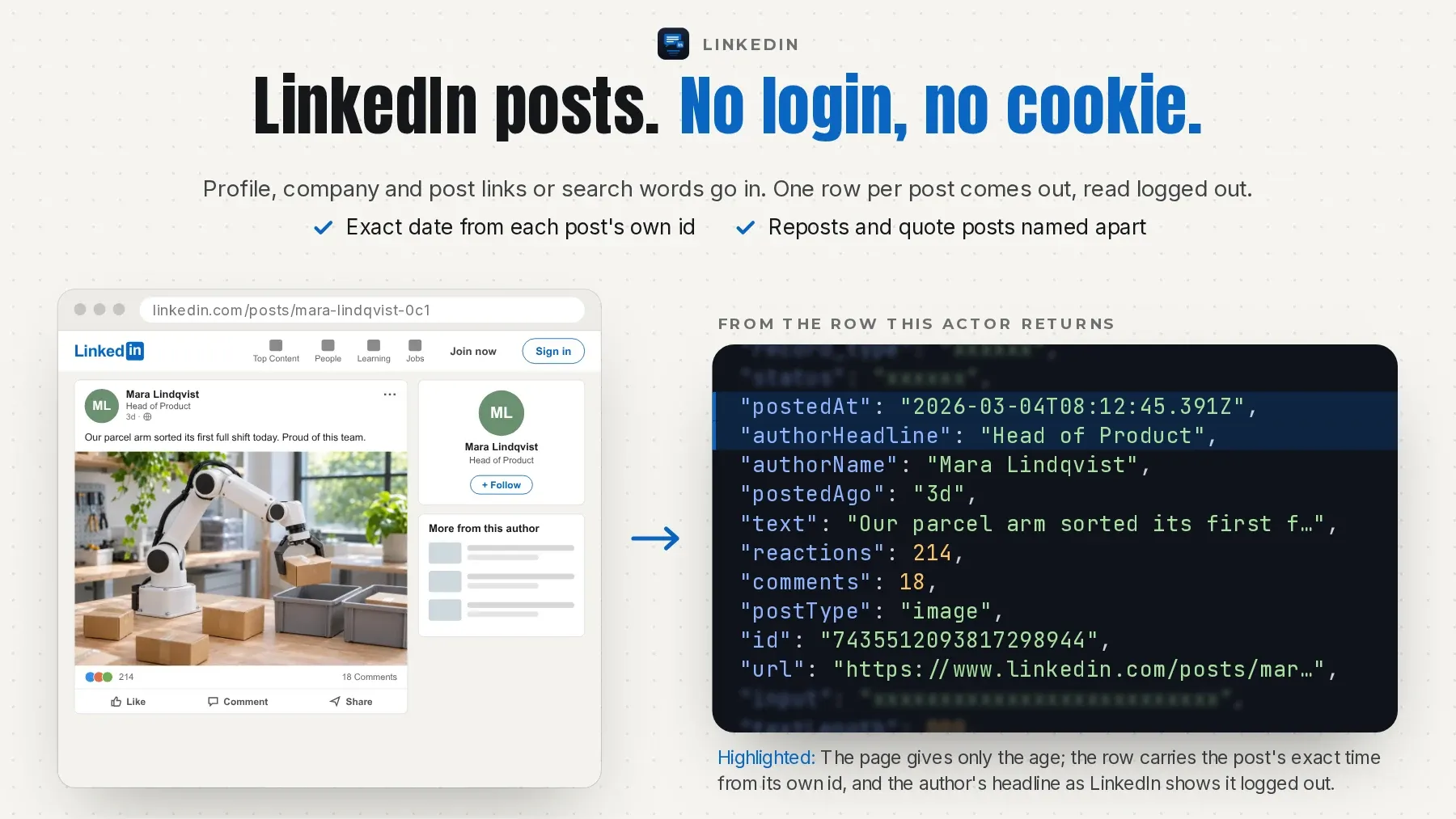
LinkedIn posts as data, logged out: profile, company, showcase and post links or search words in, one row per post out — the full text, the author with the headline where LinkedIn shows it, the exact date from the post's own id, reactions, comments, the top reaction types, images, the video file, a document's PDF, the link preview, mentions, hashtags and links, reposts and quote posts named apart, the first comments and model tags on request. A free summary row per link or search says how many posts LinkedIn showed and why the list ended. A private, missing or empty page is a free row, never charged. No login, no LinkedIn account, no cookie, proxies handled for you.
From $2.00 per 1,000 rows (post) on the Free plan, $1.70 on Starter; every row and add-on is priced under Pricing below. A run start is $0.002105. The default input returns about 21 rows for about $0.040105. A profile LinkedIn shows nobody logged out, a missing page, a company with no posts and a value that names nothing are free rows.
How it compares
- Cheaper than harvestapi's LinkedIn Profile Posts Scraper, with more data: $1.51 per 1,000 posts, against $1.75; 30 fields per post, against 15. It is 4 times faster: 20 posts in 5.5 s, against our 19 posts in 24 s.
- Cheaper than harvestapi's LinkedIn Company Posts Scraper, with more data: $1.51 per 1,000 posts, against $1.75; 30 fields per post, against 15. It is 3 times faster: 20 posts in 7.3 s, against our 19 posts in 24 s.
- Cheaper than supreme_coder's Linkedin Post Scraper: $1.51 per 1,000 posts, against $2.00. It is faster: 19 posts in 19 s, against our 24 s.
Measured on 2026-11-15. Each line compares one job, run by both scrapers at the same time. Prices are per 1,000 posts: Apify Actors at the Scale plan's prices.
Tested head-to-head on 2026-11-15
The job: The newest 10 posts of a public profile and of a company page (the input schema's example: targetUrls satyanadella and google, maxPosts 10). Every Actor ran on it the same day from the same harness; every run's cost is at the Scale plan's prices: a rival's charged events at its price for that plan, this Actor's at its list price. Fields counts the filled fields of a typical row. Every actor ran the same two links in the same minute; ours reads LinkedIn logged out, so a profile gives its newest 8-9 posts, and every link ends with a free row that says how far its list went. Re-measured monthly.
| Actor | Rows | First row | Run time | Cost | Fields | Failures |
|---|---|---|---|---|---|---|
| this Actor | 19 | 4.2 s | 24 s | $0.029 | 30 | none |
harvestapi/linkedin-profile-posts | 20 | 4.6 s | 5.5 s | $0.035 | 15 | none |
harvestapi/linkedin-company-posts | 20 | 6.4 s | 7.3 s | $0.035 | 15 | none |
supreme_coder/linkedin-post | 19 | 14 s | 19 s | $0.038 | 29 | none |
Why this LinkedIn post scraper
- No login, ever. Every post is read from LinkedIn's public pages as a logged-out visitor sees them: no cookie, no account to lose (the lane's reviews name cookie expiry and restricted accounts again and again), nothing of yours sent to LinkedIn.
- The depth stated, never a silent short list. LinkedIn shows a logged-out reader a profile's newest 8-9 posts and a company's newest 70 (the company feed read page by page to its end, the end read twice); a search lists up to about 1,000 posts from a search engine. Every link and search gets a free summary row with the posts listed and delivered and the verdict: COMPLETE (your cap), LIST_END (the whole list), TRUNCATED (LinkedIn's logged-out depth or the engine's end), DATE_LIMIT or PARTIAL with the reason.
- Exact dates, real counts. The date is the post's own id (its creation time to the millisecond, equal to the page's own date on 108 of 108 posts we checked), never a '1yr' turned into a date; reactions and comments are LinkedIn's own numbers, and a count the page does not show is null, never 0.
- Reposts and quote posts apart. A repost row names the original's author, text, id, link and date and who reposted it; a quote post carries the shared post in
quotedPost; switch either off and it is dropped free. A post two of your links list is delivered and charged once. - The media a buyer can use. The video file in every rendition with the poster, the length and the captions link; a document's title, page count, cover pages and PDF link; every image; the link preview; the mentions, hashtags and links of the text.
- Fast. One page gives 8-11 posts, read with no browser. Over the speed runs of builds 0.1.8 and 0.1.9 (three of a profile's first post, three of a 50-post search, and the head-to-head card's run above, all at 512 MB) the first post came in 4-15 seconds, and a 50-post search with no add-on, each post read on its own page, gave 118-124 posts a minute.
Who it's for
- Marketers and social media teams — a competitor's or a brand's company posts with their reactions, comments, media and dates, a profile's newest posts, a daily run for the new ones.
- Sales and recruiting teams — posts that name an open role or a buying signal from searches or company pages, with the author's headline and page, the optional tags marking hiring posts.
- Researchers and analysts — posts on a topic from a search or a topic page with exact dates and counts, a summary row per input to reconcile against, sentiment and kind tags on request.
- Developers and data teams — links in, typed rows out keyed by the post id, a free row for every link LinkedIn does not show, the leader's input names read as they are, a run summary to check a pipeline against.
Quick start
A profile's and a company's newest posts
A company's posts of the past month, to the end of its feed
Posts about a topic from a search, with the first comments
One post by its link, tagged
Switching from harvestapi/linkedin-profile-posts?
Your input works as it is. Each name in the left column is read as this Actor's own field and the run log says so (read <theirs> as <ours>); a name marked not read is ignored with a note. A value in the other Actor's shape, an object list or its own date form, is read too.
| harvestapi/linkedin-profile-posts | this Actor | what to know |
|---|---|---|
targetUrls | targetUrls | The same: profile and company links, and here also showcase, post, topic, newsletter and article links. |
maxPosts | maxPosts | The same: the most posts per link; 0 = everything a logged-out reader is shown (a profile's 8-9, a company's 70). |
postedLimit | postedLimit | The same values (any, 1h, 24h, week, month, 3months, 6months, year), checked on each post's own date. |
postedLimitDate | postedLimitDate | The same: only posts from this date on. |
includeQuotePosts | includeQuotePosts | The same. |
includeReposts | includeReposts | The same. |
scrapeComments | scrapeComments | The same switch: the first comments LinkedIn shows a logged-out reader (up to 10), not every comment. |
maxComments | maxComments | The same, up to 10 (the post page's own). |
scrapeReactions | not read | Not read: who reacted is shown to signed-in members only. Each row carries the reactions count and the top reaction types. |
maxReactions | not read | Not read: who reacted is shown to signed-in members only. |
commentsPostedLimit | not read | Not read: the post page shows its first comments only; each comment carries its date. |
contextCountry | not read | Not read: LinkedIn serves a logged-out reader the same posts from every country we measured (US, GB, DE, IN). |
What differs:
- The leader logs in to LinkedIn; this Actor never does. A profile gives its newest 8-9 posts and a company its newest 70 (what LinkedIn shows a logged-out reader), where the leader pages a member's feed; the summary row states the depth served.
- Reactions per type, the reposts count, who reacted, comment replies and LinkedIn's own post search need a login: the rows carry the total reactions and the top reaction types, the first comments on request, and the search goes through a search engine's index of LinkedIn posts.
- The rows are flat columns (authorName, postedAt, reactions, …) where the leader nests objects (author, postedAt, engagement); the date is the same exact time.
Output
One row per post (and one free summary row per link or search):
| field | meaning |
|---|---|
record_type | post on a post row (charged when status is ok); target (a link) or search on an input's free summary row. |
status | ok, or why an input gave no post (not_public, not_found, no_posts, invalid_input, failed, not_read), or duplicate on a post another input delivered. |
input | The link or the search words this row answers. |
id | The post's activity id (an article's link for a LinkedIn article). |
url | The post's page: its /posts/ link, else its id-only link. |
postType | text, image, video, document, link (a link preview), article, repost or quote. |
text | The post's full text, line breaks kept; a link shows as its text. |
textLength | The text's length in characters. |
title | An article's title (null on a post). |
postedAt | When the post was created (UTC, to the millisecond, from its own id). |
postedAtTimestamp | The same time in epoch milliseconds. |
postedAgo | The card's relative time as LinkedIn shows it ("2d", "1mo"; on a profile's repost, the original's). |
edited | True when LinkedIn marks the post Edited; null when the page shows no time line. |
authorName | The author's name (a repost: the original's author). |
authorUrl | The author's LinkedIn page. |
authorPublicId | The author's public id (the /in/ or /company/ part of the link). |
authorType | person or company. |
authorHeadline | The author's headline where LinkedIn shows it to logged-out readers (a person author on a post page); null otherwise. |
authorFollowers | The author's followers where the page shows them. |
authorImage | The author's photo or the company's logo. |
authorLocation | The author's location: a profile's or company's own posts, and with authorDetails. |
authorCompanyId | The company author's numeric LinkedIn id: a company's own posts, and with authorDetails. |
authorMemberId | The person author's numeric member id: a profile's own posts, and with authorDetails. |
reactions | Total reactions LinkedIn shows. |
comments | The comments count LinkedIn shows. |
topReactionTypes | The up to three reaction types LinkedIn shows (LIKE, PRAISE, EMPATHY, INTEREST, APPRECIATION, ENTERTAINMENT), no counts. |
engagementRate | (reactions + comments) ÷ the author's followers × 100, in percent; null when the followers are not shown. |
isRepost | True on a repost (shared without a comment). |
repostedBy | On a repost: who reposted it {name, url}. |
originalId | On a repost: the original post's activity id, where the page names it. |
originalUrl | On a repost: the original post's link. |
originalPostedAt | On a repost: when the original was created (UTC). |
quotedPost | On a quote post: the shared post {id, url, authorName, authorUrl, text, postedAt, images, video, document, article}. |
images | Every image of the post. |
video | The video {url (the highest rendition), renditions [{url, bitrate}], thumbnail, duration (seconds), captionsUrl}. |
document | A document post {title, pageCount, coverPages, manifestUrl, pdfUrl}. |
article | A link preview {title, url, source, image}. |
links | The links in the text (LinkedIn's redirect unwrapped). |
mentions | The people and companies the text links to [{name, url, type}]. |
hashtags | The hashtags of the text, without #. |
commentList | With scrapeComments: the first comments the post's page shows [{id, urn, text, authorName, authorUrl, postedAgo, postedAt, likes}]. |
analysis_sentiment | With tagPosts: the text's sentiment from -1 (negative) to 1 (very positive). |
analysis_kind | With tagPosts: hiring, employer_branding, product_announcement, event_or_webinar, company_news, customer_story, personal_milestone, thought_leadership, educational, promotion or other. |
analysis_hiring | With tagPosts: true when the post names an open role or asks people to apply. |
analysis_language | With tagPosts: the text's language code (en, de, fr, es, pt, it, nl, hi, ar, zh, ja, other). |
analysis_confidence | With tagPosts: the model's confidence in each answer, 0-1. |
urn | The post's urn (urn:li:activity:…). |
shareUrn | The share or ugcPost urn the card names (a repost: the original's). |
searchQuery | On a search's rows: the search words. |
searchRank | On a search's rows: the post's place in the engine's list. |
matchedIn | On a search's rows: where your quoted words stand — text, title (the engine's title only), none (elsewhere on the post: its author line, its link preview or the engine's snippet) or unquoted. |
detailStatus | When the post's own page was read for this row: served, not_served (LinkedIn has no page for it) or failed; null when it was not needed. |
statusNote | Why a row lacks a part it would have (the post's page not served, tags cut by the time limit). |
verdict | On a summary row: COMPLETE (your cap), LIST_END (the list's own end), TRUNCATED (LinkedIn's logged-out depth or the engine's end), DATE_LIMIT (the date window) or PARTIAL (stopped: note says why). |
rows_delivered | On a summary row: the posts it delivered. |
posts_listed | On a summary row: the posts LinkedIn (or the engine) listed for it. |
note | Why a summary row has the status or the verdict it has. |
scraped_at | When this row was read (UTC). |
Example record:
Pricing
Pay for the posts a run delivers, for the tags only on the posts you ask to tag, and one run start. No platform usage is billed to you, and the post's price falls with your Apify plan.
| event | unit | Free | Starter | Scale | Business |
|---|---|---|---|---|---|
Post (post) | per 1,000 | $2.00 | $1.70 | $1.40 | $1.00 |
Post tags (post-tags) | per 1,000 | $0.50 | $0.50 | $0.50 | $0.50 |
Run start (start) | per run | $0.0021054 | $0.0021054 | $0.0021054 | $0.0021054 |
A post is $2.00 per 1,000 on the Free plan ($0.002 a post) and $1.70 on Starter, with everything its row carries (the first comments and the author's details included when you ask for them). Each run that delivers a post also pays the run start, $0.0021054 once; a run that delivers none pays nothing at all. So the newest 10 posts of 10 company pages cost $0.2021054 on the Free plan and $0.1721054 on Starter; a search to 500 posts $1.0021054 and $0.8521054.
With tagPosts, each tagged post adds $0.0005 ($0.50 per 1,000) on every plan; a post with no text is not tagged and not charged for tags. Free: every summary row of a link or a search, a profile LinkedIn shows nobody logged out, a missing page, a company with no posts, a post your filters leave out, a search result that holds none of your words, a repeat of a post the run already delivered, a value that names nothing, and a run that delivered nothing. A run that stops early (a timeout, an abort) is charged for the posts it delivered.
Before the first request the log names the prices at your plan and the most the run can cost: maxPosts a link or search, maxItems over the whole run, one post a post link, and never more than your charge limit; with no cap it names how far LinkedIn's lists go. Enterprise plans have their own rates — the Actor's Pricing tab shows the price for your plan.
Usage patterns
- Links —
targetUrlstakes LinkedIn links in any form (www or a country host, with or without parameters, a link wrapped in a redirect): a profile (/in/…, its newest 8-9 posts), a company or showcase page (its newest 70, the feed read page by page), a post (/posts/…,/feed/update/urn:li:activity|share|ugcPost:…, also a bare post id or urn: one row), a topic page (/top-content/…: its 9 top posts), a newsletter (each issue as an article row) or an article (/pulse/…: one row). A bare word is read as a profile's public id. A member-id profile link (/in/ACoAA…), a school page and a group page are shown to signed-in members only, so each gives a freeinvalid_inputrow that says so, as does a value that names nothing. - Search —
searchQueries(one search a line) goes to a search engine's index of LinkedIn posts as written: quotes keep a phrase, -word leaves a word out. The engine lists 10 results a page, up to about 1,000; each result is read on its own post page, and a post two inputs list is delivered once. It is not LinkedIn's own signed-in search (its filters and its ranking need a login). The engine relaxes words it cannot match: a result whose post holds none of your words (every quoted phrase, or at least one other word) is left out free, the search row counts them, and the search ends at an engine page whose posts hold none. The row'smatchedInsays whether your quoted words are in the post's text (text), only in the engine's title (title) or elsewhere on the post (none: its author line, its link preview or the engine's snippet), andsearchRankgives the engine's order. WithpostedLimitthe engine is asked for the day, the week or the month, and every row's own date is checked again. - What a row is —
record_type=post,status=ok: one post (charged).postTypeistext,image,video,document,link(a post with a link preview),article(a LinkedIn article page),repostorquote. A freepostrow withstatusduplicateis a post another input of the run already delivered.record_type=target(a link) orsearch: the free summary — itsstatus(ok,not_public,not_found,no_posts,invalid_input,failed,not_read,duplicate: another form of a link you gave, read once),rows_delivered,posts_listedand theverdictwith itsnote; a newsletter's row also carries itstitle,url, description (text) and creator (authorName,authorUrl). - How far a link goes — A profile's page shows a logged-out reader its newest 8-9 posts (TRUNCATED: LinkedIn's limit); a profile page with no posts section names its newest few posts in its record, and each is read on its own page. A company's or showcase's page shows 10 and its feed 10 more a page to the newest 70 (TRUNCATED), or to the list's own end for a company with fewer posts (LIST_END: a short last page, or the feed's end read again on a second connection). A link's posts come in LinkedIn's own order, newest first, and a search's in the engine's order (
searchRank); there is no sort input.maxPostscaps one link or search (COMPLETE),maxItemsthe whole run;postedLimitandpostedLimitDateend a company's walk at the first page older than the window (DATE_LIMIT). A run cut by its time limit or an abort writes PARTIAL with what it delivered. - Options —
scrapeCommentsreads each post's own page for its first comments (up to 10,maxComments): author, text, date and likes incommentList; replies and the rest are signed-in only.authorDetailsreads each distinct author's page once for the location, the followers and the numeric id, for posts from post links, searches, topics and newsletters (a profile's or company's own posts get them from the page the run reads anyway).tagPostsaddsanalysis_kind,analysis_sentiment,analysis_hiringandanalysis_languagefrom a classification model, charged per tagged post.keywords,minReactions,minComments,includeRepostsandincludeQuotePostsdrop posts free.maxConcurrencysets the links read at once (4 by default).
Input configuration
| field | type | default | what it does |
|---|---|---|---|
targetUrls | array | [] | LinkedIn links in any form (www or a country host such as uk.linkedin.com, with or without parameters, a link wrapped in a redirect): a profile (/in/…), a company or showcase page, a post (/posts/… or /feed/update/urn:li:activity:…), a topic page (/top-content/…), a newsletter or an article (/pulse/…); also a bare post id or urn, or a bare profile public id such as satyanadella. A profile gives its newest 8-9 posts (what LinkedIn shows a logged-out reader), a company its newest 70. A value that names nothing, or a page LinkedIn shows only to signed-in members (a member-id profile link, a school, a group), gives a free row that says why. |
searchQueries | array | [] | One post search per line, sent to a search engine's index of LinkedIn posts as written: quotes keep a phrase, -word leaves a word out; each result is read on its own post page. The engine lists up to about 1,000 posts per search; it is not LinkedIn's own signed-in search, and the row's matchedIn says where your quoted words stand. |
maxPosts | integer | 0 | The most charged posts one link or one search delivers; 0 = everything a logged-out reader is shown (a profile's 8-9, a company's 70, a search's up to about 1,000). |
postedLimit | any / 1h / 24h / week / month / 3months / 6months / year | "any" | Only posts this new, checked on every post's own date; an older post is dropped free, and a company's walk stops at the first page older than the window. A search also asks the engine for the day, the week or the month. |
postedLimitDate | string | Only posts from this date on (2026-10-01, or a time in UTC); with Posted within, the later of the two applies. | |
includeReposts | boolean | true | Reposts (shared without a comment) are rows of their own, with the original's author, text and link, and repostedBy. Off: they are dropped free. |
includeQuotePosts | boolean | true | Quote posts (shared with the reposter's own text) carry the shared post in quotedPost. Off: they are dropped free. |
minReactions | integer | 0 | Only posts with at least this many reactions; the others are dropped free. |
minComments | integer | 0 | Only posts with at least this many comments; the others are dropped free. |
keywords | array | [] | Only posts whose text holds at least one of these words or phrases as whole words, any case (AI keeps "our AI roadmap", not "available"; a Chinese, Japanese or Thai word anywhere in the text); the others are dropped free. |
scrapeComments | boolean | false | Reads each post's own page for the first comments it shows (up to 10, with author, text, date and likes) in commentList. One more page per post, so slower. Replies and the rest of the comments are shown to signed-in members only. |
maxComments | integer | 10 | How many of the first comments to keep (1-10) when Add the first comments is on. |
authorDetails | boolean | false | For posts from post links, searches, topics and newsletters: reads each distinct author's own page once for the location, the follower count and the numeric id. A profile's or company's own posts get these from the page the run reads anyway. |
tagPosts | boolean | false | Adds analysis_kind (hiring, employer branding, product announcement, event, company news, customer story, personal milestone, thought leadership, educational, promotion, other), analysis_sentiment (-1 to 1), analysis_hiring and analysis_language to each post with text, read by a classification model, with the confidence of each answer. Charged per tagged post. |
maxItems | integer | 0 | The most charged posts of the whole run; 0 = no cap beyond your charge limit. Free rows (summary rows, private or missing pages, duplicates, posts a filter drops) do not count. |
maxConcurrency | integer | 4 | Links and searches read in parallel, each on its own connection. |
feedback | string | A note to the people who maintain this Actor: what you needed and did not get. For example a missing field, a wrong or empty result, or the Actor you switch from or to, and why. The run does not read it: the rows and the charges stay the same. A person reads every note. |
Errors
A run does not fail because of your input. When an input cannot be used — a date that is not a date, an id in the wrong form, two settings that contradict each other — the run ends Succeeded, charges nothing, and says what to change:
- the status message starts with
INPUT REJECTED; - the dataset holds one row,
{"error": true, "code": "…", "message": "…"}, and no results; - the key-value store record
ERRORholds the same object.
From code, check error on the first row before reading results.
A link or search that gives no post is not an error: the dataset holds its free summary row (its status or verdict says why) and nothing is charged. A run that ends Failed is a fault on our side, never your input; it charges nothing, and we are alerted.
FAQ
Why only 8-9 posts of a profile?
LinkedIn shows a logged-out reader a profile's newest 8-9 posts on its page; the profile's activity pages are for signed-in members. This Actor never logs in, so a profile link gives those posts and its summary row says so (TRUNCATED). A company's feed goes to its newest 70. A search with the person's name in quotes lists more posts that name them (the search engine's list: their own posts among others).
Why is the author's headline empty on some rows?
LinkedIn shows a post author's headline on the post's own page, and only for authors who show it to logged-out readers. A profile's own posts get it from one of its post pages; a post from a link or a search gets it from its page; a repost's original author on a profile page has none, and a company author's line is its follower count.
Are the per-type reaction counts, the reposts count and the views included?
No. LinkedIn shows logged-out readers the total reactions, the comments count and up to three reaction types (topReactionTypes), not the count per type or the number of reposts; views are shown to the author only. Who reacted is a signed-in list too.
Does it need a LinkedIn account, cookies or an API key?
No. Everything is read logged out with a plain HTTP client; no member cookie is accepted and none is used.
Which status is which?
A post row: ok (charged), duplicate (another input of the run delivered it; free). A summary row: ok with its verdict, not_public (LinkedIn shows the profile to nobody logged out: it was refused on four connections of two kinds), not_found (LinkedIn answered "Page not found" on two connections), no_posts (the page shows no posts), invalid_input (a value that names nothing, or a page shown to signed-in members only), failed (the page could not be read on several connections), not_read (left at maxItems, the charge limit or the run's time limit). None of them is charged.
Can I get only new posts every day?
Yes: schedule the run with postedLimit 24h (or week). Each post's own date is checked, so only the posts of the window are delivered and charged.
Do I need Apify Proxy or my own proxy?
No. The Actor uses its own connections, at no extra cost to you.
Integration
JavaScript
Python
CLI
REST
AI agents and MCP
Apify's MCP server offers this Actor as a tool to Claude, Cursor, VS Code and any other MCP client. Connect https://mcp.apify.com?tools=hyperbach/linkedin-post-scraper and ask, for example: "Get the latest LinkedIn posts of Satya Nadella and Google with their text, date, reactions, comments and media". The agent fills the input from the table above and reads the rows from the run's dataset. A field under the name another Actor gives it is read as this Actor's own: profileUrls, companyUrls, postUrls, urls as targetUrls; searchQuery, queries, query, search as searchQueries; limit, maxResults, resultsLimit, postsLimit as maxPosts; maxTotalPosts, maxRecords, totalLimit as maxItems (and more). An agent or a person can add feedback to any run and say what was needed and not delivered: a missing field, a wrong or empty result, the Actor switched from or to, and why. The run returns the same rows at the same price, and a person reads every note.
n8n, Make and Zapier
The Apify node in n8n, the Apify app in Make and the Apify integration in Zapier run this Actor on a schedule or from a trigger and read its dataset. A webhook on the run's end (Integrations on the Actor page) sends the rows on to your own endpoint. Nothing to install on our side.
Support
Disagree with a charge? Write to apify@hyperbach.com with the run ID. We will ask Apify to compensate you, and the charge comes back to your Apify account as platform credit.
Did it do the job? A short review on the Store, at any rating, helps the next buyer choose.
See also
- LinkedIn Jobs Scraper — LinkedIn job listings for keywords and a location, with the applicants count, the salary block and the company's facts.
- LinkedIn Ad Library Scraper — every ad a company runs on LinkedIn, with the full detail page: payer, impressions by country and the targeting the advertiser chose.
- LinkedIn Profile Scraper & People Search — LinkedIn profiles logged out, by link or people search: name, headline, location, about, followers, connections, companies and schools.
- Telegram Profile Scraper — Telegram channels, groups, bots and users by username or link, with the exact subscriber or member count.
- YouTube Channel Search Scraper — the YouTube channels a keyword finds, with subscribers, the exact video and view counts and the country.
- Threads Scraper — Threads profiles with the exact follower count, their posts and replies with view counts, and keyword and tag search, without a login.
This page is generated from the Actor's schemas and a live sample — it cannot describe a field the Actor does not have.


