

Zhihu Scraper: Questions, Answers, Profiles, Articles (知乎)
Pricing
from $1.27 / 1,000 zhihu records
Zhihu Scraper: Questions, Answers, Profiles, Articles (知乎)
Zhihu (知乎) scraper and Zhihu data API without a login: questions with their shown answers, answers, user profiles, column articles with comments, a column's first page. Full text as Markdown and HTML, votes, comments, topics, author, IP location. Misses free.
Pricing
from $1.27 / 1,000 zhihu records
Rating
0.0
(0)
Developer

Hyperbach
Maintained by CommunityActor stats
0
Bookmarked
2
Total users
1
Monthly active users
2 days ago
Last modified
Categories
Features
Share
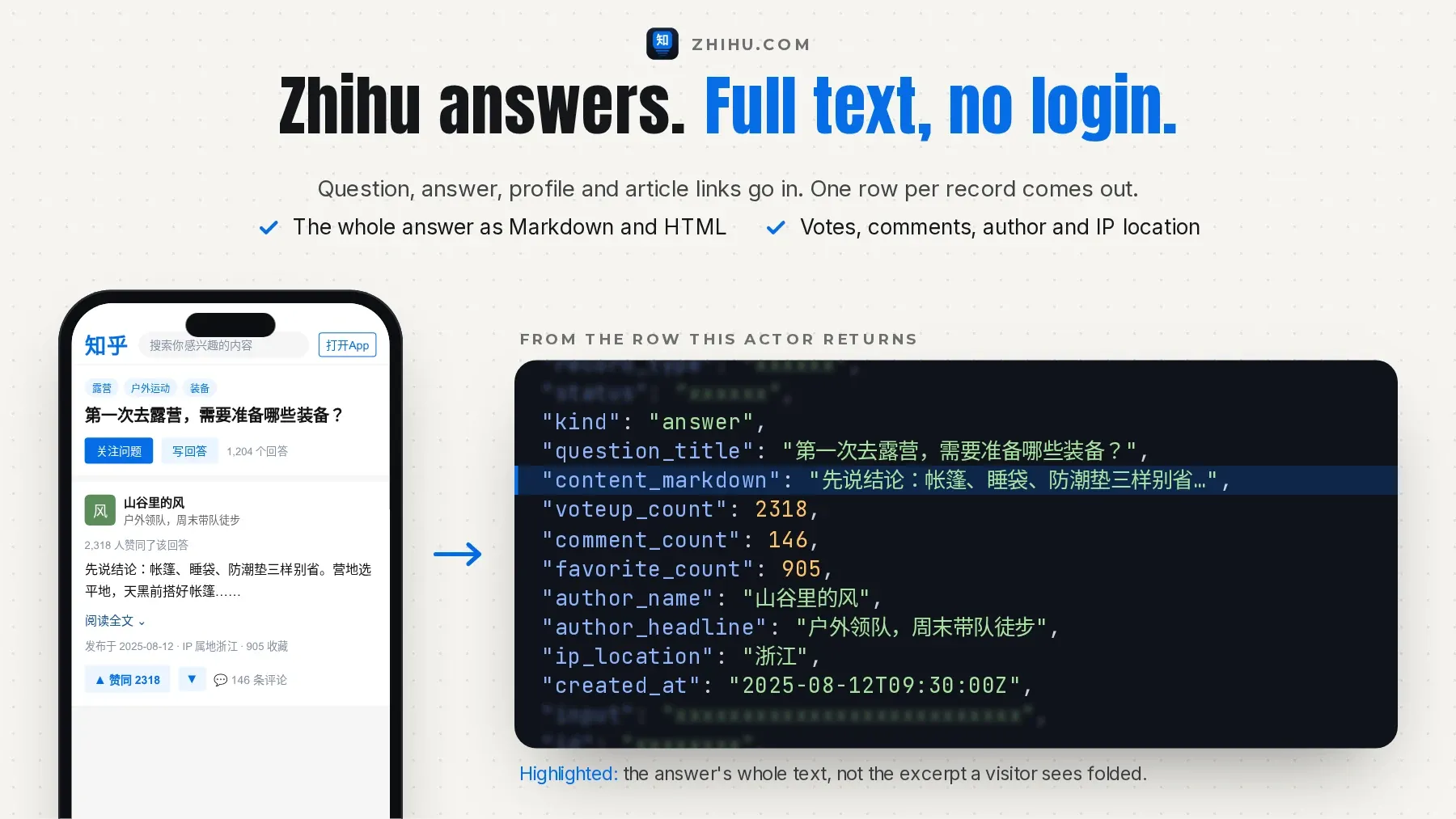
Zhihu (知乎) without a login: question, answer, profile, column-article and column links in; one row per record out — a question with the answers Zhihu shows a visitor who is not signed in, an answer, a user profile, a column article with its comments, a column's first page of items. Each row carries the full text as Markdown and HTML with its image links, the vote, comment, favourite, thanks and like counts, the topics, the times, the IP location and the author; each link's own free row names its verdict against Zhihu's own count. No login, no cookies, no account of yours; Zhihu's bot wall handled for you.
From $2.5415 per 1,000 rows (result) on the Free plan, $2.160275 on Starter; every row and add-on is priced under Pricing below. A run start is $0.004705. The default input returns about 2 rows for about $0.015248. Every link gets one free row with its verdict and Zhihu's own count; a page Zhihu says does not exist (not_found, read twice), a page our route could not read this time (refused) and a link this Actor does not read (invalid_input) are named there and never charged.
How it compares
- socialdatax's 知乎 / Zhihu API is cheaper: $4.04 per 1,000 records, against our $6.86.
- zen-studio's Zhihu Scraper is 2 times cheaper: $3.19 per 1,000 records, against our $6.86.
- devcake's Zhihu Scraper 2026 returned nothing for this job: this Actor returned 2 records.
- sian.agency's Zhihu Scraper gives more data: 72 fields per record, against our 30. The price is about the same: $6.86 per 1,000 records, against $6.55.
Measured on 2026-11-18. Each line compares one job, run by both scrapers at the same time. Prices are per 1,000 records: Apify Actors at the Scale plan's prices.
Tested head-to-head on 2026-11-18
The job: A Zhihu question with the answers it shows, one answer by its link and an official profile (the input schema's example). Every Actor ran on it the same day from the same harness; every run's cost is at the Scale plan's prices: a rival's charged events at its price for that plan, this Actor's at its list price. Fields counts the filled fields of a typical row. Each rival reads the same question (19550225) and its answer by link as far as its input allows (none of them takes the profile link in the same run): socialdatax is the most used Zhihu actor, zen-studio and devcake the next, sian.agency the one with a question-answers operation of its own. Re-measured monthly.
| Actor | Rows | First row | Run time | Cost | Fields | Failures |
|---|---|---|---|---|---|---|
| this Actor | 2 | 3.7 s | 97 s | $0.014 | 30 | none |
socialdatax/socialdatax-zhihu-data-api | 1 | 4.0 s | 4.1 s | $0.004 | 31 | none |
zen-studio/zhihu-scraper | 5 | 4.3 s | 5.0 s | $0.016 | 31 | none |
devcake/zhihu-scraper | 0 | — | 5.4 s | $0.0001 | — | FAILED: The run stopped while processing input 1 of 2. 0 results were saved. |
sian.agency/zhihu-scraper | 5 | 7.9 s | 10 s | $0.033 | 72 | none |
Why this Zhihu scraper
- No login, cookies or keys of yours. Zhihu walls every plain client with a script check, and its API asks for a signed request. This Actor reads the pages through the fleet's own unblocker (a browser passes Zhihu's check on a connection in China and the page is read over it), so you paste links and get rows.
- Every kind of record a link names. A question with the answers Zhihu shows a visitor who is not signed in, an answer by its link, a user profile with its follower, answer, article and vote counts, a column article with its comments, and a column's first page of items: one charged row each, with
kindsaying which. - Counts that do not lie. Zhihu shows a visitor who is not signed in the first 3 answers of a question and the first 10 items of a column, and says that the rest needs a login. Each link's free row says so (
verdictTRUNCATED) with Zhihu's own count beside what was delivered ("3 of the question's 1,537 answers"), never a full list it is not. - Full text, three ways. Each answer, article and question carries its text as Markdown (
content_markdown, images as links), the source's own HTML (content_html) and its short excerpt, with the image links listed apart (images). - No silent failures. A page our route could not read is a free
refusedrow with the reason; a page Zhihu says does not exist is a freenot_foundrow only when two reads agree; a search or hot-list link gets a free row that says Zhihu needs a login for it. Nothing is charged for any of them.
Who it's for
- Market and consumer researchers — read what Chinese users write about a product, a brand or a topic: the question, its top answers with their votes and comments, and the authors' standing.
- Content and media teams — follow Zhihu columns and authors: each profile's follower, answer and article counts, a column's latest items and an article's full text and comments.
- AI and data teams — collect Zhihu answers and articles as clean Markdown with their image links, counts, topics and dates for analysis or a model's sources.
Quick start
Basic — newest postings
Switching from socialdatax/socialdatax-zhihu-data-api?
Your input works as it is. Each name in the left column is read as this Actor's own field and the run log says so (read <theirs> as <ours>); a name marked not read is ignored with a note. A value in the other Actor's shape, an object list or its own date form, is read too.
| socialdatax/socialdatax-zhihu-data-api | this Actor | what to know |
|---|---|---|
operation | not read | Not needed: each link is read by its own kind. get_content_comments turns includeComments on; get_content_detail and get_user_info are what a link gives here; the search, hot-list, user-list and reply operations need a Zhihu login: a run that names one is rejected at no charge, and its status says why. |
keyword | not read | Not read: Zhihu's search asks for a login (the build's tests: HTTP 401 even on a signed request). A keyword with no link is rejected at no charge; give question, answer, profile, article or column links instead. |
content_type | not read | Not read: a filter of the search, which needs a Zhihu login. |
sort_type | not read | Not read: a sort of the search, which needs a Zhihu login. |
publish_time_range | not read | Not read: a filter of the search, which needs a Zhihu login. |
content_url | startUrls | Read as one link of startUrls: an answer or a column article link (a question, profile or column link works too). |
comment_id | not read | Not read: a comment's replies are not read; each comment row carries its reply count (reply_count). |
comment_sort_type | not read | Not read: an article's comments come in Zhihu's default order. |
profile_url | startUrls | Read as one link of startUrls: the profile's own row. A user's answer and article lists ask for a Zhihu login; a user's column is read by its column link. |
page_token | not read | Not needed: the Actor pages by itself, to maxCommentsPerArticle and maxItems; every run starts from the first page. |
max_items | maxItems | The same: the most charged rows of the whole run. |
auto_paginate | not read | Not needed: the Actor always pages by itself to the caps. |
What differs:
- The leader runs one operation a run on one link or one keyword; here every link in
startUrlsis read in one run, each by its own kind (a question, an answer, a profile, an article, a column). - The leader's content search, user search, suggestions, hot list and comment replies run on Zhihu's signed-in API through its own service; on Zhihu without a login each of them asks for a login, so this Actor does not offer them, and a search or hot-list link gets a free row that says so.
- The leader's answer and article comments: here an article's comments (
includeComments); the comments of an answer are not read (Zhihu serves them only to a request its own page script signs, which this Actor does not run). - A question here gives the question and the answers Zhihu shows without a login (3 on every question read in the build's tests), with Zhihu's own answer count beside them; the leader does not take a question link.
- The leader's columns are snake_case like ours, but its names differ (
content_url→url,voteup_count→voteup_count, the author block flattened intoauthor_*columns here).
Output
One row per Zhihu record (kind: question, answer, profile, article, comment), and one free summary row per link:
| field | meaning |
|---|---|
record_type | result on a record row (charged); target on a link's free summary row. |
status | ok (a charged record, or a link that delivered), or why a link's row is free: not_found (Zhihu says the page does not exist, on two reads), refused (our route could not read the page this time; run it again later), invalid_input (a value that names no page this Actor reads), failed, not_read (the run stopped before it). |
kind | What the row is: question, answer, profile, article or comment (on a link's row: the link's kind). |
input | The link or id you gave that this row answers. |
id | Zhihu's own id of the record (a question, answer, article or comment number; a profile's member id). |
url | The record's page on Zhihu (a comment: its article's page). |
page_fee | On a record row: true on a row that carried a page fee: an answer or article link's first record, and an article's first comment when its comments were asked; false on every other record row; null on a link's row. |
title | The question's title (on an answer: its question's title), or the article's title. |
excerpt | Zhihu's own short excerpt of the text. |
content_markdown | The full text as Markdown, images as links (a question: its description; a comment: its text). |
content_html | The full text as Zhihu's own HTML. |
images | The text's image links, each once, the full-size one first. |
question_id | On a question or an answer: the question's id. |
question_title | On a question or an answer: the question's title. |
question_url | On an answer: its question's page. |
parent_id | On a comment: the id of the article it was written on. |
parent_type | On a comment: what it was written on (article). |
column_id | On an article: its column's slug (zhuanlan.zhihu.com/ |
column_title | On an article read by its own link: its column's title. |
topics | The topics Zhihu tags the question or the article with. |
voteup_count | Upvotes (赞同) of a question, an answer or an article; on a profile, the upvotes the user received. |
comment_count | Comments, as Zhihu counts them (replies included). |
favorite_count | Times saved to a collection (收藏). |
thanks_count | On an answer read on a page: thanks (感谢). |
like_count | Likes (喜欢) of an answer or an article; on a comment, its likes. |
reply_count | On a comment: its replies. |
answer_count | On a question: Zhihu's own count of its answers (the yardstick of the link's verdict); on a profile: the user's answers. |
follower_count | Followers of a question or of a profile. |
visit_count | On a question: its views. |
created_at | When the record was published (UTC). |
updated_at | When the record was last edited (UTC). |
ip_location | The province or country Zhihu shows as the author's IP location (IP 属地); null where the page does not show it. |
author_name | The author's display name; null for an anonymous author. |
author_url_token | The author's url_token (the profile link's last part); null for an anonymous author. |
author_url | The author's profile page; null for an anonymous author. |
author_headline | The author's one-line headline. |
author_follower_count | The author's followers, where the page shows it (a question page's answers do; an answer page does not). |
author_is_org | Whether the author is an organisation account. |
author_verification | The author's verification line as Zhihu shows it (a credential or 已认证的个人), null when none. |
author_avatar_url | The author's avatar image link, null when Zhihu shows none (an anonymous author, or one who hides the profile from visitors). |
author_anonymous | Whether the author wrote anonymously (匿名用户): no name, token or link is shown then. False with a null name: the author hides the profile from visitors who are not signed in (shown as 知乎用户); the badge Zhihu still shows is in author_verification. |
name | On a profile: the user's display name. |
url_token | On a profile: the url_token (the profile link's last part). |
headline | On a profile: the one-line headline. |
description | On a profile: the about text. |
is_org | On a profile: whether it is an organisation account. |
verification | On a profile: the verification line Zhihu shows, null when none. |
avatar_url | On a profile: the avatar image link. |
gender | On a profile: male or female as the profile says, null when it does not say. |
following_count | On a profile: the users it follows. |
article_count | On a profile: its articles. |
question_count | On a profile: its questions. |
thanked_count | On a profile: thanks received. |
favorited_count | On a profile: times its records were saved. |
pin_count | On a profile: its pins (想法). |
column_count | On a profile: its columns. |
zvideo_count | On a profile: its videos. |
verdict | On a link's row: COMPLETE (everything the link names), TRUNCATED (Zhihu shows less without a login than its own count: note gives both), CAPPED (maxCommentsPerArticle), LIST_END (an article's comment list ended under its count, read twice), PARTIAL (stopped: note says why). |
rows_delivered | On a link's row: the record rows it delivered. |
note | Why a link's row has the status or the verdict it has, with Zhihu's own count. |
scraped_at | When this row was read (UTC). |
Example record:
Pricing
Pay for the Zhihu records a run delivers, plus a page fee for an answer or an article link and one run start. No platform usage is billed to you, and the record's price falls with your Apify plan.
| event | unit | Free | Starter | Scale | Business |
|---|---|---|---|---|---|
Zhihu record (result) | per 1,000 | $2.5415 | $2.160275 | $1.77905 | $1.27075 |
Answer or article page (page) | per link | $0.00546 | $0.00546 | $0.00546 | $0.00546 |
Run start (start) | per run | $0.004705 | $0.004705 | $0.004705 | $0.004705 |
A record is $2.5415 per 1,000 on the Free plan ($0.0025415 a row) and $2.160275 on Starter, whatever its kind: a question, an answer, a profile, an article or a comment, with everything its row carries. An answer or a column-article link pays the page fee, $0.00546, once with its record, and an article's comment list pays it once more with its first comment when you switch on includeComments: each of those pages is a paid read for this Actor. A question, a profile or a column link never pays it. Each run that delivers a charged row pays the run start, $0.004705 once.
So a question with the 3 answers it shows costs $0.014871 on the Free plan and $0.0133461 on Starter; 10 profiles $0.03012 and $0.02630775; one answer by its link $0.0127065 and $0.012325275; the example (a question, one of its answers by link and an official profile) at most $0.025414 and $0.02312665 when the question's page is served (6 rows: the question, its 3 answers, the answer by link, the profile), $0.015248 and $0.01448555 when it is not served this hour (2 rows); an article with 20 comments $0.0689965 and $0.060990775. Free: every link's own row (its verdict and Zhihu's count), a page Zhihu says does not exist, a page our route could not read this time, a link this Actor does not read, a record the run already delivered (one row, one charge: an answer read on its question's page and from its own link pays no page fee either), and a run that delivered no charged row (no run start either). A run that stops early (a timeout, an abort, the charge limit) is charged for the rows it delivered.
Before the first request the log names the prices at your plan and what the run can cost: "at most" under maxItems (the dearer rows first: each answer or article link's first row with its page fee) and your charge limit; with no maxItems the line says "about", from the rows Zhihu shows a visitor who is not signed in (3 answers a question, 10 items a column). Enterprise plans have their own rates: the Actor's Pricing tab shows the price for your plan.
Usage patterns
- A question and its answers — Paste question links (or bare question ids) in
startUrls: each gives the question's own row (title, answer, follower, visit and comment counts, topics) and a row for each answer Zhihu shows without a login (3 on every question read in the build's tests), with Zhihu's own answer count on the link's free row. - Answers, profiles and articles by link — An answer link gives that answer with its question; a profile link (or a url_token) the user's profile row; a column article link (zhuanlan.zhihu.com/p/
- A column's latest items — A column link (zhuanlan.zhihu.com/
Input configuration
| field | type | default | what it does |
|---|---|---|---|
startUrls | array | [] | One Zhihu link or id a line: a question (https://www.zhihu.com/question/19550225, or the bare number 19550225), an answer (…/question/ |
includeComments | boolean | false | For each column article: also deliver its comments (the top-level comments, each with its reply count), one charged row each, up to the limit below. Comments of an answer are not read (Zhihu serves them only to a request its own page script signs). |
maxCommentsPerArticle | integer | 20 | The most comments read for one article when Article comments is on. |
maxItems | integer | 0 | The most charged rows of the whole run; 0 = no cap beyond your charge limit. |
feedback | string | A note to the people who maintain this Actor: what you needed and did not get. For example a missing field, a wrong or empty result, or the Actor you switch from or to, and why. The run does not read it: the rows and the charges stay the same. A person reads every note. |
Errors
A run does not fail because of your input. When an input cannot be used — a date that is not a date, an id in the wrong form, two settings that contradict each other — the run ends Succeeded, charges nothing, and says what to change:
- the status message starts with
INPUT REJECTED; - the dataset holds one row,
{"error": true, "code": "…", "message": "…"}, and no results; - the key-value store record
ERRORholds the same object.
From code, check error on the first row before reading results.
A value that names nothing this Actor reads (not a Zhihu link, a search or hot-list link, a topic page) is not an error: it gets one free row whose status and note say why, and the run goes on with the others. A run that ends Failed is a fault on our side, never your input; it charges nothing, and we are alerted.
FAQ
Why only 3 answers of a question?
Zhihu shows a visitor who is not signed in the first answers of a question and asks for a login for the rest: every question page read in the build's tests held 3 answers and said so. This Actor reads Zhihu without a login, so it delivers those answers and says on the link's free row how many Zhihu counts (verdict TRUNCATED). An answer outside them is read by its own link.
Why no search or hot list?
On Zhihu without a login, the search, the hot list and a user's answer and article lists each ask for a login (the build's tests: HTTP 401 and 403 even on a signed request); the comments of an answer need a request Zhihu's own page script signs, which this Actor does not run. This Actor takes no login or cookie of yours, so it reads what Zhihu serves without one: questions, answers, profiles, column articles with their comments and a column's first page.
How fast is it?
A profile or a column takes 1 to 4 seconds (the build's tests of 2026-11-18). A question page takes 2 to 5 seconds when the fleet's unblocker has a connection open (4.1 s in a test run on 2026-11-17). Answers, articles and comments, and a profile or column the fast route did not serve, are read through a slower route: 9 to 75 seconds a page in the build's tests. A question page waits up to 1.5 minutes for a connection before its link's row says refused. Give a run a timeout of 5 minutes or more.
What is a free row?
Every link gets one row of its own, never charged: its verdict, the records it delivered, Zhihu's own count and why it stopped. A page Zhihu says does not exist, a page our route could not read this time and a link this Actor does not read are free rows too, and so is a record another link of the run already delivered.
What if a run restarts?
A run Apify moves to another server, or one you resurrect after a timeout, goes on where it stopped: it reads its own dataset first, never delivers or charges a row twice, and reads again each link the cut left. Such a link then has two rows of its own in the dataset, one from each part of the run; its last row is its verdict.
Which IP location is that?
ip_location is the province or country Zhihu itself shows on the record ("IP 属地"): on an answer read by its own link, an article, a comment and a profile. An answer read on its question's page carries none (the page does not show it).
Do I need Apify Proxy or my own proxy?
No. The Actor uses its own connections, at no extra cost to you.
Integration
JavaScript
Python
CLI
REST
AI agents and MCP
Apify's MCP server offers this Actor as a tool to Claude, Cursor, VS Code and any other MCP client. Connect https://mcp.apify.com?tools=hyperbach/socialdatax-zhihu-data-api and ask, for example: "Get the Zhihu question https://www.zhihu.com/question/19550225 with its answers, each answer's full text, votes, comments and author". The agent fills the input from the table above and reads the rows from the run's dataset. A field under the name another Actor gives it is read as this Actor's own: content_url, profile_url, urls, url as startUrls; max_items, maxResults, limit, maxRows as maxItems; withComments, comments, scrapeComments as includeComments; maxComments, commentsLimit, max_comments as maxCommentsPerArticle. An agent or a person can add feedback to any run and say what was needed and not delivered: a missing field, a wrong or empty result, the Actor switched from or to, and why. The run returns the same rows at the same price, and a person reads every note.
n8n, Make and Zapier
The Apify node in n8n, the Apify app in Make and the Apify integration in Zapier run this Actor on a schedule or from a trigger and read its dataset. A webhook on the run's end (Integrations on the Actor page) sends the rows on to your own endpoint. Nothing to install on our side.
Support
Disagree with a charge? Write to apify@hyperbach.com with the run ID. We will ask Apify to compensate you, and the charge comes back to your Apify account as platform credit.
Did it do the job? A short review on the Store, at any rating, helps the next buyer choose.
See also
- Telegram Profile Scraper — Telegram channels, groups, bots and users by username or link, with the exact subscriber or member count.
- YouTube Channel Search Scraper — the YouTube channels a keyword finds, with subscribers, the exact video and view counts and the country.
- Threads Scraper — Threads profiles with the exact follower count, their posts and replies with view counts, and keyword and tag search, without a login.
- Substack Scraper — the posts of a Substack newsletter with the full text of free posts, the date, the paywall flag and the likes.
- Weibo Scraper — Weibo posts, profiles, search, comments and the hot-search boards, without a login.
- Pinterest Search Scraper — the pins of a Pinterest search, with the link each pin points to, the image and the pinner.
This page is generated from the Actor's schemas and a live sample — it cannot describe a field the Actor does not have.


