

Google Immersive Product API | Product Pages for E-Commerce
Pricing
from $11.33 / 1,000 immersive product pulleds
Google Immersive Product API | Product Pages for E-Commerce
Get Google's rich immersive product pages for any product search as structured JSON: title, brand, price range, aggregated rating and review breakdown, specs, variants, stores, videos, and user reviews. For e-commerce competitive intelligence and product research agents. Pay per product, MCP-ready.
Pricing
from $11.33 / 1,000 immersive product pulleds
Rating
5.0
(1)
Developer

John
Maintained by CommunityActor stats
5
Bookmarked
14
Total users
7
Monthly active users
4 days ago
Last modified
Categories
Share
Google Immersive Product API | Rich Product Pages for E-Commerce Agents
Get Google's rich immersive product pages for any product search as clean structured JSON. Give the API a product query and get back the deep product detail page Google shows shoppers, for the top matching products: title, brand, price range across stores, the aggregated rating and full star-by-star review breakdown, specs, variants, the stores selling it, related videos, and sample user reviews. It is the structured version of the page your customers and competitors are looking at.
What you get
One row per product:
title,brand, andprice_rangeacross storesratingandreviewscount, plus aratingsstar-by-star breakdownabout_the_productspecs,variants, andthumbnailsstoresselling the product, relatedvideos, anduser_reviews
Use cases
- Pull the full product page for e-commerce competitive intelligence
- Track a product's price range, rating, and review count over time
- Compare variants and specs across competing products
- Feed an AI shopping agent the rich product detail in one call
- Build product-research datasets with specs, ratings, and store coverage
- Power a Google product AI shopping experience with live specs, prices, and ratings
🔌 Integrations: Automate Product Data Monitoring
A single run answers one product question. The real value comes from running this Google Immersive Product API on a schedule, so price ranges, ratings, and review counts pile up into a history you can chart and act on. See the full list of Apify platform integrations.
Tasks and Schedules (the core recipe)
Save one task per product line you watch (for example a task with query: "running shoes"), then attach a schedule from the Actor's Actions, then Schedule menu. One schedule can trigger many tasks at once. Handy cron strings:
0 7 * * *runs every day at 7 AM0 */6 * * *runs every six hours for fast-moving prices0 9 * * 1runs every Monday morning
The Featured Tasks below are ready-made starting points you can save and put on a schedule.
n8n
This Actor ships as an n8n community node (see the n8n integration section below). A typical workflow is Schedule Trigger, then the Actor node, then a Filter on rating or price_range, then a Slack or email node so you hear about a rating drop the moment it happens.
Make and Zapier
The same pattern works no-code in Make and Zapier: trigger on a schedule, run the Actor, then route the rows to a sheet or a chat channel.
Store price and rating history in Supabase
Send each run into a database so you can chart how a product's price_range, rating, and reviews move over time. No-code path: an n8n Actor node followed by a Supabase node. In Python, run the Actor and bulk-insert the flat output rows:
The runnable client and more code samples live in the example repo on GitHub.
MCP and AI agents
Add this Actor to any MCP client through the Apify MCP server and let an agent pull rich product pages on its own. See the Use this API from Claude (MCP) section for the exact URL. From Claude Code (free trial) or Claude Cowork (free trial) you can ask it to "compare the ratings and price ranges of the top 10 running shoes."
Webhooks
For anything custom, add an Apify webhook on the ACTOR.RUN.SUCCEEDED event to push fresh product data straight into your own service.
Input
| Field | Type | Description |
|---|---|---|
query | string | A single product search, e.g. running shoes. Provide this, queries, or both. |
queries | array of strings | A batch of product searches to run in one go. Merged with query and de-duplicated. |
gl | string | Optional two-letter country code for pricing and localization. Default us. |
hl | string | Optional two-letter language code. Default en. |
maxResultsPerQuery | integer | Products per query to pull the rich page for. Default 10, maximum 20. |
Example input
Sample output
Pricing
Pay-per-result: a small $0.005 per-query search fee (the lookup that finds the matching products) plus $0.015 per product page returned. Each product is a deep detail page, richer than a standard product listing, so a typical query is the price of one search plus the products it returns.
How to get started
- Open Google Immersive Product API on the Apify Store.
- Enter a
query(or aquerieslist of product searches). - Set
maxResultsPerQuery, then run the Actor. - Export the dataset as JSON, CSV, or Excel, or pull it from the API.
Prefer code? See johnvc's GitHub for setup guides and code examples.
Want a runnable client and MCP walkthrough? See the Google Immersive Product API example repo.
Run from the API
🔌 Use this API from Claude (MCP)
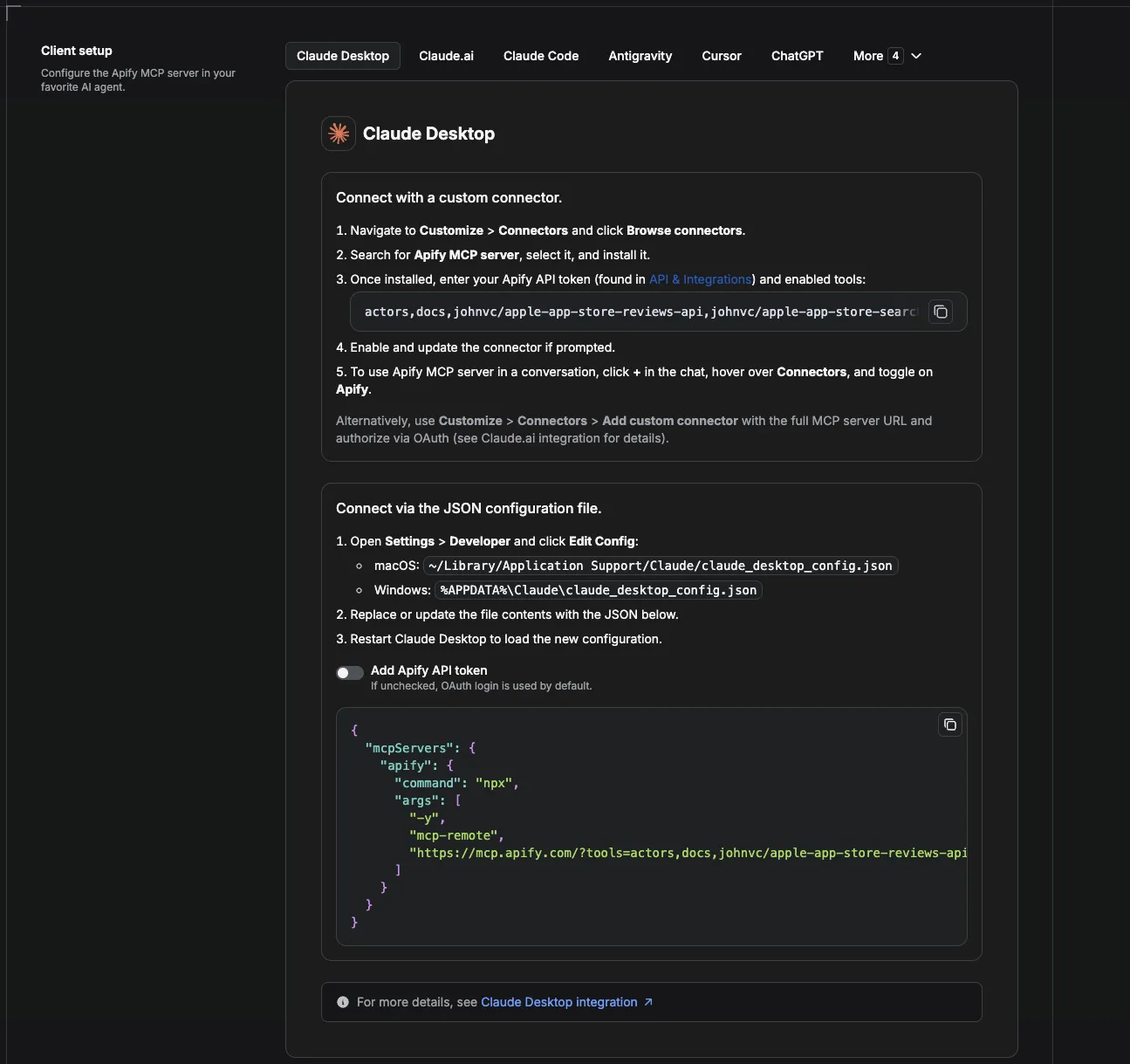
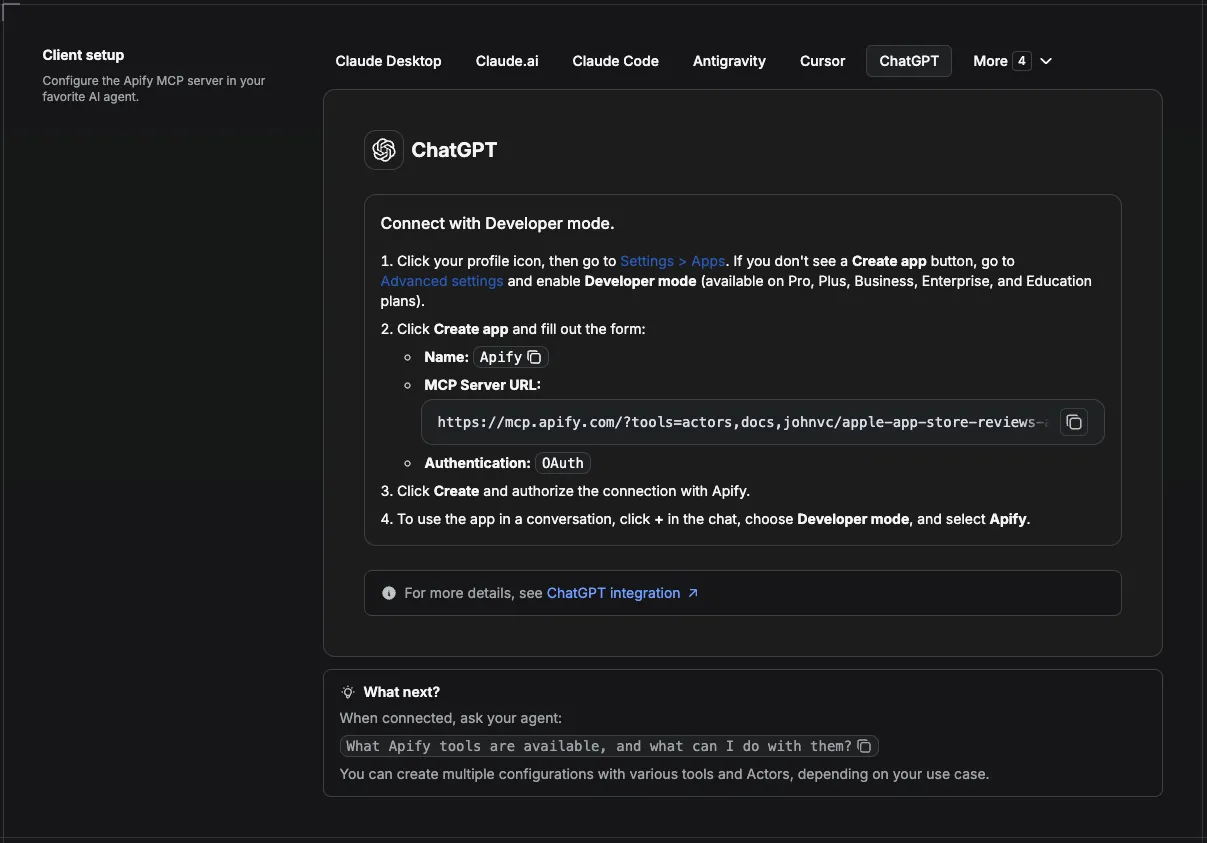
This Actor is compatible with the Model Context Protocol (MCP), so AI agents can call it as a tool. Add it through the hosted Apify MCP server using this Actor-specific URL:
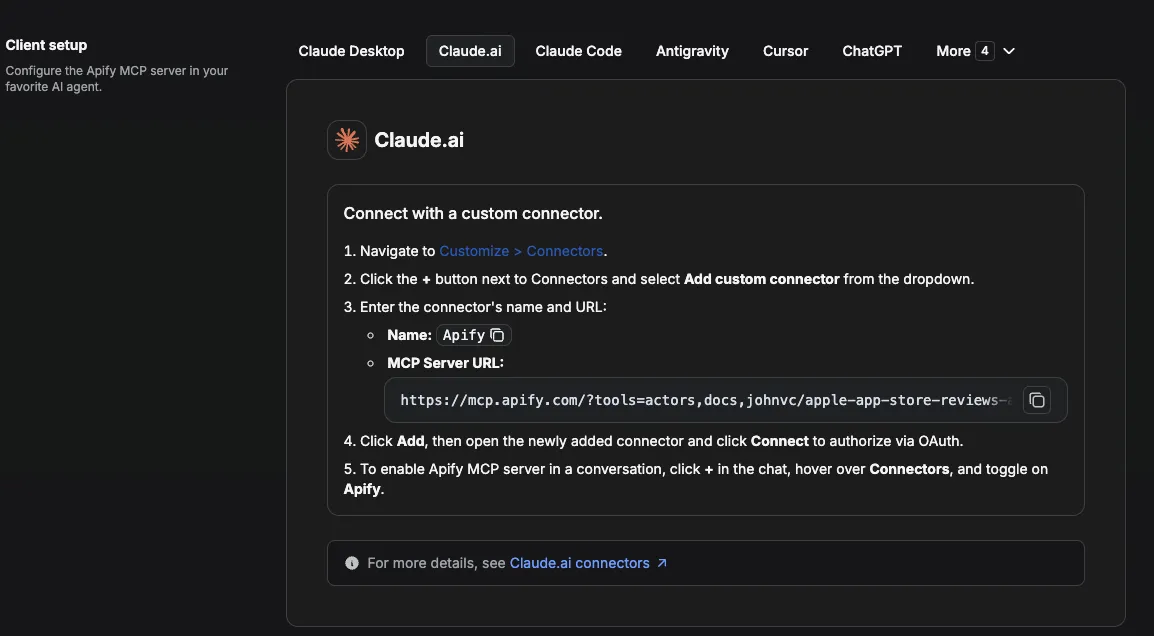
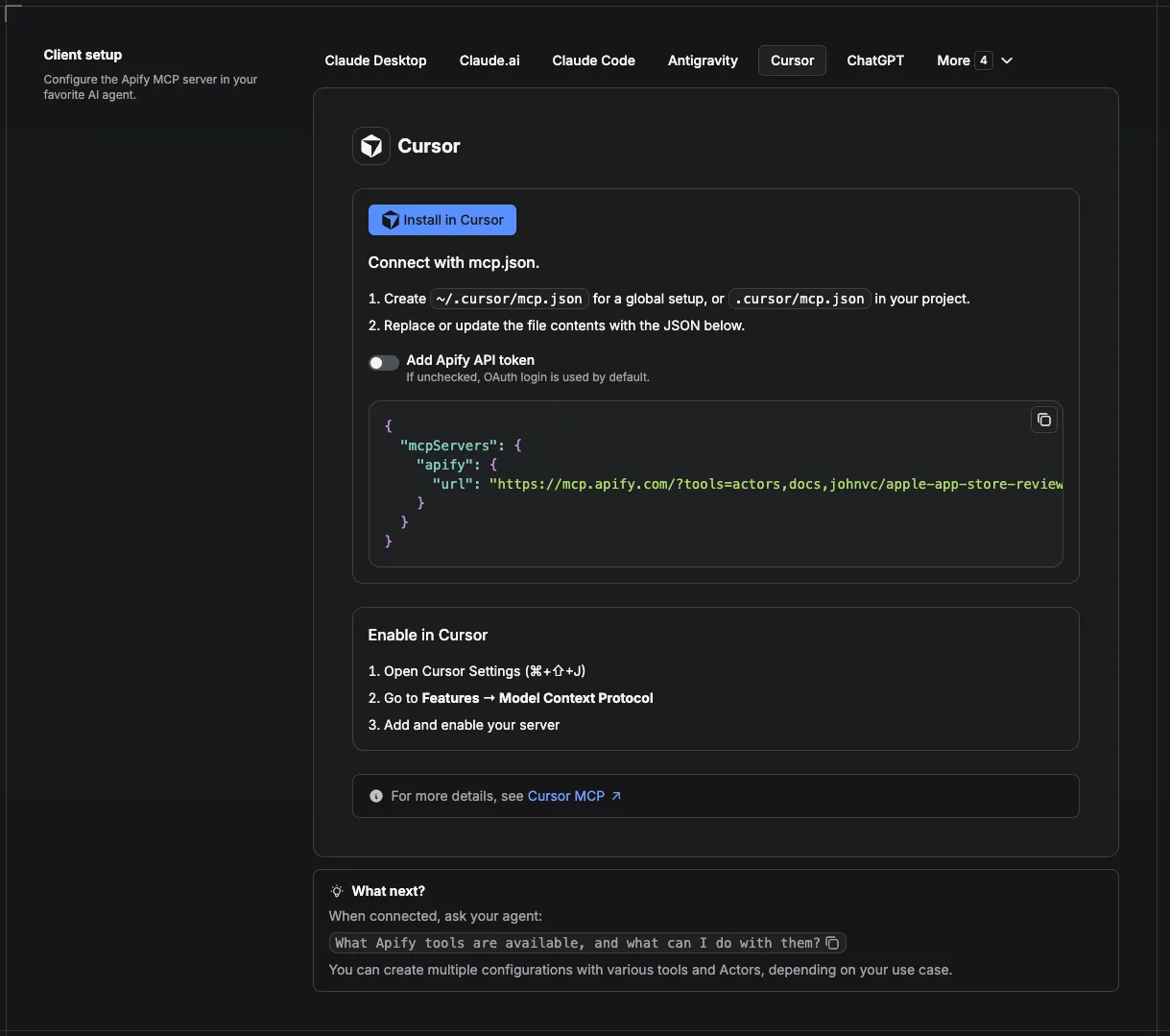
https://mcp.apify.com/?tools=actors,docs,johnvc/google-immersive-product-api
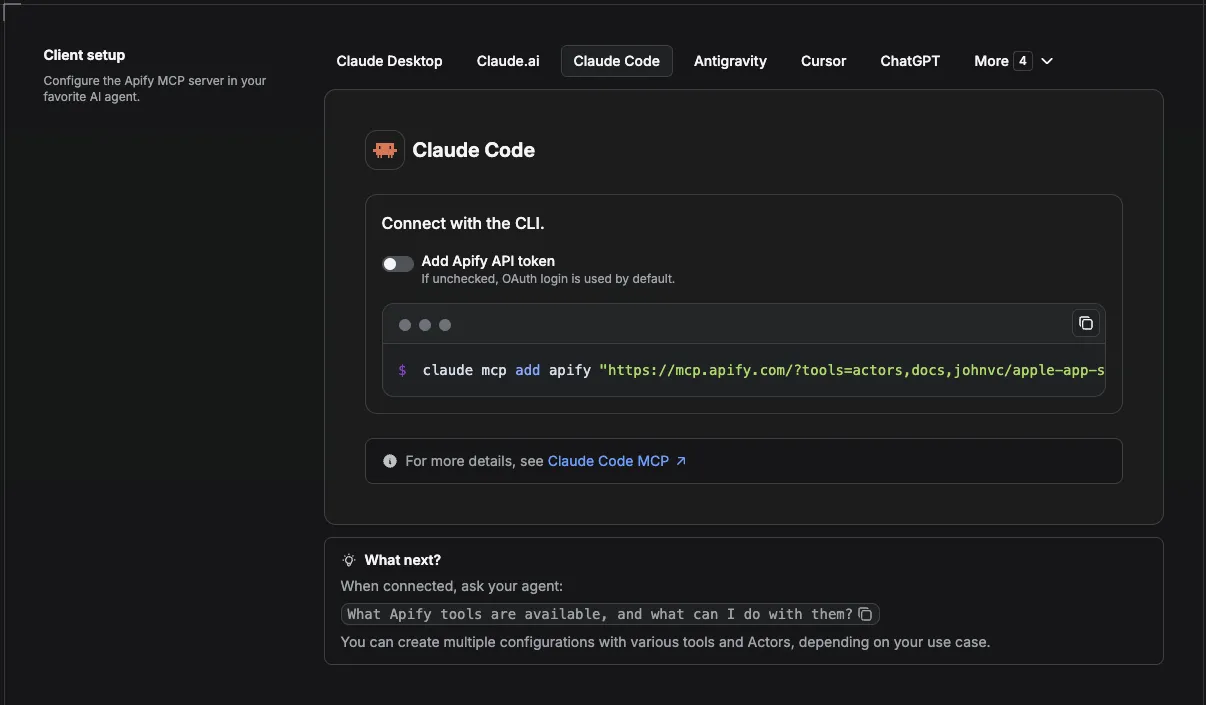
If you run agents from Claude Code (free trial) or Claude Cowork (free trial), add the Apify MCP server and ask it to "pull the rich product pages for the top 10 running shoes and compare ratings."
Setup walkthrough:
Apify MCP integration docs: https://docs.apify.com/platform/integrations/mcp
MCP call timing (waitSecs)
Rich product queries enrich each product with its variants, stores, reviews, and videos, so a run can take up to about 60 seconds (simple queries finish in a few seconds). That can be longer than the hosted MCP call-actor wait window, where waitSecs defaults to 30 and maxes out at 45. If you call this Actor over MCP with the defaults, the tool call can return while the run is still RUNNING, with no items yet or only a partial set. The run is healthy: it simply finishes after the wait window has closed, and the full data lands in the dataset a short time later.
Two ways to handle it:
- Set
waitSecs: 45(the maximum) to give the run as long as MCP allows. This covers most queries. - Fire-and-forget, then poll (best for large or richly enriched queries): call with
waitSecs: 0to start the run and get arunIdanddatasetIdback right away, then read the results from the dataset (for example with theget-dataset-itemstool) once the run reachesSUCCEEDED.
An immediate RUNNING status, or an empty or partial first response, is expected behavior over MCP, not an error.
MCP setup, step by step
Visual setup guides for each client (source and more assets: ApifyPublicData on GitHub):
Claude Cowork Desktop (free trial)
Claude Code (free trial)
Claude (website)
Cursor
ChatGPT
💸 Pay per run with crypto (x402)
The Google Immersive Product API supports agentic payments via the x402 protocol. AI agents and MCP clients can pay for runs in USDC (on Base) with no Apify account or API token needed: point your agent at the Apify MCP server and it can discover, pay for, and run this Actor autonomously. Read the Apify x402 announcement for details.
🔗 Related Tools
Building an e-commerce product data pipeline? These related APIs from the same catalog pair well with the immersive product pages this Actor returns:
- Google Shopping API returns the Google Shopping results grid (product listings, prices, sellers, and deals), so you can find products in bulk and then pull the deep immersive page for the ones that matter.
- Google Images API pulls product and reference images at scale, a fast way to enrich a product catalog alongside the
thumbnailsthis Actor returns. - Google Shopping Lite API is a lighter, lower-cost way to grab core Shopping listing fields when you do not need the full immersive detail page.
Prefer a maintained option: another Google product page scraper on the Store (google-products-scraper) covers similar ground but currently reports a success rate near 33 percent and a small user base, while this API is actively maintained and returns clean, consistent fields on every run.
🤖 Ask an AI assistant about this API
Open a ready-to-send prompt about the Google Immersive Product API in the AI of your choice:
- 💬 ChatGPT
- 🧠 Claude
- 🔍 Perplexity
- 🅒 Copilot
FAQ
What is an immersive product page?
It is the rich product detail panel Google shows for a product, with specs, ratings, variants, stores, and reviews. This API returns that panel as structured data.
How does it find products?
It runs a shopping search for your query, then pulls the immersive page for the top matching products, up to maxResultsPerQuery.
How many products come back?
Up to maxResultsPerQuery (default 10) per query.
Can I research many products at once?
Yes. Pass a queries list; each search is run independently and its products are tagged with the source query.
Can I schedule this product API?
Yes. Any run can be automated on a schedule. Save a task with your query or queries, then attach a schedule from the Actor's Actions, then Schedule menu. Use 0 7 * * * for a daily 7 AM pull, 0 */6 * * * for every six hours, or 0 9 * * 1 for a Monday check, and note that one schedule can drive many tasks at once. See the Integrations section above for the full price-and-rating monitoring recipe.
Should I use an API or a Web Scraper?
Both describe the same thing here. An official product API from a large platform is usually rate limited, quota bound, and missing the review and variant fields you want. This Actor behaves like a clean API endpoint you call yourself, backed by live web scraping, with no quota to manage: you send a product query and get the structured immersive page back.
Can I integrate this Google product Scraper with other apps?
Yes. It connects to almost any cloud service through Apify integrations, including Make, Zapier, and Slack, and you can fire an Apify webhook on ACTOR.RUN.SUCCEEDED to push each run into your own system. The Integrations section above has copy-paste recipes.
Can I use this Immersive Product API with the Apify API?
Yes. The Apify API runs the Actor, schedules it, and returns datasets programmatically, and the apify-client package is available for both Node.js and Python. See the Actor's own API tab for ready-made snippets.
Can I use this API through an MCP Server?
Yes. Add it as a tool to any MCP client (Claude, Cursor, and others) through the hosted Apify MCP server using the URL https://mcp.apify.com/?tools=actors,docs,johnvc/google-immersive-product-api. From Claude Code (free trial) or Claude Cowork (free trial) you can ask an agent to pull and compare product pages directly. See the Apify MCP docs.
How much does it cost to pull immersive product pages?
You pay a small per-query search fee for the lookup that finds the matching products, plus a per-product fee for each rich detail page returned. A typical run is the price of one search plus the handful of products it returns. See the Pricing section above for exact figures.
How do businesses extract product data from Google Shopping?
Most teams doing product research or competitive pricing pull structured data straight from Google Shopping instead of copying pages by hand. This API returns the deep immersive product page (specs, variants, stores, ratings, and reviews); pair it with the Google Shopping API to first find products in bulk, then enrich the ones that matter. It also works well as a structured feed behind a Google product AI shopping assistant.
How can I track other e-commerce and product data tools?
Combine this Actor with related APIs from the same catalog: the Google Shopping API for the full listings grid and prices, the Google Images API for product imagery, and the Google Shopping Lite API for lightweight listing pulls. See Related Tools above for how they fit together.
n8n integration
Available as an n8n community node, n8n-nodes-google-immersive-product-api. In n8n: Settings, Community Nodes, install n8n-nodes-google-immersive-product-api, then use it in any workflow (it also works as an AI Agent tool).
Featured Tasks
Ready-to-run examples that show this API solving a specific problem. Each opens its own setup so you can run it on your account in one click.
- Get Rich Product Detail Pages From a Google Search
- Get a Product's Ratings and Reviews From Google
- Get Apple Watch Prices and Ratings as JSON
- Get Laptop Prices, Brands, and Ratings as JSON
- Get Headphone Prices and Ratings as JSON
🌐 About Alpha OSINT
This Actor is part of Alpha OSINT, toolset of financial and operations data sources and APIs. See the Google Immersive Product API source page for related tools and use cases. For support or requests for this actor, please start a ticket directly on our support page.
Last Updated: 2026.10.04


