
Leather Working Group Scraper - Certified Suppliers
Pricing
from $2.80 / 1,000 results
Leather Working Group Scraper - Certified Suppliers
⚡ Fast Leather Working Group scraper. No login, no API key. Get LWG certified tanneries, traders and subcontractors by directory URL or name, with filters for rating, leather, animal, tannage and country. Returns URN, audit expiry, traceability, materials, phone, website and address.
Pricing
from $2.80 / 1,000 results
Rating
0.0
(0)
Developer

jooah code
Maintained by CommunityActor stats
0
Bookmarked
2
Total users
1
Monthly active users
3 days ago
Last modified
Categories
Features
Share
Scrape certified tanneries, traders, and subcontractors from the Leather Working Group supplier directory and download them as JSON, CSV, Excel, or HTML. No account or login required.
What does Leather Working Group Scraper do?
Leather Working Group Scraper turns the LWG certified supplier directory into a structured dataset. Paste a directory URL you filtered in your browser, or type a company name or URN, and get each supplier's LWG rating, URN, certification and audit expiry dates, leather, tannage and animal types, traceability, phone, website, and full address.
Leather Working Group (LWG) runs the best-known certification program for responsible leather production. Brands, sourcing teams, and auditors rely on its directory to see which suppliers are certified, at what rating, and until when. The scraper reads the same public information you see in the directory, so you can run it once, schedule it, or connect it to your own tools.
Features
- Search or paste URLs: start from company names or URNs, or from any directory page you already filtered on the website.
- Keeps your filters: rating, member type, leather type, animal type, tannage type, country, search, and page number in the URL are applied to the results.
- Built-in filters for searches: pick a member type, rating, leather type, animal type, tannage type, or country for your search queries.
- Clean data: dates use one standard format, percentages are numbers, and lists such as leather types are real arrays.
- Small, cheap runs: set a result limit per URL or query and pay only for what you need.
- Automation ready: schedule runs, export to Google Sheets, or connect to Make, Zapier, and n8n.
Data fields
- Supplier:
url,id,name,urn,memberType - Certification:
rating,protocol,certifiedSince,auditExpiryDate,auditCategory - Production:
leatherTypes,tannageTypes,animalTypes,industriesSupplied - Subcontractor scores:
subcontractorAuditRating,subcontractorScore - Traceability:
traceability(physical,documented,sourceGroup,regional,notTraceable) - Trader materials:
materials(name,materialType,animalType,materialCondition,materialScore,mrsl,sourcingTransferValue,physicalTraceability,documentedTraceability,groupTraceability,regionalTraceability) - Contact and location:
phone,website,logo,address,city,postcode,county,country
Who uses this Leather Working Group scraper?
- Sourcing teams find certified tanneries by rating, leather type, animal type, tannage, or country.
- Compliance teams confirm that suppliers hold an LWG certification and track when each audit expires.
- Sales teams build contact lists of leather manufacturers and traders with phone numbers and websites.
- ESG researchers compare traceability levels and chrome-free or vegetable tanning across regions.
- Data and AI teams load ready-to-use supplier data into spreadsheets, dashboards, or AI workflows.
How to use Leather Working Group Scraper
Step 1. Paste one or more LWG directory URLs into Start URLs, or type company names or URNs into Search queries.
Step 2. Optionally choose filters (member type, rating, leather type, animal type, tannage type, country) for your search queries.
Step 3. Set Maximum number of results to how many suppliers you want per URL or per query.
Step 4. Click Start and wait for the run to finish.
Step 5. Download the data in JSON, CSV, Excel, or HTML from the Output tab.
Input parameters
startUrls(Start URLs): LWG pages to scrape. Supported pages: the supplier directory (https://directory.leatherworkinggroup.com/) with any search, filters, or page number set on the website, single supplier pages (https://directory.leatherworkinggroup.com/company-detail?id=...), and the certified suppliers pages on leatherworkinggroup.com. Filters in the URL are kept.searchQueries(Search queries): company names or URNs to search in the directory, one per line. Each query is scraped separately.maxResults(Maximum number of results): how many suppliers to collect for each start URL or search query. Use 0 for no limit.memberType(Member type): only suppliers of this member type: Commissioning Manufacturer, Leather Manufacturer, Subcontractor, or Trader.rating(Rating): only suppliers with this LWG rating: Approved, Audited, Bronze, Gold, or Silver.leatherType(Leather type): only suppliers that produce or trade this leather type, for example Full Grain, Suede, or Nubuck.animalType(Animal type): only suppliers that work with this animal type, for example Bovine, Goat, or Sheep.tannageType(Tannage type): only suppliers that use this tannage: Chrome, Chrome-Free, or Vegetable.country(Country): only suppliers located in this country.
The six filters apply to search queries only; start URLs keep the filters in their own URL. Start URLs and search queries can be combined in one run.
Example input
Scrape Gold-rated suppliers in Italy
Search by company name
Sample output
Every supplier becomes one dataset item, for example:
For traders, each entry in materials describes one certified material:
Export the dataset as JSON, CSV, Excel, XML, or HTML, or read it through the Apify API.
Good to know
- Each directory filter takes a single value, such as one country or one rating. To cover several values, add one search query or one start URL per value.
- Which fields are filled depends on the member type: traceability is mostly shown for leather manufacturers, materials for traders, and subcontractor scores for subcontractors. Anything missing comes back as
nullor an empty list. - Traceability values are percentages, exactly as the website shows them.
- Contact person names, email addresses, and auditor details are no longer published in the LWG directory, so they are not part of the output.
- A supplier is saved only once per run, even when several start URLs or queries return it.
- Only directory, supplier, and certified suppliers pages are supported; any other URL is skipped.
Frequently asked questions
How many results can I scrape?
Any number you set in Maximum number of results, or 0 to collect every matching supplier. The whole directory lists a little over 2,000 certified suppliers.
Do I need a Leather Working Group account?
No. Only public data is collected, so you do not need to log in or share any account details.
Can I run it on a schedule?
Yes. Apify Schedules can run it every day or week, so you can follow new certifications, rating changes, and audit expiry dates.
Can you add a new filter or input?
Yes. The scraper supports start URLs, search queries, and the directory filters today. Other inputs or fields can be added on request.
Can I get a custom or private version?
Yes. It can be adapted to your workflow, delivered as a private version, or a new scraper can be built for another website. See the contact details below.
Support and custom scrapers
Need another field, a private version, or a scraper for a different website? Get in touch:
- Email: jooah.code@gmail.com
- Apify profile: joaah-code
Image credit
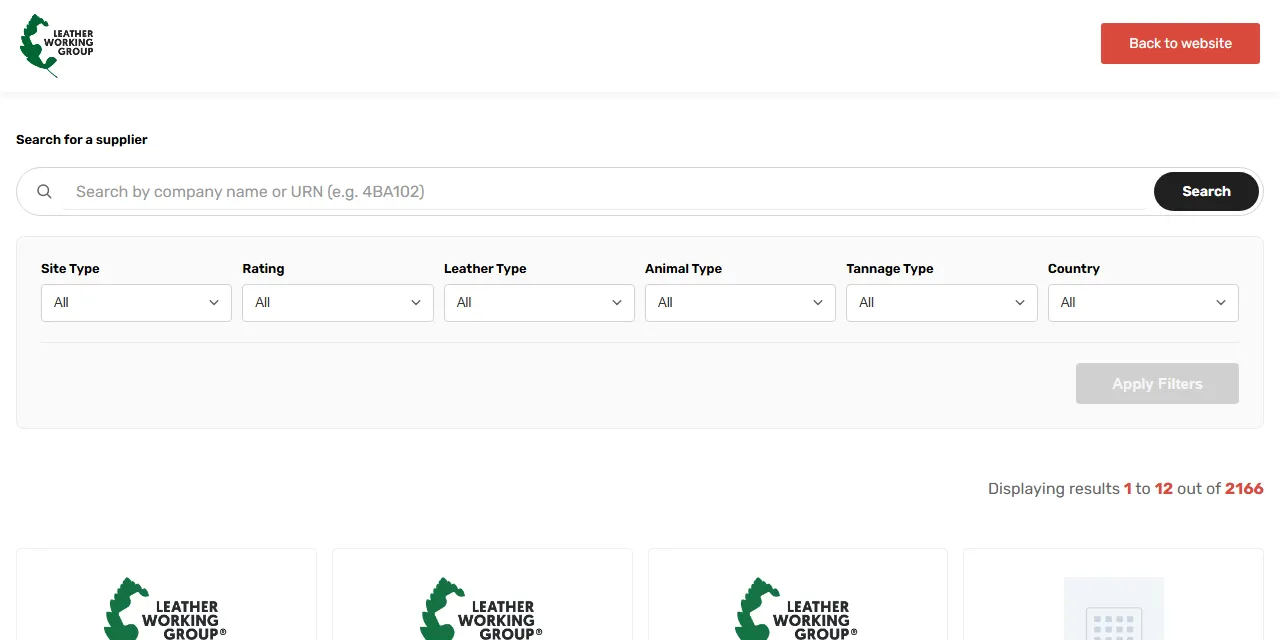
Banner: screenshot of Leather Working Group.


