

Bearing Life Calculator (ISO 281 L10, aISO, Rating Sizing)
Pricing
Pay per event
Bearing Life Calculator (ISO 281 L10, aISO, Rating Sizing)
Rolling bearing life calculator from plain text: equivalent load with X, Y, e, L10 and modified life with a1 and aISO (oil viscosity, contamination), static safety, duty cycles, and the dynamic rating a target life needs.
Pricing
Pay per event
Rating
0.0
(0)
Developer

Jumble Mog
Maintained by CommunityActor stats
0
Bookmarked
2
Total users
1
Monthly active users
a day ago
Last modified
Categories
Security
Limited permissionsShare
How long will the bearing last? Describe it in one line and find out. Type 6205, C 14.8 kN, C0 7.8 kN, Fr 2 kN, Fa 0.5 kN, 3000 rpm, ISO VG 68 at 70 C, 99% reliability, 20000 hours or find the rating: 2 kN radial at 1725 rpm, 5000 hours. You get back:
- The equivalent load P = X·Fr + Y·Fa with the X, Y and e factors used (from Fa/C0 for deep-groove bearings), and the static equivalent load P0.
- The basic rating life L10 in millions of revolutions and in hours.
- The modified life Lnm at your reliability (a1) and, when you give the oil and cleanliness, ISO 281's aISO from the viscosity ratio κ, the contamination factor ec and the fatigue load limit Cu.
- The static safety s0 = C0/P0.
- The rating a target life needs, by ISO 281 and by Shigley's three-parameter Weibull method, with the Weibull reliability your bearing reaches at the target.
- Duty cycles: several loads and speeds with their share of the time, combined into one equivalent load and mean speed.
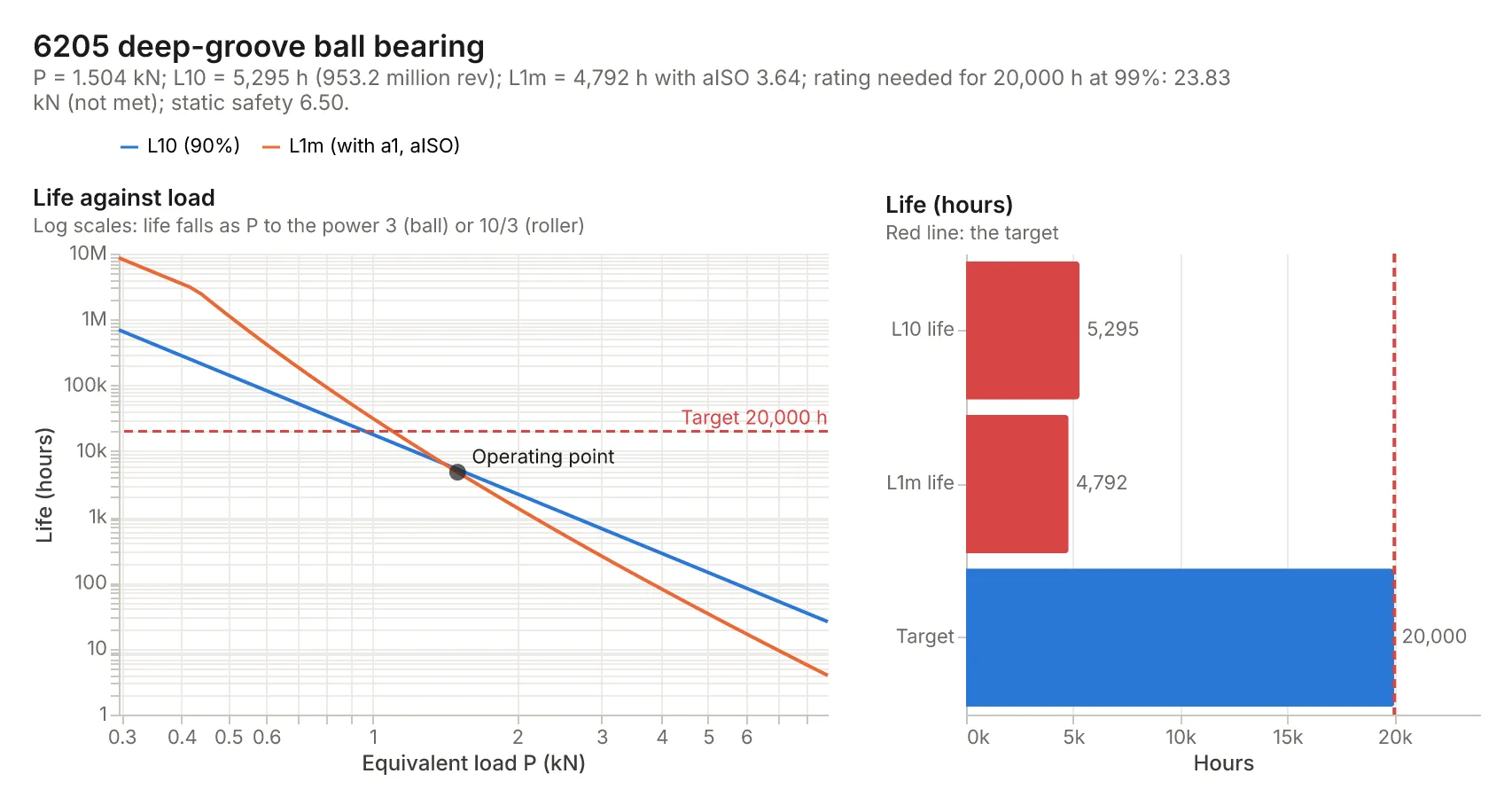
- A chart: life against load on log scales with the operating point and the target, next to the lives (or the ratings needed).
Bearings: deep-groove ball, angular contact ball (15° to 45°), cylindrical roller, tapered roller, spherical roller, needle roller, self-aligning ball and thrust ball. Standard designations (6205-2RS, 7308 BE, NU 210, 30206, 22212, 51105) give the type, bore and outside diameter; sealed bearings count as clean. Metric (kN, mm) or inch (lbf, in): results come back in the units you wrote.
It's made for:
- Mechanical designers picking bearings for shafts, pulleys, gearboxes and motors.
- Maintenance and reliability engineers estimating remaining life and comparing lubricants.
- Engineering students working Shigley-style bearing problems.
- AI agents that need real bearing-life numbers instead of a guess.
How to use it
- Write Bearings, one per entry. The form has examples.
- Optionally set a default reliability, target life, application factor, cleanliness or the Units.
- Click Start. Each bearing is a row in the results, with its summary, chart and report.
Writing a bearing
| You write | It means |
|---|---|
6205-2RS, 7308 BE, NU 210, 30206, 22212, 51105 | the bearing: type, bore and outside diameter |
deep groove, angular contact 25°, cylindrical roller, tapered roller, spherical roller, thrust ball | the type, without a designation |
C 14.8 kN, C0 7.8 kN, Cu 0.335 kN | the catalog ratings |
Fr 2 kN, Fa 0.5 kN, 3 kN radial, 700 lbf thrust | the loads |
3000 rpm | the speed |
20000 hours, 500 million revolutions | the target life |
99% reliability | the reliability (90% if not given) |
application factor 1.2 | multiplies the loads |
ISO VG 68 at 70 C, viscosity 20 cSt | the lubricant at operating temperature |
normal cleanliness, typical contamination, ec 0.5 | the cleanliness |
e 0.37, Y 1.6, Y1 2.4 | catalog factors for tapered and spherical roller bearings |
Fr 5 kN at 1500 rpm 60%; Fr 9 kN at 800 rpm 40% | a duty cycle |
find the rating ... (or no C) | the rating the target needs |
Objects work too; see Input.
Examples
All of these ran on this Actor; the numbers are from the results.
| Bearing | Result |
|---|---|
6205, C 14.8 kN, C0 7.8 kN, Fr 2 kN, Fa 0.5 kN, 3000 rpm, ISO VG 68 at 70 C, normal cleanliness, 99% reliability, 20000 hours | Fa/Fr under e, so P = 2 kN; L10 2,251 h; κ 1.5, aISO 2.47, L1m 1,380 h; a 36.1 kN rating would be needed, with a warning |
deep groove ball bearing, radial load 413 lbf, application factor 1.2, 300 rpm, 30000 hours, 99% reliability (Shigley Example 11-3) | Rating needed 6,690 lbf by the Weibull method (book: 6,696 with its approximate form) and 6,421 lbf by ISO 281 |
30206 tapered roller, C 54 kN, C0 63 kN, e 0.37, Y 1.6, Fr 8 kN, Fa 4 kN, 800 rpm, 15000 h | P = 0.4·8 + 1.6·4 = 9.6 kN; L10 6,594 h, short of the target; 69.1 kN needed |
6308, C 42.3 kN, C0 24 kN: Fr 5 kN at 1500 rpm 60%; Fr 9 kN, Fa 2 kN at 800 rpm 40%; 99% reliability, VG 46 at 60 C | Duty-cycle P 6.57 kN at a mean 1,220 rpm; L10 3,648 h, L1m 1,851 h |
7308 BE, C 50 kN, C0 33.5 kN, Fr 6 kN, Fa 9 kN, 1500 rpm | 40° angular contact: P = 0.35·6 + 0.57·9 = 7.23 kN; L10 3,675 h |
The tests check that:
- Shigley's Examples 11-1 and 11-3 come out, and the Weibull rating gives back its reliability.
- a1, ν1, the oil viscosity at temperature and aISO follow ISO 281 (with the cap of 50).
- X, Y and e follow the ISO tables for deep-groove, angular contact and tapered roller bearings.
- Designations give the right type and size, and duty cycles average with the cube (ball) or 10/3 power (roller).
How-to examples
Each example is a complete input; the results are from runs of the Actor (also listed under Examples).
How to calculate bearing life (ISO 281 L10 and modified life)
Result: Fa/Fr is under e, so P = 2 kN; L10 2,251 h; κ 1.5, aISO 2.47 and L1m 1,380 h. A 36.1 kN rating would be needed, with a warning.
How to find the dynamic load rating a bearing needs
Result: this is Shigley's Example 11-3: 6,690 lbf by the Weibull method (book 6,696 with its approximate form) and 6,421 lbf by ISO 281.
How to calculate bearing life over a duty cycle
Result: duty-cycle P 6.57 kN at a mean 1,220 rpm; L10 3,648 h and L1m 1,851 h.
How to let an AI agent check bearing life
Add this Actor to the Apify MCP server with https://mcp.apify.com/?tools=jumblemog/bearing-life-calculator. The agent passes the bearing, loads and speed in one line and answers with the life in hours or the rating needed.
FAQ
Which bearing types does it know? Deep-groove and angular contact ball bearings, and tapered and spherical roller bearings, with ISO 281's X, Y and e for each.
Does it look up C from the bearing number? No. Ratings differ between makers, so give C and C0 from the catalog; the designation sets the type and size.
What does the lubricant change? The ISO 281 aISO factor, from the oil viscosity at temperature and the cleanliness. Without a lubricant aISO is 1.
What isn't covered? Grease life, speed limits, temperature rise, fits and clearance, oscillating motion, and the thrust a tapered or angular contact bearing induces in its partner.
Input
| Field | What it is |
|---|---|
bearings | Bearings, as text or objects. |
reliability | Default reliability in % (90). |
lifeHours | Default target life in hours. |
applicationFactor | Default application factor (1). |
contamination | Default cleanliness (normal cleanliness). |
units | mm (kN and mm, default) or in (lbf and inches), for numbers written without a unit. |
charts | Draw charts (default on). |
A bearing as an object takes:
designationortype,contactAngle,bore,outsideDiameter.c,c0,cu;e,y,y1,y0for roller bearings.fr,fa,rpm, orloads: a list of{fr, fa, rpm, share}.reliability,lifeHoursorlifeRevolutions,applicationFactor.viscosity(mm²/s), oroilGrade(ISO VG) withtemperature(°C);contamination(a class or ec).mode(analyzeordesign),units,title, andtext(a line of text, with the other fields overriding what it says).
Output
One dataset item per bearing, also saved together in the run's OUTPUT record:
Every item has warnings, notes (the formulas and assumptions), a Markdown report and links to the chart and report. A request that can't be computed has "status": "failed" and the reason in error, and isn't billed.
How it works
- Reading: each line is read for the bearing, ratings, loads, speed, target and options; numbers carry their units.
- Equivalent load: ISO 281's X, Y and e by type (deep-groove from Fa/C0, angular contact by contact angle, tapered and spherical from the catalog's e and Y); ISO 76 for P0. Duty cycles: P = (Σ U·n·P^p / Σ U·n)^(1/p) with p = 3 for ball and 10/3 for roller bearings.
- Life: L10 = (C/P)^p million revolutions; Lnm = a1·aISO·L10 with a1 = 0.95·(ln(1/R)/ln(1/0.9))^(2/3) + 0.05.
- aISO: ν1 from the speed and pitch diameter, κ = ν/ν1 (oil viscosity at temperature by the Walther equation), ec from the cleanliness class and size, Cu from the catalog or estimated from C0 (Annex B), then ISO 281 eqs. 15 to 18, capped at 50.
- Rating needed: C = P·(L/(a1·aISO))^(1/p) by ISO 281, and C10 = af·F·[xD/(x0 + (θ − x0)·ln(1/R)^(1/b))]^(1/a) by Shigley's Weibull method (x0 0.02, θ 4.459, b 1.483).
Results are engineering estimates for the stated assumptions; check the catalog's own life method, minimum load, speed limits and fits before buying.
Pricing
You pay one low price per bearing, at the price shown on this page. It includes the chart and the report. Requests that can't be computed are never charged. If you set a maximum cost per run, the Actor stops before a request that wouldn't fit.
Speed
A bearing takes a millisecond, plus the chart. A run through the API answers in about 5 to 10 seconds, including the cloud container starting.
Tips and limits
- Use catalog ratings: C, C0 and Cu differ between makers; the Actor doesn't guess C from a designation.
- Tapered and angular contact pairs: the thrust each bearing induces in its partner isn't added; give each bearing's net axial load.
- Without a lubricant aISO is 1, so the life is L10 corrected only for reliability.
- Not covered: grease life, speed limits, temperature rise, fits and clearance, oscillating motion.
- Limits: 500 bearings per run.
For AI agents and developers
This Actor works with the Apify MCP server, so AI agents can call it as a tool. Pass bearings as plain text and read summary, life, staticSafety, target and warnings. A direct API call that waits for the answer:
run-sync instead returns the run's OUTPUT: the status, the counts and every result as JSON.
In Python, with the apify-client package:
Credits
- Charts: Vega-Lite and vl-convert (BSD-3-Clause), with the Inter font (SIL Open Font License).
- Method: ISO 281:2007 and ISO 76 as presented in their published equations, and Budynas and Nisbett, Shigley's Mechanical Engineering Design, chapter 11.


