

Reinforced Concrete Calculator (ACI 318, Eurocode 2)
Pricing
Pay per event
Reinforced Concrete Calculator (ACI 318, Eurocode 2)
Check or design reinforced concrete beams and columns from plain text by ACI 318-19 or Eurocode 2: bending and shear strength, interaction diagrams, cracked section and the lightest bars that work.
Pricing
Pay per event
Rating
0.0
(0)
Developer

Jumble Mog
Maintained by CommunityActor stats
0
Bookmarked
2
Total users
1
Monthly active users
4 days ago
Last modified
Categories
Security
Limited permissionsShare
Check or design a reinforced concrete beam or column from one line of text. Type beam 12 x 24 in, 4 #8 bottom, f'c 4000 psi, Grade 60, Mu 250 kip-ft, Vu 40 kips, #3 stirrups at 10 in or column 400 x 400 mm, C30/37, 8 x 20 mm, NEd 3000 kN, MEd 150 kNm. You get back:
- Bending strength: the neutral axis, the compression block, the strain in the tension steel, φ and φMn (ACI 318-19) or MRd (Eurocode 2), the minimum and maximum steel, and the utilization against your moment.
- Shear strength: Vc with ACI 318-19's size effect or VRd,c, the stirrups' share with Eurocode 2's variable strut angle, the maximum spacing, and the stirrup spacing you need when the shear is too high.
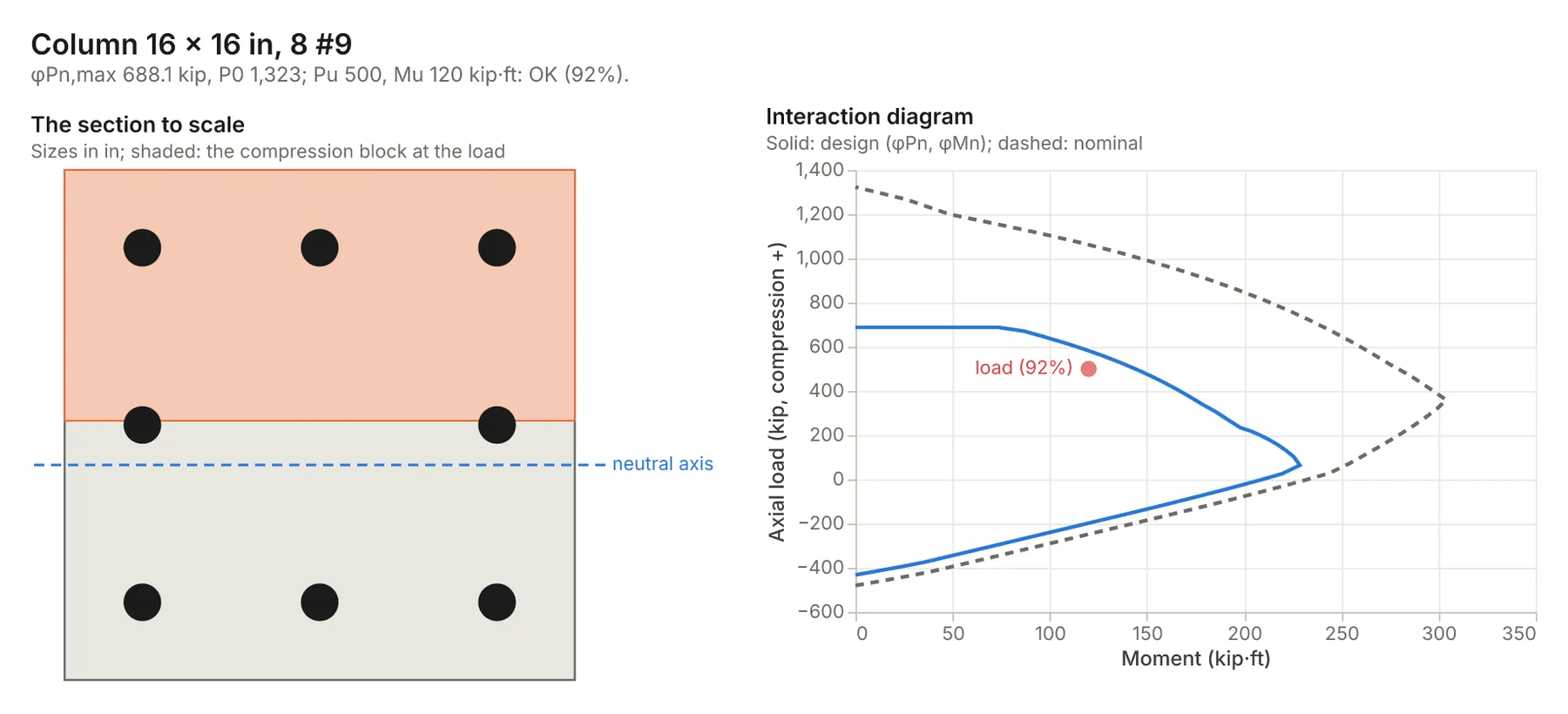
- Columns: the full axial-moment interaction diagram (nominal and design), the squash load, φPn,max with ties or spirals, and where your load sits on the diagram.
- Bar design: leave the bars out (or write
design) and it picks the lightest arrangement that works, with the runners-up. - Cracked section: Ig, the cracking moment, the modular ratio, the cracked neutral axis and Icr for deflection checks.
- A chart: the section to scale with its bars, compression block and neutral axis, next to the interaction diagram or the demand against capacity.
Rectangular beams and columns, T-beams and circular columns; top and bottom steel in one or more layers; US bars (#3 to #18), Canadian (10M to 55M) and metric (Ø6 to Ø40). US units (in, kip, kip·ft, psi) or metric (mm, kN, kN·m, MPa): results come back in the units you wrote.
It's made for:
- Structural engineers doing quick checks and sizing between full design runs.
- Engineering students working reinforced concrete problems by ACI or Eurocode.
- Contractors, detailers and estimators who want to know if a section and its bars work.
- AI agents that need real code checks instead of a guess.
How to use it
- Write Beams and columns, one per entry. The form has examples.
- Optionally set the default design code or the Units.
- Click Start. Each member is a row in the results, with its summary, chart and report.
Writing a member
| You write | It means |
|---|---|
beam 300 x 500 mm, 12 x 24 in | Width x total depth |
T-beam, flange 1200 x 100 mm, web 300 x 600 mm | Flange width x thickness, web width x total depth |
column 16 x 16 in, circular column 500 mm diameter | A column; bars go round the perimeter |
4 #8 bottom, 2 #5 top, 4 H20, 6-25M, 8 x 25 mm | Bars (bottom for beams unless you say top) |
design, or no bars | Pick the lightest bars that work (using #8 bars fixes the size) |
f'c 4000 psi, fck 30, C30/37 | Concrete strength |
Grade 60, fy 420 MPa, B500 | Bar yield strength |
cover 2 in, 50 mm cover | Clear cover to the stirrups (default 1.5 in or 40 mm) |
#3 stirrups at 8 in, H10 links @ 150 mm, 4-leg | Stirrups or ties |
Mu 250 kip-ft, MEd 150 kNm | Factored moment |
Vu 40 kips, VEd 120 kN | Factored shear |
Pu 500 kips, NEd 2000 kN, tension 50 kN | Factored axial load |
spiral, lightweight, hogging | Spiral column, λ = 0.75, tension on top |
EC2, Eurocode, ACI | The code (C30/37, B500, MEd or VEd also mean Eurocode 2) |
Or send an object: {"type": "column", "shape": "circle", "d": "500 mm", "bars": "8 x 25 mm", "fc": "35 MPa", "pu": "3000 kN", "mu": "200 kNm", "spiral": true}. Fields: type, code, shape, b, h, d, bf, hf, cover, fc, fy, fyt, bars, bottom, top, barSize, stirrups, spacing, legs, spiral, mu, vu, pu, lambda, negative, design, alphaCC, gammaC, gammaS, units, title, text.
Examples
beam 10 x 22.5 in, 3 #8 bottom, f'c 4000 psi, Grade 60, Mu 180 kip-ft, Vu 30 kips, #3 stirrups at 8 in→ φMn 192.3 kip·ft (φ 0.9, εt 0.0093): OK (94%); φVn 44 kips: OK (68%).beam 300 x 500 mm, C30/37, 4 H20 bottom, MEd 200 kNm→ MRd 215.5 kN·m (x/d 0.259): OK (93%).design a beam 300 x 600 mm, C30/37, for MEd 250 kNm→ Use 6 Ø16 bottom: MRd 257.8 kN·m (97%).column 16 x 16 in, 8 #9, Pu 500 kips, Mu 120 kip-ft→ φPn,max 688 kips, P0 1,323 kips; the load is at 92% of the interaction diagram.design beam 14 x 28 in for Mu 400 kip-ft, Vu 60 kips→ 5 #8 bottom, and the shear needs 2-leg #3 stirrups at 6 in.
How-to examples
Each example is a complete input; the results are from runs of the Actor (also listed under Examples).
How to check a reinforced concrete beam (ACI 318)
Result: φMn 192.3 kip·ft (φ 0.9, εt 0.0093): OK at 94%; φVn 44 kips: OK at 68%.
How to design the reinforcement for a concrete beam (Eurocode 2)
Result: use 6 Ø16 bottom, for MRd 257.8 kN·m (97%). In US units, design beam 14 x 28 in for Mu 400 kip-ft, Vu 60 kips gives 5 #8 bottom and 2-leg #3 stirrups at 6 in.
How to check a concrete column with an interaction diagram
Result: φPn,max 688 kips and P0 1,323 kips; the load is at 92% of the interaction diagram, which is drawn in the chart.
How to let an AI agent check concrete members
Add this Actor to the Apify MCP server with https://mcp.apify.com/?tools=jumblemog/concrete-design-calculator. The agent passes the beam or column as one line and answers with the capacities and utilizations from ACI 318-19 or Eurocode 2, with the intermediate values to check by hand.
FAQ
Which codes does it follow? ACI 318-19 in US units and Eurocode 2 in metric. The code is picked from the units and names you use (#8, Grade 60 or C30/37, H20), or set code.
Can it design the steel for me? Yes. Start the line with design and give the moment and shear, and it picks the bars and stirrups.
Does it check shear? Yes: Vc with ACI 318-19's size effect or VRd,c, the stirrups' share and the spacing you need.
Is it a stamped design? No. The results are engineering estimates for the stated assumptions; a licensed engineer should check any design against the code.
Input
| Field | What it is |
|---|---|
members | The beams and columns, as lines of text or objects (up to 200 per run) |
code | Default code for requests that don't show one: aci (ACI 318-19) or ec2 (Eurocode 2) |
units | For numbers without a unit: mm or in |
charts | Draw a chart for each member (default on) |
Output
One dataset item per member, also saved together in the run's OUTPUT record:
Items also have units, section, materials, reinforcement (bars, steel area and ratio, effective depth), cracking (beams), column (columns: P0, the design axial limit, the check and the interaction points) and design (when it picked the bars). Every item has summary, warnings, notes (the method and assumptions), a Markdown report and links to the chart and report. A member that can't be computed has "status": "failed" and the reason in error, and isn't billed.
How it works
- Reading: each line is read for the shape and size, bars, materials, stirrups and loads; numbers carry their units, and the code is taken from what you wrote.
- Bars are placed inside the cover and stirrups with at least the minimum clear spacing, in more layers when they don't fit in one.
- Strength: strain compatibility with a uniform compression block (ACI: 0.85f'c over β1·c, εcu 0.003; Eurocode 2: η·fcd over λ·x, εcu3) and elastic-perfectly plastic bars. The neutral axis is found for each axial load, and bars inside the block subtract the concrete they displace.
- ACI factors: φ from the tension steel's strain (Table 21.2.2), φPn,max = 0.80φP0 with ties or 0.85φP0 with spirals; Eurocode 2 uses γc 1.5, γs 1.15 and αcc 1.0 (all changeable), and the minimum eccentricity for columns.
- Shear: ACI 318-19 22.5 (with the size effect when stirrups are below the minimum) or Eurocode 2 6.2 with cot θ from 2.5 down to 1.
- Design tries each bar size with the fewest bars that work and keeps the lightest, honouring εt ≥ 0.004 (ACI), x/d ≤ 0.45 (EC2) and the column steel limits.
Results are engineering estimates for the stated assumptions; a licensed engineer should check any design against the code.
Pricing
You pay one low price per member, at the price shown on this page. It includes the chart and the report. Members that can't be computed are never charged. If you set a maximum cost per run, the Actor stops before a member that wouldn't fit.
Speed
A member takes well under a second, plus the chart. A run through the API answers in about 10 to 20 seconds, including the cloud container starting.
Tips and limits
- Short columns only: slenderness (ACI 6.6.4 moment magnification, EC2 5.8 second-order effects) isn't included; bending is about one axis (no biaxial bending).
- Bending axis: compression is at the top for positive moments; write
hoggingornegative momentfor tension on top. - Not covered: deflection limits and crack widths (the cracked properties are given for your own check), torsion, development lengths and laps, prestressing, and seismic detailing.
- Shear in columns includes the axial load's benefit; columns get ties as their stirrups.
- Limits: 200 members per run.
For AI agents and developers
This Actor works with the Apify MCP server, so AI agents can call it as a tool. Pass members as plain text and read summary, flexure, shear, column and warnings. A direct API call that waits for the answer:
run-sync instead returns the run's OUTPUT: the status, the counts and every result as JSON.
In Python, with the apify-client package:
Credits
- Geometry: Shapely (BSD-3-Clause).
- Charts: Vega-Lite and vl-convert (BSD-3-Clause), with the Inter font (SIL Open Font License).
- Methods: ACI 318-19, Building Code Requirements for Structural Concrete; EN 1992-1-1:2004, Eurocode 2: Design of concrete structures; Wight and MacGregor, Reinforced Concrete: Mechanics and Design.


