

Fluid Properties: Steam Tables, Refrigerants, Psychrometrics
Pricing
Pay per event
Fluid Properties: Steam Tables, Refrigerants, Psychrometrics
Thermodynamic properties from plain text: steam tables, refrigerants (R134a, R410A, R32, CO2, ammonia), gases, glycol and brine, moist air with a psychrometric chart, refrigeration and Rankine cycles. SI or US units. For AI agents.
Pricing
Pay per event
Rating
0.0
(0)
Developer

Jumble Mog
Maintained by CommunityActor stats
0
Bookmarked
2
Total users
1
Monthly active users
7 days ago
Last modified
Categories
Security
Limited permissionsShare
Look up thermodynamic properties the way you'd write them on paper. Type water: 10 bar, 300 C, R134a at -10 C, saturated vapor or 30 C, 50% RH, and get back temperature, pressure, density, specific volume, enthalpy, internal energy, entropy, quality, heat capacities, speed of sound, viscosity, thermal conductivity and more. It also handles:
- Steam tables of saturated liquid and vapor, by temperature or pressure.
- Refrigeration and heat-pump cycles, with COP, compressor work, discharge temperature and flows.
- Rankine cycles, with efficiency, back-work ratio, turbine exit quality and steam flow.
- Moist air (psychrometrics), with all states plotted on a psychrometric chart.
The numbers come from CoolProp, the open-source library that implements the reference equations of state: IAPWS-95 for water, plus 120+ other fluids. Fluids include water/steam, refrigerants (R134a, R410A, R32, R1234yf, R404A, R407C, R22, R290 propane, R600a isobutane, R744 CO₂, R717 ammonia), gases (air, nitrogen, oxygen, hydrogen, helium, methane, argon), hydrocarbons and solvents, and ethylene and propylene glycol and brine solutions. Results come in SI or US units (°C, kPa, kJ/kg or °F, psia, Btu/lb), each with a one-line summary.
It's made for engineering students checking steam-table homework, HVAC technicians and designers, refrigeration and energy engineers, developers of calculators, and AI agents that need exact property values instead of guessing them.
What it does
- Fluid states from any two properties: temperature, pressure, quality, enthalpy, entropy, internal energy, density or specific volume. Each value is recognized by its label (
h = 2800 kJ/kg) or its unit (10 bar,300 C,6.5 kJ/kg-K). Words likesaturated liquid,saturated vaporand90% qualitywork too.- Every state comes back with its phase, and its saturation temperature and degrees of superheat or subcooling.
- One temperature or pressure alone gives saturated liquid and vapor side by side, with h_fg and s_fg.
- Saturation tables:
water from 0 to 100 C step 10, orwater: 10 kPa to 20 MPa, 15 rows(log-spaced). Each row has T, P, v, u, h and s of saturated liquid and vapor. The table comes as CSV, Markdown and a saturation-curve chart. - Refrigeration and heat-pump cycles: evaporating and condensing temperatures, superheat, subcooling, compressor isentropic efficiency and capacity. Returns:
- The four states, cooling and heating effects, compressor work and discharge temperature.
- COP (cooling, heating and Carnot), pressure ratio and flash-gas quality.
- With a capacity: refrigerant mass flow, compressor power and suction volume flow.
- A pressure-enthalpy (P-h) diagram.
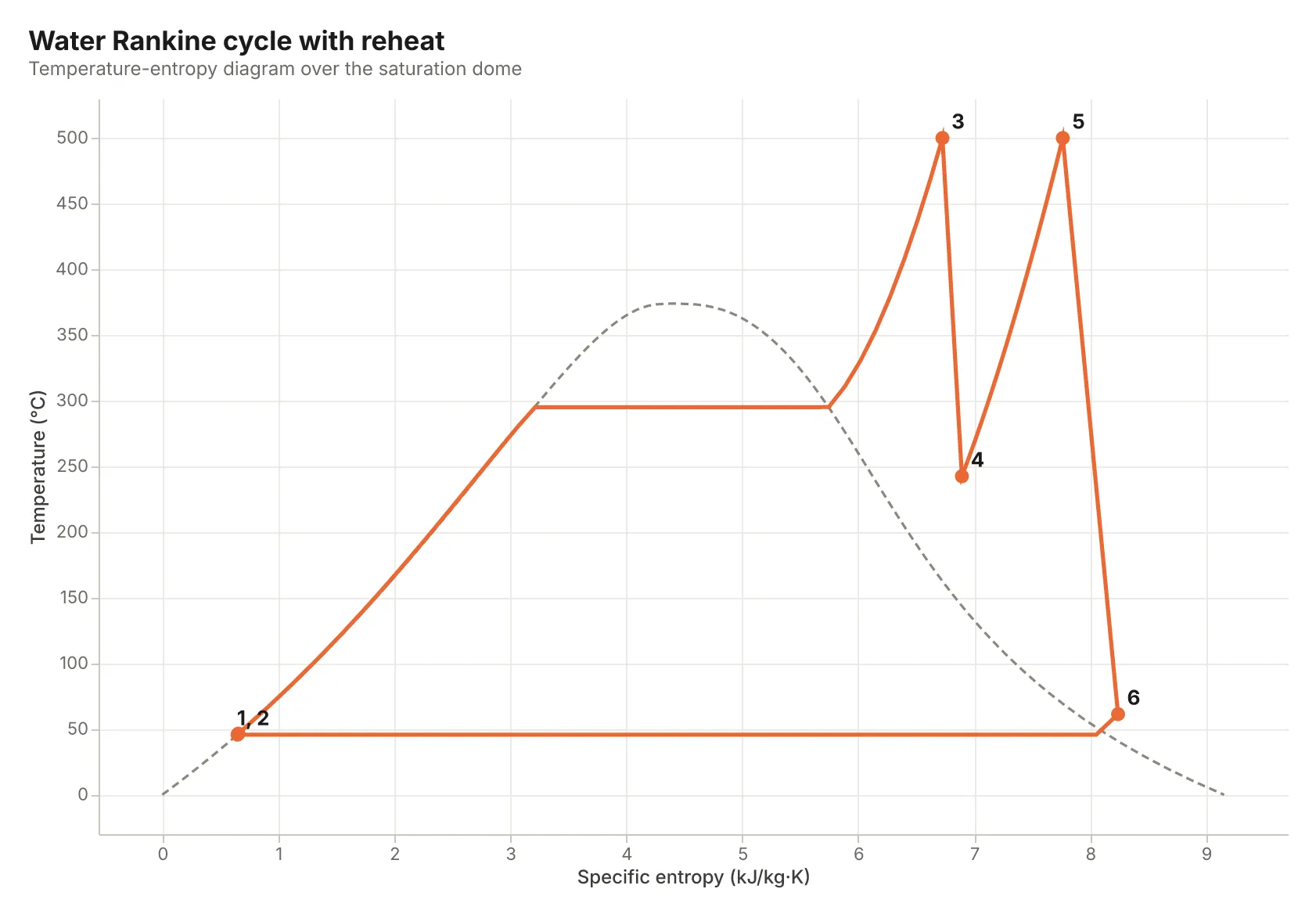
- Rankine cycles, steam or organic, with optional reheat. Returns:
- Every state, heat in and out, turbine and pump work, net work and thermal efficiency.
- Back-work ratio and turbine exit quality, with a warning below 88%.
- With a power: the steam flow.
- A temperature-entropy (T-s) diagram.
- Moist air: dry bulb with relative humidity, wet bulb, dew point or humidity ratio, or enthalpy with one of them. Pressure or altitude can be given. Returns wet bulb, dew point, RH, humidity ratio, enthalpy, specific volume, density and vapor pressure. All states go on a psychrometric chart, optionally joined as a process.
- Reference states: the fluid's usual one, or IIR, ASHRAE or NBP, to match the tables you're comparing with.
- Batches: up to 500 requests per run, mixed freely.
Who it's for
- Students of thermodynamics and heat transfer: check steam-table lookups, interpolations, cycle homework and psychrometric problems, with charts.
- HVAC and refrigeration technicians and engineers: refrigerant saturation pressures, superheat and subcooling, cycle COP, coil and air-handling states.
- Energy and process engineers: steam and power-cycle estimates, gas and brine properties.
- Developers: a property API for calculators, apps and spreadsheets, with no library to install.
- AI agents: property values and cycle results in one call, instead of approximate numbers from memory.
How to use it
- Type Fluid states, one per line, such as
water: 10 bar, 300 C. - Add Saturation tables, Cycles or Moist air states if you want them.
- Leave Units on automatic (US units are picked when you write °F, psia or Btu), or choose SI or US.
- Click Start. Each request is a row in the results, with its summary and chart.
Examples
All of these ran on this Actor, and the numbers are from the results.
| Request | Result |
|---|---|
water: 10 bar, 300 C | Superheated vapor: h = 3052 kJ/kg, s = 7.125 kJ/kg·K, v = 0.258 m³/kg, 120.1 K superheated |
steam: 150 psia, 500 F | h = 1274 Btu/lb, s = 1.66 Btu/lb·R, v = 3.68 ft³/lb |
R134a at -10 C, saturated vapor | 200.6 kPa, h = 392.7 kJ/kg, s = 1.733 kJ/kg·K |
steam at 100 C, quality 0.9 | 101.4 kPa, h = 2450 kJ/kg, v = 1.505 m³/kg |
water from 0 to 100 C step 10 | 11 rows from 0.01 °C (the triple point) to 100 °C; at 100 °C, 101.42 kPa and h_fg = 2256.4 kJ/kg |
30 C, 50% RH | Wet bulb 22 °C, dew point 18.45 °C, humidity ratio 13.37 g/kg, enthalpy 64.36 kJ/kg dry air |
dry bulb 95 F, wet bulb 75 F | 39.8% RH, dew point 66.77 °F, 98.95 gr/lb, 30.73 Btu/lb dry air |
An R134a refrigeration cycle: {"type": "refrigeration", "fluid": "R134a", "evaporating": "-10 C", "condensing": "40 C", "superheat": "5 K", "subcooling": "3 K", "efficiency": 0.75, "capacity": "10 kW"}
R134a refrigeration cycle: COP 3.13 cooling (4.13 heating, Carnot 5.26), cooling effect 145 kJ/kg, compressor work 46.29 kJ/kg, discharge 61.88 °C, pressures 200.6 kPa to 1017 kPa (ratio 5.07). For 10 kW of cooling: 0.06897 kg/s of refrigerant, 3.193 kW of compressor power.
A steam power plant with reheat (the picture above): {"type": "rankine", "fluid": "water", "boilerPressure": "80 bar", "turbineInlet": "500 C", "condenserPressure": "10 kPa", "turbineEfficiency": 0.85, "pumpEfficiency": 0.8, "netPower": "100 MW", "reheatPressure": "10 bar", "reheatTemperature": "500 C"}
Water Rankine cycle: thermal efficiency 35.4% (Carnot 58.7%), net work 1328 kJ/kg, heat in 3750 kJ/kg, back-work ratio 0.75%. For 100 MW net: 75.29 kg/s of steam, 282.4 MW of heat.
Textbook checks: the ideal Rankine cycle of Çengel's Example 10-1 (3 MPa, 350 °C, 75 kPa) comes out at 26.0% efficiency with 88.6% exit quality, and the reheat cycle of Example 10-4 at 45.0%. Both match the book.
How-to examples
Each example is a complete input; the results are from runs of the Actor (also listed under Examples).
How to look up steam table properties
Result: superheated vapor at 10 bar and 300 °C with h = 3052 kJ/kg, s = 7.125 kJ/kg·K and v = 0.258 m³/kg (120.1 K superheated); wet steam at 100 °C with h = 2450 kJ/kg; and a saturation table of 11 rows from the triple point to 100 °C, where h_fg = 2256.4 kJ/kg. US units work too: steam: 150 psia, 500 F.
How to calculate a refrigeration cycle's COP
Result: "R134a refrigeration cycle: COP 3.13 cooling (4.13 heating, Carnot 5.26), cooling effect 145 kJ/kg, compressor work 46.29 kJ/kg, discharge 61.88 °C, pressures 200.6 kPa to 1017 kPa (ratio 5.07). For 10 kW of cooling: 0.06897 kg/s of refrigerant, 3.193 kW of compressor power."
How to find dew point and wet bulb (psychrometrics)
Result: at 30 °C and 50% RH, a wet bulb of 22 °C, dew point 18.45 °C, humidity ratio 13.37 g/kg and enthalpy 64.36 kJ/kg dry air; at 95 °F dry bulb and 75 °F wet bulb, 39.8% RH and a dew point of 66.77 °F.
How to let an AI agent look up fluid properties
Add this Actor to the Apify MCP server with https://mcp.apify.com/?tools=jumblemog/fluid-properties. The agent writes states the way an engineer would ("R134a at -10 C, saturated vapor") and uses real property values instead of recalled ones.
FAQ
Where do the properties come from? CoolProp, the open-source property library, with the reference equations of state: IAPWS-95 for water, plus 120+ other fluids.
Which fluids are there? Water and steam, refrigerants such as R134a, R410A, R32 and R1234yf, R404A, R407C, R22, propane and isobutane, ammonia, CO2, air, nitrogen, hydrogen, methane and other gases, ethylene and propylene glycol and brine, plus moist air.
Can I use US units? Yes. Give the values in °F, psia and Btu/lb and the results come back in US units (units picks them automatically, or set SI or US).
Does it do Rankine cycles? Yes, with reheat, turbine and pump efficiencies and a net power. The textbook checks against Çengel's examples match the book.
Does it work with Zapier, Make or n8n? Yes. Call the Actor with its Apify app or an HTTP request and pass the values on.
Input
| Field | What it is |
|---|---|
states | Fluid states, one per line: the fluid, then two properties (water: 10 bar, 300 C). Objects such as {"fluid": "nitrogen", "T": "77 K", "P": "1 atm"} work too. |
fluid | The fluid for lines that don't name one. |
saturationTables | <fluid> from <start> to <end> step <step> or ..., <n> rows, by temperature or pressure. |
cycles | Objects. Refrigeration or heat pump: type, fluid, evaporating, condensing, superheat, subcooling, efficiency, capacity. Rankine: fluid, boilerPressure, turbineInlet, condenserPressure or condenserTemperature, turbineEfficiency, pumpEfficiency, netPower, reheatPressure, reheatTemperature. |
humidAir | Moist-air states, one per line: 30 C, 50% RH, dry bulb 95 F, wet bulb 75 F, 25 C, dew point 10 C, altitude 1500 m, 24 C, W = 9 g/kg. |
airPressure / altitude | The pressure for moist-air lines that don't give one (default: sea level). |
connectAirStates | Join the moist-air states in order on the chart, for a process. |
units | auto (default), SI or US. |
referenceState | default, IIR, ASHRAE or NBP: where enthalpy and entropy are zero. |
Units it reads:
- Temperature: C, F, K, R.
- Pressure: Pa, kPa, MPa, bar, mbar, atm, psi, psia, psig, barg, inHg, mmHg, torr.
- Enthalpy: J/kg, kJ/kg, Btu/lb, kcal/kg.
- Entropy: kJ/kg·K, Btu/lb·R.
- Density and specific volume: kg/m³, lb/ft³, m³/kg, ft³/lb.
- Humidity ratio: kg/kg, g/kg, gr/lb.
- Power: W, kW, MW, hp, Btu/h, tons.
Gauge pressures (psig, barg) add one standard atmosphere.
Output
One dataset item per request, also saved together in the run's OUTPUT record:
Each request type adds its own fields:
- Saturation requests have
liquid,vapor,hfgandsfg. - Tables have
rows,csvUrl,imageUrlandmarkdownUrl. - Cycles have
states(each point's T, P, h, s, density and quality),results(COP or efficiency, works, heats and flows),imageUrlandsvgUrl(the diagram) andmarkdownUrl. - Moist-air items have
properties(dry bulb, wet bulb, dew point, RH, humidity ratio, enthalpy, specific volume, density, vapor pressure) and the psychrometric chart inimageUrl.
A request that can't be computed has "status": "failed" and the reason in error, and isn't billed.
How it works
- Each line is read into a fluid and two properties in SI units. A property is recognized by its label or its unit, and gauge pressures are converted.
- CoolProp's Helmholtz-energy equations of state give the state: IAPWS-95 for water, and the reference equations for each refrigerant and gas. Transport properties come from CoolProp's correlations. Glycol and brine solutions use its incompressible-liquid fits, and moist air uses the ASHRAE RP-1485 model.
- Blends that CoolProp models as single pseudo-pure fluids (R404A, R407C, R410A, R507A, air) have no two-phase states of their own. A two-phase state of one is mixed from its saturated liquid and vapor by mass, and the result says so.
- Cycles are built state by state. The evaporator is at the dew point and the condenser at the bubble point. Compressor, pump and turbine outlets come from the isentropic state and the efficiency.
- Charts are drawn with Vega-Lite and rendered with vl-convert.
Pricing
You pay per result, at the prices shown on this page:
- One price per state: a fluid state, saturation point or moist-air state.
- A higher price per table or cycle, with its chart, CSV and report included.
Requests that can't be computed are never charged. If you set a maximum cost per run, the Actor stops before a request that wouldn't fit.
Speed
A state takes a few milliseconds and a cycle with its chart about a second. A run through the API answers in about 5 to 10 seconds, including the cloud container starting.
Tips and limits
- Two properties fix a state: temperature and pressure don't fix a two-phase state, so give the quality (or enthalpy or entropy) for a mixture.
- Reference states: enthalpy and entropy differences don't depend on the reference, but absolute values do. Steam tables use IAPWS (u = s = 0 for liquid at the triple point), which is the default. For refrigerants the default is IIR (h = 200 kJ/kg at 0 °C), and many US textbooks use ASHRAE (h = s = 0 for liquid at -40 °C).
- Transcritical CO₂ cycles (condensing above the critical temperature) aren't covered by the refrigeration cycle. Individual CO₂ states at any pressure work.
- Glycols and brines take temperature and pressure only (they're liquids). The result gives the freezing point.
- Moist air must not be supersaturated: a relative humidity over 100% or a wet bulb above the dry bulb is refused with the reason.
- Limits: 500 requests per run, tables up to 1000 rows.
For AI agents and developers
This Actor works with the Apify MCP server, so AI agents can call it as a tool: pass states as text lines (or humidAir, saturationTables, cycles) and read summary and properties from the result. A direct API call that waits for the answer:
run-sync instead returns the run's OUTPUT: the status, the counts and every result as JSON.
In Python, with the apify-client package:
Credits
- Properties: CoolProp by Ian Bell and contributors (MIT). Bell, I. H., Wronski, J., Quoilin, S., Lemort, V. (2014), Pure and Pseudo-pure Fluid Thermophysical Property Evaluation and the Open-Source Thermophysical Property Library CoolProp, Ind. Eng. Chem. Res. 53(6), 2498-2508.
- Charts: Vega-Lite and vl-convert (BSD-3-Clause), with the Inter font (SIL Open Font License).


