

Generator Size Calculator (Watts, Fuel & Runtime)
Pricing
Pay per event
Generator Size Calculator (Watts, Fuel & Runtime)
Generator sizing from a plain list of appliances: running and starting watts, the peak when the biggest motor starts, the portable or standby size, 240 V amps and connection, and fuel use, runtime and cost.
Pricing
Pay per event
Rating
0.0
(0)
Developer

Jumble Mog
Maintained by CommunityActor stats
0
Bookmarked
2
Total users
1
Monthly active users
9 hours ago
Last modified
Categories
Features
Share
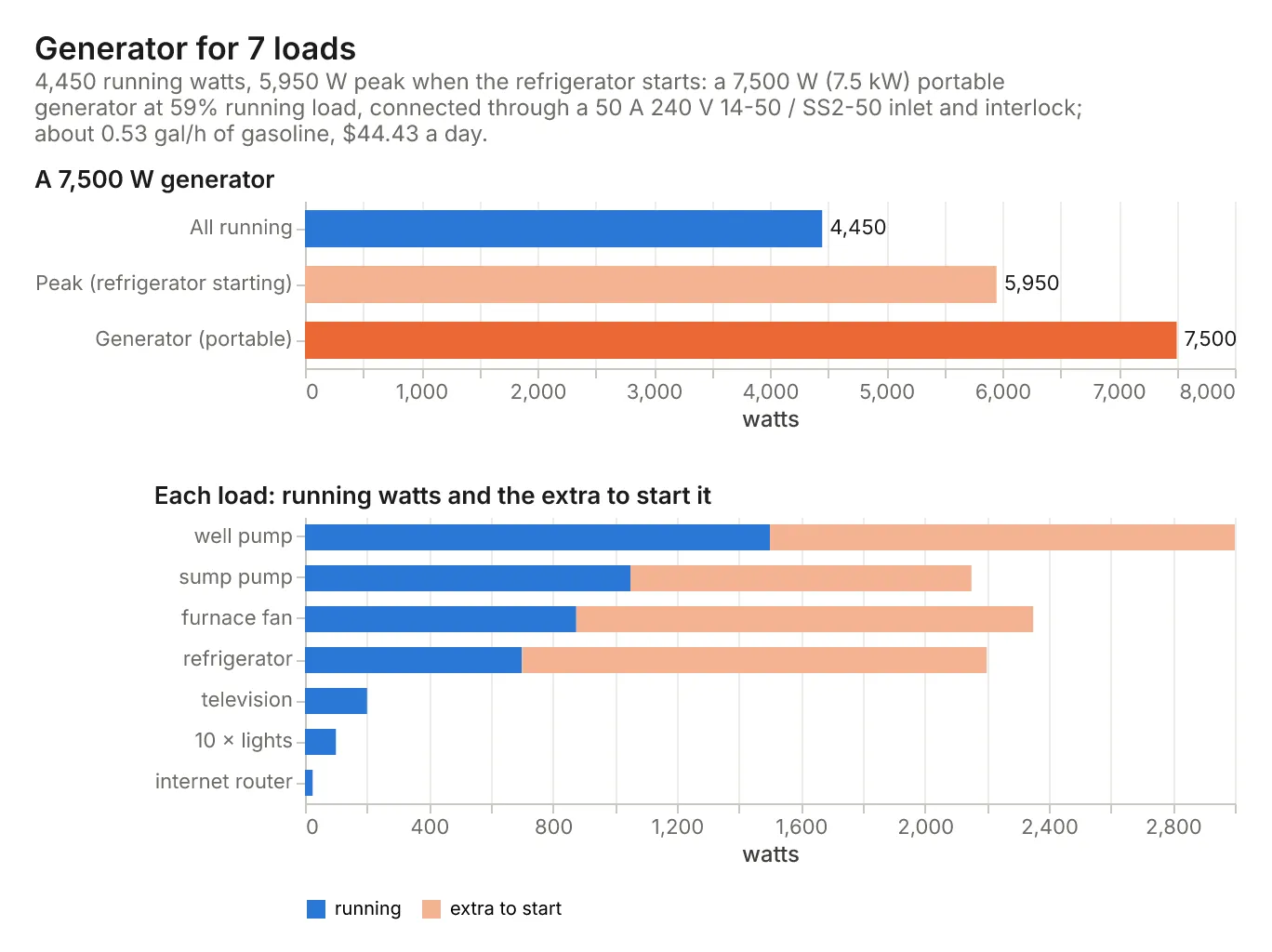
Find what size generator you need from a plain list of what it must run. Ask generator for a refrigerator, sump pump, furnace, 10 lights, tv, internet router and a well pump and you get back:
- Each load's running and starting watts, from a built-in table of 45 common appliances and tools, or from the watts, horsepower, tons or BTU you give.
- The peak: everything running plus the biggest motor starting (motors start one at a time).
- The generator size: portable or home standby, with headroom to run at about 80%, its volts and amps, and how it connects (a 30 A or 50 A inlet and interlock, or a transfer switch).
- Fuel: gasoline, propane, natural gas or diesel per hour and per day, the cost, the runtime on a tank, and totals for a multi-day outage.
- A check of a generator you already have.
- Charts (running, peak and generator watts, and each load's running and starting watts) and a Markdown report.
It's made for:
- Homeowners getting ready for storms and outages, RV owners and campers.
- Electricians and generator dealers quoting portable and standby units.
- AI agents, home and outdoor apps that need a generator size they can show their work for.
How to use it
- Write Requests, one per entry: the loads separated by commas or "and". The form has examples.
- Optionally set the fuel and the generator kind.
- Click Start. Each request is a row in the results, with its summary, chart and report.
What you can write
| You write | It means |
|---|---|
refrigerator, 2 freezers, 10 lights, furnace, sump pump, tv, router, microwave | Loads from the table |
1 hp well pump, 3 ton central ac, 10,000 btu window ac, space heater 1500 w, aquarium heater 300 w | Loads with their size |
with a soft start | AC compressors with a soft starter (about a third of the surge) |
portable, standby, whole house | The kind of generator |
propane, natural gas, diesel (gasoline by default) | The fuel |
20 lb tank, 100 lb tank, 5 gallon tank, $3.20/gal, 3 days, 12 hours a day | Runtime and cost |
7500 watt generator | Check one you have |
The same as an object: {"loads": ["refrigerator", {"name": "medical equipment", "runningW": 300}, {"name": "sump pump", "hp": 0.5}], "fuel": "gasoline"}.
Examples
generator for a refrigerator, sump pump, furnace, 10 lights, tv, internet router and a well pump→ 4,450 running W, 5,950 W peak: a 7,500 W portable, about 0.53 gal/h of gasoline.whole house standby generator on natural gas: 4 ton central ac, electric water heater, electric range, refrigerator, freezer, well pump, 30 lights→ 17,500 running W, 27,500 W peak: a 32 kW standby with a 150 A transfer switch.3 ton central air with a soft start, fridge, furnace fan and 20 led lights, propane, 100 lb tank→ a 9,500 W generator, about 25 hours on the tank.rv ac, microwave, coffee maker, tv, 5 gallon tank→ a 5,500 W generator, about 12 hours on 5 gallons.job site: table saw, air compressor, 2 circular saws, 4 drills→ a 12,000 W generator.7500 watt generator for a 1 hp well pump, 2 fridges, space heater, microwave, 3 days→ yours is big enough; about 42 gallons over 3 days.
How-to examples
These are examples from Examples above, written as complete inputs; the result lines are from their runs.
How to size a portable generator for a power outage
Result: 4,450 running W, 5,950 W peak: a 7,500 W portable, about 0.53 gal/h of gasoline.
How to size a whole-house standby generator
Result: 17,500 running W, 27,500 W peak: a 32 kW standby with a 150 A transfer switch.
How to estimate generator runtime on a propane tank
Result: A 9,500 W generator, about 25 hours on the tank.
How to let an AI agent size a generator
Add this Actor to the Apify MCP server with https://mcp.apify.com/?tools=jumblemog/generator-size-calculator. The agent writes the loads in plain words ("fridge, sump pump, furnace, 10 lights") and passes on the running and peak watts, the generator size and the fuel use instead of guessing them.
FAQ
How does it pick the size? It adds the running watts of everything you list, then the biggest motor's starting surge, and picks the next generator size up.
Can I use my own appliance watts? Yes, and they beat typical values: write fridge 900 w.
Which fuels does it cover? Gasoline, propane and natural gas, with fuel use per hour and runtime on your tank.
Does it cover three-phase sites? No. It's for single-phase homes, RVs and small job sites.
How many can I run at once? Up to 200 load lists per run, each as a line of text or an object. A request that can't be computed isn't billed.
Does it work with Zapier, Make or n8n? Yes. Call the Actor with its Apify app or an HTTP request and pass the results on.
Input
| Field | What it is |
|---|---|
requests | Lists of loads as lines of text or objects (up to 200 per run) |
fuel | The fuel when a request doesn't say (gasoline for portable, natural gas for standby) |
kind | Portable or standby when a request doesn't say (chosen by size) |
charts | Draw a chart for each request (default on) |
Output
One dataset item per request, also saved together in the run's OUTPUT record:
Every item has warnings (including any words it couldn't match to a load), notes (every assumption and default), a Markdown report and links to the chart and report. A request that can't be computed has "status": "failed" and the reason in error, and isn't billed.
How it works
- Loads: typical running and starting watts from generator makers' wattage guides (refrigerator 700/2,200 W, sump pump 1,050/2,150, furnace fan 875/2,350, well pump 1,500/3,000 at 240 V ...). Motors given in hp at 1,600 W/hp; central AC and heat pumps at 1,250 W a ton with 3 times that to start (a soft starter cuts the extra by about two thirds); window AC at BTU ÷ 9.
- Peak = every running watt + the largest extra starting surge, since motors start one at a time.
- Size = the larger of the peak and running × 1.2 (about 80% loading), up to the next portable size (2,000-15,000 W) or standby size (10-60 kW).
- Connection: a 120 V outlet up to 3,600 W, a 30 A L14-30 inlet up to 7,200 W, a 50 A inlet up to 12,000 W; standby units with an automatic transfer switch.
- Fuel: average load = half the running watts (fridges, pumps and furnaces cycle); fuel/h = full-load fuel × (0.25 + 0.75 × load share), with about 6.7 kWh per gallon of gasoline, 4.8 per gallon of propane, 5.9 per therm of natural gas and 11.4 per gallon of diesel. Prices default to $3.50, $2.75, $1.60 a therm and $4.00.
Pricing
You pay one low price per generator sized, at the price shown on this page. The charts and report are included. Requests that can't be computed are never charged. If you set a maximum cost per run, the Actor stops before a request that wouldn't fit.
Speed
A request takes milliseconds. A run through the API answers in about 10 seconds, including the cloud container starting.
Tips and limits
- Nameplates win: the watts on your appliance's label (volts × amps) beat typical values; add them as
fridge 900 w. - Start big motors first, then add the rest, and stagger the AC and well pump.
- Never backfeed through an outlet: use an interlock or transfer switch installed by an electrician, and run the generator outdoors away from windows (carbon monoxide).
- Limits: 200 requests per run; single-phase homes, RVs and small job sites.
For AI agents and developers
This Actor works with the Apify MCP server, so AI agents can call it as a tool. Pass requests as plain text and read summary, generator, totals, fuel and warnings. A direct API call that waits for the answer:
run-sync instead returns the run's OUTPUT: the status, the counts and every result as JSON.
In Python, with the apify-client package:
Credits
- Values: typical running and starting watts from generator makers' published wattage guides; fuel from typical small-generator efficiencies.
- Charts: Vega-Lite and vl-convert (BSD-3-Clause), with the Inter font (SIL Open Font License).


