

Math Solver API: Equations, Calculus & Algebra, Step by Step
Pricing
Pay per event
Math Solver API: Equations, Calculus & Algebra, Step by Step
Solve math in plain words, LaTeX or SymPy syntax: equations, derivatives and integrals with steps, limits, series, matrices, differential equations, statistics and unit conversions. Exact answers, decimals, LaTeX and graphs. A Wolfram Alpha alternative for AI agents.
Pricing
Pay per event
Rating
0.0
(0)
Developer

Jumble Mog
Maintained by CommunityActor stats
0
Bookmarked
2
Total users
1
Monthly active users
10 days ago
Last modified
Categories
Security
Limited permissionsShare
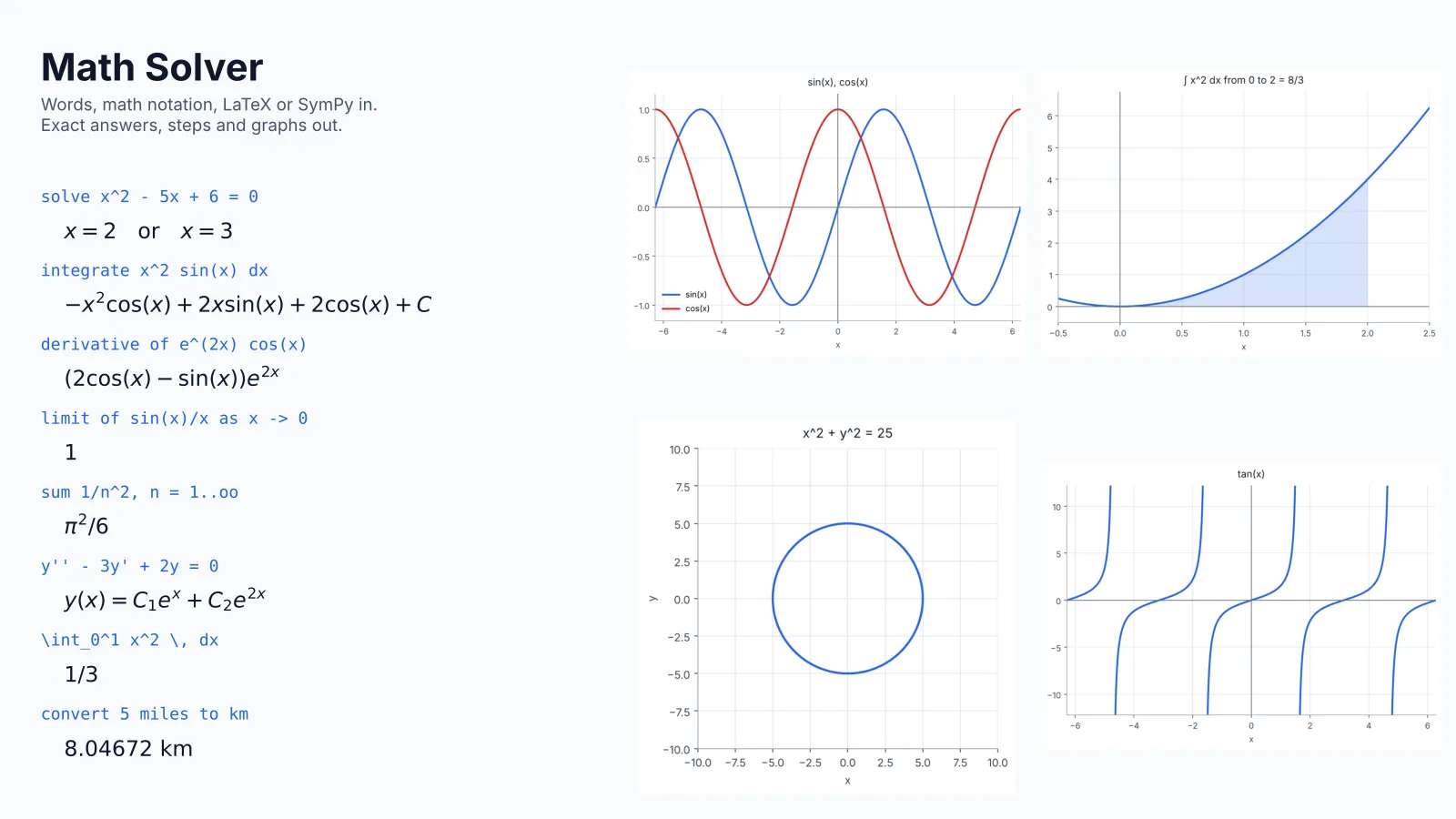
Solve math problems the way you would type them. Write a problem in plain words, math notation, LaTeX or SymPy syntax (solve x^2 - 5x + 6 = 0, integrate x^2 sin(x) dx, \lim_{x \to 0} \frac{\sin x}{x}, convert 5 miles to km) and get the exact answer, a decimal to any precision, the answer in LaTeX, step-by-step working and a graph. Equations and inequalities, derivatives, integrals, limits, series, sums, differential equations, matrices, number theory, statistics and unit conversions, worked out by the SymPy computer algebra system. A pay-per-problem Wolfram Alpha alternative that people, spreadsheets, automations and AI agents can call.
What it does
- Equations: polynomial, rational, radical, absolute value, exponential, logarithmic and trigonometric equations. Periodic equations get every solution (
x = π*n + π/4, for any integer n), polynomials get their complex roots too, and equations with no formula are solved numerically (cos(x) = xgivesx ≈ 0.739085133215161). Systems of linear and nonlinear equations, equations with letters (solve a*x^2 + b*x + c = 0 for x), and where two curves meet. - Inequalities:
x^2 > 4isx < -2 or x > 2, with interval notation. Chains like0 < 2x - 1 < 5work too. - Derivatives: any order, partial derivatives, values at a point (
derivative of x^3 at x = 2), andf'(x) if f(x) = ..., with the product, quotient and chain rule steps. - Integrals: indefinite (
+ C), definite, improper (to infinity) and double integrals, with substitution, integration by parts and partial fraction steps. Integrals that diverge are reported as diverging, with the Cauchy principal value where it exists, and integrals with no closed form are computed numerically and cross-checked, so a divergent integral never comes back as a made-up number. - Limits: two-sided, one-sided and at infinity, with L'Hôpital steps. Limits that don't exist say why (
the limit from the left is -∞, from the right ∞). - Series and sums: Taylor and Maclaurin series around any point, sums and products with a formula (
sum of k^2 for k from 1 to n), and infinite series (sum 1/n^2, n = 1..ooisπ^2/6). - Differential equations: first and second order ODEs, with initial conditions (
y'' + 4y = sin(x), y(0) = 0, y'(0) = 1), the method used and the general solution. - Algebra: simplify, expand, factor, partial fractions, combine and cancel fractions, rationalize, trig and log identities, functions you define (
f(x) = x^2 + 1, find f(3)), and true or false checks (is sin(x)^2 + cos(x)^2 = 1). - Linear algebra: determinant, inverse, transpose, rank, trace, reduced row echelon form, eigenvalues and eigenvectors, null space, characteristic polynomial, diagonalization, and matrix sums, products and powers.
- Numbers: exact arithmetic with fractions and huge integers (
100!), any number of digits (pi to 1000 digits), complex numbers, primes and prime factorization, GCD and LCM, divisors, Euler's totient, the nth prime or Fibonacci number, bases 2 to 36 and Roman numerals, and the closed form of a decimal (1.4142135623731issqrt(2)). - Optimization: minimum and maximum (on an interval too), critical points and what kind they are, inflection points, and critical points of functions of two variables.
- Statistics: mean, median, mode, sample and population variance and standard deviation, geometric and harmonic mean, range and more.
- Units: length, area, volume, mass, time, speed, energy, power, pressure and data sizes, plus °C, °F and K (
98.6 °F in °C,how many feet in a mile,60 mph to km/h). - Graphs: functions, several functions together, the shaded area of a definite integral, a function with its derivative or a Taylor polynomial, both sides of an equation, and curves like
x^2 + y^2 = 25, as PNG or SVG.
Ways to write a problem
| Style | Examples |
|---|---|
| Plain words | solve x^2 - 5x + 6 = 0, derivative of x^2 sin(x), area under x^2 from 0 to 2, limit of (1 + 1/n)^n as n approaches infinity, two plus three times four, what is 15% of 80 |
| Math notation | x² + 3x − 5 = 0, ∫ x e^x dx, ` |
| LaTeX | \int_0^1 x^2 \, dx, \frac{d}{dx} \sin(x^2), \sum_{k=1}^{n} k^2, \begin{vmatrix} 1 & 2 \\ 3 & 4 \end{vmatrix}, $x^2 = 4$ |
| SymPy syntax | integrate(x**2, (x, 0, 1)), diff(x**3, x, 2), limit(sin(x)/x, x, 0), series(cos(x), x, 0, 8), solve([x + y - 3, x - y - 1], [x, y]), N(pi, 30) |
Implicit multiplication works (2x, x y, 2 pi r), ^ and ** both mean powers, e and i are Euler's number and the imaginary unit, log and ln are the natural logarithm, and Greek letters can be written as symbols (θ) or names (theta).
How to use it
- Type a problem into Problem, or many into More problems.
- Keep Operation on Detect, or pick one (such as Integral) to apply it to bare expressions like
x^2 sin(x). - Click Start. The answers appear in the Output tab, one row per problem.
You can also run it through the Apify API, on a schedule, or from Make, n8n, Zapier and other integrations.
How-to examples
Each example below is a complete input, checked with a run of the Actor.
How to solve an equation with an API
Result: "answer": "x = 2 or x = 3", with the solutions as a list, in LaTeX (x = 2 \quad\text{or}\quad x = 3) and as decimals.
How to get a derivative or an integral with steps
Result: "answer": "x*(x*cos(x) + 2*sin(x))", the unsimplified form x^2*cos(x) + 2*x*sin(x), and five steps in words and LaTeX, starting "Use the product rule with $u = x^{2}$ and $v = \sin{\left(x \right)}$". Add "plot": true for a graph.
How to solve many problems in one call, in any notation
Result, one row each: (x - 1)*e^x + C; 1/3 (0.333333333333333); y(x) = C1*e^x + C2*e^(2*x); and 12. Plain words, math symbols, LaTeX and SymPy syntax can be mixed.
How to let an AI agent do exact math
Add this Actor to the Apify MCP server with https://mcp.apify.com/?tools=jumblemog/math-solver. Language models make arithmetic and algebra slips, so the agent sends the problem as written and gives the user answer, or latex for a formatted answer, with the steps.
FAQ
What can it solve? Arithmetic, algebra, equations and systems, inequalities, derivatives, integrals, limits, series, sums, matrices and determinants, and differential equations.
Are the answers exact? Yes. It uses SymPy, a computer algebra system, so 1/3 stays 1/3 and sqrt(2) stays exact, with a decimal value next to it.
Does it show the steps? For derivatives and other common problems, yes, in words and LaTeX.
Can it read LaTeX? Yes, as well as plain words ("area under x^2 from 0 to 2"), math symbols (∫, ², √) and SymPy syntax.
Does it work with Zapier, Make or n8n? Yes. Call the Actor with its Apify app or an HTTP request and pass answer or latex on.
Input
| Field | What it does |
|---|---|
problem | One math problem. |
problems | More problems, each answered (and charged) on its own. Up to 1,000 per run. |
operation | auto (default: read it from the problem), evaluate, simplify, expand, factor, solve, derivative, integral, limit, series or plot. |
variable | The variable to solve for, differentiate or integrate by, when the problem doesn't say. By default x, then y, z, t and the first other letter. |
showSteps | Step-by-step working for derivatives, integrals, limits, Taylor series, equations and differential equations (on by default). |
digits | Significant digits of the decimal answers (15 by default, up to 1,000). |
domain | Where equations are solved: auto (default), real or complex. |
plot, plotFrom, plotTo, plotFormat | Draw a graph for each answer in one variable, its x range (such as -2*pi to 2*pi), and png (default) or svg. Problems that start with plot are always drawn. |
timeoutSeconds | The time limit for one problem (30 s by default, up to 120). A run stops early if its timed-out problems add up to more than 3 minutes. |
Many problems in one run:
An integral with its graph:
Output
Each problem becomes one dataset item:
| Field | What it holds |
|---|---|
answer | The answer as readable text: x^2, sqrt(2), π, e, i, ∞, ln(x). |
result | The answer in SymPy syntax, which SymPy and this Actor can read back. |
latex | The answer in LaTeX, ready for MathJax or KaTeX. |
numeric | The decimal value, with the digits you asked for (when the answer is a number). |
solutions, solutionsLatex, solutionsNumeric | Each solution of an equation or system as {"x": "..."}, in the three forms. |
interpretation, interpretationLatex | How the problem was read, so you can check it was understood as you meant. |
steps | The working, as sentences with LaTeX between $ signs. |
alternateForms | Other ways to write the answer: factored, expanded, partial fractions, interval notation, mixed fraction, polar form, exact value. |
notes | Things worth knowing: the constant of integration, complex solutions left out, where a numeric answer came from. |
plotUrl | A link to the graph, when one was drawn. |
error | Why a problem couldn't be answered, such as Couldn't tell what to do with '5 apples to oranges' (the word 'to' isn't math). Try a command such as 'solve ...', 'integrate ... from 0 to 1' or 'convert 5 miles to km'. |
All the answers are also saved together as the run's OUTPUT record, so the run-sync API endpoint returns them in one response. Graphs live in the run's key-value store; download them within your plan's data retention period.
Pricing
You pay per problem solved, at the price shown on this page. Problems that can't be read, can't be solved or run out of time are never charged. If you set a maximum cost per run, the Actor stops when the next problem wouldn't fit.
Speed
Most problems take a few hundredths of a second; hard integrals, big systems and numeric solving can take a few seconds. A run with one problem takes about 3 to 6 seconds through the API, most of it the run starting up, so send many problems in one run when you can.
Tips and limits
- When a problem isn't understood, the error says why. Rephrasing as a command (
solve ...,integrate ... from a to b,derivative of ...,limit of ... as x -> a,convert ... to ...) or as SymPy syntax always works. - Answers are exact when SymPy finds an exact form. Equations with no formula fall back to numeric solutions between -100 and 100, and integrals with no closed form to a checked numeric value.
domaindecides whether equations are solved over the real or complex numbers; inequalities are always solved over the reals.- Each problem runs in a separate, unprivileged process with a memory cap and the time limit you choose, so a problem that is too hard is stopped cleanly and the rest of the run carries on.
- Problems can be up to 5,000 characters. Python code (attribute access, imports, strings) isn't accepted, only math.
- Word problems in full sentences ("a train leaves at 3 pm...") aren't parsed; turn them into equations first, which is easy for an AI model.
For AI agents and developers
Language models are good at turning questions into math and bad at exact arithmetic, algebra and calculus. This Actor is the calculator they can call: it works with the Apify MCP server, so agents can use it as a tool. Pass the problem in problem and read answer (or numeric and latex) from the result. For a direct API call that waits for the answer:
Or get every answer of a batch in one JSON response with run-sync, which returns the run's OUTPUT:
Credits
- Built on SymPy (BSD-3-Clause) with mpmath (BSD-3-Clause), NumPy (BSD-3-Clause), Matplotlib (PSF-based Matplotlib license) and Lark (MIT).
- This Actor isn't affiliated with Wolfram Research, Wolfram Alpha or the SymPy project.


