

Pavement Design Calculator: AASHTO 93 Flexible, Rigid, ESALs
Pricing
Pay per event
Pavement Design Calculator: AASHTO 93 Flexible, Rigid, ESALs
AASHTO 1993 pavement design from plain text: asphalt structural number and layer thicknesses, concrete slab thickness with joints and dowels, checks of given sections, and design ESALs from AADT or axle loads, with a chart.
Pricing
Pay per event
Rating
0.0
(0)
Developer

Jumble Mog
Maintained by CommunityActor stats
0
Bookmarked
2
Total users
1
Monthly active users
15 days ago
Last modified
Categories
Features
Share
AASHTO 1993 pavement design from one line of text. Describe the traffic and the subgrade (flexible pavement, 5 million ESALs, 95% reliability, subgrade MR 5000 psi), a concrete pavement (concrete slab, 30 million ESALs, k 150 pci, Sc 650 psi) or just the traffic (AADT 8000, 15% trucks, truck factor 1.0, 2% growth, 20 years). You get back:
- Asphalt (flexible) pavements: the structural number (SN) the traffic needs and a layered design of asphalt surface, granular base and subbase by the Guide's procedure, rounded to buildable thicknesses and the AASHTO minimums. Or give your layers (
4 in asphalt, 10 in base, 8 in subbase) to check them: the SN they give, whether each layer protects the one below, and the ESALs the section carries. - Concrete (rigid) pavements: the slab thickness for the traffic, with joint spacing and dowel size, or a check of a given slab.
- Design ESALs: from AADT, truck share, truck factor, growth, design period, directional split and lanes, or from axle loads per day with AASHTO load equivalency factors.
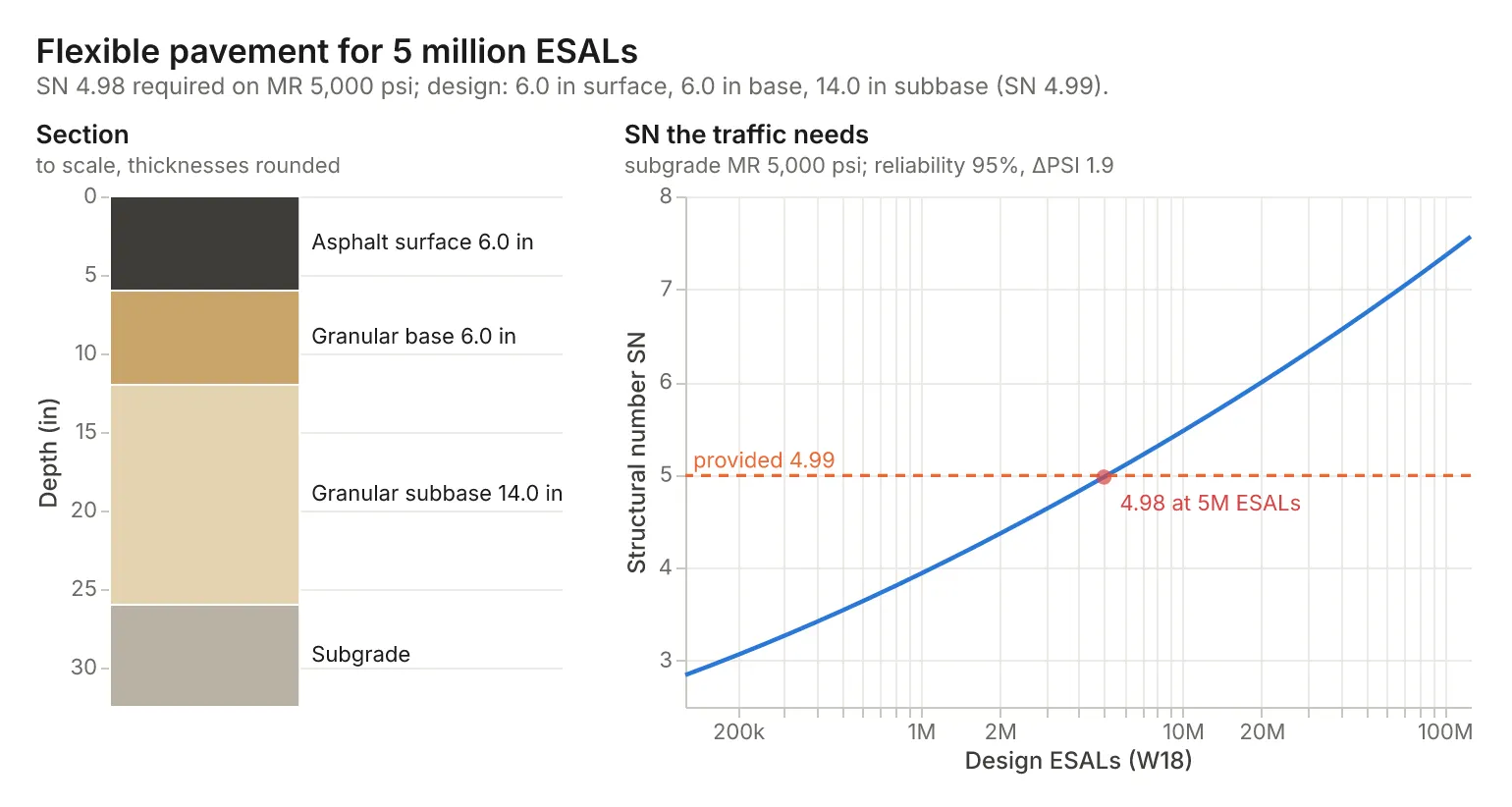
- A chart: the pavement section to scale next to the SN or slab thickness the traffic needs, or ESALs by year.
US units (inches, psi, pci, kips) or metric (mm, MPa, MPa/m, kN); results come back in the units you wrote.
It's made for:
- Civil and pavement engineers sizing roads, parking lots and yards, or checking a design.
- Contractors and estimators who need a defensible section for a bid.
- Civil engineering students working AASHTO 93 problems (and checking PE exam answers).
- AI agents that need correct pavement numbers instead of a guess.
How to use it
- Write Pavements and traffic, one per entry. The form has examples.
- Optionally set the Units for requests written without one (US by default).
- Click Start. Each request is a row in the results, with its summary, chart and report.
What you can write
| You write | It means |
|---|---|
5 million ESALs, W18 2.5e6 | Design traffic in 18-kip ESALs |
AADT 12000, 10% trucks, truck factor 1.2, 3% growth, 20 years, 2 lanes each way | Design traffic from counts (also AADTT, directional split 60%, lane factor 0.8) |
18 kip single 500 per day, 34 kip tandem 250 per day | Axle loads per day (single, tandem, tridem; kips or kN) |
reliability 95%, S0 0.45, ΔPSI 1.9 or p0 4.2, pt 2.5 | Reliability and serviceability (defaults 90%, S0 0.45 asphalt / 0.35 concrete, pt 2.5) |
subgrade MR 5000 psi, MR 35 MPa, CBR 6 | Subgrade resilient modulus (from CBR as 1500 x CBR psi) |
base modulus 30000 psi, a2 0.14, m2 1.1, good drainage, no subbase | Asphalt layer materials (defaults a1 0.44, base 30,000 psi, subbase 15,000 psi) |
4 in asphalt, 10 in base, 8 in subbase | Layers to check instead of designing |
k 150 pci, k 40 MPa/m | Modulus of subgrade reaction (or MR/19.4 from the subgrade) |
Sc 650 psi, flexural strength 4.5 MPa, Ec 4,000,000 psi, f'c 4000 psi | Concrete strength and modulus |
doweled, undoweled, CRCP, tied shoulders, J 3.2, Cd 1.0 | Load transfer and drainage |
a 10 in slab | A slab to check instead of designing |
The same as objects: {"type": "flexible", "w18": 3000000, "mr": "40 MPa", "reliability": 90, "subbase": false, "units": "metric"} or {"type": "rigid", "aadt": 15000, "trucks": "12%", "truckFactor": 1.4, "growth": "2%", "years": 30, "k": "150 pci"}.
Examples
flexible pavement, 5 million ESALs, reliability 95%, S0 0.35, ΔPSI 1.9, subgrade MR 5000 psi→ SN 4.98 (the Guide's nomograph example reads 5.0); 6.0 in asphalt, 6.0 in base, 14.0 in subbase.check 4 in asphalt, 10 in base, 8 in subbase for 2 million ESALs, MR 7500 psi, 95% reliability→ SN 4.01 against 4.12 needed: not enough, it carries 1.67 million ESALs.rigid pavement, 5.1 million ESALs, reliability 95%, S0 0.29, ΔPSI 1.7, k 72 pci, Sc 650 psi, Ec 5,000,000 psi, J 3.2, Cd 1.0→ 9.71 in by the equation (the Guide's nomograph example reads 10 in); use 10.0 in, joints at 15 ft, 1.25 in dowels.ESALs from axles: 18 kip single 500 per day, 32 kip tandem 300 per day, 10 kip single 900 per day, 2% growth, 20 years→ 836 ESALs a day, 7.41 million over 20 years.
How-to examples
Each example is a complete input; the results are from runs of the Actor (also listed under Examples).
How to design a flexible (asphalt) pavement by AASHTO 93
Result: SN 4.98 (the Guide's nomograph example reads 5.0): 6.0 in of asphalt, 6.0 in of base and 14.0 in of subbase.
How to design a concrete (rigid) pavement slab
Result: 9.71 in by the equation (the Guide's nomograph example reads 10 in): use 10.0 in, joints at 15 ft and 1.25 in dowels.
How to calculate ESALs from axle loads
Result: 836 ESALs a day, 7.41 million over 20 years. From counts, AADT 8000, 15% trucks, truck factor 1.0, 2% growth, 20 years works too.
How to let an AI agent design pavements
Add this Actor to the Apify MCP server with https://mcp.apify.com/?tools=jumblemog/pavement-design-calculator. The agent passes the traffic and subgrade in one line and answers with the structural number or slab thickness and the layer thicknesses.
FAQ
Which method does it use? The AASHTO 1993 Guide, the empirical method most agencies and exams still use; not the mechanistic-empirical Pavement ME method.
Can it check an existing section? Yes: check 4 in asphalt, 10 in base, 8 in subbase for 2 million ESALs, MR 7500 psi, 95% reliability gives SN 4.01 against 4.12 needed, so it carries 1.67 million ESALs.
What if I only have a CBR? It converts with MR = 1500 × CBR, which is for fine-grained soils with CBR 10 or less.
Which values does it assume? Reliability, S0, serviceability, layer coefficients, concrete strength and J when you don't give them; they're listed in notes, so give your agency's values to replace them.
Input
| Field | What it is |
|---|---|
requests | The pavements and traffic, as lines of text or objects (up to 200 per run) |
units | For requests without a unit: us (in, psi, pci, kips) or metric (mm, MPa, MPa/m, kN) |
charts | Draw a chart for each request (default on) |
Output
One dataset item per request, also saved together in the run's OUTPUT record:
Concrete results have slab (required and used thickness, ok, ESALs it carries) and joints; traffic results have traffic, yearly and, from axle loads, axles with each load's equivalency factor. Every item has units, summary, warnings, notes (the method and every assumed value), a Markdown report and links to the chart and report. A request that can't be computed has "status": "failed" and the reason in error, and isn't billed.
How it works
- Flexible: log10(W18) = ZR·S0 + 9.36·log10(SN+1) − 0.20 + log10(ΔPSI/2.7)/(0.40 + 1094/(SN+1)^5.19) + 2.32·log10(MR) − 8.07, solved for SN; SN = Σ ai·Di·mi.
- Layered design (Guide 3.1.5): the asphalt protects the base with the SN the base modulus needs, the base protects the subbase, the subbase the subgrade; base and subbase coefficients from their moduli (Guide Figures 2.6 and 2.7).
- Rigid: the AASHTO 93 rigid equation with S'c, Cd, J, Ec and k, solved for the slab thickness.
- Reliability: ZR is the standard normal deviate for the reliability (95% → −1.645).
- Traffic: AADT × trucks × truck factor × 365 × growth factor ((1+g)^n − 1)/g × directional split × lane factor (Guide Table 2.3); load equivalency factors from the Guide's Appendix D equations.
Pricing
You pay one low price per request, at the prices shown on this page; ESAL-only requests cost less. The chart and report are included. Requests that can't be computed are never charged. If you set a maximum cost per run, the Actor stops before a request that wouldn't fit.
Speed
Each request takes a few milliseconds. A run through the API answers in about 10 seconds, including the cloud container starting.
Tips and limits
- AASHTO 1993 is the empirical method most agencies and exams still use; it isn't the mechanistic-empirical (Pavement ME) method, and it doesn't check frost depth, rutting or cracking directly.
- Assumed values (reliability, S0, serviceability, layer coefficients, concrete strength, J) are listed in
notes; give your agency's values to replace them. - CBR to MR (1500 x CBR) is for fine-grained soils with CBR 10 or less; measure MR for granular subgrades.
- Rigid k-values: give the composite k on top of a subbase if you have one; from MR alone the slab is taken as resting on the subgrade.
- Limits: 1,000 to 10 billion ESALs; 200 requests per run.
For AI agents and developers
This Actor works with the Apify MCP server, so AI agents can call it as a tool. Pass requests as plain text and read summary, structuralNumber, layers, slab, joints, traffic and warnings. A direct API call that waits for the answer:
run-sync instead returns the run's OUTPUT: the status, the counts and every result as JSON.
In Python, with the apify-client package:
Credits
- Charts: Vega-Lite and vl-convert (BSD-3-Clause), with the Inter font (SIL Open Font License).
- Method: AASHTO, Guide for Design of Pavement Structures (1993); Huang, Pavement Analysis and Design.


