

Press Fit & Pressure Vessel Calculator (Lamé, ISO Fits, ASME)
Pricing
Pay per event
Press Fit & Pressure Vessel Calculator (Lamé, ISO Fits, ASME)
Press and shrink fit, thick cylinder and pressure vessel calculator from plain text: contact pressure from an interference or ISO fit (H7/s6), stresses, holding torque, assembly temperature, Lamé wall stresses, and ASME VIII shell and head thickness and MAWP.
Pricing
Pay per event
Rating
0.0
(0)
Developer

Jumble Mog
Maintained by CommunityActor stats
0
Bookmarked
2
Total users
1
Monthly active users
a day ago
Last modified
Categories
Security
Limited permissionsShare
Will the hub crack, will the fit slip, how thick must the shell be? Describe it in one line and find out. Type press fit: 50 mm steel shaft in a cast iron hub, H7/s6, hub OD 100 mm, 40 mm long, torque 500 N·m or ASME vessel: 1.5 MPa, 1000 mm ID, SA-516-70, spot RT, 3 mm corrosion, 2:1 ellipsoidal heads. You get back:
- Press and shrink fits: the contact pressure at the largest and smallest interference (from an ISO 286 fit like
H7/s6, or the interference you give), the hoop stresses in the hub and shaft, von Mises stresses and safety factors, the torque and axial force the fit holds before it slips, and how hot to heat the hub (or how cold to chill the shaft) to slide it on. Solid or hollow shafts, and different materials for shaft and hub. - Thick-walled cylinders (Lamé): hoop, radial and axial stress at the bore and the outside under internal and external pressure, von Mises and Tresca stresses, the yield safety factor, and the thin-wall estimate for comparison. Closed ends, open ends or plane strain.
- ASME Section VIII Div. 1 vessels: the required thickness of the shell (UG-27) and the heads (UG-32: 2:1 ellipsoidal, hemispherical or torispherical) with the corrosion allowance, the next standard plate, each part's MAWP and the vessel's, and the hydrotest pressure (UG-99). Built-in allowable stresses for common plate and pipe grades, or give your own.
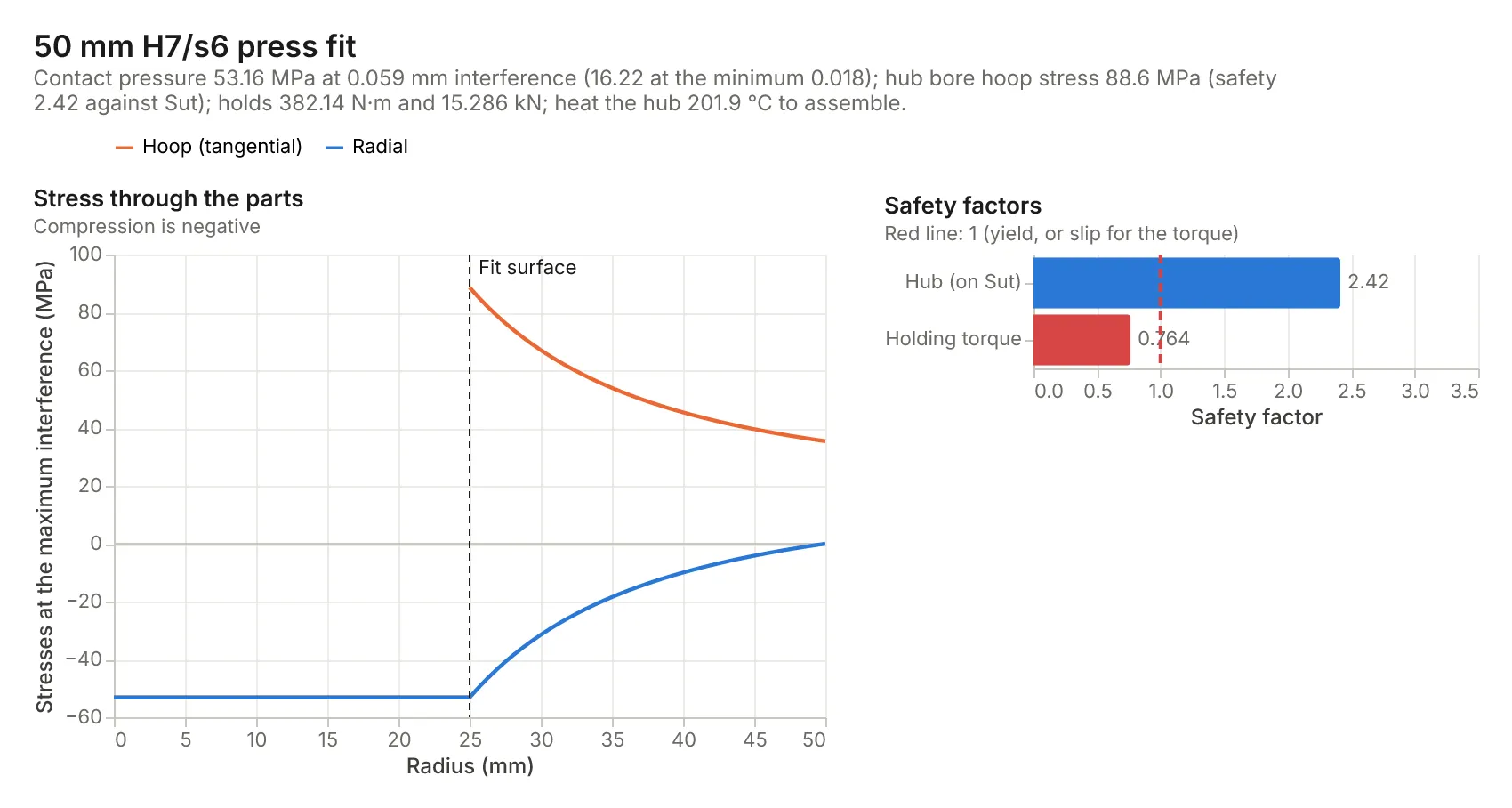
- A chart: the stresses through the shaft and hub or the wall, next to the safety factors; or for a vessel, each part's thickness against its plate next to its MAWP.
Metric (mm, MPa) or inch (in, psi): results come back in the units you wrote.
It's made for:
- Mechanical designers fitting gears, pulleys, bearings and bushings onto shafts.
- Engineers sizing tanks, receivers and pipes, and checking existing vessels.
- Engineering students working Shigley-style press fit and thick cylinder problems.
- AI agents that need real stress numbers instead of a guess.
How to use it
- Write Requests, one per entry. The form has examples.
- Optionally set a default material, friction, joint efficiency or the Units.
- Click Start. Each request is a row in the results, with its summary, chart and report.
Writing a request
| You write | It means |
|---|---|
press fit, shrink fit, thick cylinder, ASME vessel | the kind of request (it's usually clear from the rest) |
50 mm shaft, 2 in shaft, 40 mm bore gear | the fit diameter |
hub OD 100 mm, 1 in shaft bore | the hub's outside diameter, a hollow shaft's bore |
H7/s6, 0.05 mm interference, 0.0015 to 0.0025 in interference | the interference |
40 mm long, friction 0.12, torque 500 N·m | the fit length, friction, and the torque it must hold |
steel shaft in a cast iron hub, 1045, 4140, aluminum, bronze, yield 350 MPa | materials |
ID 100 mm, OD 200 mm, wall 10 mm | a cylinder's size |
internal pressure 50 MPa, external pressure 10 MPa, open ends | a cylinder's loads |
1.5 MPa, 150 psi, 15 bar, ID 1000 mm | a vessel's design pressure and diameter |
SA-516-70, SA-240-304, allowable stress 138 MPa | the vessel material |
full RT, spot RT, no RT, corrosion 3 mm | joint efficiency (1.0, 0.85, 0.70) and corrosion allowance |
2:1 ellipsoidal, hemispherical, torispherical, shell 8 mm | the heads, and a wall to check |
Objects work too; see Input.
Examples
All of these ran on this Actor; the numbers are from the results.
| Request | Result |
|---|---|
press fit: 50 mm steel shaft in a cast iron hub, H7/s6, hub OD 100 mm, 40 mm long, torque 500 N·m | 53.16 MPa contact pressure at the 0.059 mm maximum interference, 16.22 at the 0.018 minimum; hub bore hoop 88.6 MPa, safety 2.42 against Sut; holds only 382 N·m at the minimum, so it warns; heat the hub 202 °C |
shrink fit 40 mm bore gear, 0.05 mm interference, hub OD 80 mm, 1045 steel | 97.03 MPa; hub von Mises 226 MPa, safety 1.37; heat the hub 192 °C |
| Gear on a hollow shaft: 2 in, 0.0015 to 0.0025 in, hub 3.5 in, 1 in bore, 1045 CD shaft, 4140 hub, μ 0.12 | 10,320 psi at the maximum, 6,192 at the minimum; safety 3.52; holds 7,003 lbf·in |
thick cylinder ID 100 mm, OD 200 mm, internal pressure 50 MPa, 4140 | At the bore: hoop 83.33, radial −50, axial 16.67 MPa, von Mises 115.47; yield safety 5.67 (thin-wall estimate 75) |
ASME vessel: 1.5 MPa, 1000 mm ID, SA-516-70, spot RT, 3 mm corrosion, 2:1 ellipsoidal heads | Shell 10 mm (needs 9.487), heads 10 mm (needs 9.445); MAWP 1.62 MPa corroded; hydrotest 2.1 MPa |
vessel: 150 psi, 48 in ID, SA-516-70, spot RT, corrosion 1/16 in, hemispherical heads | Shell 5/16 in (needs 0.2759), heads 3/16 in; MAWP 176 psi; hydrotest 228 psi |
vessel 15 bar, ID 800 mm, SA-240-316L, no RT, torispherical heads, shell 8 mm | The 8 mm shell passes (needs 7.528); F&D heads need 14 mm; MAWP 1.59 MPa |
The tests check that:
- The contact pressure matches the closed-form same-material formula p = Eδ(ro² − R²)/(2R·ro²), and the hollow-shaft and two-material cases agree with Shigley's eq. 3-56.
- Lamé gives 83.33 and 16.67 MPa for a 100 × 200 mm cylinder at 50 MPa, and external pressure compresses the bore.
- ISO 286 limits come out right (50 r6 = +34/+50 µm, 100 s6 = +71/+93, 25 u6 = +48/+61).
- The ASME thickness formulas round-trip: the MAWP of the exact required thickness is the design pressure.
How-to examples
Each example is a complete input; the results are from runs of the Actor (also listed under Examples).
How to calculate the contact pressure and torque of a press fit
Result: 53.16 MPa contact pressure at the 0.059 mm maximum interference and 16.22 MPa at the 0.018 mm minimum; hub bore hoop stress 88.6 MPa, safety 2.42 against Sut. It holds only 382 N·m at the minimum, so it warns. Heat the hub 202 °C to assemble.
How to size an ASME pressure vessel shell and heads
Result: a 10 mm shell (needs 9.487 mm) and 10 mm heads (need 9.445 mm); MAWP 1.62 MPa corroded; hydrotest 2.1 MPa.
How to calculate stresses in a thick-walled cylinder (Lamé)
Result: at the bore: hoop 83.33, radial −50 and axial 16.67 MPa, von Mises 115.47 MPa; yield safety 5.67, where the thin-wall formula would say 75 MPa hoop.
How to let an AI agent check fits and vessels
Add this Actor to the Apify MCP server with https://mcp.apify.com/?tools=jumblemog/press-fit-vessel-calculator. The agent describes the fit, cylinder or vessel in one line and answers with the pressure, stresses and thicknesses.
FAQ
Does it read ISO fit codes? Yes, such as H7/s6. For inch ANSI FN fits, give the interference range from your table.
Which vessel parts does it size? ASME VIII-1 shells and hemispherical, 2:1 ellipsoidal and torispherical heads under internal pressure, with joint efficiency from the radiography and a corrosion allowance.
What isn't covered? External pressure (UG-28 buckling), nozzle reinforcement, flat heads, cones, and wind and seismic loads.
Is it a code calculation? It's an engineering estimate. A code vessel still needs a qualified designer, the current edition of the Code and an Authorized Inspector.
Input
| Field | What it is |
|---|---|
requests | Requests, as text or objects. |
material | Default material for fits and cylinders that name none. |
friction | Default friction coefficient (0.15). |
jointEfficiency | Default ASME joint efficiency (1.0). |
units | mm (mm and MPa, default) or in (inches and psi), for numbers written without a unit. |
charts | Draw charts (default on). |
A request as an object takes type (press fit, cylinder or vessel), title, units, text (a line of text, with the other fields overriding what it says) and:
- Fits:
diameter,fit(likeH7/s6),interference(a value or a range) orradialInterference,hubDiameter,shaftBore,length,friction,torque,assemblyClearance,material,shaftMaterial,hubMaterial,yieldStrength,shaftYield,hubYield. - Cylinders:
insideDiameter,outsideDiameterorthickness,pressure,externalPressure,ends,material,yieldStrength. - Vessels:
pressure,insideDiameter,asmeMaterialorallowableStress,jointEfficiency,corrosion,heads,thickness.
Output
One dataset item per request, also saved together in the run's OUTPUT record:
Cylinders have geometry, pressures, inner, outer (each with tangential, radial, axial, vonMises, tresca), material, safety and thinWallHoop. Vessels have design, parts (each with requiredThickness, withCorrosion, plate, mawp and the formula), mawp and hydrotest. Every item has summary, warnings, notes (the formulas and assumptions), a Markdown report and links to the chart and report. A request that can't be computed has "status": "failed" and the reason in error, and isn't billed.
How it works
- Reading: each line is read for sizes, pressures, materials, fits and factors; numbers carry their units.
- Press fits: p = δ / (R[(1/Eo)((ro² + R²)/(ro² − R²) + νo) + (1/Ei)((R² + ri²)/(R² − ri²) − νi)]) with δ the radial interference (Shigley eq. 3-56); hoop stresses from Lamé; holding torque T = 2π·μ·p·R²·L and force F = 2π·μ·p·R·L; assembly temperature ΔT = (2δ + clearance)/(α·d). ISO fits use the ISO 286 tolerance grades and deviations.
- Cylinders: σt, σr = (pi·ri² − po·ro²)/(ro² − ri²) ± ri²·ro²(pi − po)/(r²(ro² − ri²)); σa = (pi·ri² − po·ro²)/(ro² − ri²) for closed ends (Shigley section 3-14).
- Vessels: shell t = PR/(SE − 0.6P) (and the longitudinal PR/(2SE + 0.4P)); hemispherical heads PR/(2SE − 0.2P); 2:1 ellipsoidal PD/(2SE − 0.2P); torispherical 0.885PL/(SE − 0.1P); all on the corroded radius, plus the corrosion allowance, rounded up to a standard plate; MAWP from the same formulas solved for P with the plate less corrosion; hydrotest 1.3 × MAWP.
Results are engineering estimates for the stated assumptions; a code vessel still needs a qualified designer, the current edition of the Code, and an Authorized Inspector.
Pricing
You pay one low price per request, at the price shown on this page. It includes the chart and the report. Requests that can't be computed are never charged. If you set a maximum cost per run, the Actor stops before a request that wouldn't fit.
Speed
A request takes a few milliseconds, plus the chart. A run through the API answers in about 5 to 10 seconds, including the cloud container starting.
Tips and limits
- Fits are elastic: once the hub yields the real pressure is lower than shown. Cast iron hubs are checked against their tensile strength.
- Inch fits: ISO fit codes are metric; for ANSI FN fits give the interference range from your table.
- Vessel allowable stresses are the room-temperature values of a recent edition of ASME II-D; at high temperature give
allowable stressyourself. - Not covered: external pressure on vessels (UG-28 buckling), nozzle reinforcement, flat heads, cones, wind and seismic loads.
- Limits: 500 requests per run.
For AI agents and developers
This Actor works with the Apify MCP server, so AI agents can call it as a tool. Pass requests as plain text and read summary, safety, mawp, parts and warnings. A direct API call that waits for the answer:
run-sync instead returns the run's OUTPUT: the status, the counts and every result as JSON.
In Python, with the apify-client package:
Credits
- Charts: Vega-Lite and vl-convert (BSD-3-Clause), with the Inter font (SIL Open Font License).
- Method: Budynas and Nisbett, Shigley's Mechanical Engineering Design, sections 3-14 to 3-16 and Table A-5; ISO 286-1/-2 limits and fits; ASME Boiler and Pressure Vessel Code Section VIII Division 1, UG-27, UG-32 and UG-99.


