

Retaining Wall Block Calculator (Materials & Geogrid)
Pricing
Pay per event
Retaining Wall Block Calculator (Materials & Geogrid)
Segmental block retaining walls: courses, blocks, caps, base gravel, drain stone, pipe and fabric, a cost estimate, and a gravity wall stability check with the geogrid a taller wall needs.
Pricing
Pay per event
Rating
0.0
(0)
Developer

Jumble Mog
Maintained by CommunityActor stats
0
Bookmarked
2
Total users
1
Monthly active users
9 hours ago
Last modified
Categories
Features
Share
Plan a segmental block retaining wall from one line of text. Ask retaining wall 40 ft long, 3 ft high, standard blocks, loam soil and you get back:
- The layout: courses above ground and buried, the total height, the batter and how far the top steps back, and the trench to dig.
- Materials: blocks (with 5% for cuts), caps and adhesive, base gravel and drainage stone in cubic yards and tons, perforated drain pipe, filter fabric and geogrid, the block weight and the excavation.
- A cost estimate for the materials, at your prices or typical US ones.
- A stability check: whether the wall stands as a gravity wall (Coulomb earth pressure, overturning and sliding), the tallest wall that would, and the geogrid layers and length a taller wall needs, with slopes and driveways above the wall.
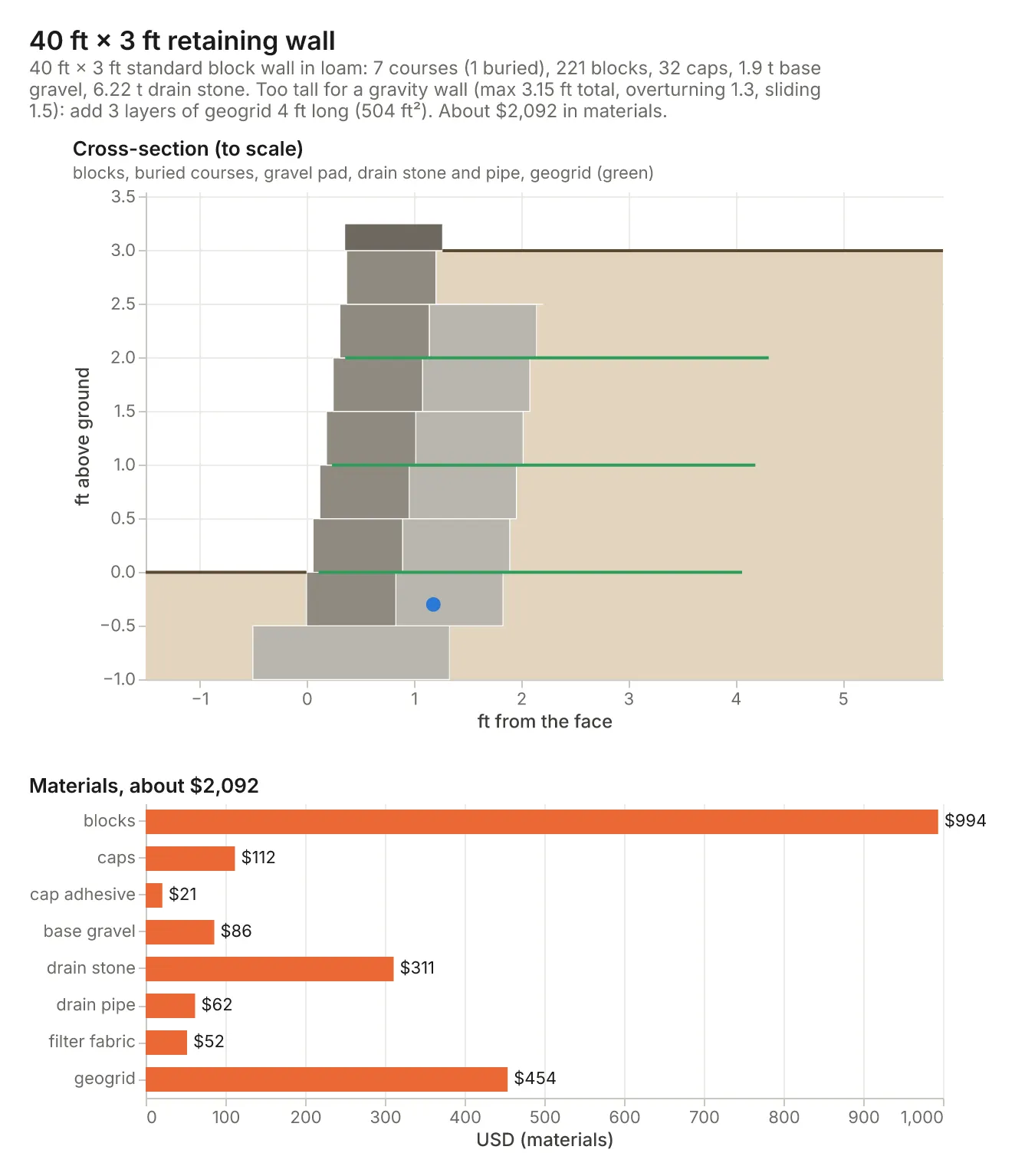
- Charts (a to-scale cross-section and the cost by item) and a Markdown report.
It's made for:
- Homeowners and DIYers pricing a garden or landscape wall before a trip to the store.
- Landscapers and hardscape contractors quoting walls.
- AI agents, home improvement and landscaping apps that need a retaining wall estimate they can show their work for.
How to use it
- Write Requests, one per wall. The form has examples.
- Optionally set the default block and soil.
- Click Start. Each request is a row in the results, with its summary, chart and report.
What you can write
| You write | It means |
|---|---|
40 ft long, 3 ft high, 50' x 2', 4 ft wall 60 ft long, 12 m long 1 m high, 18 inches high | Length and height above ground |
garden, standard, large, jumbo blocks | 12×4×7, 16×6×10, 18×8×12 or 18×8×21 in blocks |
12x4x7 block 22 lb, 3/4 inch setback, 12 degree setback | Your block |
clay, loam, sand, gravel | The soil behind the wall (loam by default) |
2:1 slope behind, 20 degree slope, driveway above, patio, 250 psf | Slopes and loads above the wall |
$6.50 per block, caps $4 each | Prices |
no caps, no pipe, 10% waste | Options |
The same as an object: {"length": 80, "height": 3.5, "block": "large", "soil": "sand", "prices": {"block": 6.25}}.
Examples
retaining wall 40 ft long, 3 ft high, standard blocks, loam soil→ 7 courses (1 buried), 221 blocks, 32 caps, 1.9 t base gravel, 6.2 t drain stone; too tall for a gravity wall, so 3 layers of geogrid 4 ft long; about $2,092.50' x 2' garden block wall with caps→ 420 blocks, 53 caps; garden blocks top out near 2 ft total as a gravity wall.4 ft wall 60 ft long with large blocks in clay, driveway above→ no height stands without geogrid under a driveway; an engineer's design.30 ft long 5 ft tall wall, large blocks, 2:1 slope behind, $6.50 per block, caps $4 each→ 189 blocks, 4 layers of geogrid.retaining wall 12 m long 1 m high, jumbo blocks, gravel→ stands as a gravity wall (overturning 4.3, sliding 3.3).{"length": 80, "height": 3.5, "block": "large", "soil": "sand"}→ a gravity wall up to 4.85 ft total.
How-to examples
These are examples from Examples above, written as complete inputs; the result lines are from their runs.
How to count blocks for a retaining wall
Result: 7 courses (1 buried), 221 blocks, 32 caps, 1.9 t base gravel, 6.2 t drain stone; too tall for a gravity wall, so 3 layers of geogrid 4 ft long; about $2,092.
How to estimate a garden block wall with caps
Result: 420 blocks, 53 caps; garden blocks top out near 2 ft total as a gravity wall.
How to check whether a wall needs geogrid
Result: Stands as a gravity wall (overturning 4.3, sliding 3.3).
How to let an AI agent estimate a block retaining wall
Add this Actor to the Apify MCP server with https://mcp.apify.com/?tools=jumblemog/retaining-wall-calculator. The agent writes the wall in one line ("40 ft long, 3 ft high, standard blocks, loam soil") and passes on the block, cap, gravel and geogrid quantities and its warnings instead of guessing them.
FAQ
What does it give me? Courses, blocks, caps, base gravel, drain stone, geogrid layers and a cost, with a check of whether the wall stands as a gravity wall.
Which soils and blocks does it know? Garden, standard, large and jumbo blocks in gravel, sand, loam or clay.
Does it work in metric? Yes: retaining wall 12 m long 1 m high works.
Is this an engineered design? No. Bearing, global stability and seismic loads aren't checked; a tall wall, poor soil or a load above needs an engineer, and your block maker's chart wins.
How many can I run at once? Up to 200 walls per run, each as a line of text or an object. A request that can't be computed isn't billed.
Does it work with Zapier, Make or n8n? Yes. Call the Actor with its Apify app or an HTTP request and pass the results on.
Input
| Field | What it is |
|---|---|
requests | Walls as lines of text or objects (up to 200 per run) |
block | The block when a request doesn't say (standard by default) |
soil | The soil when a request doesn't say (loam by default) |
charts | Draw a chart for each request (default on) |
Output
One dataset item per request, also saved together in the run's OUTPUT record:
Every item has warnings, notes (every assumption and default), a Markdown report and links to the chart and report. A request that can't be computed has "status": "failed" and the reason in error, and isn't billed.
How it works
- Courses: the height above ground in whole courses, plus buried courses (1 inch per 8 inches of height, at least 6 inches). Blocks = ⌈length × 12 ÷ face width⌉ × courses × 1.05.
- Base and drainage: a 6 in compacted gravel pad 12 in wider than the block, drainage stone 12 in behind the wall to 6 in below the top, a 4 in perforated pipe at the base running to daylight, and filter fabric in loam or clay. Stone at 1.4 tons a cubic yard.
- Stability per foot of wall: Coulomb active pressure with wall friction 2/3 φ and the wall leaning back by its setback, soil at 120 pcf (φ gravel 34°, sand 32°, loam 30°, clay 26°), the wall at 125 pcf, base friction 34°, slopes and surcharges above; overturning about the toe and sliding on the base must reach 1.5 (NCMA minimums).
- Geogrid when the gravity check fails: layers on top of every second 6-8 in course (16 in at most apart), each at least 60% of the wall height and 4 ft long, lengthened until the reinforced block passes the same checks.
- Warnings for walls over 4 ft (IRC R404.4 needs a design), geogrid walls under slopes or driveways, and garden blocks pushed past their height.
Pricing
You pay one low price per wall planned, at the price shown on this page. The charts and report are included. Requests that can't be computed are never charged. If you set a maximum cost per run, the Actor stops before a request that wouldn't fit.
Speed
A request takes milliseconds. A run through the API answers in about 10 seconds, including the cloud container starting.
Tips and limits
- Follow your block maker's chart: their tested heights and geogrid schedules for that block win over these generic numbers.
- Drainage matters most: most failed walls fail from water pressure, which this check assumes the drain stone and pipe keep away.
- Bearing, global stability and seismic loads aren't checked; a tall wall, poor soil or a load above needs an engineer.
- Limits: 200 requests per run; straight walls (add blocks for corners and curves) up to 30 ft.
For AI agents and developers
This Actor works with the Apify MCP server, so AI agents can call it as a tool. Pass requests as plain text and read summary, materials, stability, geogrid, cost and warnings. A direct API call that waits for the answer:
run-sync instead returns the run's OUTPUT: the status, the counts and every result as JSON.
In Python, with the apify-client package:
Credits
- Method: Coulomb active earth pressure and the overturning and sliding checks of the NCMA design manual for segmental retaining walls; common installation rules for burial, base, drainage and geogrid.
- Charts: Vega-Lite and vl-convert (BSD-3-Clause), with the Inter font (SIL Open Font License).


