

Stormwater Calculator: Runoff, Manning, Culverts, Weirs
Pricing
Pay per event
Stormwater Calculator: Runoff, Manning, Culverts, Weirs
Stormwater hydrology and hydraulics from plain text: rational method and NRCS curve-number hydrographs, Manning channels and pipe sizing, HDS-5 culvert headwater, weirs and orifices, with charts.
Pricing
Pay per event
Rating
0.0
(0)
Developer

Jumble Mog
Maintained by CommunityActor stats
0
Bookmarked
2
Total users
1
Monthly active users
8 hours ago
Last modified
Categories
Features
Share
Stormwater hydrology and hydraulics from one line of text. Type rational method, 10 ha, C 0.5, 100 mm/h, trapezoidal channel b 3 m, side slopes 2:1, n 0.025, slope 0.1%, Q 10 m3/s or 36 in concrete culvert, square edge headwall, 100 ft long, slope 1%, 60 cfs. You get back:
- Peak runoff by the rational method: Q = C·i·A with C weighted over land covers (
60% pavement, 40% lawn), the frequency factor for 25 to 100-year storms, and the time of concentration by Kirpich or FAA from the flow length and slope, or from an IDF curve. - NRCS curve-number runoff and hydrographs: runoff depth and volume, and the full runoff hydrograph from the NRCS dimensionless unit hydrograph and the Type II 24-hour storm (or a uniform storm), with the peak flow and its time. Tc by the NRCS lag method.
- Channels and pipes by Manning's equation: normal and critical depth, velocity, Froude number, shear stress and critical slope for rectangular, trapezoidal, triangular and circular sections; the flow at a given depth; full-pipe capacity. Leave the diameter out and it picks the smallest standard pipe; leave the width out and it finds it.
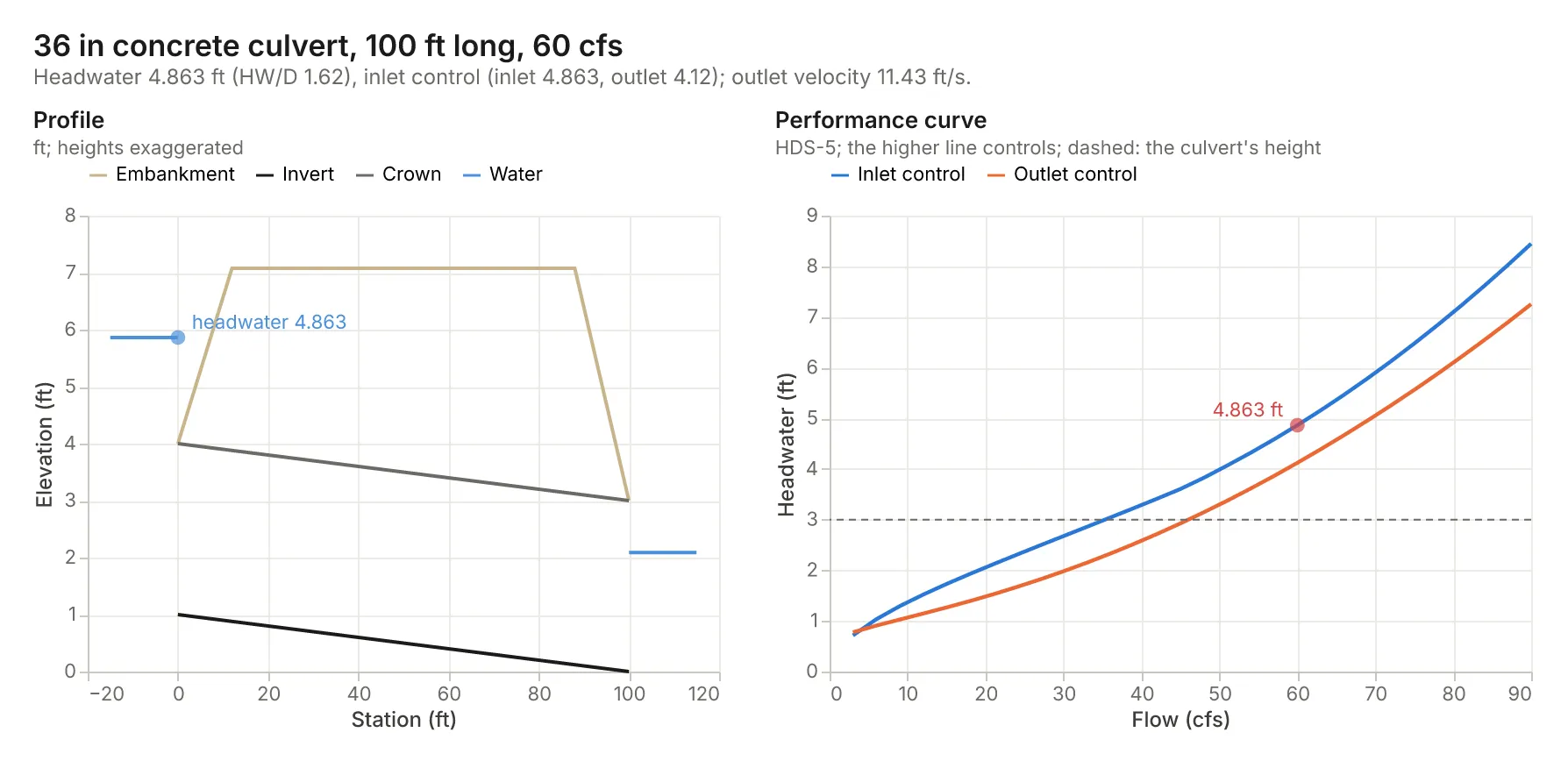
- Culverts by FHWA HDS-5: headwater for inlet and outlet control, the controlling one, HW/D, outlet depth and velocity, for round concrete and corrugated metal pipes and box culverts with nine inlet types; multiple barrels, tailwater, and sizing to an allowable headwater.
- Weirs and orifices: sharp-crested rectangular (with end contractions), V-notch, broad-crested and Cipolletti weirs and orifices: the flow for a head, or the head for a flow, with a rating table.
- A chart: the hydrograph, the section drawn to scale with its rating curve, the culvert profile with its performance curve, or the weir rating curve.
Metric (m, m³/s, ha, mm, mm/h) or US (ft, cfs, acres, in, in/h): results come back in the units you wrote. Words like concrete, pvc, cmp, grass or riprap fill in Manning's n, and roofs, pavement, lawn or woods fill in runoff coefficients.
It's made for:
- Civil and drainage engineers doing quick checks and preliminary sizing.
- Site designers, landscape architects and contractors sizing pipes, swales and culverts.
- Civil engineering and hydrology students working problems.
- AI agents that need real hydraulics instead of a guess.
How to use it
- Write Runoff, channels, culverts and weirs, one per entry. The form has examples.
- Optionally set the Units for numbers written without one.
- Click Start. Each request is a row in the results, with its summary, chart and report.
Writing runoff
| You write | It means |
|---|---|
10 ha, 25 acres, 1 mi2 | Catchment area |
C 0.5, 60% pavement, 40% lawn, 4 ha roofs and 6 ha lawn | Runoff coefficient, or land covers that set it |
100 mm/h, 5 in/hr | Rainfall intensity for the rational method |
Tc 15 min, flow length 300 m, slope 2% | Time of concentration, or the path to compute it (Kirpich; FAA for overland flow) |
25-year storm | Frequency factor on C (1.1 for 25, 1.2 for 50, 1.25 for 100 years) |
CN 80, 5 in of rain | NRCS curve number and storm rainfall: the hydrograph |
uniform 6 hour storm | A uniform storm instead of the NRCS Type II 24-hour |
Writing a channel or pipe
| You write | It means |
|---|---|
trapezoidal channel b 3 m, side slopes 2:1 | Bottom width and side slopes (2 horizontal to 1 vertical) |
rectangular channel 2 m wide, v-ditch 3:1 | Other shapes |
600 mm concrete pipe, 24 in pvc pipe | A circular pipe |
n 0.013 or concrete, pvc, cmp, earth, grass, riprap | Manning's n |
slope 0.5%, at 1%, 0.002 ft/ft | The bed or pipe slope |
Q 10 m3/s, 25 cfs, 200 l/s | The flow: gives the normal and critical depth |
depth 1 m, half full | A depth: gives the flow it carries |
size a concrete pipe at 0.5% for 25 cfs | The smallest standard pipe flowing full (80% full to limit the depth) |
Q 5 m3/s, depth 1 m, find width | The bottom width for a flow at a depth |
size a pipe at 1% for 2 ha, C 0.8, 100 mm/h | Size it for the rational peak flow |
Writing a culvert
| You write | It means |
|---|---|
36 in concrete culvert, cmp culvert, 2 x 1.5 m box culvert | Round pipe or box (span x rise) |
square edge headwall, groove end, projecting, mitered, wingwalls 45° | The inlet (HDS-5 types) |
100 ft long, slope 1% | Length and slope |
60 cfs, twin barrels | Flow (shared between barrels) |
tailwater 1 ft, allowable headwater 5 ft | Tailwater depth; the headwater limit for sizing |
Writing a weir or orifice
| You write | It means |
|---|---|
rectangular weir 2 m long, contracted | Sharp-crested weir, with or without end contractions |
90° v-notch weir, broad-crested weir, Cipolletti weir | Other weirs |
orifice 150 mm diameter | An orifice |
head 0.3 m or Q 50 l/s | Head for the flow, or flow for the head |
cd 0.62, weir coefficient 3.33 | Coefficients (otherwise standard values) |
Examples
rational method, 10 ha, 60% pavement, 40% lawn, 10-year storm, flow length 300 m, slope 2%, 100 mm/h→ C 0.62, Tc 7.1 min (Kirpich), peak 1.72 m³/s.1 mi2 watershed, 5 in of rain, CN 80, Tc 1 hr→ runoff 2.89 in (154 ac·ft), peak 972 cfs at 12.6 h.trapezoidal channel b 3 m, side slopes 2:1, n 0.025, slope 0.1%, Q 10 m3/s→ normal depth 1.443 m, 1.18 m/s, Froude 0.38; critical depth 0.856 m.size a concrete storm pipe at 0.5% for 25 cfs→ 30 in (29 cfs full), 72% full at 6.6 ft/s.36 in concrete culvert, square edge headwall, 100 ft long, slope 1%, 60 cfs→ headwater 4.86 ft (HW/D 1.62), inlet control.90° v-notch weir, Q 50 l/s→ head 0.266 m.
How-to examples
Each example is a complete input; the results are from runs of the Actor (also listed under Examples).
How to calculate peak runoff with the rational method
Result: C 0.62, Tc 7.1 min (Kirpich) and a 1.72 m³/s peak.
How to calculate runoff and a peak flow with the NRCS curve number method
Result: 2.89 in of runoff (154 ac·ft) and a 972 cfs peak at 12.6 h.
How to size a storm pipe or check a culvert
Result: a 30 in pipe (29 cfs full), 72% full at 6.6 ft/s; the culvert's headwater is 4.86 ft (HW/D 1.62) under inlet control.
How to let an AI agent do drainage calculations
Add this Actor to the Apify MCP server with https://mcp.apify.com/?tools=jumblemog/stormwater-calculator. The agent passes the catchment, channel, pipe, culvert or weir in one line and answers with the flow, depth, size or headwater.
FAQ
Which methods does it use? The rational method with Kirpich Tc, NRCS curve numbers with the dimensionless unit hydrograph, Manning's equation, HDS-5 culvert inlet and outlet control, and the standard weir and orifice equations.
Does it look up rainfall intensity for my location? No. Give the intensity from your local IDF curve, or the curve's a, b and c.
Can it find a channel's normal depth? Yes: trapezoidal channel b 3 m, side slopes 2:1, n 0.025, slope 0.1%, Q 10 m3/s gives 1.443 m at 1.18 m/s, Froude 0.38, and a critical depth of 0.856 m.
How big a catchment can it handle? The rational method up to about 80 ha (200 acres) and NRCS hydrographs up to about 65 km² (25 mi²); it warns above those.
Input
| Field | What it is |
|---|---|
requests | The runoff, channel, culvert and weir requests, as lines of text or objects (up to 200 per run) |
units | For numbers without a unit: m or ft |
charts | Draw a chart for each request (default on) |
Output
One dataset item per request, also saved together in the run's OUTPUT record:
Runoff has catchment, covers, rainfall and peak (rational) or runoff, hydrograph and series (NRCS); channels have section, flow, critical, capacity (pipes) and sizes; culverts have culvert, headwater and sizes; weirs have structure, result and rating. Every item has units, summary, warnings, notes (the method and assumptions), a Markdown report and links to the chart and report. A request that can't be computed has "status": "failed" and the reason in error, and isn't billed.
How it works
- Rational method: Q = C·i·A; Kirpich Tc = 0.0195·L^0.77·S^−0.385 minutes (L in m); 5-minute minimum; the modified rational triangle (Q at Tc, back to 0 at 2·Tc) for the volume.
- NRCS: Q = (P − 0.2S)²/(P + 0.8S) with S = 1000/CN − 10 applied to the cumulative storm rainfall; the excess convolved with the NRCS dimensionless unit hydrograph (Tp = Δt/2 + 0.6·Tc, peak 484 in US units), so the hydrograph holds exactly the runoff volume.
- Manning: Q = (1/n)·A·R^⅔·S^½ solved for depth by bisection; critical depth from Q²T = gA³; circular depths take the lower root (pipes carry the most at about 94% full).
- Culverts: HDS-5 inlet control (unsubmerged form 1 below Q/AD^0.5 = 3.5, submerged above 4.0, interpolated between) with the Appendix A constants, and outlet control HW = H + ho − L·S with H = (1 + ke + 2gn²L/R^1.33)·V²/2g and ho the greater of the tailwater and (dc + D)/2; the higher governs.
- Weirs: the standard weir and orifice equations, solved for the head by bisection.
Results are engineering estimates for the stated assumptions; check designs against the local drainage manual and code.
Pricing
You pay one low price per request, at the prices shown on this page. The chart and report are included. Requests that can't be computed are never charged. If you set a maximum cost per run, the Actor stops before a request that wouldn't fit.
Speed
Each request takes a few milliseconds. A run through the API answers in about 10 seconds, including the cloud container starting.
Tips and limits
- Rational method is for small catchments (up to about 80 ha or 200 acres); it warns above that. NRCS hydrographs are for single watersheds up to about 65 km² (25 mi²).
- Intensity isn't looked up from a location: give it from your local IDF curve, or give the curve's a, b and c (
idfA,idfB,idfCin an object, i = a/(t + b)^c). - Manning assumes uniform flow in a prismatic channel; backwater and gradually varied flow aren't modelled. Pipes that can't carry the flow are reported as surcharged with the hydraulic gradient they'd need.
- Culverts: one inlet and one barrel type at a time; no road overtopping or improved (tapered) inlets.
- Limits: 200 requests per run.
For AI agents and developers
This Actor works with the Apify MCP server, so AI agents can call it as a tool. Pass requests as plain text and read summary, peak, hydrograph, flow, headwater, result and warnings. A direct API call that waits for the answer:
run-sync instead returns the run's OUTPUT: the status, the counts and every result as JSON.
In Python, with the apify-client package:
Credits
- Math: NumPy (BSD-3-Clause); geometry: Shapely (BSD-3-Clause).
- Charts: Vega-Lite and vl-convert (BSD-3-Clause), with the Inter font (SIL Open Font License).
- Methods: FHWA HDS-5, Hydraulic Design of Highway Culverts (2012); USDA NRCS, National Engineering Handbook Part 630 and TR-55; Chow, Open-Channel Hydraulics; Chow, Maidment and Mays, Applied Hydrology; USBR, Water Measurement Manual; Kirpich (1940).


