

Fire Sprinkler Hydraulic Calculator (NFPA 13)
Pricing
Pay per event
Fire Sprinkler Hydraulic Calculator (NFPA 13)
Fire sprinkler hydraulics from plain text: NFPA 13 density/area demand, a tree system worked from the remote sprinkler to the supply with Hazen-Williams friction and fittings, the water supply check, and pipe friction loss.
Pricing
Pay per event
Rating
0.0
(0)
Developer

Jumble Mog
Maintained by CommunityActor stats
0
Bookmarked
2
Total users
1
Monthly active users
3 days ago
Last modified
Categories
Security
Limited permissionsShare
Run an NFPA 13 sprinkler hydraulic calculation, size a hazard's water demand, or find the friction loss in a pipe, from one line of text. Ask light hazard office, K5.6 sprinklers 15x15 ft spacing, 4 in feed main 100 ft, 20 ft high, 70/50 psi at 1000 gpm or 150 gpm through 100 ft of 2 in schedule 40 with 2 elbows and a tee and you get back:
- The design criteria: density and design area for the hazard (light, ordinary group 1 or 2, extra group 1 or 2, or an occupancy such as "office" or "warehouse"), the sprinklers in the design area, how many per branch line, and the flow and pressure the end sprinkler needs.
- The hydraulic calculation: the most remote branch line worked sprinkler by sprinkler, the other lines by their K-factor, the cross main, the feed main with its fittings and elevation: flow, pipe size, friction, velocity and pressure at every node.
- The demand at the supply: sprinkler flow and pressure, the hose allowance, total flow, duration and water volume.
- The water supply check: the pressure your flow test gives at that demand and the safety margin.
- Pipe friction loss: Hazen-Williams loss per foot and in total, the fittings' equivalent lengths, elevation and velocity.
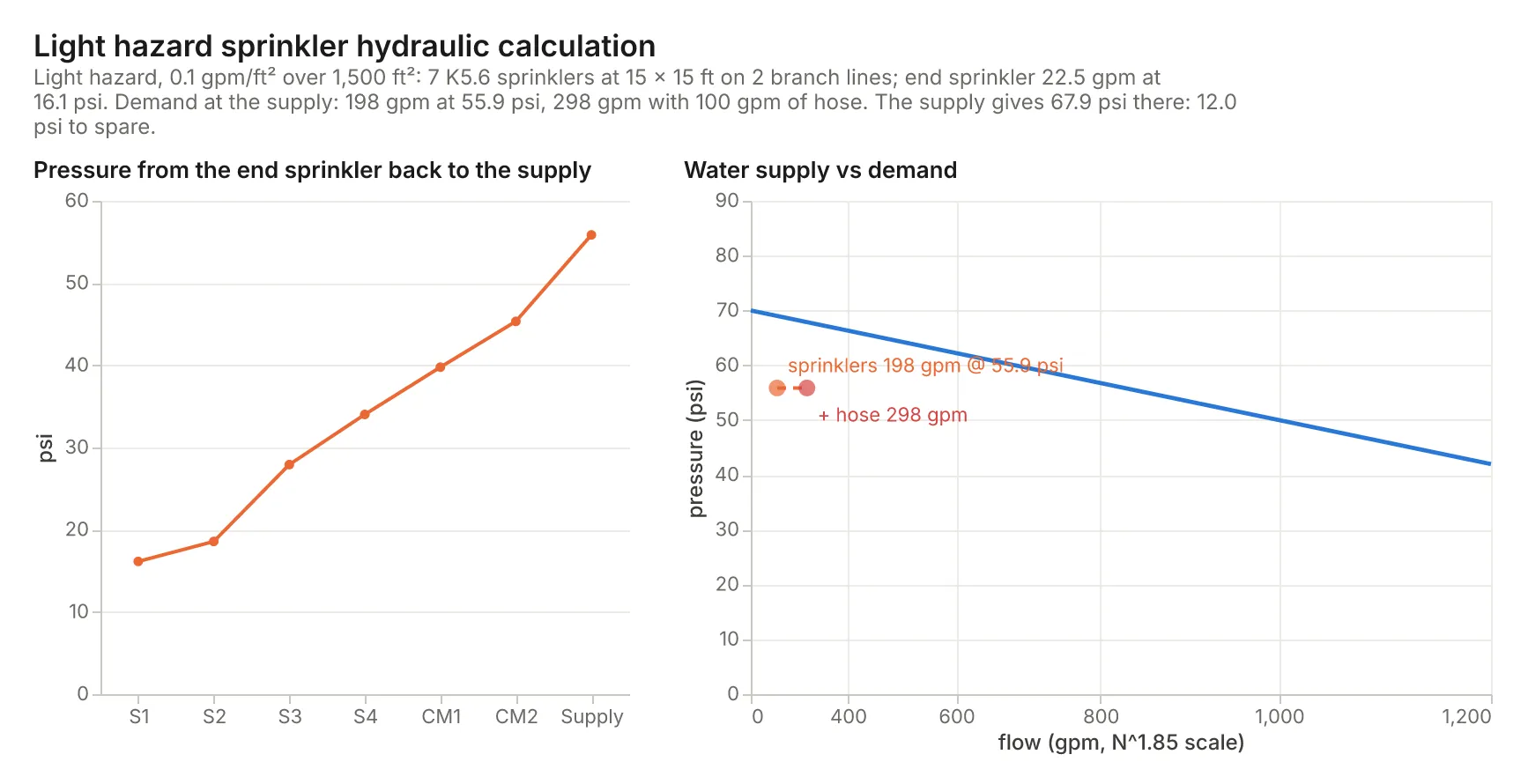
- Charts (pressure along the path and the hydraulic graph on N^1.85 paper) and a Markdown report.
It's made for:
- Fire protection designers, sprinkler contractors and engineers checking a layout or a flow test before the full calculation.
- Plan reviewers, inspectors, building owners and students learning how sprinkler hydraulics work.
- AI agents and building apps that need sprinkler demand and friction numbers they can show their work for.
How to use it
- Write Systems, demands and pipes, one per entry. The form has examples.
- Optionally change the Default hazard (ordinary hazard group 1) or the Default pipe (Schedule 40 steel).
- Click Start. Each request is a row in the results, with its summary, chart and report.
What you can write
| You write | It means |
|---|---|
light hazard, OH2, extra hazard group 1, office, warehouse | The hazard (NFPA 13 density/area curve and hose allowance) |
0.20 gpm/ft2 over 2000 sq ft, 0.15/1500 | Your own density and design area |
15x15 ft spacing, 12 x 10 heads | Sprinkler spacing along the branch lines × between them |
K5.6, K8.0, k-factor 11.2 | Sprinkler K-factor (5.6 by default, 8.0 for extra hazard) |
1 in branch lines, 2-1/2 in cross main, 4 in feed main | Pipe sizes (the NFPA 13 pipe schedule when left out) |
feed main 100 ft, 20 ft high | Feed main length and sprinkler height above the supply |
70/50 psi at 1000 gpm, static 70 psi, residual 50 psi at 1,000 gpm | The water supply flow test |
dry system, sch 10, cpvc, copper, C=100 | System type and pipe |
250 gpm hose, no hose, backflow 8 psi | Hose allowance and a backflow preventer loss |
150 gpm through 100 ft of 2 in, 2 elbows and a tee, rise 10 ft | A single pipe's friction loss |
The same as an object: {"hazard": "OH1", "spacing": "12 x 10", "k": 5.6, "branchSize": "1-1/4", "crossSize": "2-1/2", "feedLength": "200 ft", "elevation": 30, "static": 80, "residual": 60, "testFlow": 1500}.
Examples
light hazard office, K5.6 sprinklers 15x15 ft spacing, 4 in feed main 100 ft, 20 ft high, 70/50 psi at 1000 gpm→ 7 sprinklers on 2 branch lines, end sprinkler 22.5 gpm at 16.1 psi, 198 gpm at 55.9 psi at the supply (298 gpm with hose); the supply gives 67.9 psi there, 12.0 psi to spare.ordinary hazard group 2 warehouse, 10x13 ft spacing, static 65 psi, residual 45 psi at 1200 gpm→ 402 gpm at 81.0 psi needed against 58.5 psi available: 22.5 psi short, so larger pipes or a fire pump.extra hazard group 1 demand→ 0.30 gpm/ft² over 2,500 ft², 25 sprinklers, at least 750 gpm plus 500 gpm of hose, 112,500 gallons for 90 minutes.friction loss 150 gpm through 100 ft of 2 in schedule 40 with 2 elbows and a tee→ 0.1989 psi/ft over 120 ft equivalent: 23.87 psi, 14.3 ft/s.
How-to examples
Each example is a complete input; the results are from runs of the Actor (also listed under Examples).
How to run an NFPA 13 sprinkler hydraulic calculation
Result: 7 sprinklers on 2 branch lines, the end sprinkler at 22.5 gpm and 16.1 psi, and 198 gpm at 55.9 psi at the supply (298 gpm with hose). The supply gives 67.9 psi there, 12.0 psi to spare.
How to check if a water supply is enough for a sprinkler system
Result: 402 gpm at 81.0 psi needed against 58.5 psi available: 22.5 psi short, so larger pipes or a fire pump.
How to calculate friction loss in sprinkler pipe (Hazen-Williams)
Result: 0.1989 psi/ft over 120 ft equivalent length: 23.87 psi, at 14.3 ft/s.
How to let an AI agent run sprinkler calculations
Add this Actor to the Apify MCP server with https://mcp.apify.com/?tools=jumblemog/sprinkler-hydraulics-calculator. The agent passes the hazard, spacing and supply in one line and answers with the demand, the pressure at the supply and the safety margin.
FAQ
Which standard does it follow? NFPA 13 (2022): density/area curves, hose allowances, the Hazen-Williams formula and fitting equivalent lengths.
Can it give just the water demand for a hazard? Yes: extra hazard group 1 demand gives 0.30 gpm/ft² over 2,500 ft², 25 sprinklers, at least 750 gpm plus 500 gpm of hose, and 112,500 gallons for 90 minutes.
Does it use my flow test? Yes. Give the static and residual pressures at a flow and it checks the supply at the demand.
Is it a substitute for a stamped hydraulic calculation? No. It's a quick check for layouts, bids and supply questions; submittals need a full calculation by a qualified designer.
Input
| Field | What it is |
|---|---|
requests | Systems, demands or pipes, as lines of text or objects (up to 200 per run) |
hazard | Hazard when a request gives neither a hazard nor a density |
material | Pipe when a request doesn't say |
charts | Draw a chart for each request (default on) |
Output
One dataset item per request, also saved together in the run's OUTPUT record:
A system also has pipes, branchLines and remoteLine; a demand has design and demand; a pipe has pipe and fittings. Every item has warnings, notes (every assumption and default), a Markdown report and links to the chart and report. A request that can't be computed has "status": "failed" and the reason in error, and isn't billed.
How it works
- Criteria: the density and smallest design area of the hazard's curve (NFPA 13 Figure 19.3.3.1.1), 30% more area for dry systems, hose allowance and duration from Table 19.3.3.1.2.
- Design area: area ÷ coverage sprinklers, with 1.2 √A of it along the branch lines.
- End sprinkler: flow = density × coverage, pressure = (Q / K)², at least 7 psi.
- Branch line: back to the cross main, each sprinkler flowing K √P and each pipe losing 4.52 Q^1.85 / (C^1.85 d^4.87) psi per foot; the other lines flow by the first line's K-factor at the cross main pressure.
- Feed main: friction over its length plus the fittings' equivalent lengths (Table 28.2.3.1.1, corrected for C and inside diameter), 0.433 psi per foot of height, any backflow loss.
- Supply: available pressure = static − (static − residual) × (Q / test flow)^1.85, compared at the demand with hose.
Pricing
You pay one low price per request, at the price shown on this page: a system calculation, a hazard demand, or a pipe's friction loss. The charts and report are included. Requests that can't be computed are never charged. If you set a maximum cost per run, the Actor stops before a request that wouldn't fit.
Speed
A request takes milliseconds. A run through the API answers in about 10 seconds, including the cloud container starting.
Tips and limits
- A check, not stamped plans. Real systems are calculated over the actual layout by a qualified designer and approved by the authority having jurisdiction; use this to size and check before that.
- Tree systems with identical branch lines on one side of the cross main; gridded and looped systems, in-rack sprinklers, storage (ESFR, CMSA) and residential (NFPA 13R/13D) design aren't covered.
- Pipe schedule sizes are the starting point when you leave sizes out; give your sizes to calculate your layout.
- Limits: 200 requests per run.
For AI agents and developers
This Actor works with the Apify MCP server, so AI agents can call it as a tool. Pass requests as plain text and read summary, design, demand, supply and warnings. A direct API call that waits for the answer:
run-sync instead returns the run's OUTPUT: the status, the counts and every result as JSON.
In Python, with the apify-client package:
Credits
- Method: NFPA 13, Standard for the Installation of Sprinkler Systems (2022): density/area curves, hose allowances, pipe schedule, Hazen-Williams formula and fitting equivalent lengths. This Actor is not affiliated with the NFPA.
- Charts: Vega-Lite and vl-convert (BSD-3-Clause), with the Inter font (SIL Open Font License).


