

Pool Volume, Chemical, Pump & Heater Calculator
Pricing
Pay per event
Pool Volume, Chemical, Pump & Heater Calculator
Swimming pool and hot tub calculator from plain text: gallons by shape, pump flow, filter and pipe for a turnover, gas heater or heat pump size, and the chemical doses to balance a water test.
Pricing
Pay per event
Rating
0.0
(0)
Developer

Jumble Mog
Maintained by CommunityActor stats
0
Bookmarked
2
Total users
1
Monthly active users
7 hours ago
Last modified
Categories
Features
Share
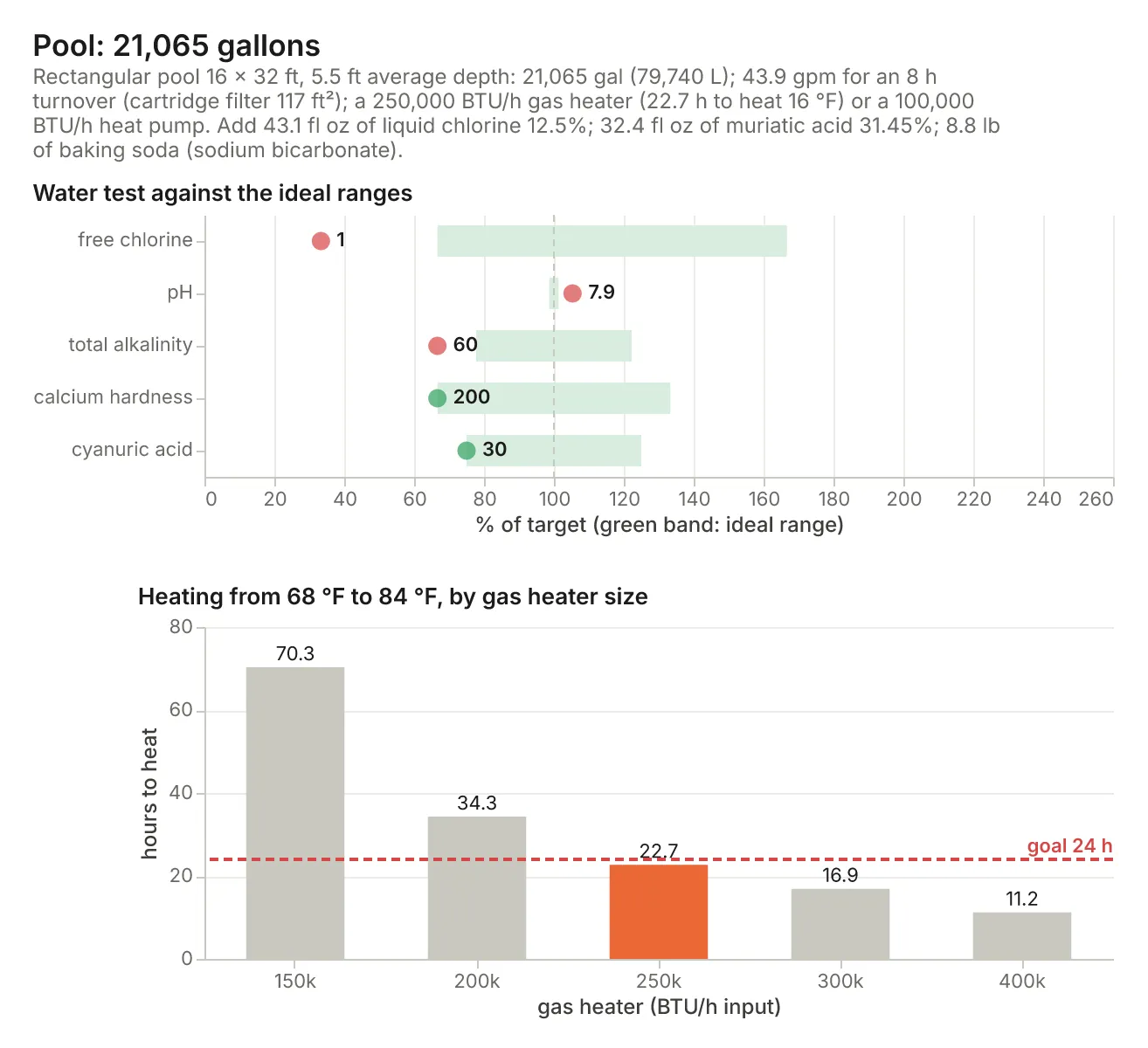
Work out a swimming pool's or hot tub's gallons, pump, heater and chemical doses from one line of text. Ask 16 x 32 ft pool, 3 to 8 ft deep, pH 7.9, FC 1, TA 60, CYA 30, calcium 200 and you get back:
- The volume in gallons and liters for a rectangle, round (above-ground), oval or kidney pool, from the size and the shallow and deep ends.
- The pump and filter: the flow for a turnover, the sand, cartridge or DE filter area, the suction and return pipe sizes and about how much pump.
- The heater, when you give temperatures: the gas heater and heat pump sizes for a heat-up time against the surface heat loss, with or without a cover.
- The chemical doses from a water test: liquid chlorine (or cal hypo), muriatic acid or soda ash, baking soda, calcium chloride, stabilizer and salt, or how much water to replace, each with why.
- Charts (the water test against the ideal ranges, heat-up hours by heater size, or pump flow by turnover) and a Markdown report.
It's made for:
- Pool owners balancing their water or buying a pump, filter or heater.
- Pool service techs, builders and pool supply stores.
- AI agents, pool-care apps and chatbots that need doses and sizes they can show their work for.
How to use it
- Write Requests, one per entry. The form has examples.
- Optionally set the turnover and the filter type.
- Click Start. Each request is a row in the results, with its summary, chart and report.
What you can write
| You write | It means |
|---|---|
16 x 32 ft, 3 to 8 ft deep, 18 x 36 x 5 ft, 8 x 4 m, 1.5 m deep | A rectangular pool |
24 ft round, 52 in wall, above ground, oval 15 by 30, kidney 15 x 30, hot tub 7 x 7 ft | Other shapes |
20,000 gallon pool, 60,000 liters | The volume, when you know it |
6 hour turnover, sand filter, cartridge, DE | The pump and filter |
heat to 84 F from 65 F in 2 days, air 60 F, with a cover, heat pump | Heating |
FC 1, pH 7.9, TA 60, calcium 200, CYA 30, salt 2400 | A water test (ppm) |
The same as an object: {"shape": "oval", "length": 30, "width": 15, "shallow": 3.5, "deep": 6, "heater": "heat pump", "airTemp": 70, "targetTemp": 84, "fc": 0.5}.
Examples
16 x 32 ft pool, 3 to 8 ft deep, pH 7.9, FC 1, TA 60, CYA 30, calcium 200→ 21,065 gal; 43.9 gpm for an 8 h turnover; add 43 fl oz of liquid chlorine, 32 fl oz of muriatic acid and 8.8 lb of baking soda.24 ft round above ground pool, 52 in wall, sand filter→ 12,972 gal; 27 gpm.kidney pool 15 x 30 ft, 4 ft average depth, heat to 84 F from 65 F in 2 days, air 60 F, with a cover→ 11,445 gal; a 150,000 BTU/h gas heater or a 75,000 BTU/h heat pump.20,000 gallon pool, salt 2400, ph 7.2, ta 140, cya 90→ muriatic acid for the alkalinity, 133 lb of salt, and replace 22% of the water for the stabilizer.hot tub 7 x 7 ft, 3 ft deep, heat to 102 F→ 1,100 gal; a 30-minute turnover.8 x 4 m pool, 1.5 m deep, cartridge filter, 6 hour turnover→ 48,000 L.
How-to examples
These are examples from Examples above, written as complete inputs; the result lines are from their runs.
How to calculate pool gallons and chemical doses
Result: 21,065 gal; 43.9 gpm for an 8 h turnover; add 43 fl oz of liquid chlorine, 32 fl oz of muriatic acid and 8.8 lb of baking soda.
How to size a pool heater
Result: 11,445 gal; a 150,000 BTU/h gas heater or a 75,000 BTU/h heat pump.
How to calculate the volume of a round above-ground pool
Result: 12,972 gal; 27 gpm.
How to let an AI agent work out pool volume and chemicals
Add this Actor to the Apify MCP server with https://mcp.apify.com/?tools=jumblemog/swimming-pool-calculator. The agent writes the pool and its test results ("16 x 32 ft, 3 to 8 ft deep, pH 7.9, FC 1") and passes on the gallons, pump flow and what to add instead of guessing them.
FAQ
What can it calculate? Volume for rectangular, round, kidney and other pools and hot tubs, the pump flow for a turnover, chemical doses from your test results, and heater size.
Which chemical strengths does it assume? 12.5% liquid chlorine, 65% cal hypo and 31.45% muriatic acid. Check your label.
Does it work in metric? Yes: 8 x 4 m pool, 1.5 m deep returns litres.
How should I add the chemicals? One at a time with the pump running. Never mix acid and chlorine.
How many can I run at once? Up to 200 pools per run, each as a line of text or an object. A request that can't be computed isn't billed.
Does it work with Zapier, Make or n8n? Yes. Call the Actor with its Apify app or an HTTP request and pass the results on.
Input
| Field | What it is |
|---|---|
requests | Pools as lines of text or objects (up to 200 per run) |
turnover | Hours to filter all the water once when a request doesn't say (8 by default; 30 minutes for a hot tub) |
filter | Cartridge, sand or DE when a request doesn't say (cartridge by default) |
charts | Draw a chart for each request (default on) |
Output
One dataset item per request, also saved together in the run's OUTPUT record:
heater is filled when a request mentions heating or temperatures, and chemistry when it has test readings. Every item has warnings, notes (every assumption and default), a Markdown report and links to the chart and report. A request that can't be computed has "status": "failed" and the reason in error, and isn't billed.
How it works
- Volume: length × width × average depth × 7.48 gal/ft³; round and oval × π/4, kidney × 0.85. The average depth is halfway between the ends; an above-ground pool's water sits 6 in below the wall.
- Pump and filter: gpm = gallons ÷ (turnover hours × 60). Filter area at 20 gpm/ft² for sand, 2 for DE, 0.375 for cartridge. Pipe sized for under 6 ft/s on the suction side and 8 ft/s on the return. Pump power at about 50 ft of head and 50% efficiency; a variable-speed pump run slower and longer uses far less.
- Heater: heat-up = gallons × 8.34 × the rise in °F, spread over the heat-up time, plus the surface loss of 12 BTU/h per ft² per °F of water over air (half with a cover). Gas heaters give about 84% of their input; a heat pump is sized to hold the temperature against the loss.
- Chemistry: targets are free chlorine 3 ppm (at least 7.5% of the cyanuric acid), pH 7.5, alkalinity 90, calcium 300, cyanuric acid 40 (70 with a salt chlorinator), salt 3,200. Per 10,000 gal: 1 ppm chlorine = 10.2 fl oz of 12.5% liquid chlorine or 2 oz of 65% cal hypo; 10 ppm alkalinity = 1.4 lb of baking soda or 26 fl oz of muriatic acid; 10 ppm calcium = 1.2 lb of calcium chloride; 10 ppm stabilizer = 13.4 oz; salt by weight. pH doses scale with the alkalinity and are estimates: add half and retest. Calcium, stabilizer and salt only come down by replacing water.
Pricing
You pay one low price per pool, at the price shown on this page, whatever parts it asks for. The charts and report are included. Requests that can't be computed are never charged. If you set a maximum cost per run, the Actor stops before a request that wouldn't fit.
Speed
A request takes milliseconds. A run through the API answers in about 10 seconds, including the cloud container starting.
Tips and limits
- Read the label: chemical strengths vary; these doses assume 12.5% liquid chlorine, 65% cal hypo and 31.45% muriatic acid.
- One chemical at a time with the pump running; never mix acid and chlorine, and add acid to water, not water to acid.
- A good test kit (a FAS-DPD chlorine test) beats strips for dosing.
- Limits: 200 requests per run; pool surface loss is a typical outdoor figure, so windy or cold sites need more heat.
For AI agents and developers
This Actor works with the Apify MCP server, so AI agents can call it as a tool. Pass requests as plain text and read summary, pool, chemistry.doses, heater and warnings. A direct API call that waits for the answer:
run-sync instead returns the run's OUTPUT: the status, the counts and every result as JSON.
In Python, with the apify-client package:
Credits
- Methods: shape volume factors, turnover and filter-rate rules, the water heating equation with a typical surface loss, and chemical doses worked out from each chemical's strength and molecular weight per 10,000 gallons.
- Charts: Vega-Lite and vl-convert (BSD-3-Clause), with the Inter font (SIL Open Font License).


