Wood Beam, Joist & Post Calculator (NDS)
Pricing
Pay per event
Wood Beam, Joist & Post Calculator (NDS)
NDS 2018 wood member design from plain text: check sawn lumber, glulam, LVL and PSL joists, rafters, beams, headers, studs and posts (bending, shear, bearing, deflection, column buckling), find the maximum span, or pick the smallest size that works.
Pricing
Pay per event
Rating
0.0
(0)
Developer

Jumble Mog
Maintained by CommunityActor stats
0
Bookmarked
2
Total users
1
Monthly active users
19 days ago
Last modified
Categories
Features
Share
Check a wood joist, rafter, beam, header, stud or post by the NDS 2018, find how far it can span, or pick the smallest size that works, from one line of text. Ask 2x10 DF-L No.2 floor joists at 16 in o.c., span 14 ft, 40 psf live, 10 psf dead, (2) 2x12 header, span 8 ft, 200 plf dead, 300 plf snow or what size beam, span 16 ft, tributary 12 ft, 40 psf live, 15 psf dead and you get back:
- Every check with its ratio: bending (with beam stability CL and glulam volume CV), shear, bearing, live or snow deflection and total deflection for beams; compression with column stability CP, bending from wind on studs (NDS 3.9.2) and plate bearing for studs and posts.
- Each load combination of ASCE 7-16 (ASD) with its load duration factor CD (0.9 dead, 1.0 floor live, 1.15 snow, 1.25 roof live, 1.6 wind), and every other factor: size CF, wet service CM, incising Ci, repetitive member Cr.
- Forces and capacities: maximum moment, shear and reaction with their allowables, the bearing length needed, deflections as L/x, or the allowable axial load.
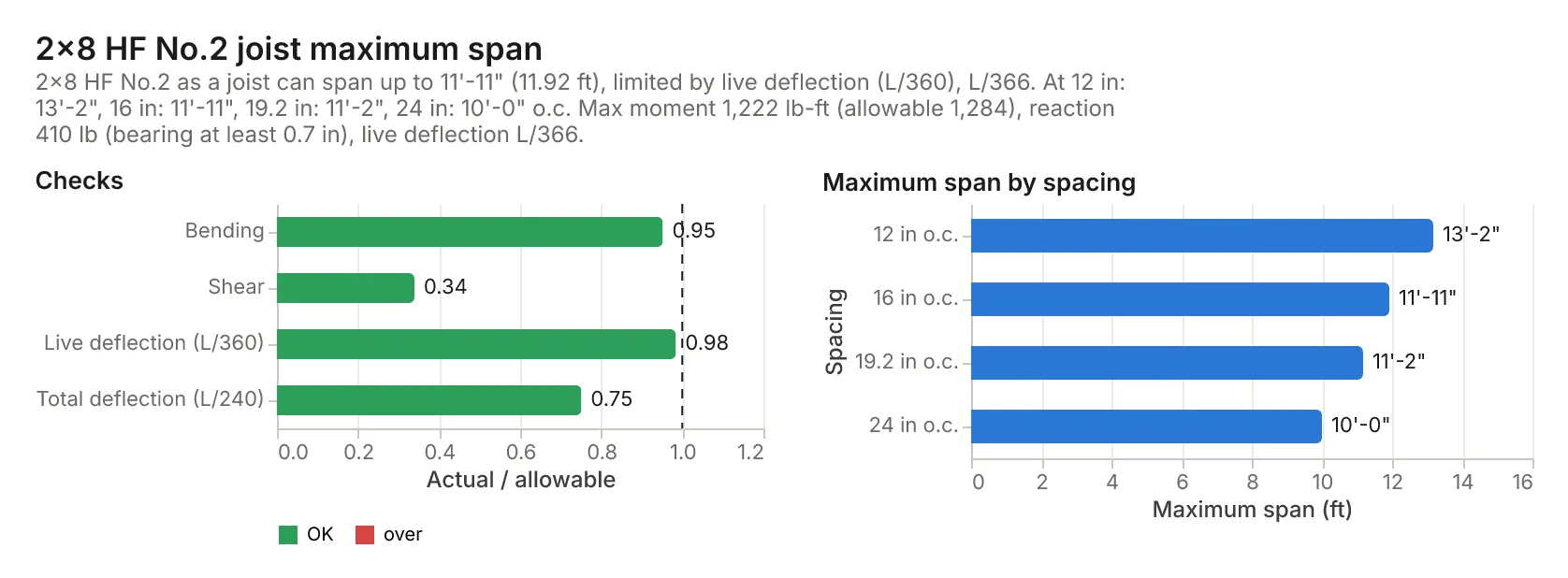
- Maximum span: the longest span or height that passes, with a span table at 12, 16, 19.2 and 24 in spacing for joists and rafters.
- Selection: the smallest sawn lumber, built-up lumber, LVL, PSL or glulam member that passes, with alternatives.
- A chart and a Markdown report for each request.
Materials: visually graded Douglas Fir-Larch, Hem-Fir and Spruce-Pine-Fir dimension lumber (Select Structural, No.1, No.2, Stud) from 2x4 to 4x16, single or built up from 2 to 5 plies; glulam 24F-V4, 24F-V8 and 24F-1.8E; LVL 2.0E and 1.9E and PSL 2.0E with typical published values.
It's made for:
- Builders, remodelers, deck builders and DIYers sizing a header, beam, joist or post, and checking a span-table answer for their own loads.
- Engineers, architects and students who want a fast NDS check with every factor shown.
- AI agents and building or estimating apps that need wood member sizes they can explain.
How to use it
- Write Members, one per entry. The form has examples.
- Optionally set a Default species and Default grade for lumber (Douglas Fir-Larch No.2 otherwise).
- Click Start. Each request is a row in the results, with its summary, chart and report.
What you can write
| You write | It means |
|---|---|
2x10, (2) 2x12, double 2x10, 3-ply 2x12, 4x4 | Sawn lumber, single or built up |
5-1/8 x 18 glulam, 1-3/4 x 11-7/8 LVL 2-ply, 3-1/2 x 11-7/8 PSL | Glulam, LVL or PSL (width x depth, inches) |
DF-L, Hem-Fir, SPF, No.2, #1, SS, Stud, 24F-V8, LVL 1.9E | Species, grade or stress class |
joist, rafter, beam, header, stud, post | How the member is used |
span 14 ft, 12'-6" span, 8 ft tall, span 4.2 m | Span (beams) or height (studs and posts) |
40 psf live, 10 psf dead, 30 psf snow, 20 psf roof live, 1.9 kPa live | Area loads |
16 in o.c. (joists, rafters, studs), tributary 12 ft (beams) | The width that area loads act on |
300 plf snow, 4.4 kN/m dead | Line loads on a beam or on a stud wall |
6000 lb dead, 8000 lb live | Axial loads on a post (or a midspan point load on a beam) |
wind 25 psf | Wind pressure on studs (bending, with 0.6W) |
unbraced 8 ft, unbraced, bearing 3 in, L/480, total L/240, K = 2, wet, incised | Options |
maximum span ..., max height ... | The longest span or height |
what size ..., select ..., max depth 11.25 in, LVL, glulam | Selection |
The same as an object: {"size": "2x12", "role": "joist", "spacing": 16, "length": "16 ft", "areaLoads": {"D": 10, "L": 40}, "species": "HF"} or {"type": "select", "role": "header", "length": "6 ft", "lineLoads": {"D": 300, "S": 500}}.
Examples
2x10 DF-L No.2 floor joists at 16 in o.c., span 14 ft, 40 psf live, 10 psf dead→ OK at 0.84 in bending: M = 1,714 lb-ft against 2,029 lb-ft (Fb' = 900 × CF 1.1 × Cr 1.15 = 1,139 psi); live deflection L/577.maximum span of 2x8 Hem-Fir No.2 floor joists, 40 psf live, 10 psf dead→ 11'-11" at 16 in o.c., limited by L/360; 13'-2" at 12 in, 11'-2" at 19.2 in, 10'-0" at 24 in.(2) 2x12 header, span 8 ft, 200 plf dead, 300 plf snow→ OK at 0.74 in bending under D + S (CD 1.15); needs 1.1 in of bearing.what size beam, span 16 ft, tributary 12 ft, 40 psf live, 15 psf dead→ (2) 1-3/4 x 14 LVL 2.0E at 0.89; also (4) 1-3/4 x 11-1/4 LVL or a 3-1/8 x 15 glulam.4x4 DF-L No.2 post, 8 ft tall, 3000 lb dead, 3500 lb live→ OK at 0.93: CP = 0.366, allowable load 6,960 lb.5-1/8 x 18 glulam beam, span 22 ft, 300 plf dead, 600 plf snow, unbraced 11 ft, bearing 4 in→ OK at 0.92 with CL 0.964 and CV 0.956.
How-to examples
Each example is a complete input; the results are from runs of the Actor (also listed under Examples).
How to check a floor joist span (NDS)
Result: OK at 0.84 in bending, with M = 1,714 lb-ft against 2,029 lb-ft (Fb' = 900 × CF 1.1 × Cr 1.15 = 1,139 psi) and a live load deflection of L/577.
How to find the maximum span of a joist
Result: 11'-11" at 16 in o.c., limited by L/360, with a span table: 13'-2" at 12 in, 11'-2" at 19.2 in and 10'-0" at 24 in.
How to size a beam or header (lumber, LVL or glulam)
Result: a (2) 1-3/4 x 14 LVL 2.0E at 0.89, or (4) 1-3/4 x 11-1/4 LVL or a 3-1/8 x 15 glulam; and the header OK at 0.74 in bending under D + S (CD 1.15), needing 1.1 in of bearing.
How to let an AI agent size wood framing
Add this Actor to the Apify MCP server with https://mcp.apify.com/?tools=jumblemog/wood-member-calculator. The agent passes the member as one line and answers with the NDS checks and factors, instead of reading a span table from memory.
FAQ
Which woods does it know? Douglas Fir-Larch, Hem-Fir and Spruce-Pine-Fir dimension lumber (Select Structural, No.1, No.2, Stud), single or built up, plus glulam, LVL and PSL with typical published values.
Which checks does it do? Bending with beam stability, shear, bearing and deflection for beams; compression with column stability for posts and studs; with the NDS 2018 adjustment factors.
Can it pick the size for me? Yes. Ask "what size beam" and it gives the smallest member that passes, with alternatives.
Is it a stamped calculation? No. It's a design aid; local codes, span tables and a licensed engineer have the final word.
Input
| Field | What it is |
|---|---|
requests | Members, as lines of text or objects (up to 200 per run) |
species, grade | Defaults for sawn lumber when a request doesn't name them |
charts | Draw a chart for each request (default on) |
Output
One dataset item per request, also saved together in the run's OUTPUT record:
Items also have combinations (every load combination with its forces and stresses), loads (the line loads on the member, self-weight included), slenderness for studs and posts, maxSpan and spanTable for spans, alternatives for selections, warnings, notes (every assumption), a Markdown report and links to the chart and report. A request that can't be computed has "status": "failed" and the reason in error, and isn't billed.
How it works
- Design values from the NDS Supplement (Table 4A for lumber, 5A for glulam) are multiplied by the adjustment factors of NDS chapters 2 to 5 for each ASD load combination (ASCE 7-16 2.4.1), with CD set by the shortest load in it.
- Beams are simple spans: bending with CL (NDS 3.3.3) and CV for glulam, shear at a distance d from the support, bearing on Fc⊥, and deflection under the largest transient load and under that plus half the dead load for creep (the full dead load when wet).
- Studs and posts: compression with CP (NDS 3.7.1) about both axes, wind bending combined by NDS 3.9.2, and plate bearing.
- Area loads become line loads by the spacing or the tributary width, and the member's self-weight is added to the dead load.
- Maximum span searches the span to the inch; selection checks every standard size and keeps the smallest that passes (sawn lumber first, then LVL or PSL, then glulam for beams and posts).
Pricing
You pay one low price per request, at the price shown on this page. The chart and report are included. Requests that can't be computed are never charged. If you set a maximum cost per run, the Actor stops before a request that wouldn't fit.
Speed
A check takes milliseconds and a selection well under a second. A run through the API answers in about 10 seconds, including the cloud container starting.
Tips and limits
- This is a design aid, not a stamped calculation. Loads, spans and support conditions are your input; local codes, span tables and a licensed engineer have the final word.
- Simple spans only: no cantilevers, continuous spans, or point loads other than at midspan. Notches, holes, connections, fire and vibration aren't checked.
- Not included: Southern Pine (its values are size-specific), timbers 5x5 and larger, MSR/MEL lumber, I-joists and engineered products other than the typical LVL and PSL values given (use your manufacturer's values for those).
- Deflection limits default to L/360 live and L/240 total for floors and L/240 and L/180 for roofs; give your own with
L/480ortotal L/360. - Beam bracing: joists and rafters are taken as braced by the sheathing, and beams as braced along the top unless you write
unbracedorunbraced 8 ft. - Limits: 200 requests per run.
For AI agents and developers
This Actor works with the Apify MCP server, so AI agents can call it as a tool. Pass requests as plain text and read summary, checks and warnings. A direct API call that waits for the answer:
run-sync instead returns the run's OUTPUT: the status, the counts and every result as JSON.
In Python, with the apify-client package:
Credits
- Method: ANSI/AWC NDS 2018, National Design Specification for Wood Construction, and its Supplement design values; ASCE 7-16 load combinations; IBC Table 1604.3 deflection limits. This Actor is not affiliated with the American Wood Council.
- Charts: Vega-Lite and vl-convert (BSD-3-Clause), with the Inter font (SIL Open Font License).