

NVD Critical CVE & KEV Vulnerability API
Pricing
from $0.70 / 1,000 normalized cves
NVD Critical CVE & KEV Vulnerability API
Search NIST NVD CVEs by product, date, CVSS severity, CWE, CVE ID, or CISA KEV status. Export normalized cybersecurity vulnerability data for SOC teams.
Pricing
from $0.70 / 1,000 normalized cves
Rating
0.0
(0)
Developer

Timo Schmidt
Maintained by CommunityActor stats
0
Bookmarked
3
Total users
2
Monthly active users
2 months ago
Last modified
Categories
Share
NVD CVE Vulnerability Monitor & Normalizer
Search NIST NVD CVE records by product, date, CVSS severity, CWE, CVE ID, or CISA KEV status. Export normalized vulnerability data for security workflows.
This product uses data from the NVD API but is not endorsed or certified by the NVD.
Try this first
Start with the example input below to find recently modified critical CVEs in CISA KEV. Results include CVSS, CWE, affected CPEs, references, and canonical NVD links.

Example output
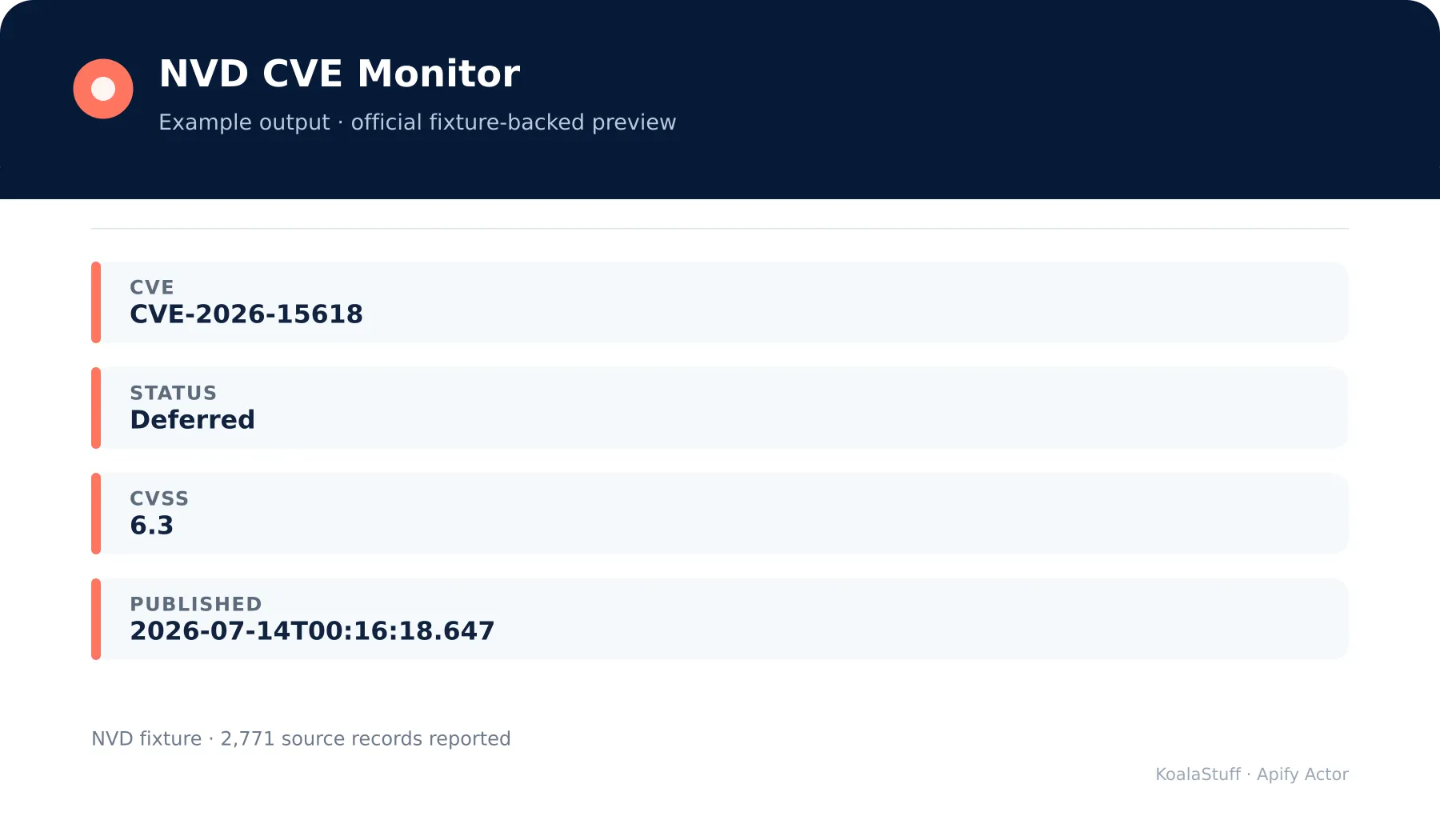
This preview is generated from a checked-in official-source fixture. It shows the normalized output shape without inventing live demand or results.
Ready-made task: Find high-severity CVEs updated recently.
For recurring monitoring, duplicate the Task and attach your own Apify Schedule; this portfolio does not enable paid schedules automatically.
Use cases
- Monitor newly published or recently modified CVEs.
- Track CISA Known Exploited Vulnerabilities from the NVD record.
- Filter by keyword, CVSS v3/v4 severity, CWE, or exact CVE IDs.
- Feed security dashboards, ticketing, asset-risk, and vulnerability-management workflows.
Input
| Field | Description | Default |
|---|---|---|
cveIds | Up to 100 exact CVE IDs; omits the date window | none |
keywordSearch | Official NVD description search | none |
dateMode | PUBLISHED or LAST_MODIFIED | LAST_MODIFIED |
daysBack | Rolling UTC window from 1 to 120 days | 7 |
cvssVersion | Version for the severity filter: ANY, V3, or V4 | ANY |
severity | LOW, MEDIUM, HIGH, or CRITICAL | none |
cweId | Exact CWE identifier | none |
hasKev | Only CVEs in the CISA KEV catalog | false |
maxResults | Hard unique-output and billing limit | 100 |
requestDelayMs | Delay between anonymous NVD API pages | 6000 |
Output
Every row includes the CVE ID, English description, publication and modification timestamps, status, best available CVSS v4/v3/v2 metric, CWE identifiers, affected CPEs, references, CISA KEV fields when present, and canonical NVD links.
Reliability and limits
- Official public JSON API only; no page scraping, browser, proxy, API key, account, or paid service.
- Anonymous NVD access permits 5 requests in a rolling 30-second window. This Actor enforces at least 6 seconds between pages and fetches sequentially.
- Date ranges are bounded to the official maximum of 120 days.
- Up to 2,000 CVEs per API page and five pages per run.
- Duplicate removal uses the stable CVE ID; maximum 10,000 unique outputs.
- Optional NVD enrichment fields remain
nullor empty arrays when the source has not published them. - NVD does not test referenced software and provides the data as-is. Verify vendor advisories before remediation decisions.
Pricing
Pay per event:
- Actor start: USD 0.00005
- Normalized CVE: USD 0.001
No proxy, browser, paid API, or external subscription is required. The user's configured maximum charge per run remains the hard billing limit.
A two-result Apify smoke run on 256 MB used USD 0.0007587613 of platform resources and completed in 50.767 seconds.
Data source and reuse
Source: https://services.nvd.nist.gov/rest/json/cves/2.0.
NIST states that its publications are available in the public domain and asks applications using the NVD to display this notice prominently: “This product uses data from the NVD API but is not endorsed or certified by the NVD.” The Actor includes the notice in its Store documentation and every dataset row.
Support
Report reproducible problems with the input, run link, expected field, and affected CVE ID. Do not include private asset inventories, credentials, or unpublished vulnerability details.
Related Actors
- CISA KEV Priority & Remediation Monitor for known-exploited-vulnerability due dates and ransomware-use data.
- EU Safety Gate Product Alert Monitor for product-safety risk monitoring.


