
CVE Exploit Priority Monitor – EPSS & Optional CVSS
Pricing
from $1.80 / 1,000 saved observations
CVE Exploit Priority Monitor – EPSS & Optional CVSS
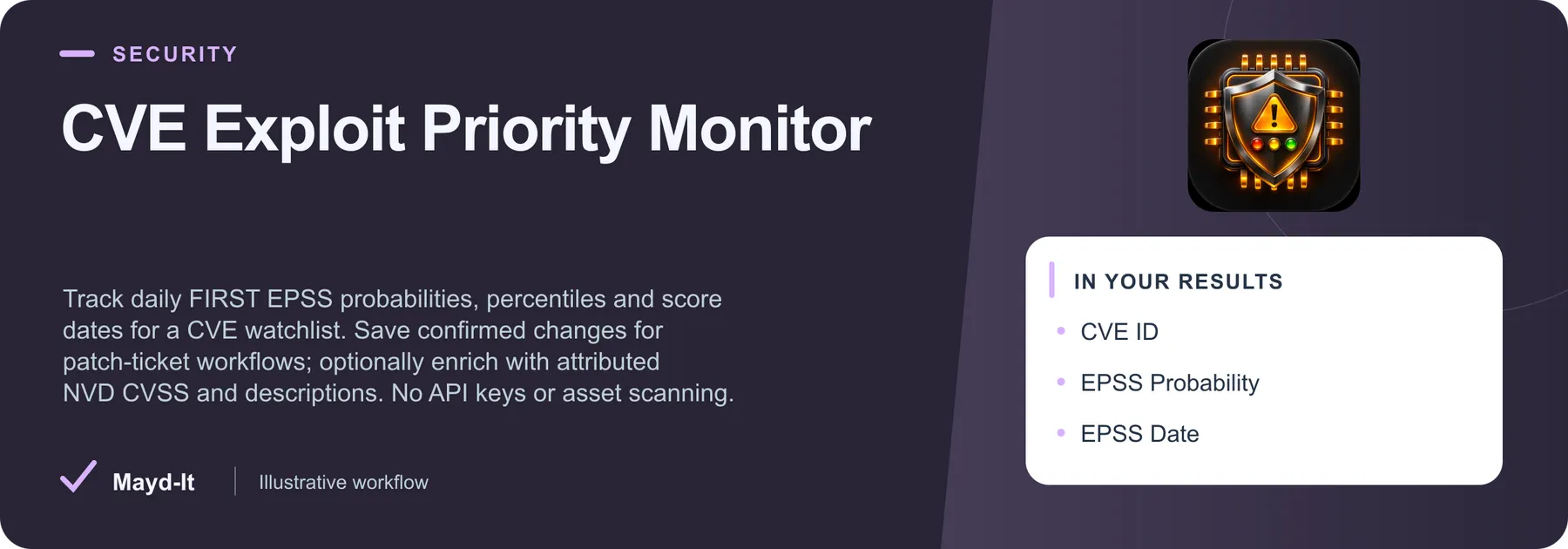
Track daily FIRST EPSS probabilities, percentiles and score dates for a CVE watchlist. Save confirmed changes for patch-ticket workflows; optionally enrich with attributed NVD CVSS and descriptions. No API keys or asset scanning.
Pricing
from $1.80 / 1,000 saved observations
Rating
0.0
(0)
Developer
Brandt May
Maintained by CommunityActor stats
0
Bookmarked
2
Total users
1
Monthly active users
4 days ago
Last modified
Categories
Features
Share
CVE Exploit Priority Monitor – EPSS & Optional CVSS
Turn known CVE identifiers into dated exploit-probability observations for patch tickets and security dashboards. Track FIRST EPSS probability, percentile and score changes. Add NVD descriptions and attributed CVSS scores when you need extra severity context.
Built for MSPs, vulnerability-management teams and ticket automations that already have a CVE inventory. This Actor does not scan assets or determine whether a particular system is vulnerable.
Start with a useful result
Paste one to ten CVE IDs. The default makes one small-batch request to FIRST, requires no key or proxy, and saves only actual scored observations. Open the dataset for records, SUMMARY for coverage, and RUN_REPORT for a readable run explanation.
Prioritize two existing patch tickets
Fetch current FIRST probability, percentile and date for Log4Shell and MOVEit without adding a second source dependency.
Check one CVE’s daily EPSS
Return the scored Log4Shell observation with explicit FIRST source and scoring date; NVD metadata is not requested.
Filter a high-probability watchlist
Keep scored CVEs whose EPSS probability is at least 0.5. This is prioritization evidence, not an exposure verdict.
Read the scores correctly
| Field | Meaning |
|---|---|
epssProbability | A 0–1 probability of exploitation in the wild over the next 30 days from the scoring date. It is not a percentage or an asset-specific exposure verdict. |
epssPercentile | The source percentile, also 0–1. It is separate from the probability. |
epssDate | FIRST’s scoring date; distinct from this Actor’s observedAt. |
epssProbabilityChange | Difference from the previous complete observation in the same snapshot. |
nvdStatus | not_requested for the default mode; available only after a validated NVD response. |
sourceUrl | The exact official source lookup for this observation. |
Every row includes recordId, observedAt, contentHash, comparisonStatus and changedFields. FIRST-only rows leave NVD description, CVSS, rejection status and NVD dates null. They do not claim that the CVE is analyzed, non-rejected or applicable to your systems. An identifier missing from a complete FIRST response is recorded in SUMMARY.unscored and produces no placeholder or billed result.
Optional NVD enrichment
Set includeNvdDetails:true to fetch NVD details for each requested CVE after FIRST succeeds. This slower mode adds the official description, CVE status, publication/modification dates, CWE identifiers, references and all supported CVSS 2.0/3.0/3.1/4.0 scoring sources. Each CVSS score retains its version, source and Primary/Secondary attribution. The preferred score uses the highest version with a Primary score; a unique NVD Primary wins if several exist. Unresolved ambiguity remains null rather than selecting the highest numeric score.
NVD requests are paced at least 6.5 seconds apart, including before the first request. Public NVD availability varies. A requested enrichment failure produces a partial or failed run and preserves history; it never silently becomes an EPSS-only success. Confirmed observations from other CVEs may still appear in a partial dataset.
includeUnscored and includeRejected apply to NVD-enriched records. A confirmed NVD CVE without a FIRST score can retain null EPSS fields when includeUnscored:true. Rejected NVD records are filtered unless explicitly included. A valid NVD “not found” answer creates no result row.
Compare complete checks
Set comparePrevious:true to establish a baseline and compare later runs. onlyChanges:true also enables comparison and skips unchanged observations; a correct repeat can save zero rows. History is separated by watchlist, filters, enrichment mode, snapshotName and result cap. Use a snapshot sequentially; conflicting concurrent writers cannot overwrite its history.
Only complete successful source collection and confirmed dataset writes advance history. Source failures, spending caps, output truncation, exhausted deadlines and unreached inputs preserve the previous baseline. Missing rows never establish removals. Scoring dates and source metadata dates are part of comparison, so a new date can count as a change without a different numeric score.
Scope and limits
- One to ten exact CVE IDs;
maxResults1–100;maxRunSeconds30–120. - No asset discovery, scanning, exploit instructions or proof of compromise. EPSS is one prioritization signal, not complete organizational risk.
- FIRST is used for small lookups, not bulk mirroring. Model updates can affect scores; preserve scoring dates and source attribution.
- Exact output cap equal to the full selected set can be complete; actual truncation cannot.
- Documented public API routes only. No arbitrary URLs, credentials, proxies or authentication bypasses.
- HTTP 401/403/429 stops further source requests. At most one paced retry is allowed for a transient 502/503/504 or transport timeout/reset when the deadline permits it.
Pricing
$0.003 per confirmed saved observation, plus the $0.00005 Actor-start event. Failed requests, invalid input, filtered rows and unchanged items skipped by onlyChanges are not billed as result rows. Apify’s displayed pricing and run spending cap govern the run.
EPSS data are provided by FIRST and Empirical Security; optional NVD data are provided by NIST. Public source access is free. Payment covers this Actor’s validation, normalization, comparisons and integrations.
Companion workflows
Each Actor runs separately with its own inputs, authorization and pricing. These instructions do not configure automatic execution.
CISA KEV Watchlist Monitor - Catalog Changes and EPSS
Check whether CVEs in your EPSS watchlist also appear in CISA’s Known Exploited Vulnerabilities catalog.
- Take the exact CVE identifiers from cveId and place a small selection in the companion input’s cveIds array.
- Keep EPSS probability and scoring date separate from CISA inclusion, added date and required-action information.
EPSS estimates probability; KEV records known exploitation under CISA’s criteria. Absence from KEV is not proof of safety, and neither source establishes whether your asset is affected.
OSV Package Advisory Monitor
Connect a CVE review with advisories for the exact package versions in your own software inventory.
- Supply verified ecosystem, package name and version values to the OSV Actor’s packages input. A CVE ID alone is not a package identifier.
- Review advisory aliases and affected-version evidence before associating a package finding with a CVE watchlist row.
This is a manual identity review, not an automatic CVE-to-package or asset-exposure mapping. Preserve each advisory’s source and affected-version semantics.
Integrations and support
Use the same small input with Apify tasks, schedules, webhooks, API, MCP or CSV/JSON exports. Include source timing, nvdStatus and SUMMARY when passing results to an AI assistant. This Actor is independently maintained by Mayd It and is not endorsed by the source providers.
Source documentation: FIRST EPSS API and NVD developer guidance.
For an issue, include the run link, a small reproducible input and the relevant SUMMARY failure. Never include secrets.


