

Luma Events Scraper - Public Calendars & Event Changes
Pricing
from $1.80 / 1,000 event observations
Luma Events Scraper - Public Calendars & Event Changes
Export public Luma city and organizer calendar subscriptions. Stable event IDs, dates, locations, literal topic evidence and saved schedule changes. No login or private guest data.
Pricing
from $1.80 / 1,000 event observations
Rating
0.0
(0)
Developer

Brandt May
Maintained by CommunityActor stats
0
Bookmarked
2
Total users
1
Monthly active users
9 hours ago
Last modified
Categories
Share
Mayd It data tools | Public calendars
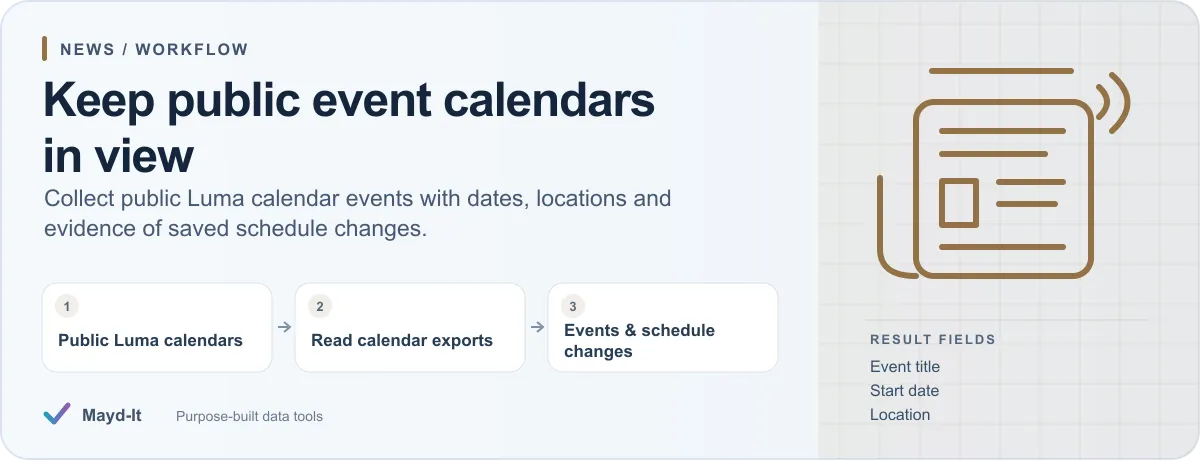
For event discovery and calendar monitoring: turn public Luma city and organizer calendar subscriptions into event rows with stable IDs, dates and locations. This reads public calendar exports, without guest lists or private attendee data.
Start here
- First run: Use San Francisco Public Luma Events below, with 10 saved results and a 100-event calendar window. Inspect the first output before enabling saved comparisons.
- Read the results: Open the default Dataset for events and SUMMARY for calendar coverage. The dates, source event link and changed fields let you inspect a saved schedule change.
- Keep in mind: Exports can include past events and are bounded by the selected window. Keyword matching is literal; a missing event does not prove cancellation or deletion.
Turn Luma's public city and organizer calendar subscriptions into event records with stable IDs, normalized times, public locations and source links. Add literal topic filters or compare saved observations to detect changes in schedules, titles, status, location and exported descriptions.
Useful for a city event watchlist, an organizer calendar export, or a recurring event research workflow. No API key, login, proxy or browser is required.
Quick start
Run with {} to save up to 20 events visible in the San Francisco public calendar feed. The Console prefill uses the same source. Events are ordered by the exported start date ascending; organizer feeds can include historical events. Use startDate when you only want dates on or after a specific day.
Each saved row is one unique exported event. Pricing is $0.003 per saved event ($3 per 1,000). Duplicates, filtered events, unchanged rows skipped by onlyChanges, and error diagnostics are not saved as paid results. Spending limits can stop a run before its requested window is finished.
Supported sources and coverage
- Public city pages such as
https://luma.com/sfandhttps://luma.com/nyc. - Public organizer calendar pages such as
https://luma.com/ignitegtm. - Public subscriptions in the form
https://api.lu.ma/ics/get?entity=calendar&id=cal-...orentity=discover&id=discplace-....
The Actor resolves the public page's calendar identifier and reads the supported iCalendar export described in Luma's subscription help. A general one-segment event page can be syntactically accepted as an input URL, but will fail with a clear unsupported-page error when it is not a calendar/city. Private calendars, personal entity=user feeds, tokens and event detail paths are unsupported. Source robots rules and public network restrictions apply to every request and redirect.
This is the currently visible subscription window, not all events or complete history. During source verification, a city page reported 70 events while its subscription exported 50. The source may retain past events or omit events. Disappearance is never declared a cancellation or deletion. SUMMARY.sourceCoverage reports exported, selected, rejected and saved counts, source refresh hints and any page-reported count.
The export publishes a 12-hour refresh interval. Schedule no more frequently than twice daily unless the publisher changes its interval. A repeated fetch does not promise fresher underlying content.
Inputs
| Input | Behavior |
|---|---|
calendarUrls | Up to 10 public city/calendar URLs. Omitted or empty uses San Francisco. Duplicate sources are removed and processing order is sorted. |
keywords | Up to 20 case-insensitive literal phrases, at most 100 characters each. Any phrase may match title, location or the first 10,000 description characters. |
startDate, endDate | Optional real YYYY-MM-DD dates, inclusive, filtering the event's exported DTSTART date. UTC exports therefore use the UTC calendar date, not an assumed venue date. |
maxEventsPerCalendar | Default 100, range 1-500. Select the earliest visible usable events before date/topic filtering. Increase this window if an organizer feed contains many older events. |
maxResults | Default 20, maximum 1,000 unique saved rows across all selected sources. |
comparePrevious | Return all matching observations with their comparison status and changed fields. Default false. |
onlyChanges | Implies comparison and skips unchanged observations. Default false. |
snapshotName | History namespace, default default; 1-80 letters, digits, underscores or hyphens. |
maxRunSeconds | Default 240; range 30-3,600. Also respects the platform deadline minus 25 seconds. |
Output and date semantics
| Fields | Meaning |
|---|---|
eventId, uid, recurrenceId | SHA-256 identity derived from the feed UID and any explicit recurrence instance. The source UID is also retained. Duplicate identities across calendars save once; the first source's metadata is retained. |
title, eventUrl | Exported title and public Luma URL if published as a URL property or inside the description. Missing links are null. |
sourceUrl, feedUrl, calendarId, calendarName | Provenance of the exported observation. |
startDate, endDate, startLocal, endLocal | Dates and date-time strings in the feed's own representation. startLocal may include Z when the feed supplied UTC. |
startsAt, endsAt, timeZone, endTimeZone | ISO UTC times when the export supplies UTC or a resolvable embedded timezone. Start and end timezone labels are retained separately; floating/unresolved times have UTC fields null. calendarTimeZone is separate page metadata and never silently substitutes an offset. |
allDay, endDateExclusive, timeUnresolved, endTimeUnresolved | All-day dates are not fabricated midnight UTC timestamps. An all-day DTEND is exclusive. timeUnresolved flags an unresolved timed start or end; endTimeUnresolved identifies the end specifically. |
status | Calendar status, such as TENTATIVE or CANCELLED. This is not ticket availability or registration approval. |
location | Only the exported location string. It can be a URL or an instruction to check the event page. Private locations are not enriched. |
description, descriptionHash | Publisher's exported text, capped at 10,000 characters. The hash covers the full received description. |
descriptionTruncated, publisherAbbreviationDetected | The first flag identifies this Actor's 10,000-character cutoff. The second is a visible ellipsis heuristic, not proof that the original description is complete or incomplete. Publishers often abbreviate export text. |
matchedTerms | Literal matching phrase, field and short excerpt. Empty when no topic filter was requested. |
comparisonStatus, changedFields, previous, previousObservedAt | Saved-history comparison, as described below. |
Recurring rules requiring recurrence expansion are skipped and reported as partial coverage; explicit recurrence instances can be identified. Invalid dates, broken intervals and malformed records also appear in SUMMARY, never as event rows. No ticket prices, attendee lists, guest counts or private contact details are promised or extracted.
Repeated runs and reliable history
Enable comparePrevious to receive new, changed or unchanged; otherwise status is not_requested. onlyChanges saves new/changed observations only. The first comparison run warns that it is establishing observations. A first row marked new describes the comparison result; SUMMARY.historyUpdated confirms whether the history write succeeded.
History uses the named store maydit-luma-public-calendar-history, scoped by snapshotName, sorted source URLs, keywords and date filters. Only confirmed saved rows advance it. Other observations remain intact on partial runs, limits and filtered windows. No output row means no new baseline for that identity. Volatile DTSTAMP, SEQUENCE and observation time do not trigger changes.
Use one concurrent writer per history scope. A reread detects some concurrent changes, but it is not a transactional lock. Malformed/incompatible history fails clearly; a new snapshotName starts fresh. History is bounded at 20,000 identities per scope.
Run status and limitations
SUMMARY in the default key-value store records failures, rejected entries, window limits, unchanged/duplicate counts and stops caused by time or spending limits. A requested result/window cap is a successful bounded run; it is not complete historical coverage. Source failures produce partial when useful observations survived. If every source fails and nothing usable is saved, the run fails after writing its summary. Empty legitimate feeds or unmatched filters can succeed with a warning and zero rows.
Requests have a 25-second limit and bounded retries for transient failures. There is no login or challenge bypass. Exported source text and locations can be incomplete or stale; verify event details at the source before attending or making decisions. Public export access does not grant blanket republication rights.
Ready-to-run examples
The following exact inputs also appear in examples.json.
San Francisco Public Luma Events
Export 10 events visible in the San Francisco public Luma calendar feed, with source links and normalized times.
New York Public Luma Calendar Events
Read 10 visible New York events from Luma's documented public calendar subscription, without private guest or ticket data.
Ignite Community Luma Calendar - Change Watch
Compare 10 visible Ignite Community calendar events with previously saved observations. The first run establishes a baseline; the export can contain historical events.


