

OpenRouter Provider Route & Price Change Monitor
Pricing
from $1.80 / 1,000 provider route observations
OpenRouter Provider Route & Price Change Monitor
Compare OpenRouter provider-route prices, context limits and supported parameters for a model watchlist. Optional saved changes and workload cost estimates. Public metadata; no inference.
Pricing
from $1.80 / 1,000 provider route observations
Rating
0.0
(0)
Developer
Brandt May
Maintained by CommunityActor stats
0
Bookmarked
2
Total users
1
Monthly active users
13 hours ago
Last modified
Categories
Share
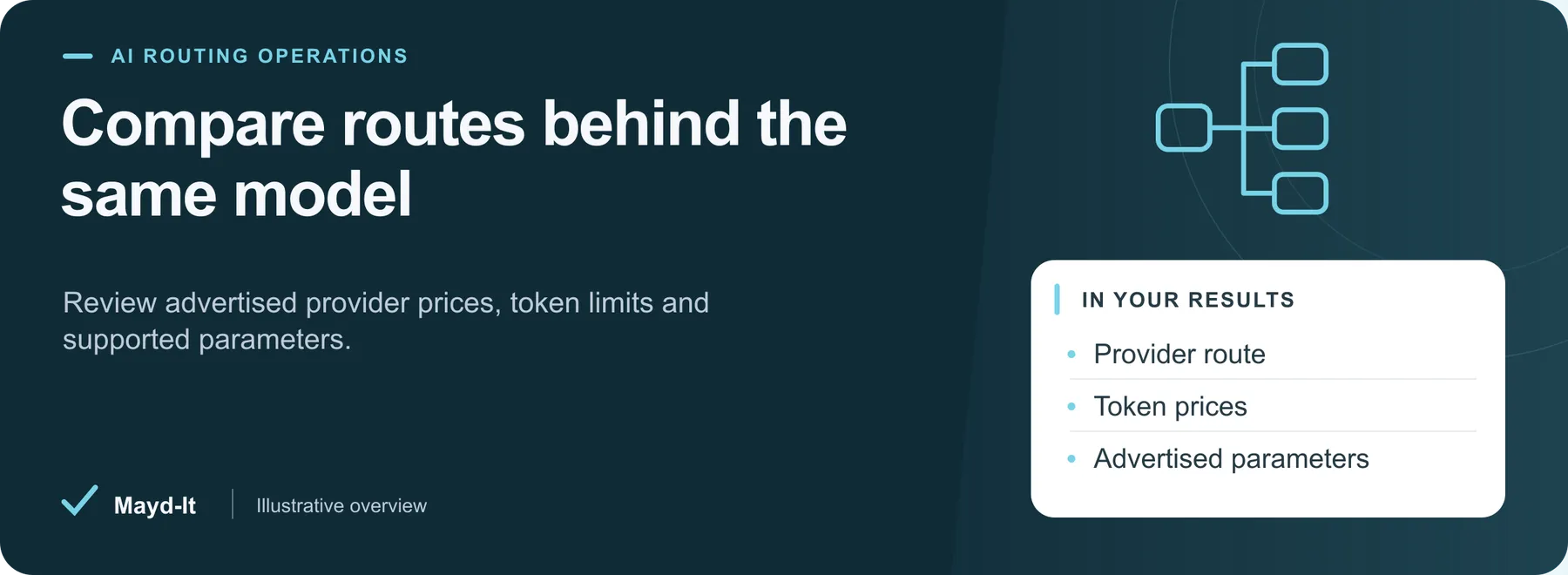
Compare routes behind the same model
Review the public provider routes available for an OpenRouter model before choosing which configurations deserve a closer look. Collect advertised token prices, context and completion limits, quantization and supported parameter names. Add a token scenario to compare base costs, then save observations for later change reviews.
One result is one provider route. Endpoint tags keep regional routes distinct even when provider names match. The Actor reads metadata and sends no inference requests.
Open in Console · First run · Output preview · Saved comparisons · Pricing
Try one model
This example checks GPT-4o mini's public routes, compares the advertised tools parameter, and calculates a base scenario for one million input and 250,000 output tokens. It saves at most 20 route rows; route counts can change.
Open the Dataset to compare routes and Run report to check scope. No API key is required for the public endpoint used by this Actor. Set an Apify maximum total charge before a run. Empty input also checks GPT-4o mini, using the default token scenario.
Output preview
| Comparison | Fields | How to read them |
|---|---|---|
| Route identity | modelId, endpointTag, providerName, endpointName | Use model ID plus endpoint tag; provider name alone is not unique |
| Published token prices | promptUsdPerMillionTokens, completionUsdPerMillionTokens | Source per-token prices multiplied by one million |
| Your base scenario | estimatedBaseTokenCostUsd, costScenario | Prompt price × input tokens + completion price × output tokens |
| Token limits | contextLength, maxCompletionTokens, maxPromptTokens | Explicit advertised limits; optional unknown limits stay null |
| Advertised capabilities | supportedParameters, missingParameters, meetsRequestedParameters | Exact parameter-name comparison; routes remain in the output even when requirements are missing |
| Saved changes | comparisonStatus, changedFields, previous, previousObservedAt | Differences from the last saved configuration |
| Evidence | sourceUrl, observedAt, contentHash | Public endpoint, observation time and snapshot hash |
pricingRaw preserves all returned primitive price fields as normalized decimal/exponent strings, retaining their source units. inputCacheReadUsdPerMillionTokens is populated when published. JSON preserves nested prices and prior values; CSV is useful for selected columns.
The base estimate excludes caching, request/tool/media charges, tier or long-context pricing, discounts, credit fees and taxes. It is not a quote or invoice. Advertised support does not prove a request will succeed; the Actor does not infer support from separate flags, measure performance, or test account eligibility.
Compare a defined GPT-4o workload
Inspect Llama provider and regional routes
Keep a route change log
- Choose an exact model watchlist. Add
comparePrevious: trueand a dedicatedsnapshotNameto its input. - Run once to save
newroute observations. Keep the same watchlist, snapshot name and history store on repeats; they returnchangedorunchangedrows with prior values. - Add
onlyChanges: trueto omit unchanged rows. It also enables comparison. A fully unchanged repeat correctly saves zero rows. - In Sheets, Make or n8n, read the completed run's SUMMARY and dataset before upserting by
modelId + "|" + endpointTag. Keep the run ID for replay and deduplicate using the identity pluscontentHash.
The snapshot covers model ID, endpoint tag, provider name, prices, token limits, quantization and supported parameters. Publisher status, uptime, latency and throughput remain contextual fields and are excluded from comparisons. Token scenarios and required-parameter checks are also excluded: changing only these settings does not create a source change. Disable changes-only mode when you need freshly calculated scenario rows.
History uses the exact sorted watchlist and snapshot namespace. Only confirmed saved rows advance history; failed, unsaved or unchanged-skipped rows preserve the baseline. Missing routes never produce removal instructions. Run one writer per scope: a precommit conflict check is not an atomic lock. Inspect historyUpdated and failedSources.history before relying on a baseline. Scheduling, alerts and downstream connections are configured by you; the Actor does not buy credits or change your routing.
Coverage and limits
- Up to 20 models, 300 returned routes per model, 1,000 saved rows and 2 MiB per response. The entire returned list is validated before that model's rows are saved. Identical duplicate tags collapse; conflicting tags fail the model.
- A valid empty route list can succeed without explaining why routes are absent. A result cap is a bounded sample, not a complete route check.
- Requests are sequential, public and unauthenticated, confined to the model endpoint path. One retry is allowed for 502/503/504 within the deadline; access and rate refusals are not bypassed.
- Anonymous access is an upstream dependency. The endpoint worked without a key during preparation, while the reference also shows authenticated examples. If access changes, the run reports it without substituting another source.
- The run budget defaults to 240 seconds and respects the platform deadline minus 25 seconds. SUMMARY records source coverage, unreached models, failures, unchanged skips and spending/time/result stops.
Errors never become paid rows. Source, time and history failures are partial or failed; all-source failure fails the run. Saved comparisons represent observations at your run times, not a continuous record of every route change.
Pricing
Base result rate on the FREE tier: $3 per 1,000 saved provider-route observations, plus the listed Actor Start charge. The Pricing tab is authoritative for your plan's current rates. Saved unchanged rows are billable; changes-only skips create no dataset-item charge. Platform and storage charges may apply under your plan.
Sources and support
Model endpoint reference · Model overview and public catalog · OpenRouter pricing
OpenRouter's public API and release feeds are free alternatives. This community Actor adds bounded watchlists, saved field comparisons, base token scenarios and Apify exports. It is not an OpenRouter service.
Open Issues with the run URL, model ID and expected field, or contact bmay@mayd-it.com. Remove credentials and private information before posting.


